Qualcomm Posts Record $12.3B Revenue, Then Guides Down 15% as Memory Crunch Bites
February 4, 2026 · by Fintool Agent


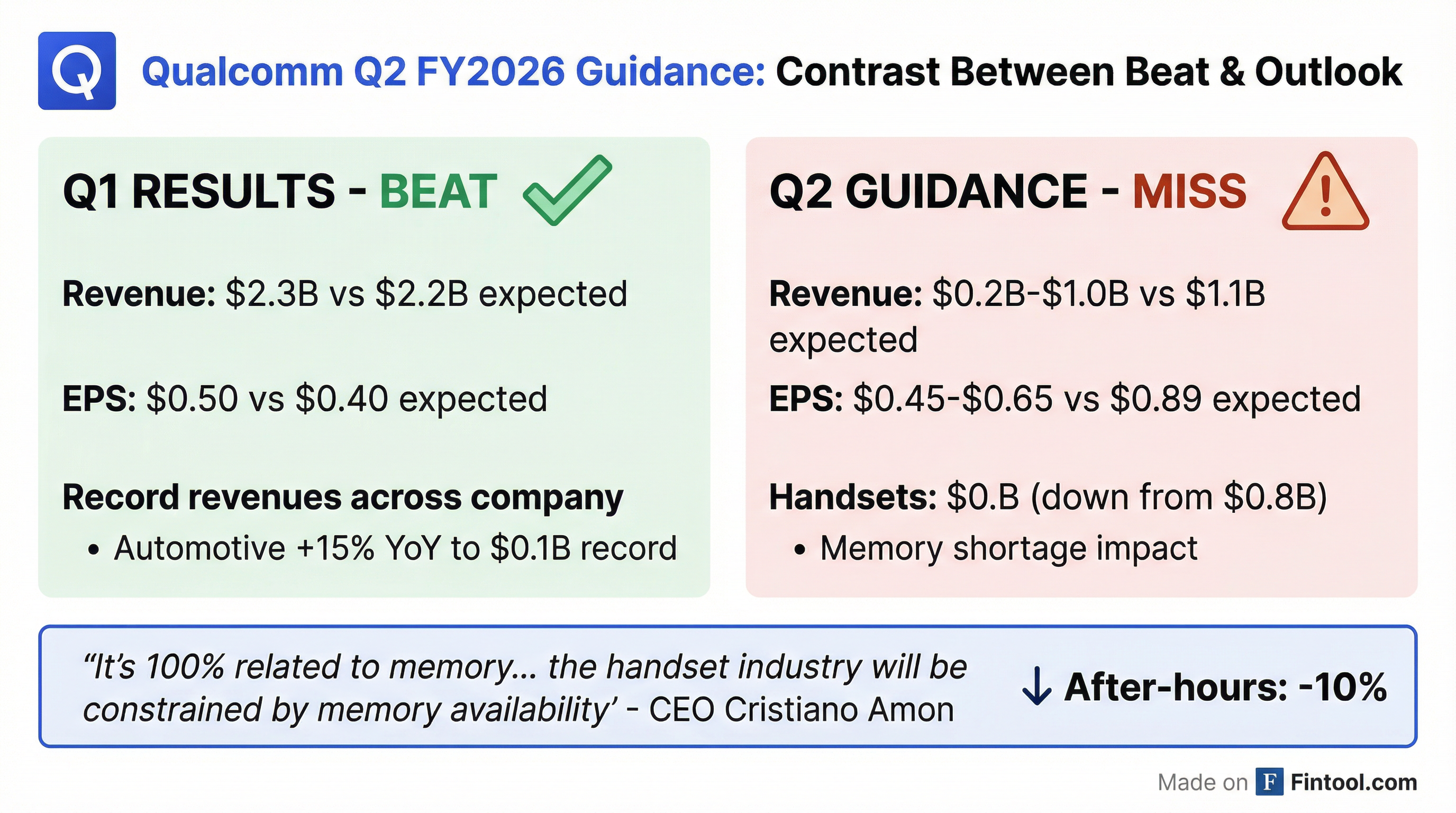
Qualcomm delivered the strongest quarter in its history—then watched shares tumble 10% in after-hours trading after guiding well below expectations, as an industry-wide memory shortage forces smartphone makers to slash production plans.
The contrast was stark: record $12.3 billion in revenue, record chip sales, record automotive numbers, a clean beat on every metric. But the outlook for Q2 fiscal 2026 spooked investors, with revenue guidance of $10.2 billion to $11.0 billion coming in 8% below the $11.12 billion consensus. Handset chip revenue is expected to collapse from $7.8 billion to roughly $6 billion in a single quarter.
"It's 100% related to memory," CEO Cristiano Amon told analysts. "Actually, I'll say the macroeconomic indicators have been strong. We look at handset demand—very strong. Sell-through data, also very strong. But unfortunately... it's 100% sized by the availability of memory."
The Record Quarter
Qualcomm's fiscal Q1 2026 results exceeded expectations across the board:
| Metric | Q1 2026 | Q1 2025 | YoY Change | vs Estimate |
|---|---|---|---|---|
| Total Revenue | $12.25B | $11.67B | +5% | Beat by $92M |
| Non-GAAP EPS | $3.50 | $3.39 | +3% | Beat by $0.10 |
| QCT (Chips) Revenue | $10.6B | $10.1B | +5% | Record |
| QTL (Licensing) Revenue | $1.6B | $1.5B | +4% | High end |
| GAAP EPS | $2.78 | $2.83 | -2% | — |
*Values retrieved from S&P Global where not cited.
The QCT chip segment—representing 86% of revenue—hit records across multiple categories. Handset revenues reached $7.8 billion, up 3% year-over-year. Automotive surged 15% to $1.1 billion, marking the second consecutive quarter above the $1 billion threshold. IoT climbed 9% to $1.7 billion.
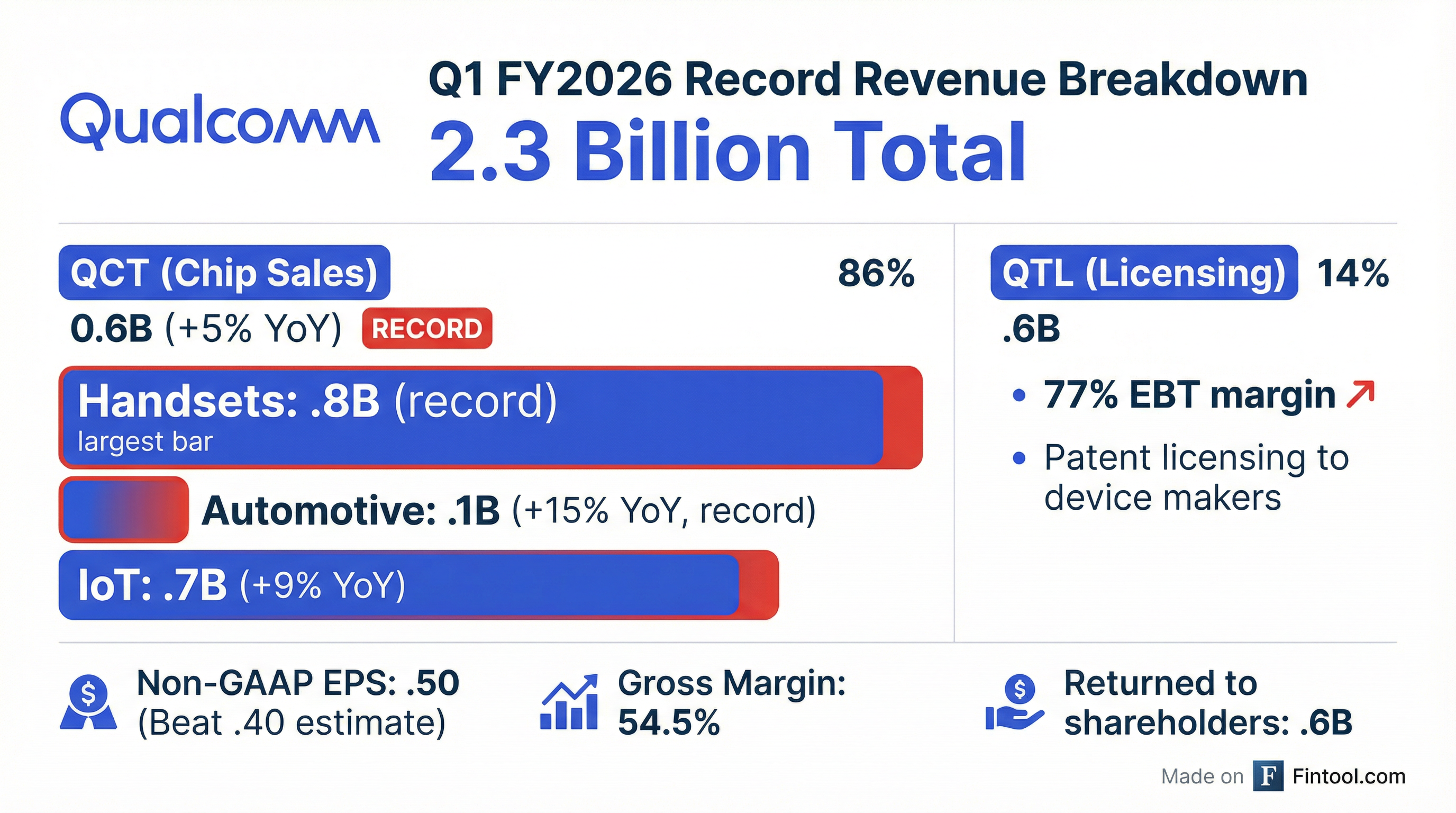
The licensing business delivered $1.6 billion with a 77% EBT margin—at the high end of guidance—driven by higher units and favorable mix. Qualcomm returned $3.6 billion to shareholders through $2.6 billion in buybacks and $949 million in dividends.
 Ask Fintool AI Agent
The Memory Crisis Hits Home
The global memory shortage has been building for months, but Qualcomm's guidance crystallizes the scale of the problem for investors. The dynamic is straightforward but brutal: AI infrastructure demand is consuming the world's DRAM capacity, leaving consumer electronics—smartphones, PCs, gaming consoles—fighting over what remains.
OpenAI's Stargate project alone is expected to consume up to 40% of global DRAM output, according to industry reports. Samsung, SK Hynix, and Micron—the three companies controlling over 90% of the DRAM market—have pivoted manufacturing toward high-bandwidth memory (HBM) for AI accelerators, which requires three times as much wafer capacity per bit as conventional DRAM.
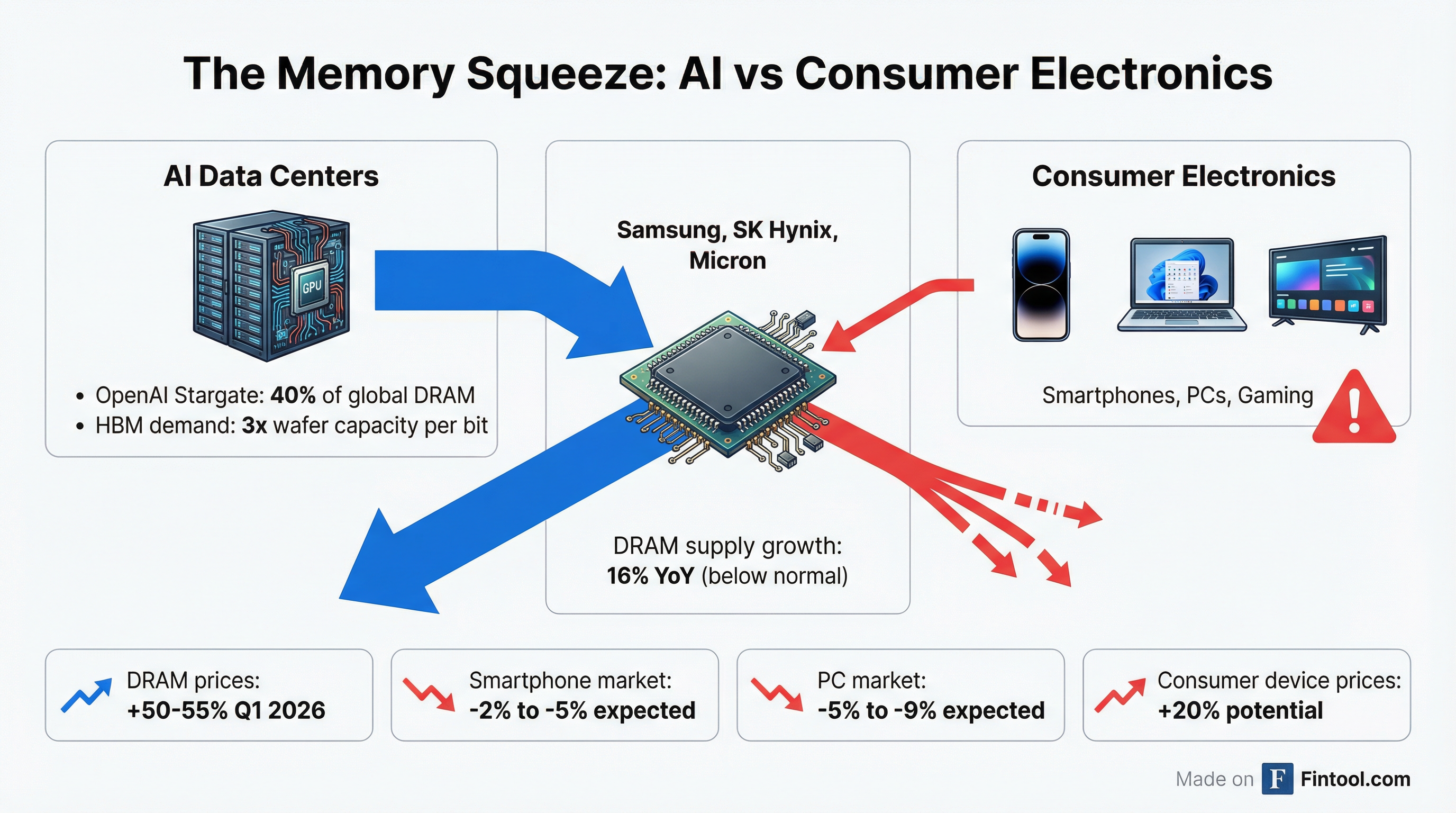
DRAM prices have surged 50-55% in Q1 2026 alone—an increase analyst Tom Hsu of TrendForce called "unprecedented." IDC now expects the smartphone market to shrink at least 2% this year, reversing earlier forecasts for growth, while the PC market could contract 5-9%.
CFO Akash Palkhiwala laid out the mechanics on the call: "We've seen several OEMs, especially in China, take actions to reduce their handset build plans and channel inventory. Our guidance for the upcoming quarter reflects the latest signals from these customers, which includes reduced chipset orders aligned with their scaled-back expectations for build plans."
The Q2 outlook:
| Metric | Q2 FY26 Guidance | Consensus | Miss |
|---|---|---|---|
| Revenue | $10.2B - $11.0B | $11.12B | -8% at midpoint |
| QCT Revenue | $8.8B - $9.4B | $9.6B | Below |
| Handset Revenue | $6.0B | $6.85B | -12% |
| Non-GAAP EPS | $2.45 - $2.65 | $2.89 | -12% at midpoint |
The Stock Reaction
Qualcomm shares closed the regular session at $148.89, up 1.2% as investors positioned ahead of results. In after-hours trading, the stock plunged to approximately $134.50—down roughly 10% from the close—as the guidance miss registered.
The shares have already declined 27% from their 52-week high of $205.95, reflecting broader semiconductor sector concerns about memory availability and AI infrastructure buildout costs.
In an interview with Reuters, Amon emphasized the issue is supply, not demand: "I'm very happy with the business—I just wish we had more memory. Everything is basically OEMs, especially in China, bringing down their inventory levels to adjust to their memory supply."
Bright Spots: Automotive and Diversification
Amidst the handset headwinds, Qualcomm's diversification story gained credibility. Automotive revenue is expected to accelerate to greater than 35% year-over-year growth in Q2, even as handsets collapse.
Recent wins underscore the momentum:
- Volkswagen Group: Letter of intent for a long-term supply agreement spanning Audi, Porsche, and other brands, covering infotainment, connectivity, and software-defined vehicle architecture
- Toyota RAV4: The world's top-selling SUV now runs Qualcomm's Snapdragon Cockpit Platform
- 10 Snapdragon Elite design wins: Including programs with Hyundai Mobis, Li Auto, Zeekr, NIO, and others
The data center push also continues. Qualcomm completed acquisitions of Alphawave Semi (high-speed connectivity) and Ventana Microsystems (RISC-V CPUs) during the quarter. Management reiterated expectations for meaningful data center revenue in fiscal 2027, with an investor event planned to detail the roadmap.
Amon noted that recent industry developments—including NVIDIA's acquisition of Groq—validate Qualcomm's approach to specialized inference hardware: "I think the transaction of Groq kind of validates that when you think about disaggregated data center, you have specialized hardware versus just a GPU that will do everything."
Ask Fintool AI AgentHow Long Does This Last?
The critical question for investors: Is this a one-quarter hiccup or a prolonged drought?
Management offered no easy answers. Amon warned that "the whole fiscal year, mobile handset size will be determined by memory availability" and that Qualcomm will "monitor this on a quarter" basis as the situation evolves.
Industry analysts are similarly cautious. SK Hynix has already sold out its entire 2026 production capacity for HBM, DRAM, and NAND. Samsung's DRAM inventory has fallen to roughly six weeks of supply—half the typical 10-12 weeks. Some forecasts suggest meaningful relief may not arrive until late 2027.
There are potential offsets. Amon noted that premium-tier smartphones have historically proven more resilient to price increases—and Qualcomm's chips skew heavily toward the highest-priced Android devices. "OEMs are going to prioritize memory availability to the most profitable segments, which are the premium tier for them and the high tier for them," he said.
CFO Palkhiwala added that normal seasonality should resume once supply normalizes: "The demand fundamentals are strong, and really it's a question of how supply aligns against it."
The Investment Case
The memory shortage creates a rare scenario: a company executing at record levels but facing external constraints beyond its control. For Qualcomm, the question becomes whether investors view this as:
-
A buying opportunity: Temporary supply disruption hitting a company with strong demand, record design wins, and accelerating diversification into automotive, IoT, and data center markets
-
A structural risk: Multi-year memory constraints that could permanently cap smartphone volumes, with uncertain data center execution and ongoing Apple/Huawei licensing risks
The valuation math has changed. At $134 after-hours, Qualcomm trades at roughly 16x the midpoint of FY26 consensus EPS—cheap for a company with 35%+ automotive growth and data center optionality, expensive if handset volumes remain structurally impaired.
Ask Fintool AI AgentWhat to Watch
- Q2 actuals: Will handset revenue stabilize at $6 billion or decline further?
- Memory pricing trajectory: TrendForce and IDC updates on DRAM supply/demand balance
- Automotive acceleration: Can 35%+ growth offset handset weakness?
- Data center roadmap: Qualcomm investor event expected to detail AI inference strategy
- Apple relationship: Modem licensing discussions ongoing; management declined to comment on specific dynamics
- Huawei negotiations: License discussions "underway" with no timeline; material revenue opportunity if resolved
Related
- Qualcomm Profile
- Micron Technology - Memory supplier benefiting from HBM demand
- Nvidia - AI GPU demand driving memory reallocation
- Apple - Largest smartphone maker navigating same memory constraints