Cartier Powers Richemont to Record €6.4B Quarter as China Finally Turns
January 15, 2026 · by Fintool Agent



Richemont just delivered a message the luxury sector has been waiting two years to hear: the Chinese consumer is back.
The Cartier and Van Cleef & Arpels owner reported record fiscal Q3 sales of €6.4 billion, up 11% at constant exchange rates—comfortably beating the €6.28 billion consensus compiled by Visible Alpha. More importantly for an industry that has suffered through China's prolonged consumption slump, Greater China sales rose 2%, marking the second consecutive quarter of improvement.
The results land one day after Saks Global filed for Chapter 11 bankruptcy, creating a stark illustration of luxury's K-shaped recovery: hard jewelry and watches thriving, wholesale-dependent department stores collapsing.
Richemont shares rose 3% in early Zurich trading.
The Numbers
| Metric | Q3 FY26 | Q3 FY25 | Change (Constant FX) |
|---|---|---|---|
| Group Sales | €6,399M | €6,150M | +11% |
| Jewellery Maisons | €4,785M | €4,501M | +14% |
| Specialist Watchmakers | €872M | €867M | +7% |
| Other (incl. F&A) | €742M | €782M | Flat |
| Net Cash Position | €7.6B | €7.9B | — |
Source: Richemont Q3 FY26 Sales Announcement
Nine-month sales reached €17.0 billion, up 10% at constant rates. The company maintained a robust €7.6 billion net cash position—a fortress balance sheet that stands in sharp contrast to the leveraged distress plaguing the department store channel.
 Ask Fintool AI Agent
Regional Performance: Middle East Leads, China Finally Turns
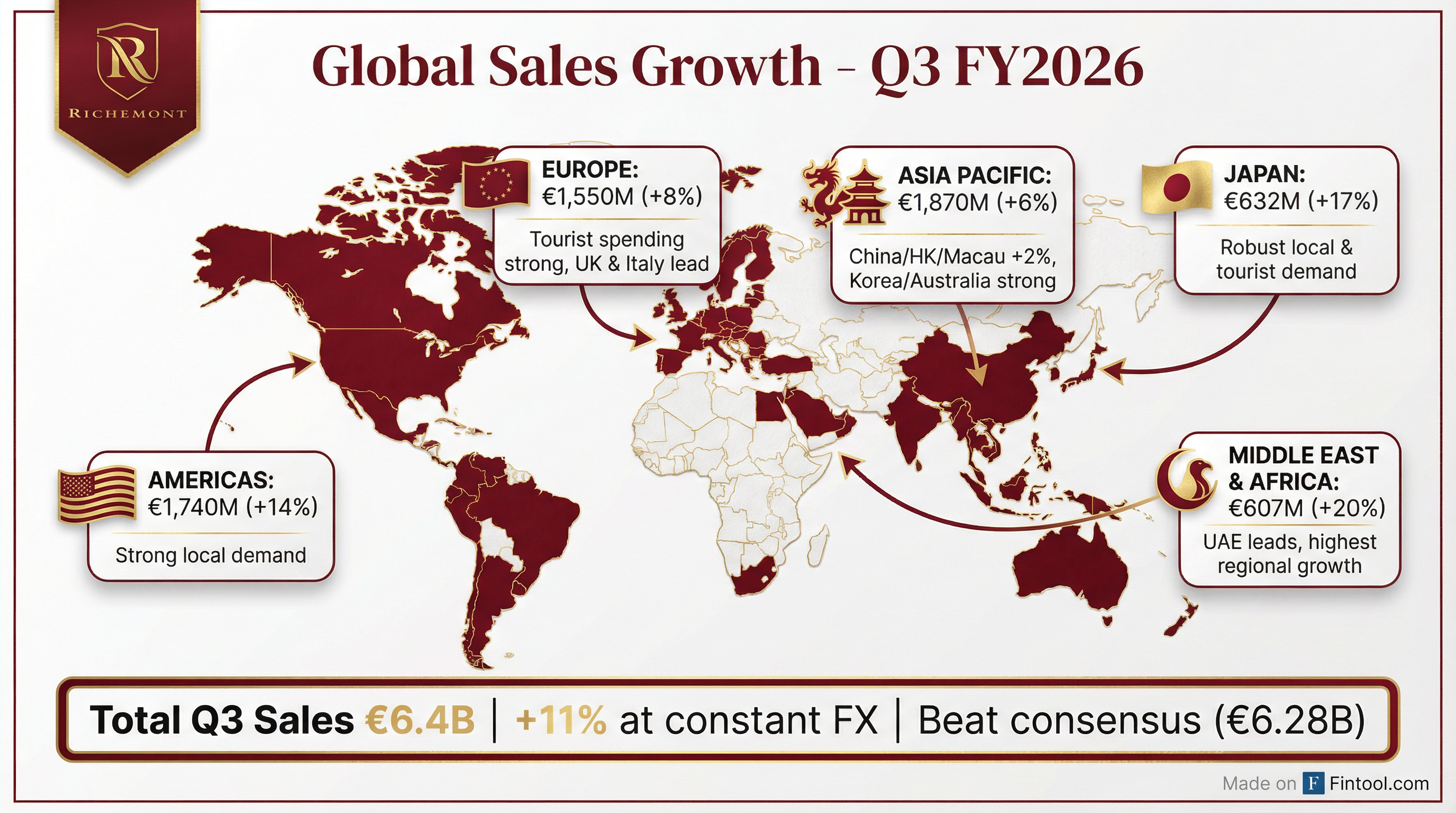
Every region delivered growth at constant exchange rates, but the story varied dramatically by market:
Middle East & Africa (+20%): The standout performer, led by strength in the UAE. Double-digit growth across all business areas as Dubai and Abu Dhabi continue absorbing wealthy tourists and regional demand.
Japan (+17%): Local demand remained "strong," with tourist spending "supportive"—a function of the persistently weak yen making luxury goods relatively cheaper for visitors. Jewellery Maisons led the regional performance.
Americas (+14%): Ongoing strength in local demand drove growth, with all business areas and main markets contributing. The U.S. remains Richemont's largest market by revenue, accounting for more than 20% of group sales.
Europe (+8%): Local demand and tourist spending—particularly from North American and Middle Eastern visitors—supported growth. The UK and Italy showed "notable strength."
Asia Pacific (+6%): The critical region showed improvement. China, Hong Kong and Macau combined rose 2%, "mostly led by solid activity in Hong Kong." South Korea and Australia delivered "robust growth."
RBC analyst Piral Dadhania called the China performance "pivotal," noting it could signal broader recovery for the sector.
"The Chinese consumer holds the key to luxury and is thus the critical sector theme for 2026."
— Nick Anderson, Berenberg analyst
Segment Deep Dive: Jewelry Dominates
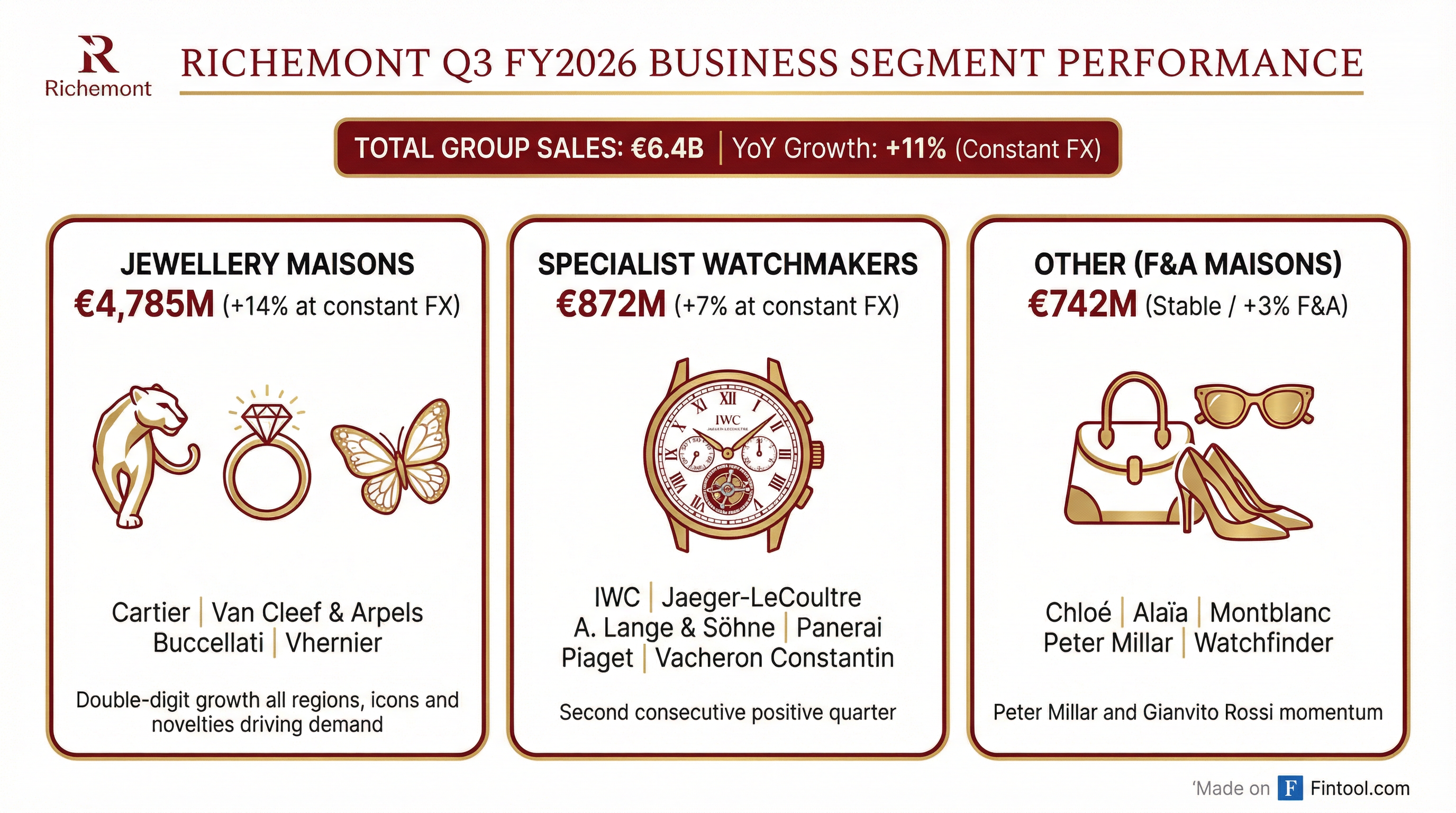
Jewellery Maisons: €4.8 Billion (+14%)
The crown jewels—literally—delivered another stellar quarter. Cartier, Van Cleef & Arpels, Buccellati and Vhernier posted 14% growth against an already demanding +14% comparative from the prior year.
The festive season proved especially strong for jewelry and watch categories, with "iconic lines fuelled by attractive novelties and impactful communication." Richemont highlighted success from bracelets and pendants—slightly lower price points that attracted gift shoppers.
Bernstein analysts noted: "Jewellery is in strong shape, and Richemont dominates it with its brands."
Specialist Watchmakers: €872 Million (+7%)
The second consecutive positive quarter for IWC, Jaeger-LeCoultre, A. Lange & Söhne, Panerai, Piaget, Roger Dubuis and Vacheron Constantin. Growth appeared across all regions, with double-digit gains in the Americas and Middle East & Africa.
Other (Fashion & Accessories): €742 Million (Flat)
The weakest segment remained stable against an 11% comp. Watchfinder & Co., the pre-owned watch platform, grew double digits. Peter Millar and Gianvito Rossi showed "solid momentum" within Fashion & Accessories (+3%).
Ask Fintool AI AgentThe Saks Contrast: Luxury's K-Shaped Reality
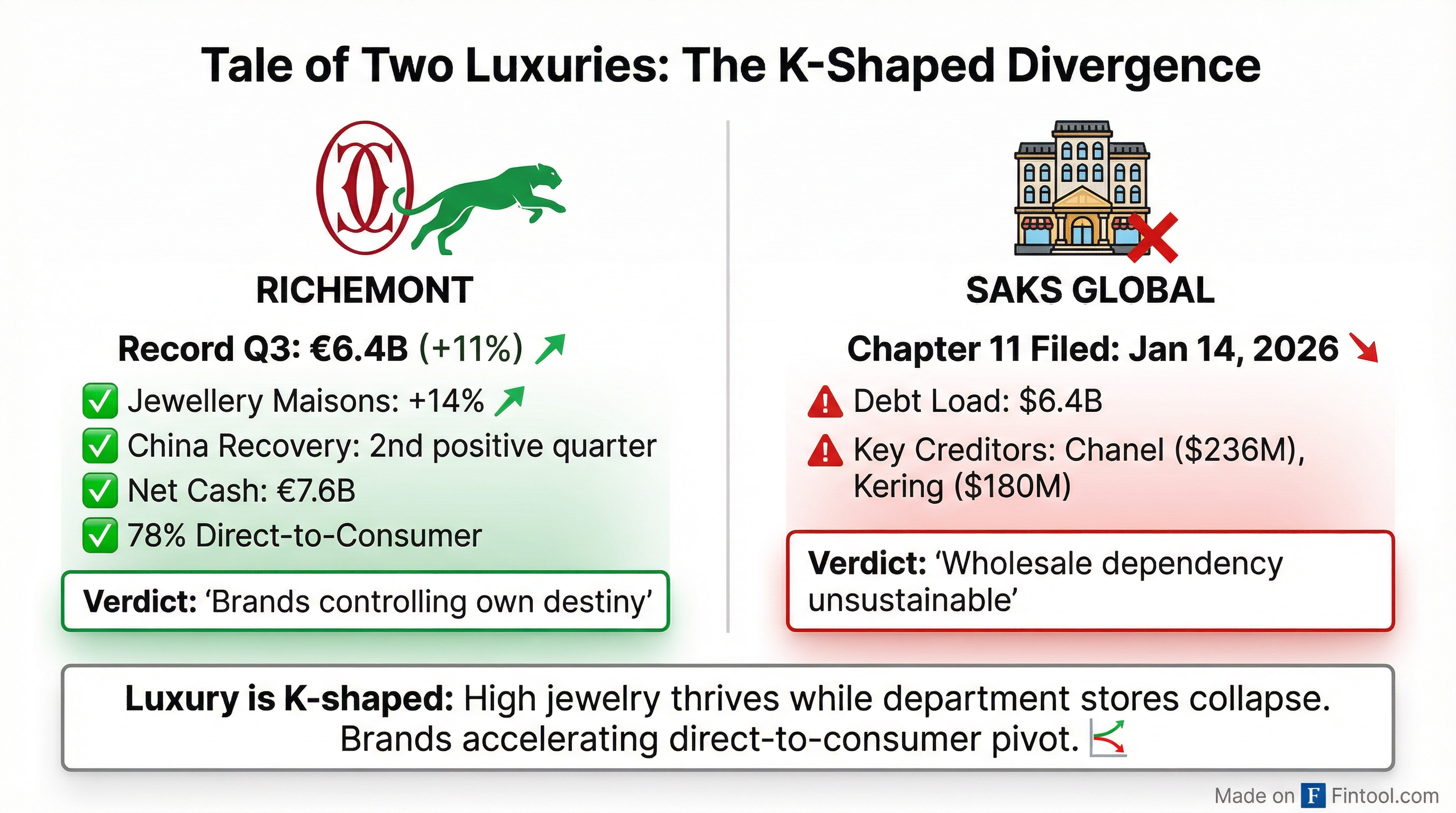
The timing of Richemont's results—one day after Saks Global filed for Chapter 11—crystallizes luxury's diverging trajectories.
| Richemont | Saks Global | |
|---|---|---|
| Status | Record Q3 | Chapter 11 bankruptcy |
| Balance Sheet | €7.6B net cash | $3.4B funded debt |
| Distribution | 78% direct-to-consumer | Wholesale/multi-brand |
| China | +2% (recovering) | N/A |
| Verdict | Brands controlling destiny | Middleman squeezed out |
Saks Global listed Chanel ($136 million), Kering ($60 million), and LVMH ($26 million) among its largest unsecured creditors—luxury brands that will accelerate their direct-to-consumer pivot following this collapse.
"For the broader luxury industry, this accelerates an existing trend: brands will reduce reliance on department stores, tighten wholesale exposure, and prioritize owned channels and curated partnerships," said Brittain Ladd, strategy consultant at Chang Robotics.
Richemont's 78% direct-to-consumer ratio—with approximately 85% at Jewellery Maisons—positions it precisely where the industry is headed.
Margin Pressures Remain
Not everything glitters. Record gold prices and the strong Swiss franc continue weighing on margins, a pressure that "could impact the group's profit outlook for the next business year if not countered by more price increases," Deutsche Bank analysts warned.
Richemont acknowledged the headwind in its release, noting that "weaker main trading currencies and rising material costs continuing to weigh on margins" persist in the complex macroeconomic environment.
The company maintained "consistent investment to nurture Maisons' growth prospects"—suggesting margin improvement won't be the immediate priority.
What to Watch
LVMH reports annual results later this month, followed by Hermès and Kering+0.13% in February. Richemont's China signal will raise expectations across the sector.
Full-year results for Richemont arrive May 22, 2026.
U.S. tariff risk looms. Richemont noted in its forward-looking statement that "if international tariffs are imposed or increased, materials and goods that Richemont imports may face higher prices, which could lead to reduced margins or increased prices that could cause decreased consumer demand."
J.P. Morgan has named Richemont a top pick for 2026, citing strong momentum at Cartier and Van Cleef.
Ask Fintool AI AgentRelated
- Richemont — Company Profile
- LVMH+0.40% — Company Profile
- Kering+0.13% — Company Profile
- Tapestry+6.22% — Company Profile
- Capri Holdings+2.59% — Company Profile