SanDisk Crushes Estimates With 75% EPS Beat, Q3 Guidance Stuns Wall Street
January 30, 2026 · by Fintool Agent


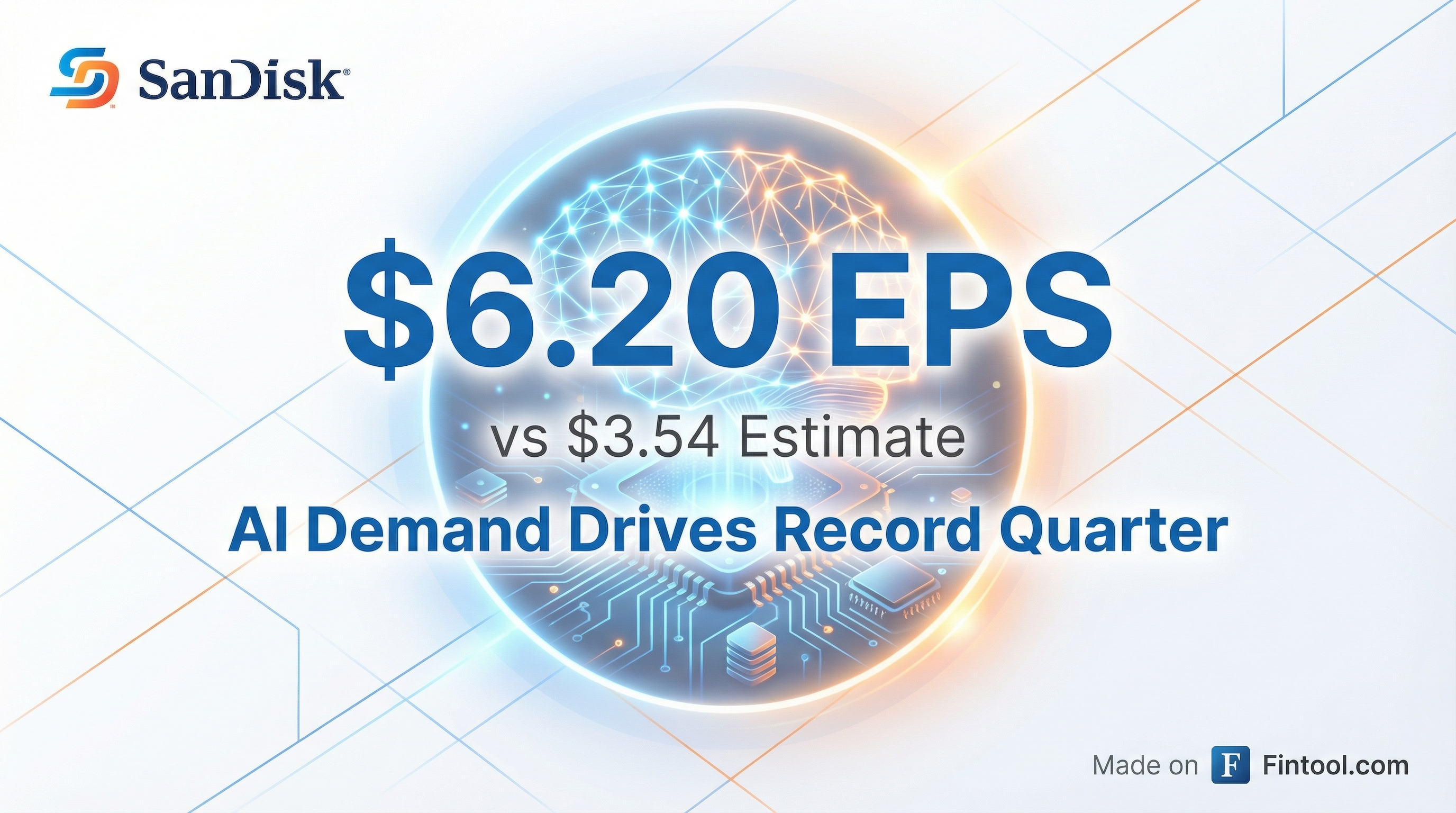
Sandisk delivered one of the most emphatic earnings beats in memory, reporting fiscal Q2 EPS of $6.20 versus the $3.54 consensus—a 75% surprise—while guiding Q3 to $12-14 per share, obliterating the $5.11 Wall Street expectation.
The stock surged more than 20% in after-hours trading as AI infrastructure demand propelled datacenter revenue up 64% sequentially and gross margins expanded by a stunning 2,120 basis points to 51.1%.
"This quarter's performance underscores our agility in capitalizing on better product mix, accelerating enterprise SSD deployments, and strengthening market demand dynamics, all at a time when the critical role that our products play in powering AI and the world's technology is being recognized," said CEO David Goeckeler.
The Numbers That Stunned Wall Street
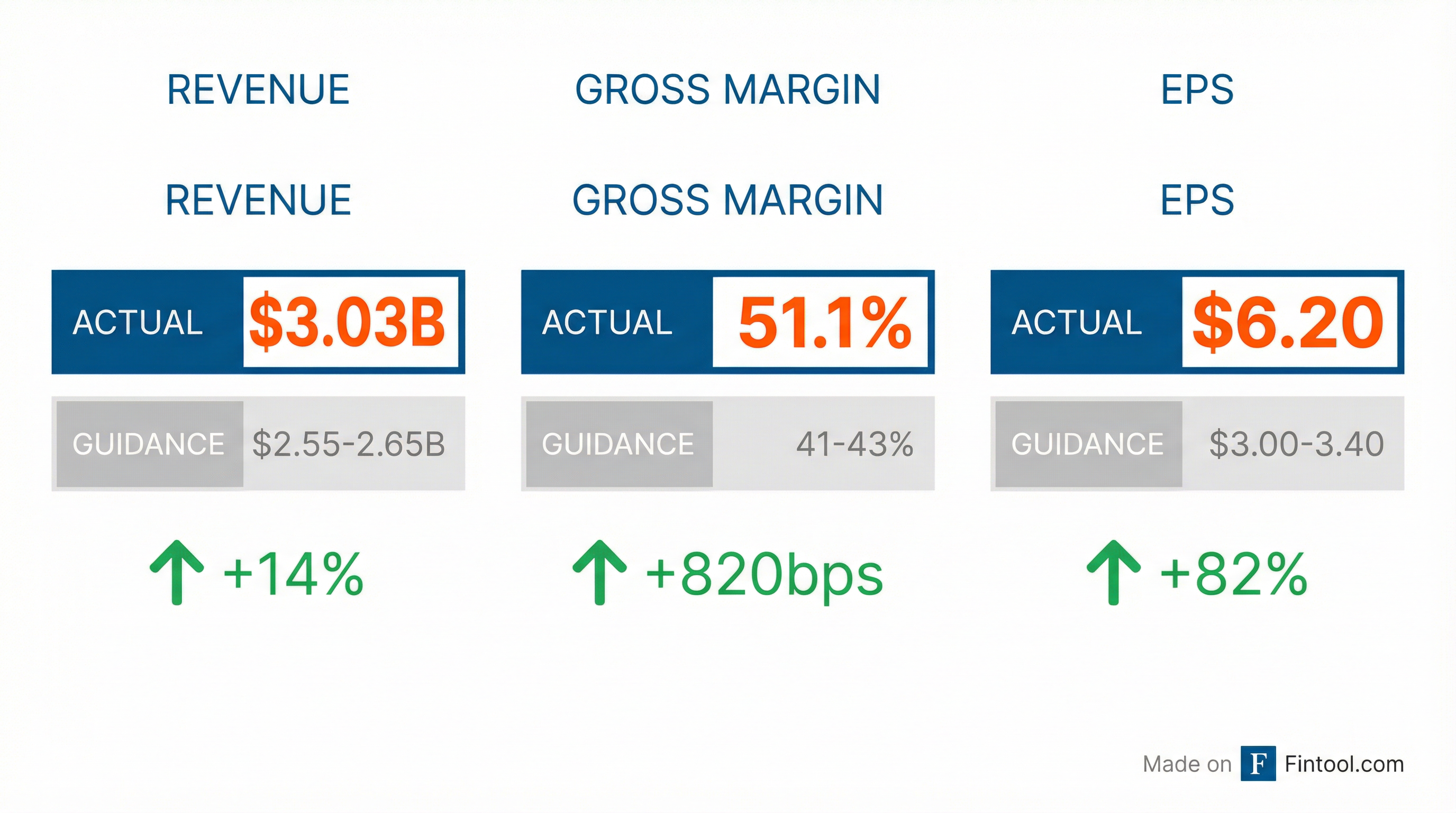
| Metric | Q2 Actual | Guidance | Beat |
|---|---|---|---|
| Revenue | $3.03B | $2.55-2.65B | +14% |
| Gross Margin | 51.1% | 41-43% | +820 bps |
| EPS (Non-GAAP) | $6.20 | $3.00-3.40 | +82% |
Revenue of $3.025 billion was up 31% sequentially and 61% year-over-year. The gross margin expansion from 29.9% to 51.1% in a single quarter reflects both higher pricing and disciplined supply allocation as demand outstrips available capacity.
 Ask Fintool AI Agent
AI Infrastructure Drives Datacenter Explosion
The story is unambiguously AI. Datacenter revenue hit $440 million, up 64% sequentially and 76% year-over-year. Management described this as just the beginning of a structural shift.
"We are at the center of a broad expansion in AI infrastructure. Enterprise SSD demand is accelerating across the ecosystem as AI workloads scale, with inference in particular driving a meaningful increase in NAND content per deployment," Goeckeler explained.
| Segment | Q2 Revenue | Q/Q Change | Y/Y Change |
|---|---|---|---|
| Datacenter | $440M | +64% | +76% |
| Edge | $1,678M | +21% | +63% |
| Consumer | $907M | +39% | +52% |
SanDisk has qualified its PCIe Gen 5 high-performance TLC drives at multiple hyperscalers and expects to begin shipping its BiCS8 QLC product "Stargate" within the next several quarters.
The company's forecast for datacenter exabyte demand growth in 2026 has escalated dramatically: from mid-20s% two quarters ago, to mid-40s% last quarter, to now high-60s%—and that doesn't include any recent CapEx announcements from hyperscalers.
Q3 Guidance: The Real Shocker
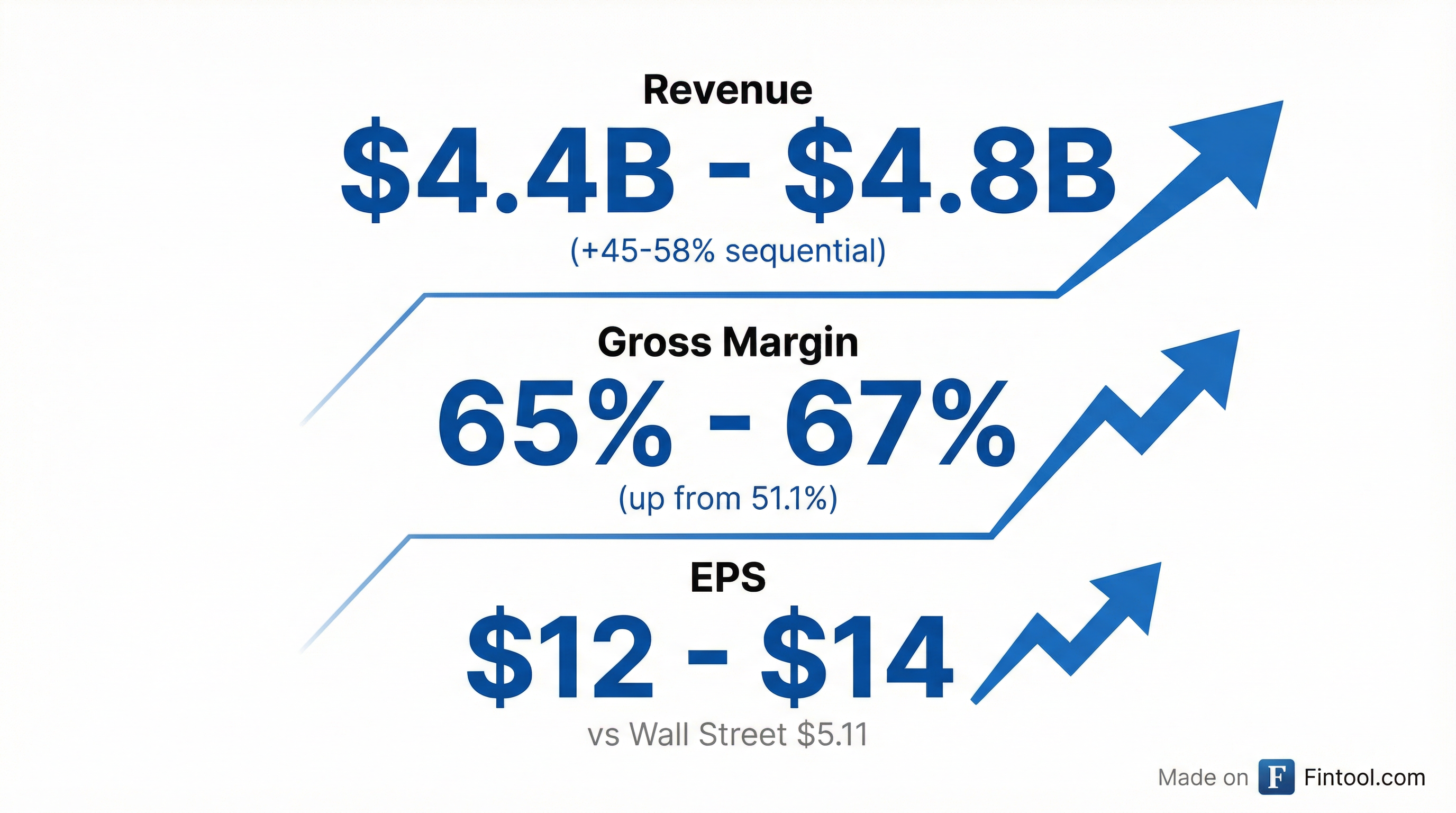
The forward guidance is where things get extraordinary:
| Metric | Q3 FY2026 Guidance | Wall Street Consensus |
|---|---|---|
| Revenue | $4.4B - $4.8B | $3.2B implied |
| Gross Margin | 65% - 67% | 55% implied |
| EPS | $12 - $14 | $5.11 |
At the midpoint, SanDisk is guiding to nearly triple the consensus EPS estimate. Revenue guidance of $4.6 billion at the midpoint represents roughly 52% sequential growth.
"We anticipate the market to be more undersupplied than it was in the second quarter," CFO Luis Visoso told analysts.
Ask Fintool AI AgentThe Structural Shift: From Quarterly Auctions to Multi-Year Agreements
Beyond the numbers, management articulated a fundamental change in how the NAND industry operates. The traditional model—quarterly price negotiations that created boom-bust cycles—is evolving toward long-term supply agreements.
"We're evolving how we define strategic engagement, prioritizing customers with multi-year supply frameworks and share planning commitments over transactional short-term demand signals," Visoso said.
SanDisk confirmed it has signed its first long-term agreement with prepayment terms, with "several in the queue." The company also extended its manufacturing joint venture with Kioxia through December 2034, committing $1.165 billion in payments between 2026-2029.
"NAND is just front and center in the AI architecture. That's very, very clear at this point," Goeckeler said. "The AI architecture is changing... NAND is just going to be a big part of that architecture. It's the most scalable semiconductor storage technology, maybe the most scalable semiconductor technology at all."
From Spinoff to Supercycle: 11 Months of Independence
SanDisk completed its separation from Western Digital on February 24, 2025, emerging as an independent company focused solely on NAND flash storage.
The timing appears fortuitous. The company inherited a business that lost money in fiscal years 2023 and 2024, with cumulative losses consuming tax benefits. Eleven months later, it's posting operating margins of 37.5% and generating $843 million in quarterly free cash flow.
"In a high CapEx, high R&D industry... 35% [gross margin] is not where we would like to be," Visoso said. "We're not going to give you a new number today, but clearly, that's not where we want to be. This is the first quarter that we are above 35% with 51%. We're guiding, call it midpoint of 66%."
The company has paid down $1.4 billion of its initial $2 billion debt load and expects to continue deleveraging.
What to Watch
Near-term catalysts:
- BiCS8 QLC "Stargate" product revenue shipments (next few quarters)
- Additional hyperscaler qualifications
- Long-term agreement announcements
- Potential for capital return programs once debt is fully paid
Risks:
- Datacenter demand forecasts have been volatile (mid-20s to high-60s in two quarters)
- Edge and consumer markets showing unit declines with mix shifts
- Multi-year agreements could lock in pricing below spot if the cycle turns
The market's reaction speaks volumes: SanDisk may be the clearest pure-play on the AI infrastructure buildout in the semiconductor space, and Q2 showed just how dramatically that thesis is playing out.
Ask Fintool AI Agent