Sony Cedes Control of Iconic Bravia TV Brand to China's TCL in Historic Joint Venture
January 20, 2026 · by Fintool Agent


Sony Group Corporation is handing majority control of its flagship Bravia television business to Chinese rival TCL Electronics, marking the end of an era for Japanese consumer electronics dominance and the latest strategic retreat from a low-margin segment that has seen Chinese manufacturers steadily consolidate market power.
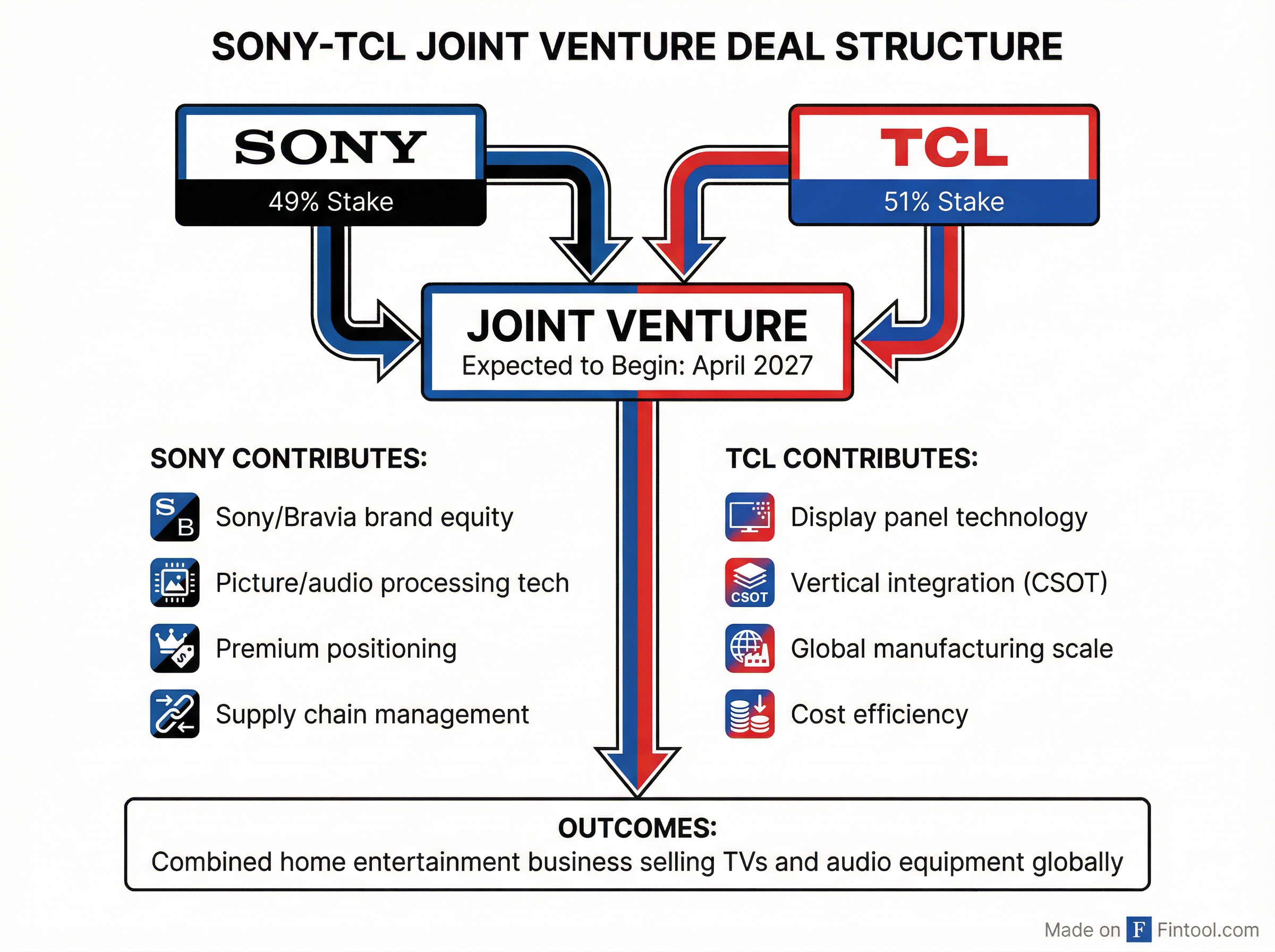
The PlayStation maker announced Tuesday it will sell a 51% stake in its home entertainment arm to TCL, with Sony retaining 49%. The joint venture is expected to begin operations in April 2027 and will continue producing televisions under the Sony and Bravia brands—but using TCL's display technology and leveraging the Chinese company's vast manufacturing scale.
The Deal Structure
Under the non-binding memorandum of understanding announced Monday, TCL will contribute its vertical supply chain strength, global market presence, and end-to-end cost efficiency. Sony brings its brand equity, picture and audio processing expertise, and supply chain management know-how to the table.
"By combining both companies' expertise, we aim to create new customer value in the home entertainment field," Sony CEO Kimio Maki said in a statement.
The binding agreements are expected to be finalized by March 2026, with the joint venture commencing April 2027, subject to regulatory approvals.
 Ask Fintool AI Agent
Why Sony Is Walking Away
The strategic rationale for Sony is clear: its TV business has been hemorrhaging relative to its higher-growth segments. In Q2 FY2025, Sony's Entertainment, Technology & Services segment—which houses TVs—posted a 7% decline in sales year-over-year primarily due to lower TV unit sales. Operating income fell 13% to ¥61 billion.
Management cut the segment's full-year operating income forecast by 11% to ¥160 billion, citing a ¥20 billion tariff impact and what CFO Lin Tao described as a "severe operating environment for TVs and smartphones."
| Metric | Q2 FY24 | Q2 FY25 | Change |
|---|---|---|---|
| ET&S Revenue (¥B) | 620 | 576 | -7% |
| ET&S Operating Income (¥B) | 70 | 61 | -13% |
| Full Year OI Forecast (¥B) | 180 | 160 | -11% |
The contrast with Sony's other segments is stark. While TVs struggle, Sony's imaging and sensing solutions business posted 50% operating income growth in Q2, driven by smartphone camera sensors supplied to Apple and others. Its music division—riding the global phenomenon of "Demon Slayer: Infinity Castle" and anime streaming—grew operating income 28% to a record high.
"The TV production, I understand, is kind of going down," one analyst noted during Sony's earnings call. Management acknowledged "TV production and movie production, structurally, we are seeing the depressed business of the industry."
TCL's Ascent in Global TVs
For TCL, this deal represents the ultimate validation of its decade-long march up the value chain.
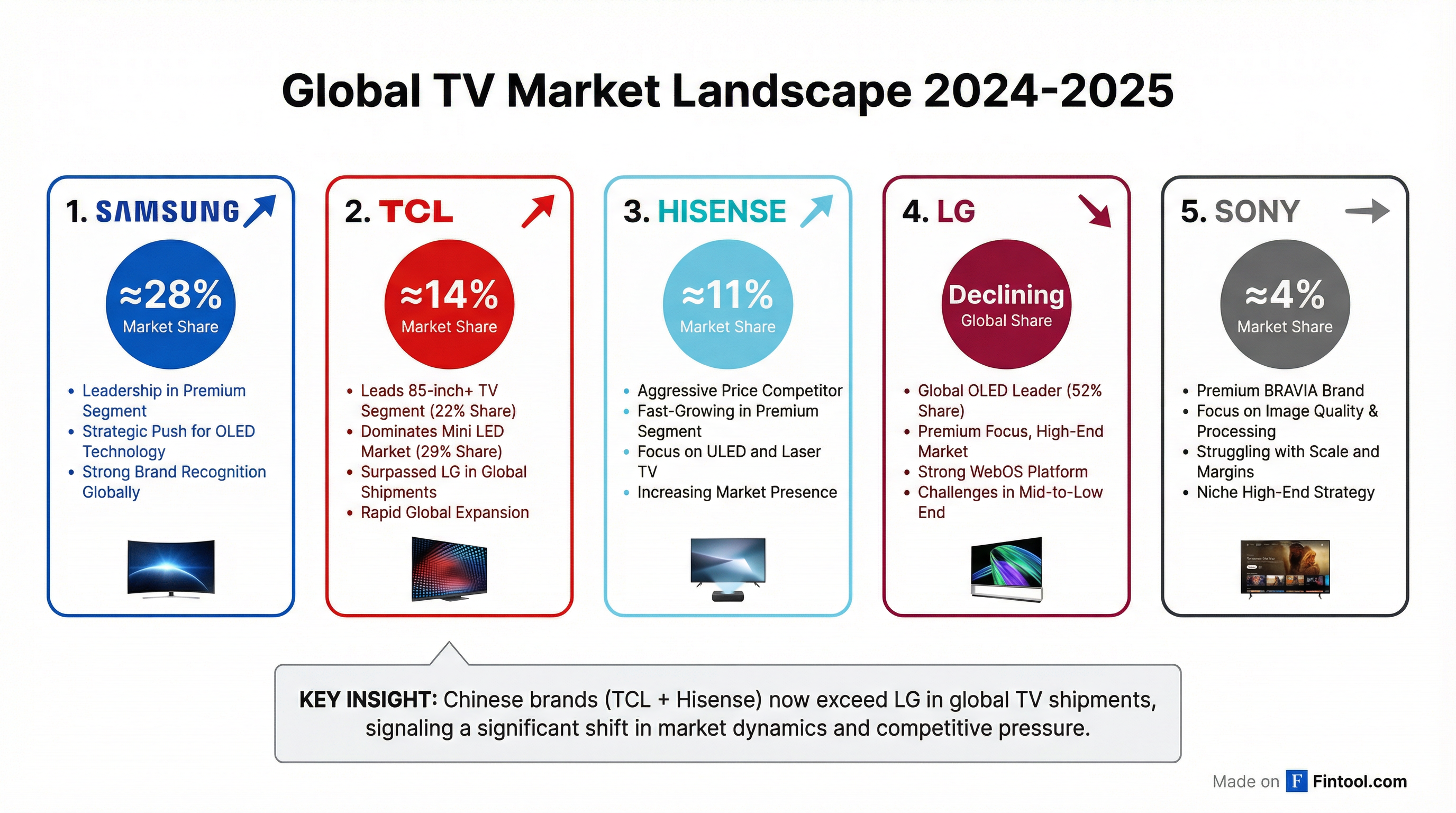
The Shenzhen-based electronics giant has become the world's second-largest TV brand by shipment volume, with 29 million units shipped in 2024—a 14.8% increase year-over-year. TCL now leads global shipments of 85-inch and larger TVs with a 22.1% market share and dominates Mini LED TVs with 28.8% share.
TCL's secret weapon is CSOT (China Star Optoelectronics Technology), its display panel manufacturing subsidiary. The company is projected to become the largest purchaser of LCD TV panels in 2025, overtaking Samsung with a 16% share. This vertical integration—controlling both panels and finished products—gives TCL cost advantages that Sony simply cannot match.
TCL Chairperson DU Juan said the joint venture would help "elevate our brand value, achieve greater scale, and optimize the supply chain in order to deliver superior products and services to our customers."
Ask Fintool AI AgentEnd of an Era for Japan
The deal represents a profound symbolic shift in global consumer electronics. Sony pioneered the Trinitron CRT television in 1968, built the Walkman into a global phenomenon, and for decades defined premium home entertainment. The company developed LED backlighting, quantum dot technology, and produced the first commercial OLED TVs.
But Sony is hardly alone in retreating. Japanese brands have been systematically exiting the TV business:
- Toshiba sold its TV business to Hisense in 2017
- Hitachi exited TV manufacturing in 2012
- Panasonic dramatically scaled back, focusing on B2B
- Sharp was acquired by Taiwan's Foxconn in 2016
Sony had already shed its PC business (Vaio, sold in 2014) and its smartphone unit is a shell of its former self. The Bravia deal continues a pattern of shedding low-margin consumer electronics to focus on gaming (PlayStation), entertainment (music, anime, movies), and semiconductor components (image sensors).
What This Means for Consumers
Future Sony-branded TVs will likely look similar to current Bravias—the brand and design language are expected to remain—but the underlying technology will shift to TCL's panels and manufacturing.
This could mean:
- Lower prices as TCL's scale and cost efficiencies are passed through
- Faster technology adoption with TCL's Mini LED and future display tech
- Maintained picture quality via Sony's processing algorithms and tuning
The risk is that premium differentiation erodes over time as TCL's influence grows. Sony's Bravia TVs have commanded price premiums for their picture processing, color accuracy, and audio quality—advantages that may be harder to maintain as a minority partner.
What to Watch
- Binding agreement deadline (March 2026): The MOU is non-binding; final deal terms could change
- Regulatory approvals: Chinese approval will be key given geopolitical tensions
- Brand management: How much control Sony retains over product positioning and pricing
- Sony's pivot acceleration: Further divestitures of non-core consumer electronics assets
Ask Fintool AI AgentRelated
Sony shares trade on the Tokyo Stock Exchange under ticker 6758 and ADRs trade on NYSE under SONY.