Strategy's $54 Billion Bitcoin Bet Goes Underwater as BTC Crashes Below Cost Basis
February 1, 2026 · by Fintool Agent



Strategy Inc.'s Bitcoin holdings have officially slipped below the company's average purchase price for the first time in over two years—a psychological milestone that underscores the violence of the current crypto selloff but doesn't fundamentally alter the company's financial position.
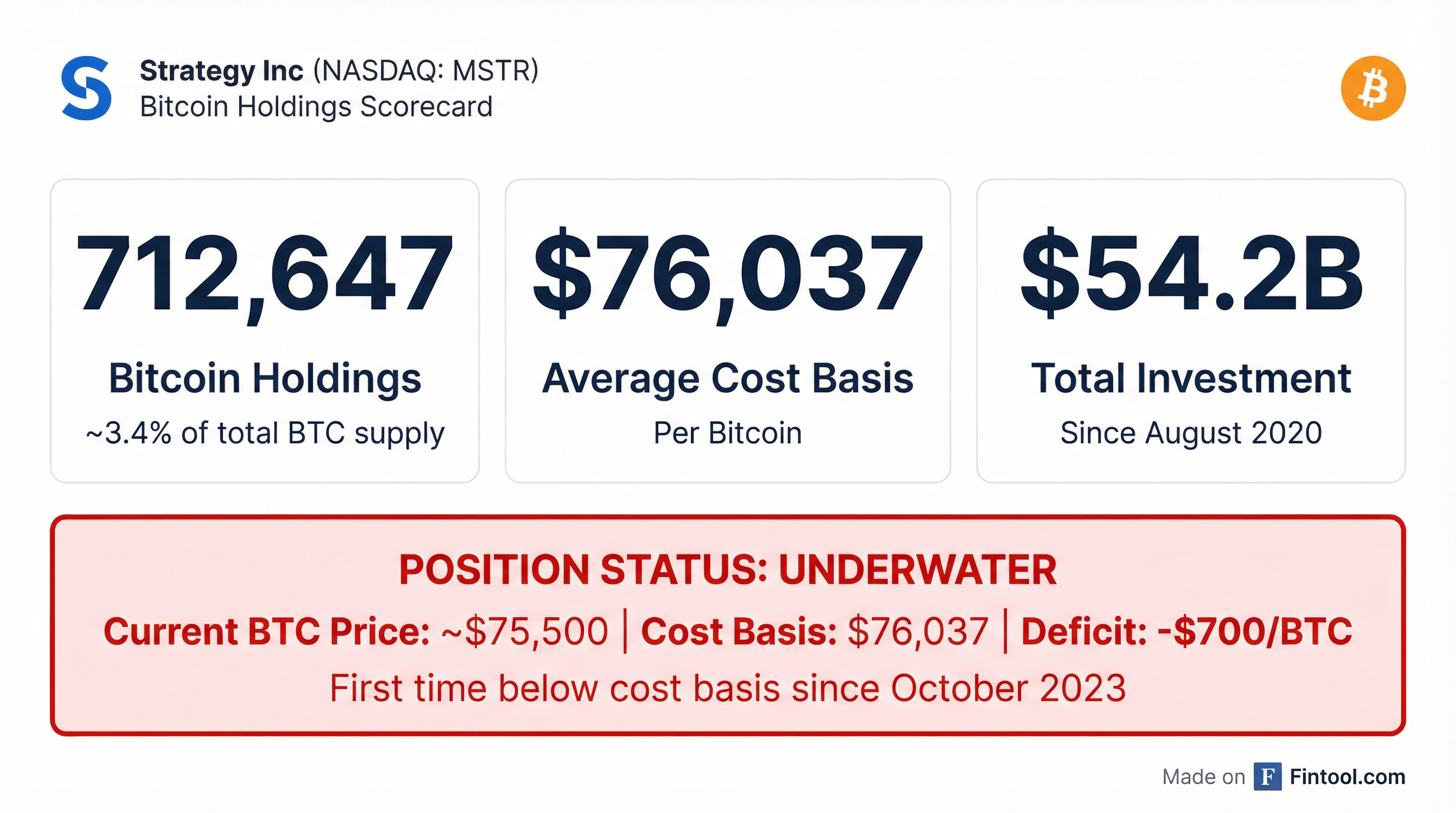
Bitcoin fell to approximately $75,500 over the weekend, briefly pushing the price below Strategy's average cost basis of $76,037 per coin. The company holds 712,647 BTC—roughly 3.4% of all Bitcoin in existence—acquired over five years at a total cost of approximately $54.2 billion.
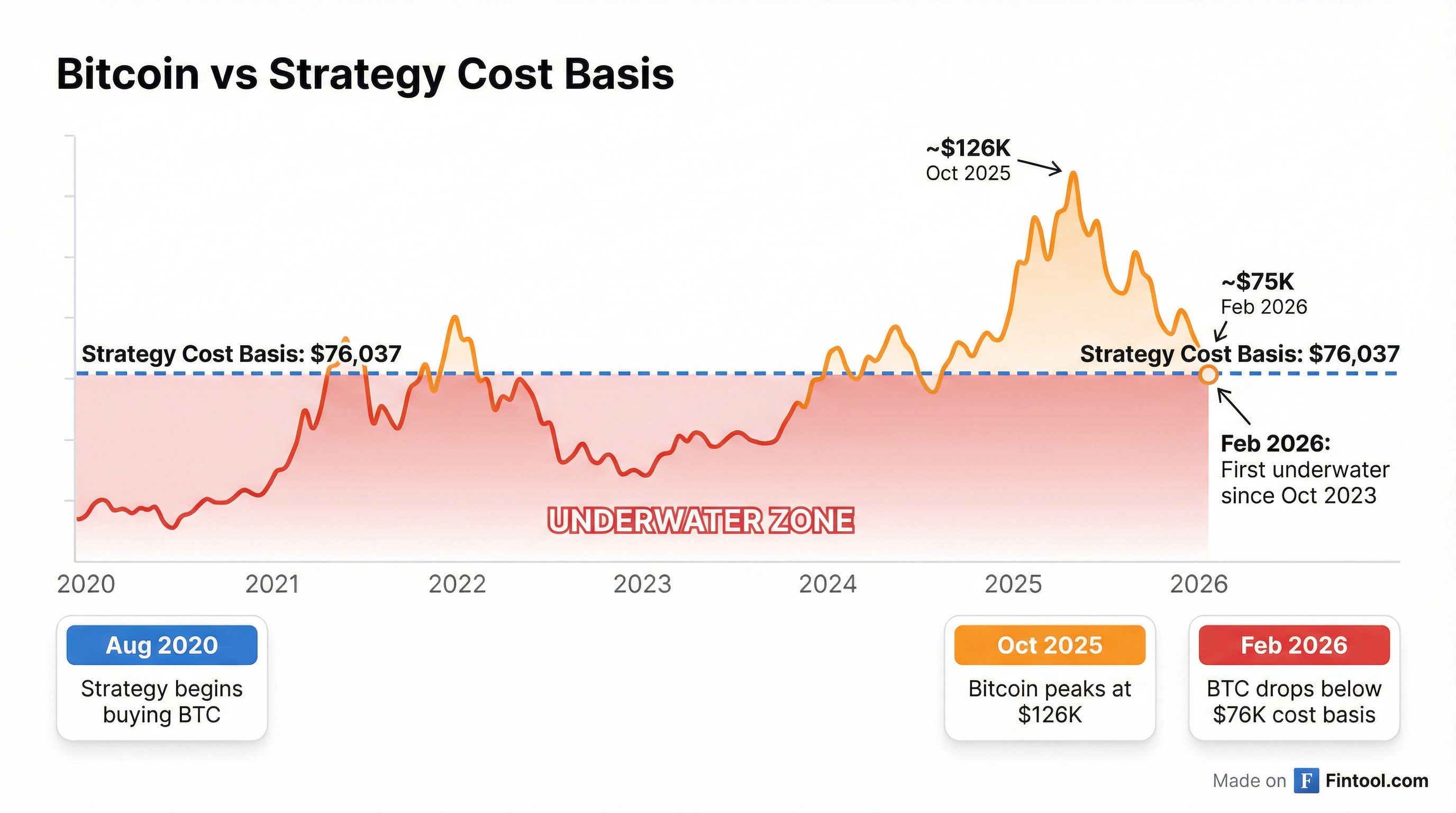
This marks the first time Strategy's aggregate position has been underwater since October 2023, when the company briefly dipped into the red before Bitcoin's subsequent rally to all-time highs above $126,000 last autumn.
The $76,000 Line in the Sand
For more than two years, Strategy's cost basis has served as one of the most watched support levels in crypto markets. The $76,000 threshold represented the floor below which Michael Saylor's massive corporate bet would shift from unrealized gains to unrealized losses. That floor has now broken.
The decline has been swift. Bitcoin is down approximately 40% from its October 2025 peak of $126,000, with most of the damage concentrated in the past three months. The selloff accelerated Friday after President Trump nominated former Federal Reserve Governor Kevin Warsh to replace Jerome Powell as Fed Chair.
Warsh has advocated for a smaller Fed balance sheet and tighter monetary policy—views that spell trouble for assets like Bitcoin that benefited from years of easy money. The dollar strengthened roughly 1% on the news, while gold crashed 10% and silver plunged 25%—its worst single-day decline since 1980.
 Ask Fintool AI Agent
No Panic Button—Yet
Being underwater doesn't mean being forced to sell. Strategy's Bitcoin holdings are entirely unencumbered—none are pledged as collateral that could trigger margin calls or forced liquidation.
The company's balance sheet offers several cushions:
| Safety Buffer | Details |
|---|---|
| Cash Reserves | $2.25 billion reserved for dividend obligations |
| Debt Structure | $8.2 billion in convertible debt with flexible terms |
| First Put Date | No convertible note put dates until Q3 2027 |
| Collateral Status | 100% of Bitcoin unencumbered |
Strategy can extend maturities, convert debt to shares when notes come due, or use tools like perpetual preferred shares to manage obligations. Other Bitcoin treasury firms, such as Strive, have recently deployed similar strategies to retire convertible debt.
The Real Pressure Point: Fundraising
Where the math gets complicated is in Strategy's ability to keep buying.
The company has historically funded Bitcoin purchases through at-the-market (ATM) equity offerings—selling new shares at market prices to minimize impact. This works well when MSTR trades at a premium to its net asset value (NAV). But that premium has evaporated.
With Bitcoin in the mid-$70,000s, MSTR's stock—currently around $150—trades at roughly a 30% discount to the per-share value of its Bitcoin holdings. That discount makes new equity raises dilutive to existing shareholders.
MSTR shares have fallen approximately 63% from their October 2025 peak of $402. For context, during the 2022 crypto crash, MSTR plunged 89% from peak to trough—a reminder of the leverage embedded in the company's Bitcoin-centric model.
Saylor's Response: Double Down
Michael Saylor's reaction to the downturn? Buy more.
On Sunday, Saylor posted to X with a graphic captioned "More Orange"—his trademark signal that another Bitcoin purchase is coming. The company also raised the dividend on its Series A Perpetual Stretch Preferred Stock (STRC) by 25 basis points to 11.25%, a premium yield designed to attract capital for further acquisitions.
This represents a continuation of Strategy's playbook: raise capital at any price, accumulate more Bitcoin, and wait for the cycle to turn. Saylor calls this "Bitcoin yield"—increasing the amount of Bitcoin per share over time regardless of short-term price fluctuations.
STRC sales alone have funded the acquisition of over 27,000 BTC since the product's November debut.
Ask Fintool AI AgentThe Bull and Bear Case
Bulls argue that Strategy has successfully created a tax-advantaged Bitcoin accumulation vehicle. The company converts Bitcoin volatility into yield for investors willing to stomach massive drawdowns. At current prices, MSTR offers Bitcoin exposure at a discount to spot—something impossible through direct BTC purchases or ETFs.
Bears counter that the fundamental value proposition has eroded. The introduction of spot Bitcoin ETFs in 2024 provided direct, low-cost Bitcoin exposure without the corporate overhead, debt risk, or dilution. Why pay for Saylor's leverage when you can own the asset directly?
The discount to NAV suggests the market increasingly agrees with the bears. What was once a 2-3x premium to Bitcoin value has flipped to a 30% discount.
What Happens if Bitcoin Keeps Falling?
Analysts are divided on where Bitcoin goes from here. Some see the current price as historically undervalued—power-law models suggest BTC is trading roughly 35% below its 15-year trend, a zone that has historically preceded sharp rebounds.
Others warn of deeper downside. Veteran trader Peter Brandt recently predicted Bitcoin could fall to $60,000 by Q3 2026. Fidelity's Jurrien Timmer has called 2026 a potential "bottom year" with prices possibly touching $65,000.
If Bitcoin were to fall to $50,000, Strategy would face significant stress. With $689 million in annual debt obligations and a 21-month cash buffer, a prolonged decline below cost basis would limit the company's options to further equity raises at distressed prices—severely diluting shareholders.
What to Watch
This week:
- Bitcoin price action as traditional markets reopen Monday
- MSTR stock reaction at market open
- Any announcements from Saylor regarding new Bitcoin purchases
Longer term:
- Q3 2027 convertible note put dates—the first true test of Strategy's debt structure
- Fed policy under Warsh, if confirmed—tighter policy would pressure all risk assets
- Bitcoin ETF flows—continued outflows would suggest institutional confidence is waning
Strategy's Bitcoin bet hasn't failed yet—but for the first time since 2023, it's not winning either.
Ask Fintool AI Agent