Stripe's Bridge Wins Federal Bank Charter, Bringing Stablecoins Under Direct U.S. Oversight
February 17, 2026 · by Fintool Agent


Bridge, the stablecoin infrastructure platform acquired by Stripe for $1.1 billion in 2024, has received conditional approval from the Office of the Comptroller of the Currency to form a federally chartered national trust bank—a milestone that positions the payments giant to issue and manage stablecoins under direct federal oversight.
The approval, granted on February 12, makes Bridge the latest in a growing roster of crypto and fintech firms securing federal banking status since the Trump administration ushered in a more crypto-friendly regulatory environment.
"This approval positions Bridge to help enterprises, fintechs, crypto businesses, and financial institutions build with digital dollars inside a clear federal framework," the company said in a statement.
The Charter: What It Enables
Once fully approved, Bridge National Trust Bank will be authorized to:
- Custody digital assets for businesses and institutions
- Issue stablecoins directly under federal oversight
- Manage stablecoin reserves in compliance with banking standards
- Orchestrate stablecoin transactions across blockchain networks
The charter allows Bridge to operate nationwide without needing individual state licenses—a significant operational advantage in the fragmented U.S. regulatory landscape.
 Ask Fintool AI Agent
A Crowded Field of Applicants
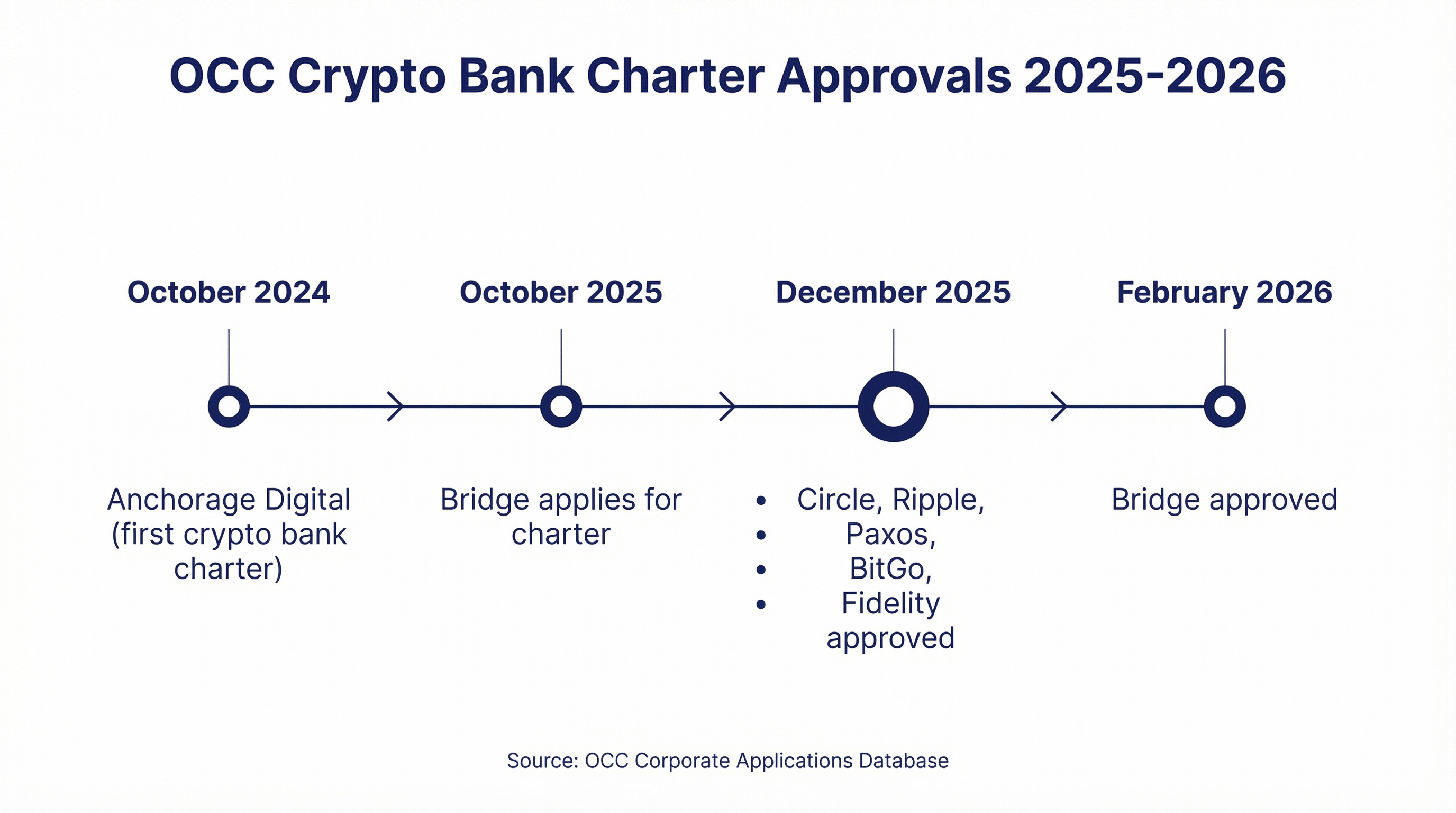
Bridge joins an accelerating wave of crypto firms seeking federal banking charters. The OCC has transformed from a bottleneck to a gateway for digital asset companies under the current administration:
| Company | Charter Type | Approval Date | Status |
|---|---|---|---|
| Anchorage Digital | National Trust Bank | January 2021 | Fully Approved |
| Circle | National Trust Bank | December 2025 | Conditional |
| Ripple | National Trust Bank | December 2025 | Conditional |
| Paxos | National Trust Bank | December 2025 | Conditional |
| BitGo | National Trust Bank | December 2025 | Conditional |
| Fidelity Digital Assets | National Trust Bank | December 2025 | Conditional |
| Bridge (Stripe) | National Trust Bank | February 2026 | Conditional |
Coinbase and Trump-linked World Liberty Financial have also applied for national trust banking charters, signaling that the race for federal crypto banking status is intensifying.
The Regulatory Backdrop: GENIUS Act Compliance
Bridge's move comes seven months after President Trump signed the Guiding and Establishing National Innovation for U.S. Stablecoins Act (GENIUS Act) into law, establishing the first comprehensive federal framework for payment stablecoins.
The law requires stablecoin issuers to:
- Maintain reserves fully backing all outstanding stablecoins
- Hold reserves in approved assets (primarily short-term Treasuries and cash)
- Meet capital, liquidity, and risk management requirements
- Implement anti-money laundering controls
- Submit to regular examinations by federal regulators
"Our compliance framework already positions Bridge to be GENIUS Act ready," the company said. "Now achieving a national trust bank charter will provide our customers the regulatory backbone they need to build with stablecoins confidently and at scale."
Sofi Technologies disclosed in its latest 10-K that it expects to request OCC approval to form a subsidiary that will become a "Permitted Issuer" under the GENIUS Act for its planned SoFiUSD stablecoin.
A $318 Billion Market Up for Grabs
The timing of Bridge's charter approval coincides with the stablecoin market reaching unprecedented scale. Total stablecoin market capitalization hit $318 billion in early 2026—a 49% increase from $205 billion just a year earlier.
Daily stablecoin trading volumes now exceed $140 billion, surpassing Visa and Mastercard's combined daily transaction volume.
The market remains dominated by two players:
| Stablecoin | Market Cap | Market Share |
|---|---|---|
| Tether (USDT) | $187B | 60.7% |
| Circle (USDC) | $76B | 23.9% |
| Others | $55B | 15.4% |
Circle's USDC grew 73% in 2025, outpacing Tether's 36% growth—driven largely by institutional demand for GENIUS Act-compliant stablecoins.
Ask Fintool AI AgentStrategic Implications for Stripe
For Stripe, the world's most valuable private fintech company (last valued at $65 billion), Bridge's charter represents a strategic bet on stablecoins becoming core financial infrastructure.
Bridge already powers stablecoin issuance for products including:
- Phantom's CASH – a consumer stablecoin wallet
- MetaMask's mUSD – through Stripe's Open Issuance platform
- Various enterprise treasury and payment applications
The federal charter gives these products—and future offerings—the regulatory foundation that institutional clients increasingly demand.
"Stablecoins are becoming core financial infrastructure," Bridge posted on X. "Institutions need regulatory clarity, operational resilience, and scalable systems to build with confidence. A national trust bank establishes that foundation."
Banking Lobby Pushback
Not everyone is celebrating. Traditional banking lobbyists have urged the OCC to slow its crypto charter approvals, warning of systemic risks.
The American Bankers Association wrote to the OCC on February 11: "We urge OCC to ensure that robust, broadly applicable safety and soundness standards are well understood and upheld during this period of rapid innovation."
The Bank Policy Institute has argued that approving crypto firms for bank charters "could significantly increase risks to the U.S. financial system"—citing concerns about deposit insurance, reserve management, and the novel risks of blockchain-based banking.
Paypal, which has its own stablecoin (PYUSD) issued through partner Paxos, acknowledged the regulatory uncertainty in its latest 10-K: "The regulatory treatment of stablecoins is evolving and has drawn significant attention from legislative and regulatory bodies around the world... we and the PYUSD Issuer may face substantial costs and risks to operationalize and comply with any additional or changed requirements."
What's Next
The OCC has not announced a timeline for Bridge's final approval. Conditional approval typically involves a period of demonstrating operational readiness, capital adequacy, and compliance systems before full charter status is granted.
For investors, the implications extend beyond crypto-native names:
- Coinbase ($43B market cap) – Already a major USDC distributor through its Circle partnership, Coinbase could face both competition and opportunity as more players enter the regulated stablecoin space.
- Paypal ($37B market cap) – PYUSD's growth depends on navigating the same GENIUS Act framework Bridge is embracing.
- Sofi ($25B market cap) – The neobank's disclosed plans for SoFiUSD suggest it sees stablecoins as a natural extension of its digital banking platform.
The broader trend is clear: the line between fintech, crypto, and traditional banking continues to blur—and the companies that secure federal banking status first will have a structural advantage in the $300 billion stablecoin market.
Ask Fintool AI Agent