Tesla Begins Driverless Robotaxi Testing in Austin—But the Road Ahead Remains Long
December 15, 2025 · by Fintool Agent


A Milestone Achieved—On Schedule
Tesla+3.50% has begun testing its robotaxis in Austin, Texas without any human occupants—a milestone CEO Elon Musk confirmed on December 14, 2025. "Testing is underway with no occupants in the car," Musk wrote on X, marking one of the final steps before Tesla can claim to operate a true robotaxi service.
The announcement delivered on Musk's timeline—he had said in early December that Tesla would remove safety monitors "in about three weeks." Shares rose 3.5% on Monday to close at $475.11, approaching the stock's all-time high of $488.54 reached in December 2024.
But beneath the headline achievement lies a more complex picture: a small fleet with a concerning crash rate, redacted safety reports, and a competitor operating at 15,000 times the scale.
The Numbers in Context
Tesla's Austin robotaxi fleet consists of approximately 31 modified Model Y vehicles—up from 29 in November. Musk has said the company aims to double this to 60 vehicles by year-end and eventually grow to 500.
Compare this to Waymo-2.53%, the Alphabet-owned robotaxi operator:
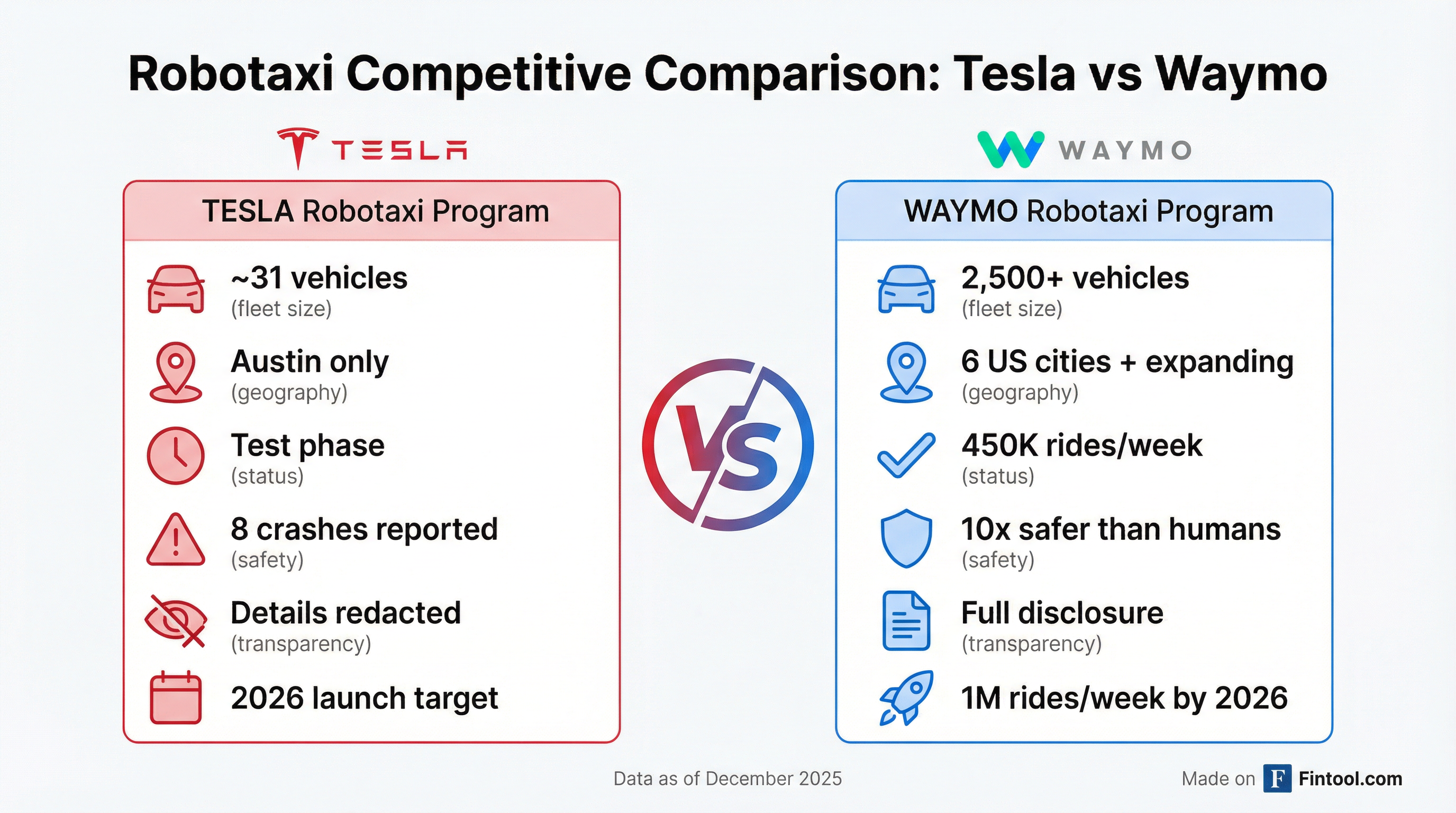
| Metric | Tesla | Waymo |
|---|---|---|
| Fleet Size | 31 vehicles | 2,500+ vehicles |
| Weekly Rides | Not disclosed (test phase) | 450,000 paid rides |
| Service Areas | Austin only | Phoenix, SF, LA, Austin, Atlanta, Miami |
| Autonomous Miles | 1.25M combined | 100M+ |
| Commercial Status | Testing | Fully operational since 2020 |
| 2026 Target | Launch Cybercab | 1M rides/week, 20+ cities |
Sources: Company disclosures, NHTSA filings, Tiger Global investor letter
Waymo is currently providing 14 million rides per year and aims to hit 1 million rides per week by end of 2026—expanding to over 20 cities including Tokyo and London.
The Crash Record Raises Questions
Tesla's small fleet has been involved in at least 8 crashes since the Austin pilot launched in June 2025—all while human safety monitors were present in the vehicles.
The crash timeline:
| Date | Incident Type | Injuries |
|---|---|---|
| July 2025 | SUV collision | Property damage |
| July 2025 | Fixed object | Minor injury |
| July 2025 | SUV collision | Property damage |
| September 2025 | Fixed object | Property damage |
| September 2025 | Passenger car | Property damage |
| September 2025 | Cyclist | Property damage |
| September 2025 | Animal | No injury |
| October 2025 | Other (redacted) | No injury |
Source: NHTSA Standing General Order filings
Philip Koopman, an autonomous systems safety researcher and emeritus professor at Carnegie Mellon University, noted the concerning pattern: "With such a small fleet, there should have been fewer than seven reportable accidents, especially considering that there is a safety supervisor in each one whose job is to prevent crashes."
Critically, Tesla has redacted the "narrative description" of all crashes in its NHTSA filings—preventing the public from knowing how incidents occurred or who was at fault. Waymo, by contrast, provides full narrative descriptions in its crash reports.
The Decade of Promises
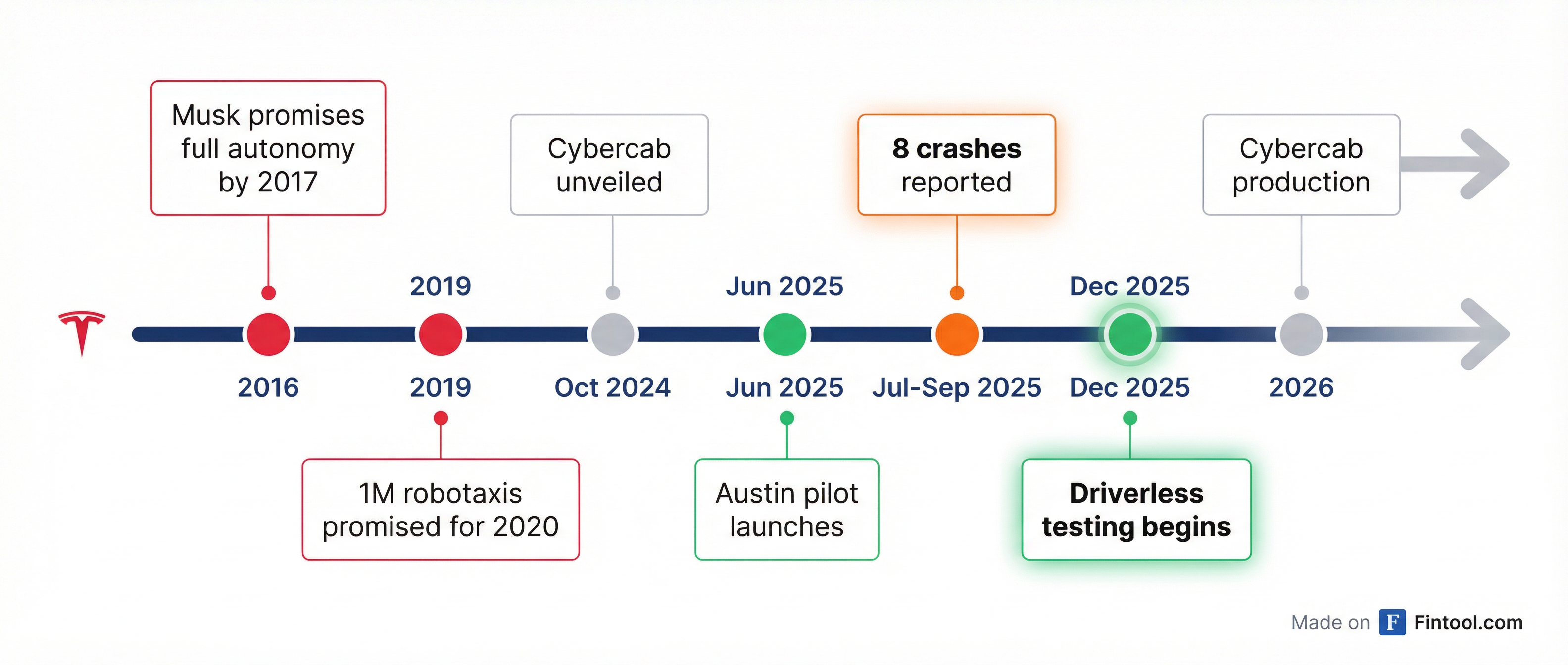
Musk's autonomous driving promises have a long history:
- 2016: Promised fully autonomous Teslas by end of 2017
- 2019: Claimed Tesla would have 1 million robotaxis on roads by 2020
- 2024: Unveiled Cybercab concept at "We, Robot" event
- June 2025: Austin pilot launch with safety monitors
- December 2025: Driverless testing begins
Last week, Musk declared that Waymo "never really had a chance against Tesla"—a claim at odds with Waymo's 450,000 weekly paid rides versus Tesla's test-phase operations.
Tesla Financial Snapshot
| Metric | FY 2022 | FY 2023 | FY 2024 |
|---|---|---|---|
| Revenue ($B) | $81.5 | $96.8 | $97.7 |
| Net Income ($B) | $12.6 | $15.0 | $7.1 |
| Gross Margin (%) | 25.6% | 18.2% | 17.9% |
| Cash Position ($B) | $16.3 | $16.4 | $16.1 |
Much of Tesla's $1.53 trillion market capitalization is tied to investor optimism around autonomous driving and robotaxi potential—not current EV sales, which grew just 1% year-over-year in FY 2024.
The Regulatory Landscape
Texas has among the most permissive autonomous vehicle regulations in the United States, requiring only that vehicles comply with traffic laws—no special permits or approval processes. The Texas Department of Motor Vehicles told CNBC it "does not have direct authority related to autonomous vehicle regulation."
This stands in contrast to California, where Tesla would need to combine multiple permits to offer fully driverless rides. Tesla currently operates a ride-hailing service in the San Francisco Bay Area, but with human drivers using Full Self-Driving (FSD) software—not driverless vehicles.
The National Highway Traffic Safety Administration is currently conducting an expanded investigation into Tesla's FSD system following multiple accidents and fatalities linked to its use.
What to Watch
Near-term milestones:
- Whether Tesla offers customer rides without safety monitors in coming weeks
- Fleet expansion progress toward 60 vehicles by year-end
- Any additional crash reports to NHTSA
2026 catalysts:
- Cybercab production timeline and initial deliveries
- Expansion beyond Austin
- Regulatory developments in California and other states
Key risks:
- Safety incidents without human backup could trigger regulatory intervention
- Continued redaction of crash details may invite regulatory scrutiny
- Waymo's aggressive expansion could define market expectations
The Bottom Line
Tesla's move to driverless testing is a genuine milestone—and a promise delivered, for once, on schedule. For investors who've bet on Tesla's autonomy narrative, it's validation that progress is being made.
But the gap between Tesla's 31-vehicle test fleet and Waymo's 450,000 weekly rides illustrates the road ahead. Tesla must now prove that its vision-only approach can achieve the safety record necessary for commercial deployment at scale—and that its crash rate, which has been concerning even with human monitors, will improve without them.
The robotaxi race is no longer about who gets there first. Waymo already won that contest. The question now is whether Tesla can close the gap—and whether the market will wait for an answer.