Texas Instruments Bets $7.5 Billion on Wireless Connectivity in Biggest Deal Since 2011
February 4, 2026 · by Fintool Agent



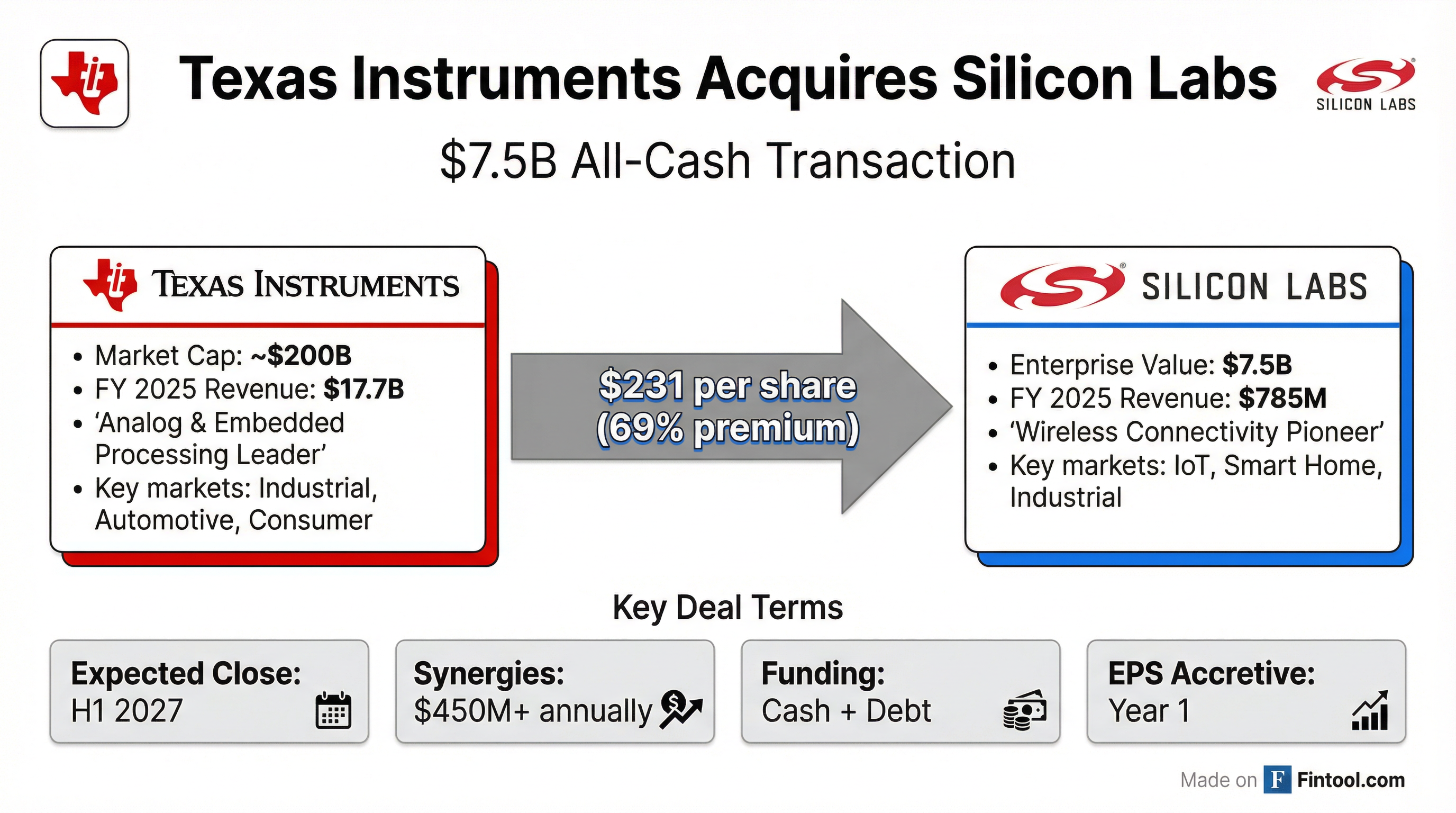
Texas Instruments is making its largest acquisition since the $6.5 billion National Semiconductor deal in 2011, agreeing to buy Austin-based Silicon Labs for $7.5 billion in an all-cash transaction that bets big on the proliferating Internet of Things.
Silicon Labs shareholders will receive $231 per share—a 69% premium to the stock's last unaffected close—triggering a 49% premarket surge that sent shares to their highest level in four years. Texas Instruments stock fell roughly 3.5% in early trading as investors weighed the deal's cost against its strategic logic.
The Strategic Logic
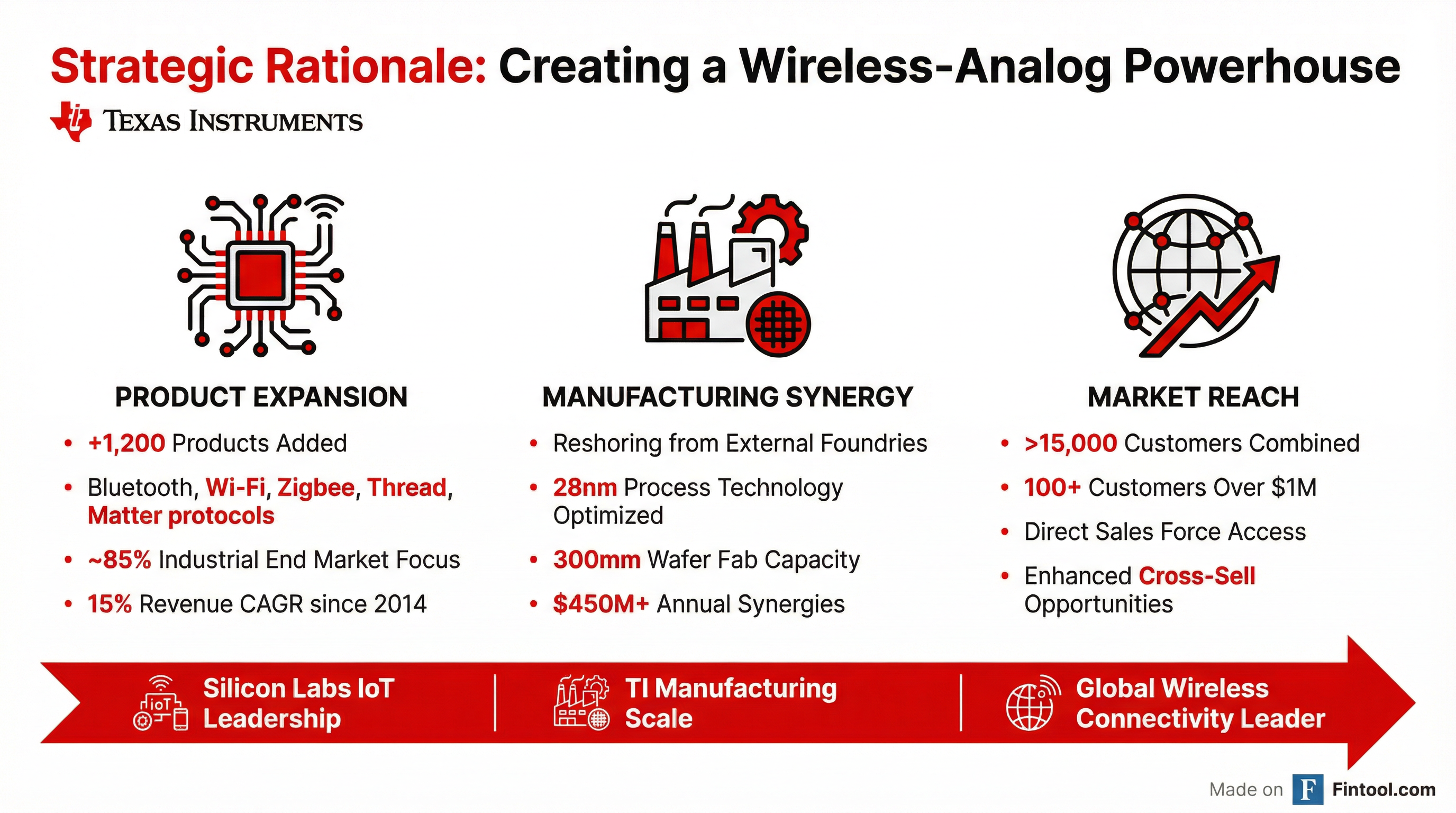
The acquisition creates what TI calls a "global leader in embedded wireless connectivity solutions" by marrying Silicon Labs' wireless expertise with TI's manufacturing muscle and market reach.
Silicon Labs brings approximately 1,200 products supporting Bluetooth, Wi-Fi, Zigbee, Thread, and Matter protocols—the standards powering everything from smart home devices to industrial automation. The company has delivered roughly 15% compound annual revenue growth since 2014, driven by accelerating demand for connected devices.
"The acquisition of Silicon Labs is a significant milestone that strengthens our long-term embedded processing strategy," said Haviv Ilan, TI's chairman, president, and CEO. "Silicon Labs' leading embedded wireless connectivity portfolio enhances our technology and IP, enabling greater scale and allowing us to better serve our customers."
For TI, whose core strength lies in analog chips that manage signals and power in electronic equipment, the deal fills a critical gap. Unlike AI chip firms Nvidia and AMD, TI focuses on foundational chips used in everyday devices—smartphones, cars, medical devices—giving it a client base that includes Apple, SpaceX, and Ford.
 Ask Fintool AI Agent
Manufacturing Synergies: The Real Prize
The financial case rests on TI's ability to reshore Silicon Labs' manufacturing from external foundries to its own 300mm wafer fab facilities in the U.S.
TI expects to generate approximately $450 million in annual manufacturing and operational synergies within three years of closing. The company's defined process technologies, including 28nm, are "optimized for Silicon Labs' portfolio, enabling more efficient and faster future process technology design cycles."
This reshoring strategy aligns with TI's broader manufacturing buildout. In January 2025, the company finalized a CHIPS Act agreement with the Biden administration, receiving $1.61 billion to support $18 billion in investment projects across Texas and Utah.
Deal Terms and Timeline
Key transaction details from the 8-K filing:
| Term | Detail |
|---|---|
| Price per share | $231.00 cash |
| Enterprise value | $7.5 billion |
| Premium | 69% to unaffected price |
| Expected close | H1 2027 |
| SLAB termination fee | $259 million |
| TXN termination fee | $499 million |
| Financing | Cash on hand + debt |
| EPS impact | Accretive in first full year post-close |
The merger agreement has been unanimously approved by both boards. Goldman Sachs is advising TI, while Qatalyst Partners represents Silicon Labs.
Financial Snapshot
Texas Instruments enters the deal from a position of strength:
| Metric | FY 2023 | FY 2024 | FY 2025 |
|---|---|---|---|
| Revenue | $17.5B | $15.6B | $17.7B |
| EBITDA Margin | 48.5% | 43.8% | 45.6% |
| Cash on Hand | $3.0B | $3.2B | $3.2B* |
*Values retrieved from S&P Global
Silicon Labs has been recovering from an inventory correction:
| Metric | FY 2024 | FY 2025 |
|---|---|---|
| Revenue | $584M | $785M* |
| Net Income | -$191M | -$65M* |
| Gross Margin | 53.4% | 58.2%* |
*Values retrieved from S&P Global
Silicon Labs reported Q4 2025 adjusted EPS of $0.56, beating consensus of $0.55, with sales of $208.2 million exceeding the $207.6 million estimate.
Ask Fintool AI AgentMarket Implications
The deal consolidates a fragmented wireless connectivity market at a time when IoT adoption is accelerating. Silicon Labs' customer base includes over 15,000 accounts, with more than 100 generating over $1 million annually. Approximately 85% of revenue comes from industrial end markets—smart meters, building automation, industrial equipment—where TI already has strong presence.
Stifel analysts noted that "while TI continues to build foundational internal capacity, Silicon Labs provides a specialized connectivity layer that could create one of the most formidable wireless-analog portfolios in the industry."
Matt Johnson, Silicon Labs' president and CEO, emphasized the cultural fit: "Texas Instruments and Silicon Labs share a strong Texas heritage and a long-term commitment to building technology companies the right way. Over the last decade, Silicon Labs has delivered double-digit growth, driven by the accelerating demand for more connected devices."
What to Watch
Regulatory approval timeline: The deal requires Hart-Scott-Rodino clearance and potentially foreign investment reviews. The merger agreement allows extensions to August 2027 and February 2028 if regulatory delays occur.
Integration execution: TI's synergy target of $450 million depends on successfully migrating Silicon Labs' products to internal fabs while maintaining customer relationships. The company has committed to preserving Silicon Labs' customer obligations.
Competitive response: The combined company will face competition from Nordic Semiconductor, Qualcomm's IoT division, and NXP in the wireless connectivity space. How rivals respond—whether through their own consolidation moves or aggressive pricing—could shape the post-close competitive landscape.
TI remains committed to its capital return strategy, pledging to return 100% of free cash flow to shareholders over time via dividends and share repurchases.
Ask Fintool AI AgentRelated: Texas Instruments | Silicon Labs