Private Equity's $4 Billion Bet on Portable Toilets Goes Down the Drain
December 29, 2025 · by Fintool Agent


United Site Services, the largest portable sanitation company in the United States, filed for Chapter 11 bankruptcy protection today with a plan to eliminate $2.4 billion in debt—wiping out equity investors including Fortress Investment Group, Ares Management, and Blackstone, who are set to lose a combined $1.4 billion on a deal that was once valued at $4 billion.
The bankruptcy represents one of the most prominent failures of the "continuation vehicle" strategy that has become increasingly popular across private equity, a structure that allowed earlier investors to cash out while concentrating risk on new backers who placed a single-asset bet on the toilet rental business.
 Ask Fintool AI Agent
A $2.4 Billion Debt Flush
USS, owned by Platinum Equity, filed for pre-packaged bankruptcy in the U.S. Bankruptcy Court for the District of New Jersey with support from more than 75% of its voting creditors. The restructuring plan will:
- Eliminate $2.4 billion of lower-priority debt by converting it into equity
- Fully repay senior lenders while wiping out existing equity
- Provide $1.1 billion in new capital, including:
- $480 million equity rights offering
- $300 million exit loan
- $120 million debtor-in-possession financing
- $195 million 5-year ABL credit facility
- $100 million revolving credit facility
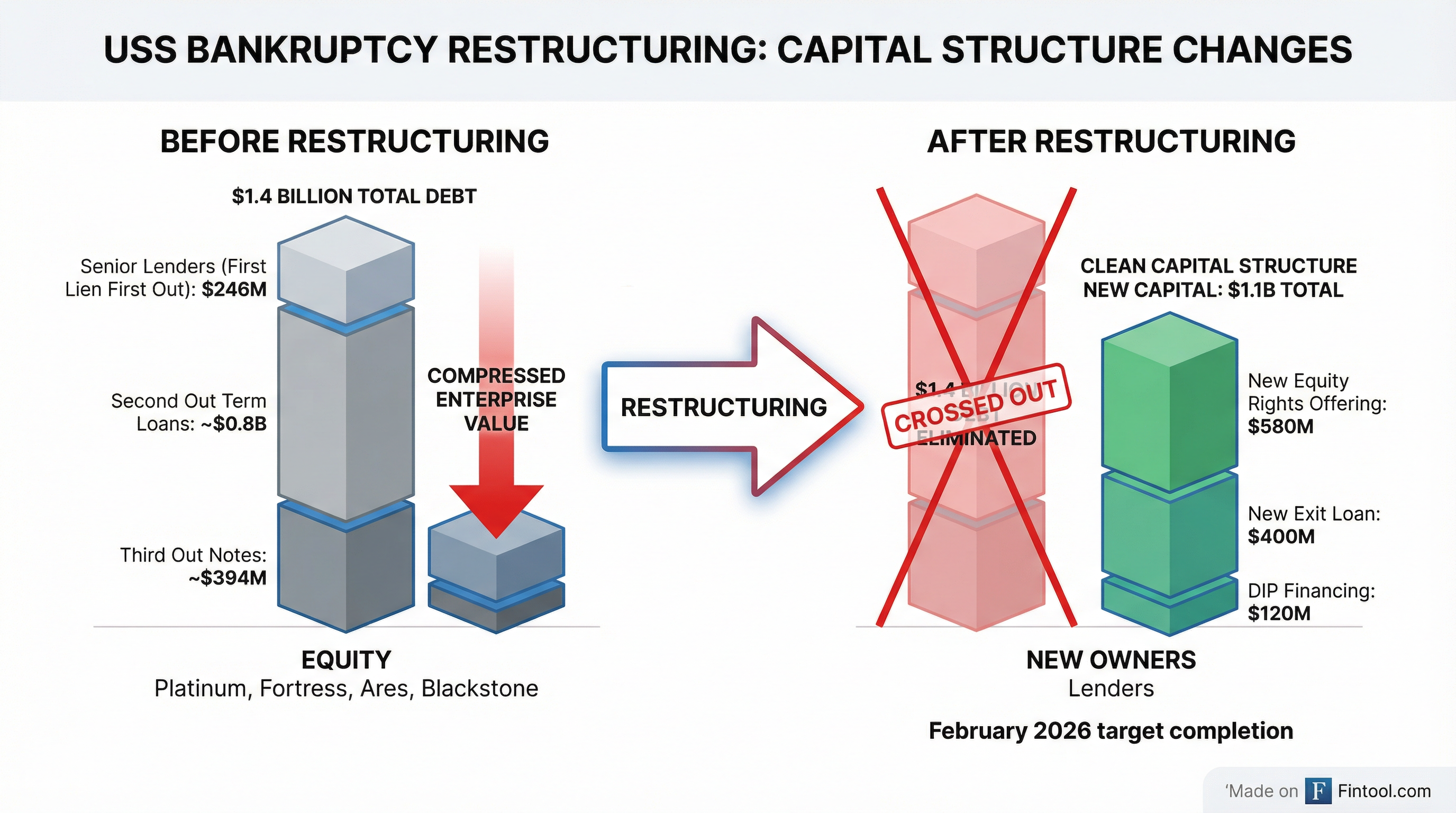
"We've been transforming how site services are performed by setting best practice standards for over 25 years—this milestone ensures we continue leading the industry for the long run," said Bobby Creason, USS's Chief Executive Officer. The company expects to emerge from bankruptcy by February 2026.
Vendors, landlords, and other general unsecured creditors will be paid in full and remain unimpaired under the plan.
The Continuation Vehicle Trap
The USS debacle highlights the hazards of continuation vehicles—a strategy that accounted for nearly a fifth of all private asset exits in the first half of 2025, according to Jefferies Financial Group.
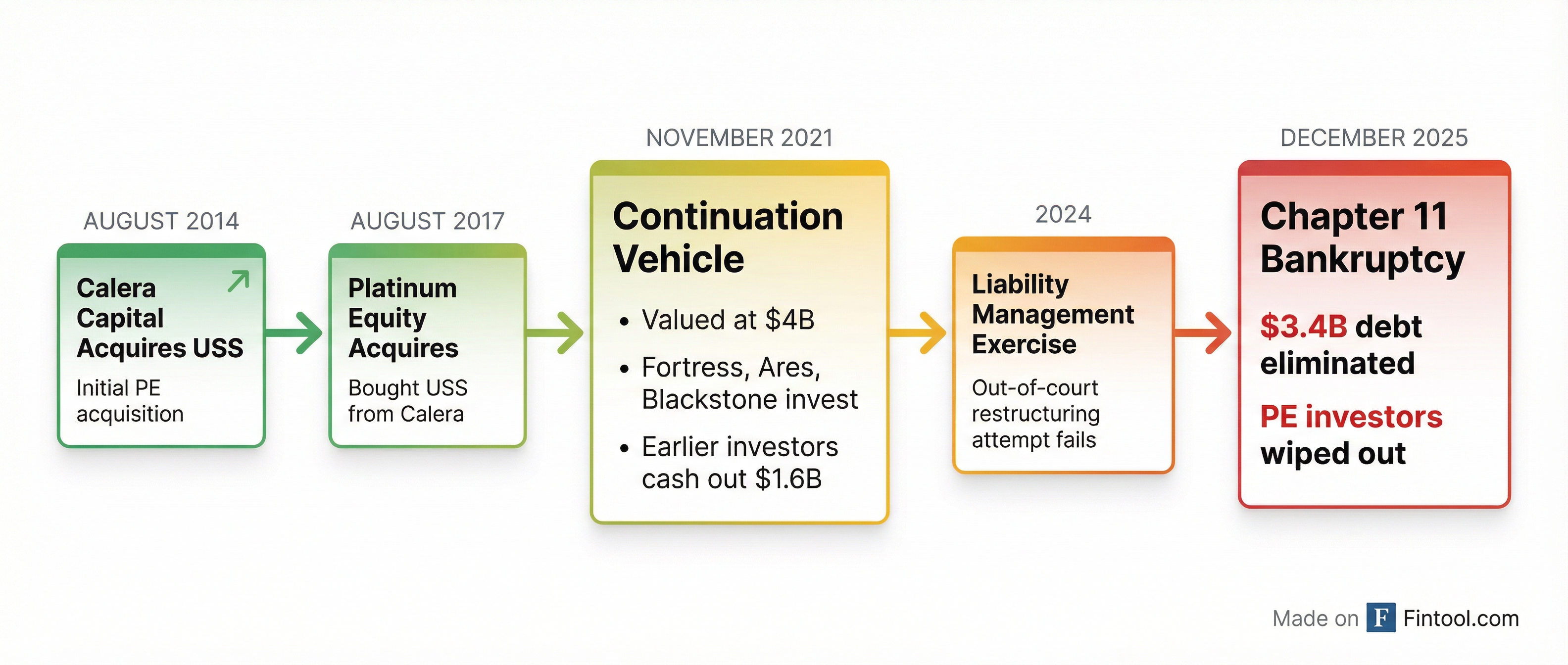
Platinum Equity acquired USS in August 2017 from Calera Capital, which had owned the company since 2014. After attempting to sell USS in 2021 amid post-pandemic optimism about a return to events and construction activity, Platinum instead created a continuation vehicle that:
- Transferred USS from an older Platinum fund into a new single-asset fund
- Valued the company at $4 billion—a premium price reflecting expected post-COVID growth
- Allowed earlier investors to cash out approximately $2.6 billion
- Attracted new anchor investors including Fortress, Ares, and Blackstone
"This transaction provides the best of both worlds," Platinum Partner Louis Samson said at the time, claiming it gave investors a chance to cash out while allowing new backers to benefit from future growth.
That growth never materialized.
Ask Fintool AI AgentWhat Went Wrong: High Rates Meet Housing Slump
USS's business model is inextricably linked to construction activity. The company's 350,000 portable restrooms and related site services—including temporary fencing, hand wash stations, and restroom trailers—serve over 70,000 customers across residential construction, commercial projects, special events, and government contracts including FEMA disaster relief and the Super Bowl.
Two forces crushed the business:
1. The Housing Construction Collapse
Residential construction—a key driver of portable toilet demand—has tumbled from its 2022 peak as higher mortgage rates priced buyers out of the market.
Single-family housing starts fell to near 2.5-year lows in late 2025, with inventory bloat weighing on new projects. Fewer construction sites means fewer portable toilets needed on job sites.
Ask Fintool AI Agent2. The Interest Rate Squeeze
The Federal Reserve's aggressive rate-hiking cycle that pushed the fed funds rate from near zero to over 4% created a double hit:
- USS's own debt burden became increasingly expensive to service, with interest payments consuming cash that could have funded operations
- Construction customers curtailed projects as financing costs soared, reducing demand for site services
The company also struggled to integrate the approximately 45 acquisitions completed under Platinum's ownership, adding operational complexity during a challenging economic environment.
Private Equity Under Pressure
USS is joining a growing list of private equity-backed companies stumbling under heavy debt loads in a higher-for-longer rate environment. Private equity firms have struggled to sell portfolio companies on the timelines promised to their investors, with more than $1 trillion in unsold assets sitting on balance sheets.
The USS situation raises particular concerns about single-asset continuation vehicles:
| Risk Factor | USS Example |
|---|---|
| Concentration risk | 100% exposure to one company in a cyclical industry |
| Valuation disconnect | $4B valuation in 2021 proved unsupportable |
| Timing risk | Post-COVID optimism didn't account for rate hikes |
| Exit optionality | No diversification to offset losses |
For Ares and Blackstone—two publicly traded alternative asset managers—the losses represent a mark against their private credit and equity operations, though both firms have vast portfolios that can absorb the hit.
Ask Fintool AI AgentWho Takes Control
USS will emerge from bankruptcy under new ownership. The company's senior lenders, including Clearlake Capital and Searchlight Capital Partners, will gain control through the debt-to-equity conversion.
Despite one large holdout creditor opposing the plan—which USS warned could pursue "delay and litigation"—the company has secured enough support to proceed. The 75%+ creditor backing positions USS for a relatively swift restructuring compared to contested bankruptcies that can drag on for years.
The company emphasized it will maintain normal operations throughout the bankruptcy process, continuing to serve customers without disruption.
The Broader Market Signal
The USS bankruptcy sends a warning signal to continuation vehicle investors and the broader private equity ecosystem:
For PE investors: Single-asset continuation funds carry outsized risk, particularly in cyclical industries sensitive to interest rates. The strategy's popularity may wane as this high-profile failure raises due diligence standards.
For private credit: The bankruptcy adds to the mounting evidence of stress in leveraged loans and private credit portfolios. Lenders who provided the $2.4 billion in debt that will now be converted to equity face years of work to recover value through the restructured company.
For the construction sector: USS's struggles reflect broader challenges in construction-adjacent businesses. Companies tied to residential homebuilding continue to face headwinds despite hopes for Fed rate cuts.
The portable sanitation market itself remains attractive—Grand View Research estimates the industry could reach $34.9 billion by 2030, up from $20.7 billion in 2023. But USS's experience shows that even market leaders can be brought down by excessive leverage and poor timing.
Ask Fintool AI AgentWhat to Watch
- February 2026: Target date for USS to emerge from bankruptcy
- Holdout creditor litigation: Could extend the restructuring timeline
- Housing market recovery: Key to USS's post-bankruptcy performance
- Fed rate path: Further cuts would ease pressure on construction activity
The USS bankruptcy won't be the last private equity casualty of the higher-rate era. Investors in continuation vehicles and single-asset funds should take note: when the music stops, there's no diversification to hide behind.
Related Companies: Ares Management | Blackstone