WaFd CEO Signals M&A Ambitions While Acknowledging Takeover Reality at 2026 Annual Meeting
February 4, 2026 · by Fintool Agent



Wafd, Inc. CEO Brent Beardall delivered a nuanced M&A message to shareholders at the Seattle-based regional bank's annual meeting on February 3: the $27 billion-asset lender prefers to be a buyer, not a target—but the board would "carefully consider" any acquisition offer.
The comments come as a wave of regional bank consolidation reshapes the industry landscape, with WaFd's "Needs to Improve" CRA rating complicating its strategic options on both sides of the M&A equation.
The M&A Question
When a shareholder directly asked whether any organizations had expressed interest in acquiring WaFd, Beardall was candid about the bank's positioning:
"WaFd's strategic plan is to deliver excellent returns for our shareholders and be there for our customers and our employees and our communities," Beardall said. "The reality is we're a publicly traded company, and we are bought and sold every single day."
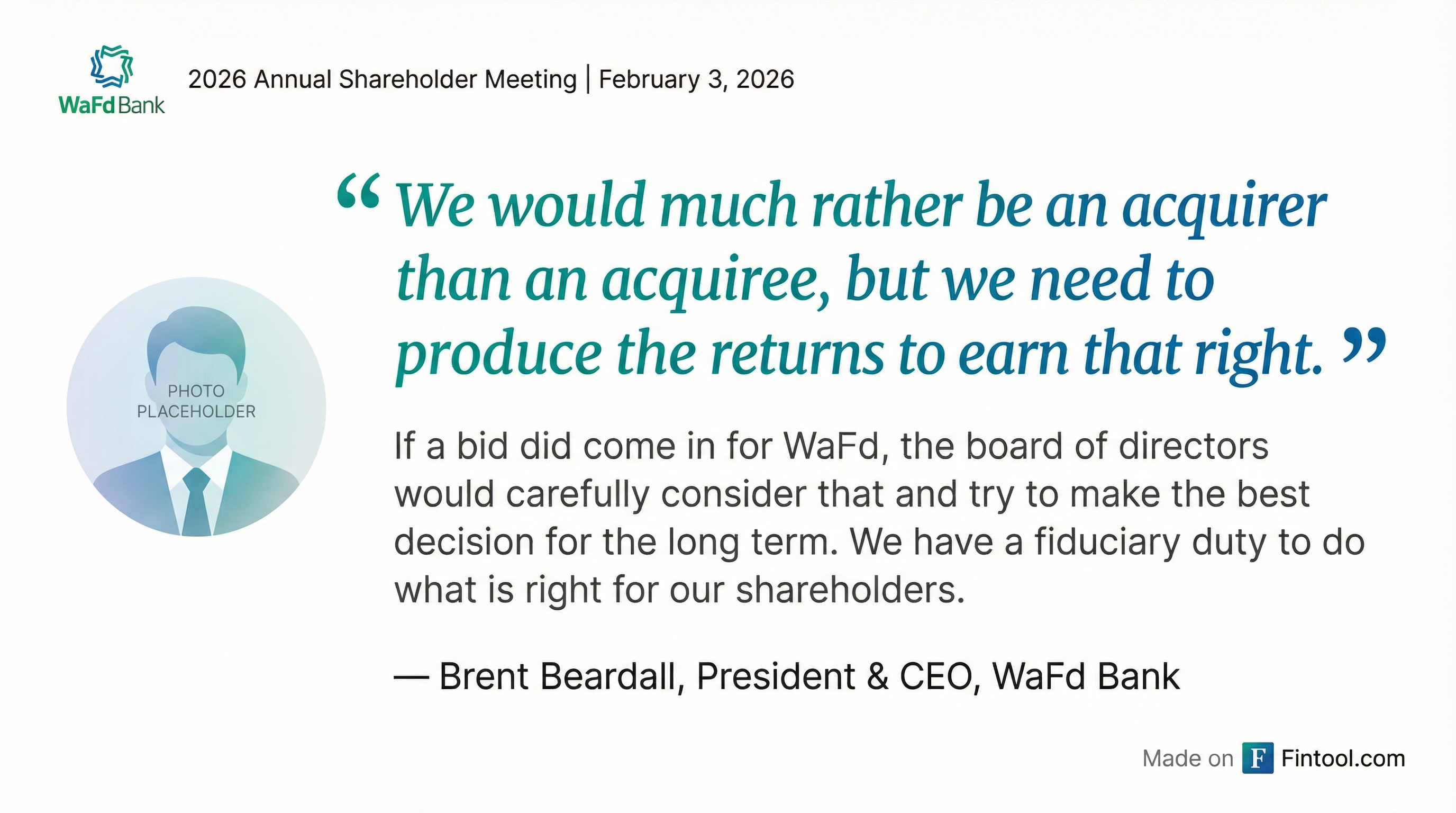
While emphasizing that management has "no intention in terms of going out and marketing WaFd," the CEO acknowledged that any incoming bid would receive serious consideration. "We have a fiduciary duty to do what is right for our shareholders," he noted, before adding the most investor-relevant line: "We would much rather be an acquirer than an acquiree, but we need to produce the returns to earn that right."
 Ask Fintool AI Agent
The CRA Hurdle
WaFd's M&A flexibility is currently constrained by a "Needs to Improve" Community Reinvestment Act rating—a regulatory designation that creates significant friction for both acquiring banks and being acquired. On the Q1 2026 earnings call, Beardall explained the practical impact: "It's also with regards to mergers and acquisitions, and we're not actively looking to do deals at all... but we like having the options, and having a need to improve doesn't preclude you from doing a merger and acquisition. It just makes it much more difficult."
The rating also affects routine branch operations. "With over 200 branches, you might imagine we have branches all the time that we need to move as leases expire," Beardall said, noting the bank faces "all kinds of hurdles" for even basic relocations.
Timing and Context: The Regional Bank M&A Wave
Beardall's comments land as the U.S. regional banking sector experiences its most significant consolidation wave since 2021. Regulatory approvals are moving at roughly double the pace of the Biden era, and deal activity has surged.
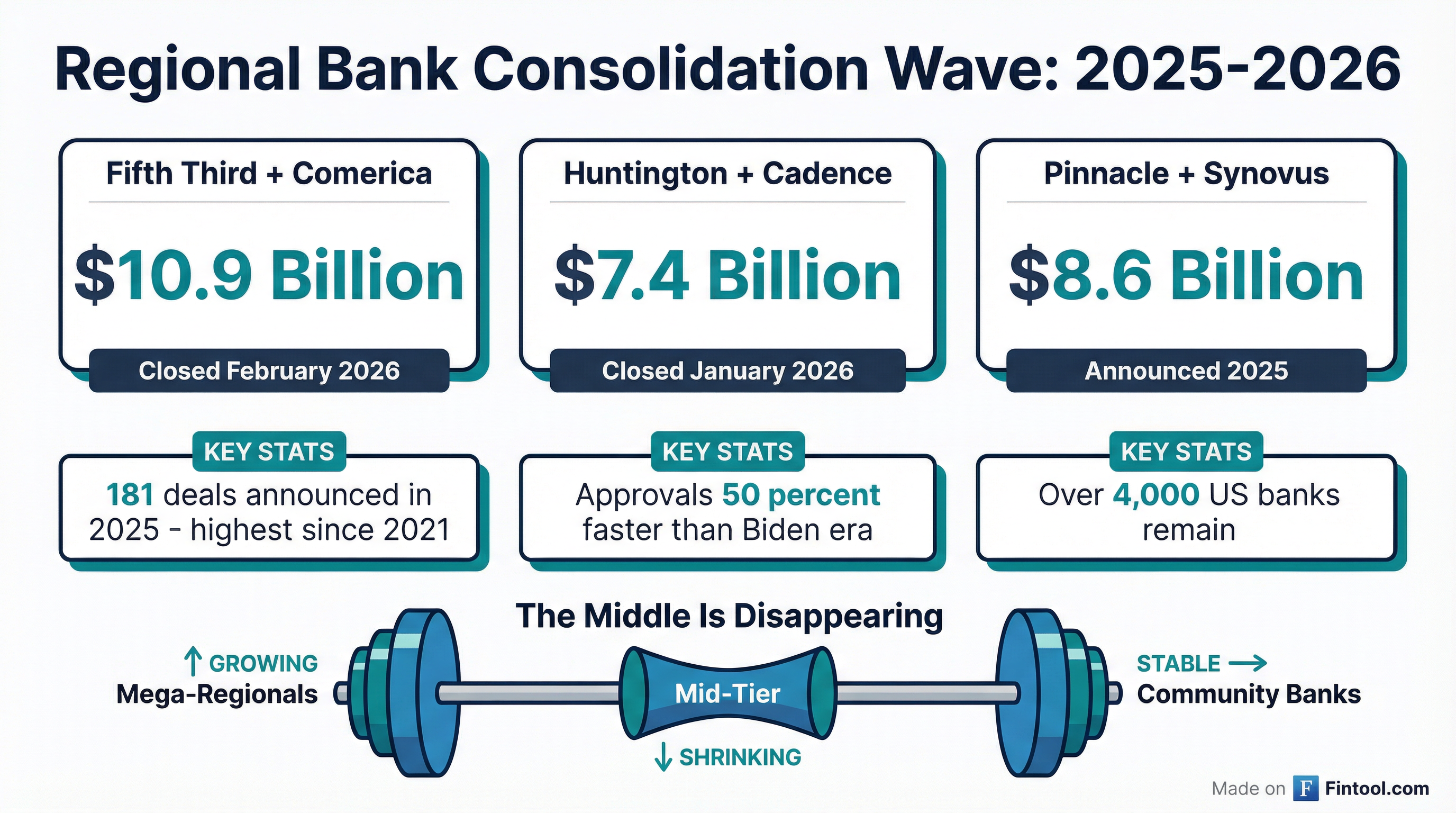
The industry recorded 181 bank M&A announcements in 2025—the highest since 2021—with several transformative regional combinations. Fifth Third Bancorp closed its $10.9 billion acquisition of Comerica in February 2026, while Huntington Bancshares completed its $7.4 billion purchase of Cadence Bank in January.
The consolidation is creating what analysts describe as a "barbell" structure—mega-regionals on one end, community banks on the other, with the traditional mid-tier shrinking. For WaFd at $27 billion in assets, the question is which side of that barbell it ends up on.
Ask Fintool AI AgentBUILD 2030: Earning the Right to Acquire
WaFd's internal focus remains its BUILD 2030 strategic transformation—a multi-year pivot from mortgage-focused lender to business bank. The initiative, launched in January 2025, aims to grow non-interest bearing deposits from 11% to 20% of total deposits by 2030.
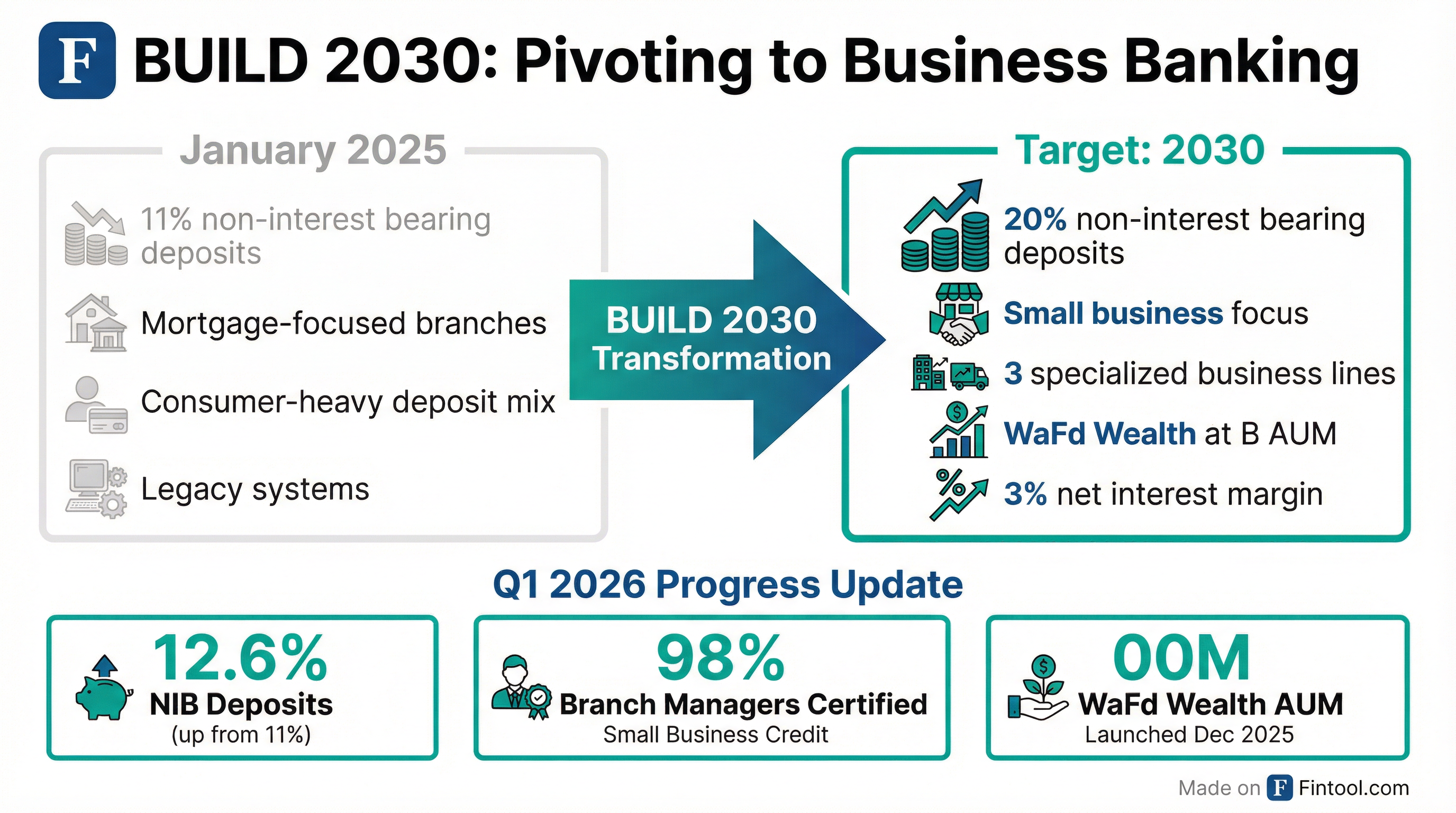
Progress is evident: WaFd became a preferred SBA lender, 98% of branch managers who formerly specialized in mortgage lending have passed the bank's small business credit certification, and non-interest bearing deposits have risen to 12.6%. The bank also launched WaFd Wealth Management in December 2025, already managing $400 million with ambitions to reach $1 billion within two years.
At the shareholder meeting, management emphasized the strategic rationale for physical branches in serving small businesses—a counterintuitive stance as many banks retreat from brick-and-mortar. "We really believe that physical locations in our communities is the way to best serve small business owners," said Corporate Secretary Kathy Cooper. "They all deserve to have a banker."
Competitive Landscape: Private Credit and Credit Unions
Beardall was notably direct about competitive pressures. When asked about private equity capital encroaching on WaFd's loan business, he acknowledged the threat but expressed confidence in the bank's durability advantage.
"Yes, it has. There is competition everywhere," Beardall said. "More than even private credit encroaching on WaFd Bank, credit unions are now pervasive, and it is an unlevel playing field with credit unions not having to pay the 22% that WaFd pays today in tax."
He noted skepticism about private credit's staying power through credit cycles: "We have not seen how they behave once a credit cycle happens, and will they be around for the long term, remains to be seen."
Shareholder Meeting Results
The annual meeting proceeded without controversy. All four directors standing for re-election received overwhelming support:
| Director | Votes For | Approval Rate |
|---|---|---|
| M. Max Yzaguirre | 57.8M | 98.2% |
| Stephen M. Graham | 56.7M | 96.5% |
| Bradley M. Shuster | 56.2M | 95.6% |
| Randall H. Talbot | 49.8M | 84.6% |
The say-on-pay vote passed with 96.1% approval, and Deloitte was reappointed as auditor with 97.9% support. David K. Grant retired from the board after 14 years, with Bradley Shuster stepping into the Audit Committee chair role.
Stock Performance and Outlook
WaFd shares closed at $34.03 on February 4, up 2.4% on the session and trading near their 52-week high. The stock has gained 15.6% over the past year, outperforming many regional bank peers as the BUILD 2030 transformation gains traction.
| Metric | Q2 2025 | Q3 2025 | Q4 2025 | Q1 2026 |
|---|---|---|---|---|
| Net Income ($M) | $56.3 | $62.0 | $60.6 | $64.2 |
| ROE (%) | 7.4% | 8.2% | 8.0% | 8.5% |
| Total Assets ($B) | $27.6 | $26.7 | $26.7 | $27.3 |
Values without citations retrieved from S&P Global.
Management targets 8-12% annual growth in active loan portfolios over the next one to two years, with a net interest margin goal of 3% by fiscal 2027.
Ask Fintool AI AgentWhat to Watch
For investors parsing Beardall's shareholder meeting comments, the M&A implications cut both ways. WaFd's preference to be a buyer signals management believes the stock remains undervalued relative to franchise potential. But the acknowledgment that any bid would receive board consideration—combined with the pro-consolidation regulatory environment and WaFd's improved financial trajectory—makes the bank a more credible target than it was a year ago.
The near-term catalysts: resolving the CRA rating to restore strategic flexibility, demonstrating continued BUILD 2030 execution, and watching whether the bank's improved returns attract either acquirer interest or provide currency for WaFd to join the consolidation wave as a buyer.
Related Companies: