Werner CEO Leathers at Citi: Regulatory Crackdown Could Remove 25% of Over-the-Road Capacity
February 17, 2026 · by Fintool Agent



Werner Enterprises CEO Derek Leathers delivered a bullish outlook at Citi's 2026 Global Industrial Tech and Mobility Conference in Miami today, arguing that federal regulatory enforcement is systematically removing unsafe and non-compliant capacity from the trucking market at a scale the industry hasn't seen before.
"All of the arrows are pointing in various degrees of up, but up and to the right," Leathers said, citing inventory replenishment needs, tax incentive timing, ISM inflecting positively, and potential rate cuts.
The timing matters: Werner is in the middle of bid season with shippers, and the regulatory tailwind is strengthening the carrier's hand at the negotiating table.
The Capacity Crackdown: 250,000 Trucks at Risk
Leathers laid out a comprehensive picture of federal enforcement actions that he believes are fundamentally reshaping the supply side of trucking:
Electronic Logging Devices (ELDs): One-third of the 1,000+ ELD providers in the U.S. have been shut down for failing to meet federal requirements. Leathers called the current self-certification process "absurd" and expects the enforcement to continue.
Driver Training Schools: The DOT has put approximately 7,000 of the nation's 17,000 CDL training schools on notice for immediate improvement or closure. Werner's own driving schools—20 facilities nationwide—passed audits with "perfect scores."
Non-Domiciled CDLs: Enforcement against fraudulently obtained commercial driver's licenses continues to tighten, particularly targeting operators who weren't domiciled where they obtained credentials.
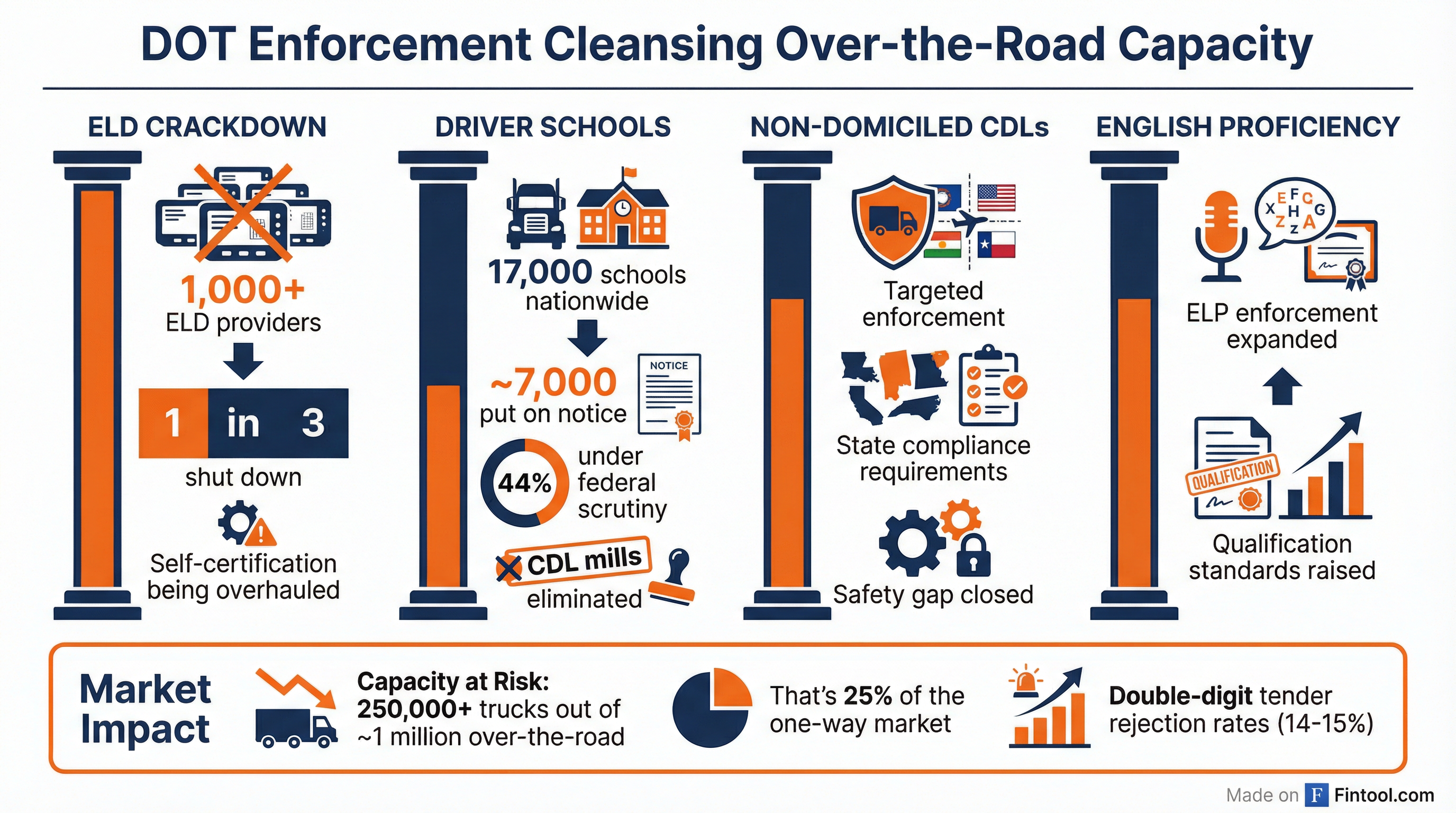
The bottom line: "250,000 or greater" trucks could be affected out of approximately 1 million in the over-the-road segment—that's 25% of the addressable market.
"When you think about 14.5% rejection rates, 14.75, I think for a couple of days... that still puts you at double-digit rejections," Leathers noted. "It still puts spot rates at sort of elevated outside of seasonality levels."
 Ask Fintool AI Agent
FirstFleet Deal: 70% of Fleet Now in Dedicated
Three weeks after closing the $245 million acquisition of FirstFleet, Werner is integrating a dedicated trucking operation that CEO Leathers called "the ideal moment for our company."
The deal transforms Werner's portfolio:
| Metric | Pre-Acquisition | Post-FirstFleet |
|---|---|---|
| Dedicated Trucks | 5,000 | 7,365 |
| Fleet in Dedicated | 50% | 70% |
| Dedicated Revenue Growth | — | +50% |
| U.S. Dedicated Ranking | — | 5th Largest |
FirstFleet brings $615 million in annual revenue with consistent operating margins, and management expects $18 million in annual synergies within 18 months.
"Over the last several out years, dedicated outperforms one-way 8 out of 10 years," Leathers said, defending the strategic pivot away from commoditized trucking. "There's no reason to think that won't be true going forward."
The acquisition also brings operational density—37 properties near 130 customer sites—that helps Werner retain dedicated drivers even when yielding out underperforming fleets.
2026 Guidance: Conservative or Realistic?
Werner's first-half guidance raised some eyebrows at the conference given the bullish market backdrop:
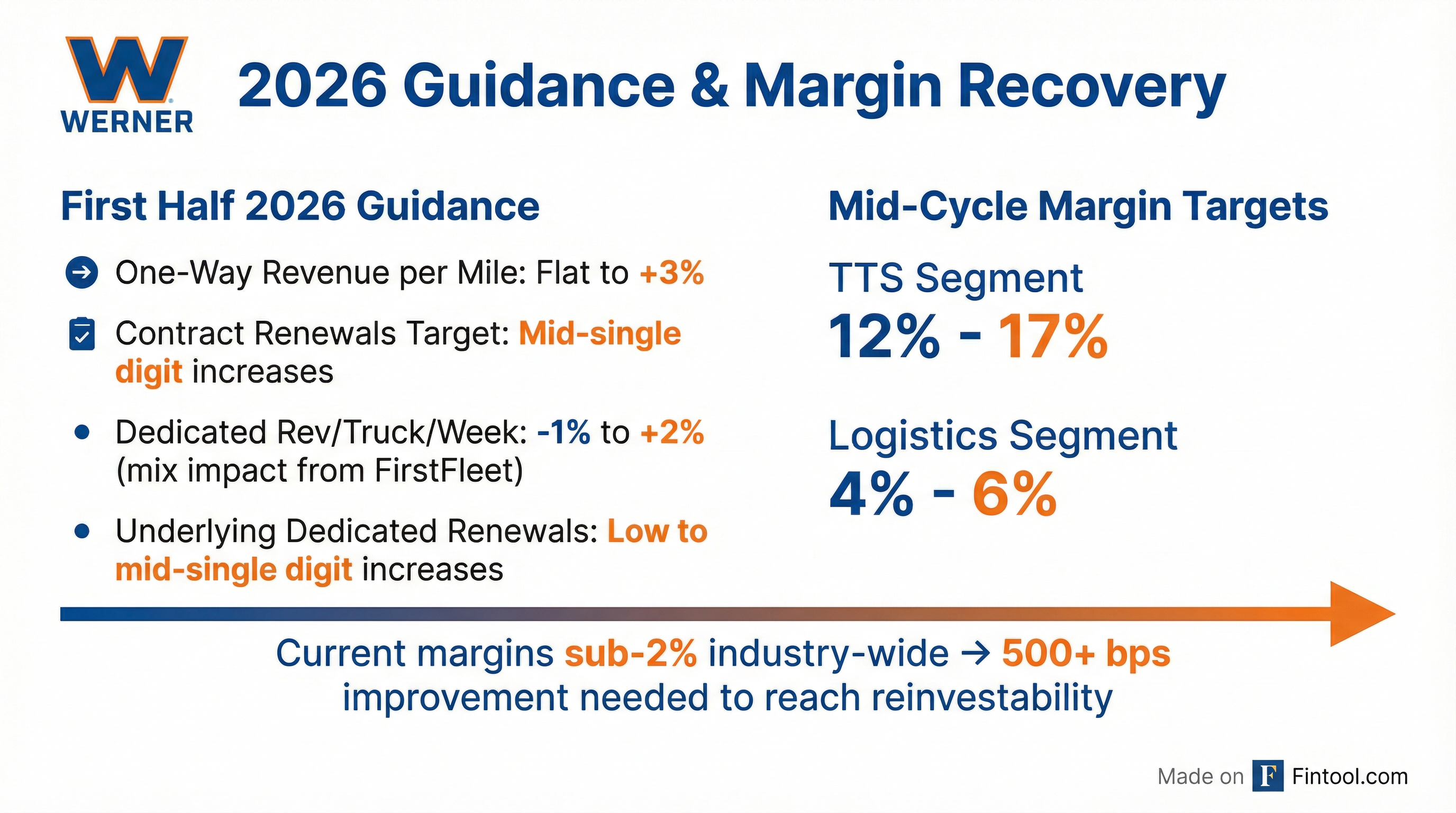
One-Way Truckload: Revenue per total mile flat to +3% for first-half 2026, with contract renewals expected at mid-single-digit increases.
Dedicated: Revenue per truck per week down 1% to up 2%—but management emphasized this is almost entirely a mix issue from integrating FirstFleet's different network structure, not underlying pricing weakness. Organic contract renewals are tracking low-to-mid single digits.
SVP Chris Neal explained the timing lag: "Here we are, halfway through the first quarter, there's very little new business that has an updated price on it... Most of the effective dates when these things actually go into place are second half of the first quarter into the second quarters."
The second half is where Werner expects "more of the inflection" as contract renewals take effect.
Ask Fintool AI AgentWill Inflation Politics Derail Enforcement?
When asked whether the Trump administration might quietly back off enforcement if trucking rate increases flow through to consumer prices, Leathers pointed to tariff policy as a guide:
"If you're willing to go out with 25%, 35%, 45%, 55% tariffs, which is a much more direct impact to cost of goods, potentially... and yet they stayed the course 'cause they believed it was the right thing to do."
He framed trucking's cost impact as manageable in comparison: transportation is roughly 4% of total supply chain costs, with over-the-road trucking representing about 2.5%. A 10% increase on that 2.5% is "a heck of a lot easier pill to swallow in the interest of safety" than tariff impacts.
The AI Disruption "Overreaction"
Leathers offered blunt criticism of last week's market reaction to Seven Cab's autonomous trucking announcement, calling it "the largest, most frustrating overreaction I think I've seen in my 37 years in the business."
"The absolute omission by the investor community to the reality that so is everybody else. There's nothing in the white paper, nothing in the announcement that everybody else isn't investing in, doing, pursuing."
Werner has invested heavily in its Edge TMS system and AI applications across logistics, dedicated, and one-way operations, with the technology transformation now in its "latter innings."
Market Context: Stock Up 30% Since November
Werner shares have rallied approximately 30% since early November, outpacing the broader trucking sector as investors price in the regulatory tailwinds and capacity cleansing. The stock closed at $33.42 on February 17, 2026.
| Trucking Peer | Current Price | Market Cap |
|---|---|---|
| Xpo | $198.63 | $23.3B |
| Schneider National | $28.96 | $5.1B |
| J.B. Hunt | — | — |
| Werner Enterprises | $33.42 | $2.0B |
What to Watch
Near-term catalysts:
- Q1 2026 earnings (May) for first read on contract renewal pricing
- Additional DOT ELD revocation announcements
- FirstFleet integration synergy realization ($18M target)
Mid-cycle targets:
- TTS segment: 12%-17% operating margins
- Logistics segment: 4%-6% operating margins
- Management noted the industry needs "500 basis point type moves" to reach reinvestable returns
Leathers concluded with characteristic directness: "All I want is a level playing field, and let our team do its job."
Ask Fintool AI AgentRelated Research