Airbus Slams Pratt & Whitney as Engine Shortage Forces Production Slowdown
February 19, 2026 · by Fintool Agent


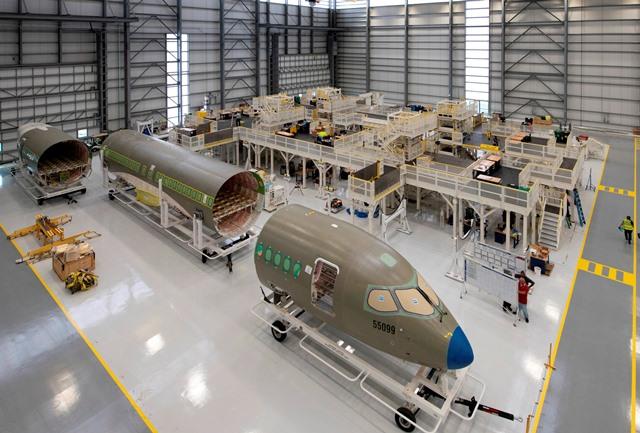
Airbus shares fell as much as 8% Thursday after the world's largest planemaker delivered a disappointing 2026 delivery outlook of just 870 aircraft—well below the 896 analysts expected—and publicly blamed engine supplier Pratt & Whitney for "significant shortages" that are constraining its production ramp-up.
The unusually direct criticism of a major supplier marks a dramatic escalation in the long-simmering tensions between Airbus and RTX Corporation's engine subsidiary. It also comes at a pivotal moment for the aerospace duopoly, with Boeing showing clear signs of recovery under CEO Kelly Ortberg and competitive dynamics shifting for the first time in years.
"Pratt & Whitney's failure to commit to the number of engines ordered by Airbus is negatively impacting this year's guidance and the ramp-up trajectory," Airbus said in a statement accompanying its full-year results.
Record Profits, Disappointing Guidance
The guidance miss overshadowed what was otherwise a strong year. Airbus posted fourth-quarter adjusted operating profit of €2.98 billion, up 17% and ahead of analyst expectations of €2.87 billion. Full-year adjusted EBIT rose 33% to €7.13 billion on revenue of €73.4 billion, up 6%.
The board proposed raising the dividend 78% to €3.20 per share, reflecting confidence in the business despite the near-term headwinds.
But investors focused on what lies ahead:
| Metric | 2026 Guidance | Consensus | 2025 Actual |
|---|---|---|---|
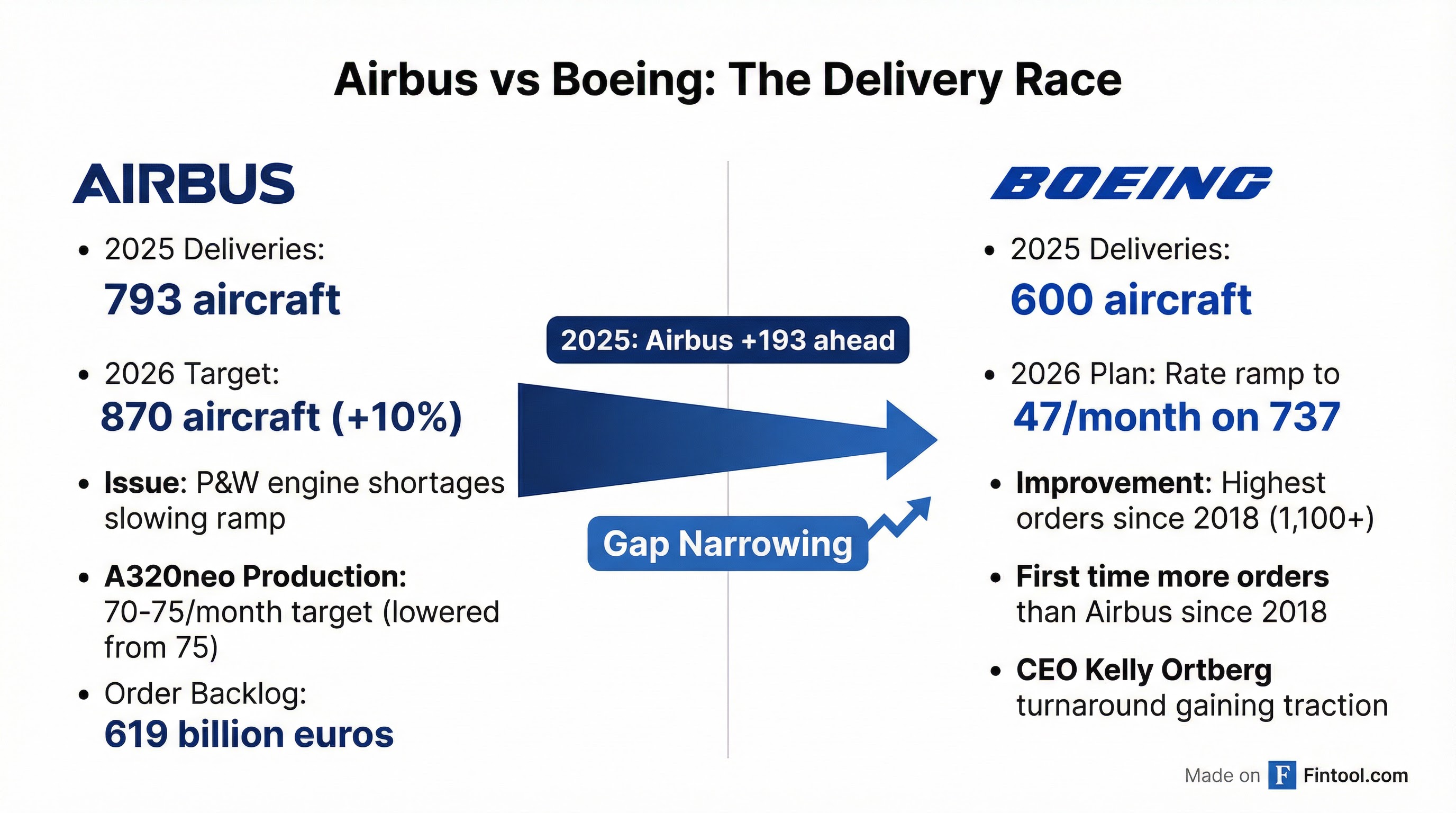
| Deliveries | 870 | 896 | 793 |
| Adjusted EBIT | €7.5B | €8.3B | €7.13B |
| Free Cash Flow | €4.5B | Higher | €4.75B |
The A320neo family—Airbus's cash cow accounting for nearly 80% of deliveries—is at the center of the supply crunch. Airbus now targets a monthly narrowbody production rate of 70-75 jets by end-2027, down from its previous goal of 75 per month. Pratt & Whitney engines power approximately 40% of A320neo aircraft.
CEO Guillaume Faury called the Pratt & Whitney shortage "the single most important topic we are dealing with."
 Ask Fintool AI Agent
RTX: Caught Between Fleet Support and New Production
The dispute highlights a fundamental tension in the engine business. RTX's Pratt & Whitney division must balance three competing demands: new engine deliveries for Airbus, spare engines for airlines, and maintenance work on the existing fleet of GTF-powered aircraft.
On RTX's January earnings call, CEO Chris Calio addressed analyst questions about the "conservative" production outlook: "We've talked at length for a number of years about the mix in the OE and balancing the need to support the flying fleet today as well as installs and Airbus."
Management emphasized that 2025 engine deliveries were "up over 50% versus 2019 levels" and projected mid-to-high single digit growth for 2026. Calio noted capacity investments coming online over the next 24 months, including "a new powder metal tower, new forging press, some additional capacity in Asheville where we do turbine airfoils."
RTX declined to comment on Airbus's public criticism.
Boeing: A Turnaround Taking Shape
The timing of Airbus's stumble couldn't be worse from a competitive standpoint. Boeing delivered 600 aircraft in 2025—its highest since 2018—and won more than 1,100 orders, the first time it has out-ordered Airbus since that year.
"In 2025, we methodically increased commercial production guided by our safety and quality plan," CEO Kelly Ortberg said on Boeing's January earnings call. "On 737, production is stabilizing at 42 airplanes per month, and we're continuing to see improvement in the program."
Boeing's supply chain appears more stable. Ortberg told analysts: "I actually don't think supply chain is going to be a big challenge for us in the next rate ramp from 42 to 47."
| Metric | Boeing 2025 | Airbus 2025 | Airbus Lead |
|---|---|---|---|
| Deliveries | 600 | 793 | +193 |
| Net Orders | 1,100+ | 920 | Boeing leads |
| January 2026 Deliveries | 46 | 19 | Boeing +27 |
Airbus's weak January—just 19 deliveries versus Boeing's 46—raised eyebrows even before Thursday's results. Management attributed the soft start primarily to the fuselage panel issues from a Spanish supplier discovered in late 2025, not engine delays.
Ask Fintool AI AgentThe Engine Duopoly Problem
Airbus faces limited options. The A320neo can be powered by either Pratt & Whitney's PW1100G-JM or CFM International's LEAP-1A engine. But CFM—the joint venture between Ge Aerospace and Safran—has signaled it won't step into the breach.
Last week, Safran indicated it was "not ready to wade into the worsening dispute" and said its priority was meeting existing supply commitments. CFM had its own tensions with Airbus just over a year ago regarding delivery delays.
The GTF engine family now powers more than 2,600 aircraft for over 90 operators across three platforms: the Airbus A320neo family, Airbus A220, and Embraer E-Jets E2.
In 2025, Pratt & Whitney expanded its GTF aftermarket network to 21 facilities worldwide, increasing shop visit output by approximately 26% year-over-year—evidence of the maintenance burden on the existing fleet.
Financial Comparison: RTX vs Boeing
| Metric | RTX FY 2025 | Boeing FY 2025 |
|---|---|---|
| Revenue | $88.6B | $89.5B |
| Operating Income | $10.4B | -$5.2B |
| Net Income | $6.7B | $2.2B |
| EBITDA Margin | 16.6% | Negative |
RTX has been a strong performer, with revenue growing from $68.9B in 2023 to $88.6B in 2025. The Pratt & Whitney segment benefits from both OE deliveries and a growing aftermarket as the GTF fleet expands.
Boeing, meanwhile, is still recovering from years of crisis. The company returned to profitability in 2025 after a $11.8B loss in 2024, though operating income remains negative as it works through legacy program charges.
Ask Fintool AI AgentWhat to Watch
Near-term catalysts:
- Whether Airbus and Pratt & Whitney can reach a supply agreement—typically set 18 months in advance
- Boeing's rate review with the FAA for the 42-to-47 production increase
- Airbus investor meeting and shareholder vote on Netflix deal (unrelated)
Longer-term implications:
- If engine constraints persist, Boeing could continue narrowing the delivery gap
- Airlines waiting for A320neo deliveries may accelerate 737 MAX orders
- Pratt & Whitney's capacity investments won't fully ramp until 2027-2028
The aerospace supply chain—barely recovered from pandemic disruptions—faces another test. Airbus's decision to go public with its frustrations suggests negotiations have reached an impasse. For investors, the question is whether this is a temporary bottleneck or a structural constraint on Airbus's growth trajectory.
Related: