Aktis Oncology Raises $318M in 2026's First Biotech IPO, Lilly Takes $100M Stake
January 8, 2026 · by Fintool Agent


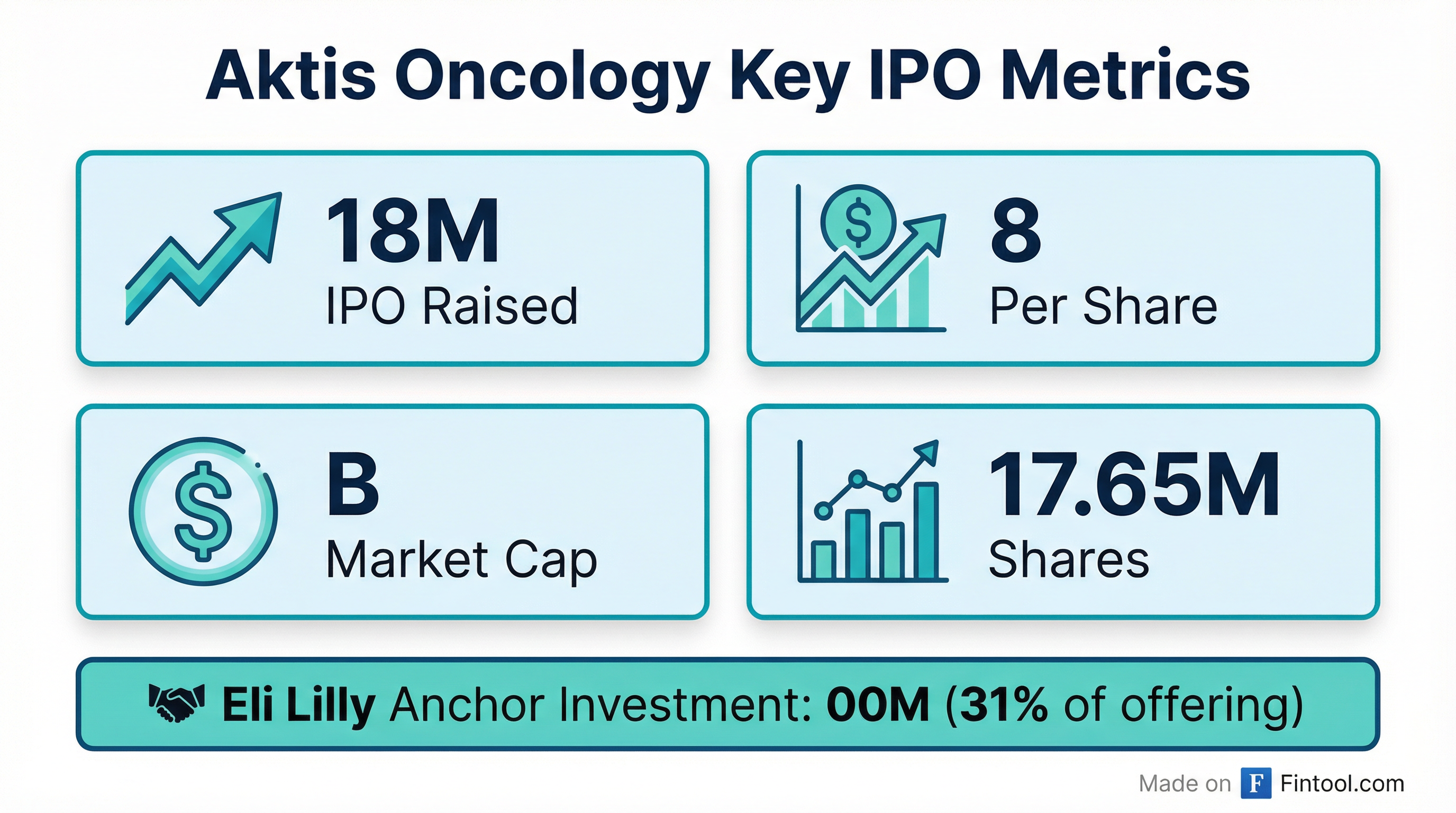
Radiopharmaceutical developer Aktis Oncology-3.01% priced the biotech sector's first IPO of 2026 on Thursday, raising $318 million after upsizing the deal and pricing at the top of its range. The offering was anchored by a $100 million commitment from existing partner Eli Lilly+3.66%, which purchased roughly one-third of the shares.
Aktis sold 17.65 million shares at $18 each—above the initially planned 11.8 million shares at a $16-$18 range—valuing the Boston-based company at approximately $1 billion at pricing. Shares will begin trading Friday on the Nasdaq under ticker AKTS.
The successful offering marks the third-largest biotech IPO since the start of 2024 and signals a potential reopening of the capital markets window after a drought that saw fewer than a dozen biotech firms price IPOs in 2025.
Lilly's $100M Vote of Confidence
Eli Lilly+3.66%'s decision to anchor the IPO with $100 million underscores the pharma giant's conviction in the radiopharmaceutical space. The investment builds on a strategic collaboration announced in May 2024, when Lilly paid Aktis $60 million upfront plus an equity stake for access to Aktis's miniprotein platform to discover novel cancer radiopharmaceuticals. That deal included up to $1.1 billion in potential milestones and royalties.
Lilly has been aggressively building its radiopharmaceutical capabilities following its $1.4 billion acquisition of Point Biopharma in December 2023, which brought manufacturing infrastructure, a Toronto R&D center, and clinical-stage PSMA-targeted therapies. On the Q4 2023 earnings call, Lilly management described the Point deal as "Lilly's entry into radioligand therapy, a promising technology with potential to deliver meaningful advances against a range of cancers."
 Ask Fintool AI Agent
The Radiopharmaceutical Opportunity
Aktis is developing a novel class of alpha-emitting radiopharmaceuticals—targeted drugs that deliver highly localized radiation directly to tumors. Unlike beta-emitters like lutetium-177 (used in marketed drugs like Novartis's Pluvicto), alpha particles deposit energy over just a few cell diameters, creating dense DNA double-strand breaks that are far more difficult for cancer cells to repair.
The radiopharmaceutical market was valued at $6.2 billion in 2024 and is projected to reach $19.6 billion by 2034, growing at a 12.7% CAGR—making it one of the fastest-growing segments in oncology.
Aktis's Miniprotein Platform
What distinguishes Aktis is its proprietary miniprotein radioconjugate platform. Traditional radiopharmaceuticals use antibodies or small molecules to target tumors, but miniproteins offer a middle ground: they're small enough for rapid tumor penetration yet stable enough to deliver therapeutic payloads precisely where needed.
The platform enables:
- High tumor uptake with limited exposure to healthy tissue
- Rapid clearance from non-target areas
- Theranostic pairing of imaging and therapeutic agents (same targeting molecule, different isotope)
Clinical Pipeline: Two Lead Programs
AKY-1189: Targeting Nectin-4
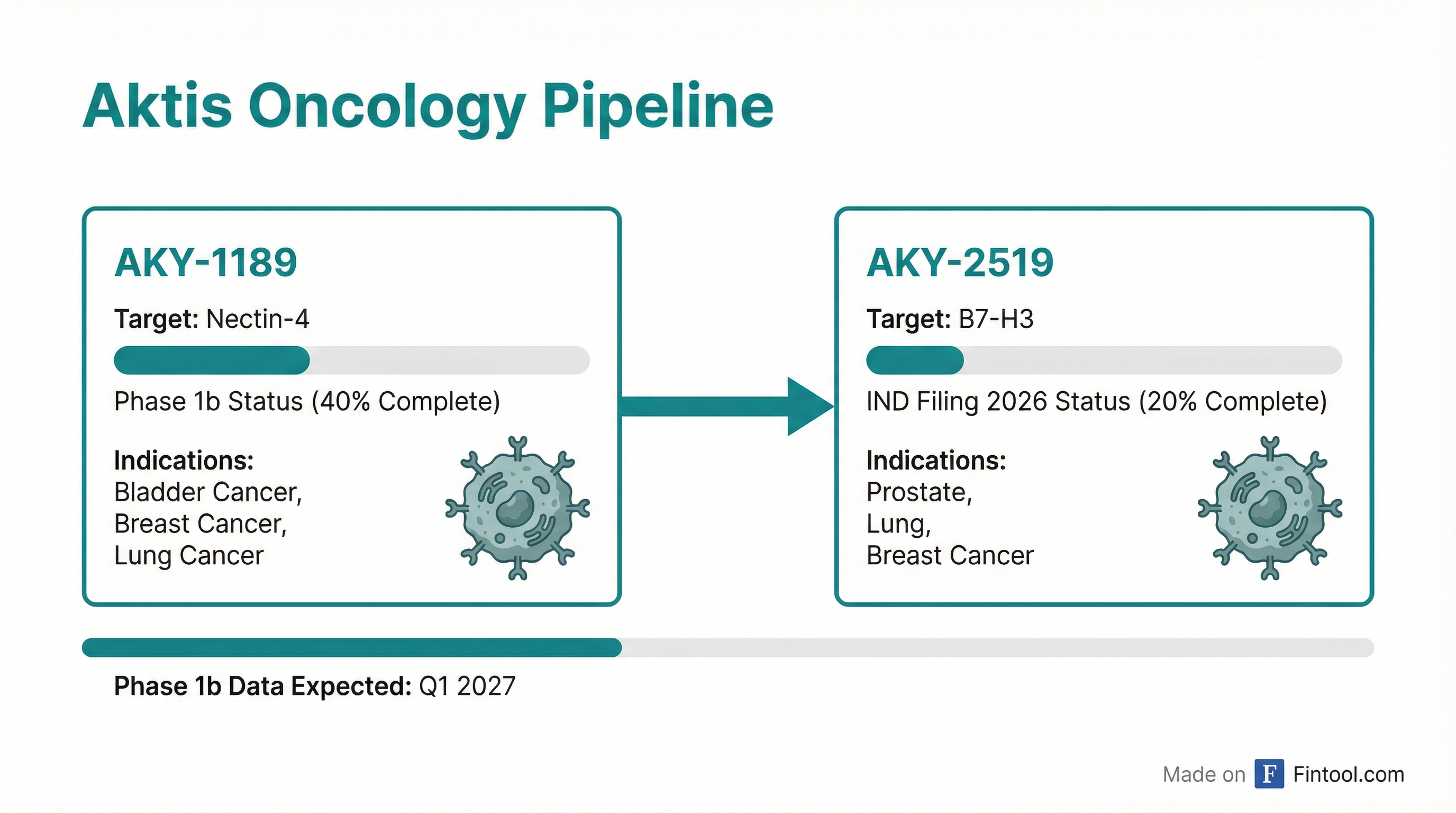
Aktis's most advanced candidate, [225Ac]Ac-AKY-1189, targets Nectin-4—the same protein targeted by Pfizer+2.76%/Astellas's Padcev (enfortumab vedotin), which generated approximately $1.9 billion in 2024 sales.
The Phase 1b NECTINIUM-2 trial (NCT07020117) is currently enrolling approximately 150 patients with locally advanced or metastatic solid tumors including:
- Urothelial (bladder) cancer
- Triple-negative breast cancer (TNBC)
- Non-small cell lung cancer
- Colorectal, cervical, and head/neck cancers
Preliminary results are expected in Q1 2027.
Preclinical data presented at the 2024 EORTC-NCI-AACR Symposium demonstrated substantial tumor uptake across multiple Nectin-4-expressing tumor types with limited exposure to normal tissue—a critical differentiator from existing therapies.
AKY-2519: Targeting B7-H3
The second pipeline candidate targets B7-H3, a protein associated with aggressive tumors that respond poorly to checkpoint inhibitors like anti-PD-1 therapies. An IND filing is planned for 2026.
Ask Fintool AI AgentUse of Proceeds
Aktis disclosed the following planned use of IPO proceeds:
| Purpose | Amount |
|---|---|
| Phase 1b trial of AKY-1189 (Nectin-4) | $140-150M |
| Development of AKY-2519 (B7-H3) | $70-80M |
| General corporate & working capital | Remainder |
The company enters public markets with a cash runway expected to extend into 2028, providing adequate capital to reach key data milestones.
Competitive Landscape
Big Pharma has been racing to build radiopharmaceutical capabilities:
| Company | Key Moves |
|---|---|
| Novartis | Markets Pluvicto (prostate) and Lutathera (NET); acquired Mariana Oncology ($1B, May 2024) |
| Eli Lilly | Acquired Point Biopharma ($1.4B, 2023); partnered with Aktis ($60M upfront, $1.1B milestones) |
| Bristol Myers Squibb | Acquired RayzeBio ($4.1B, late 2023) |
| AstraZeneca | Acquired Fusion Pharmaceuticals ($2B, March 2024) |
The surge of M&A activity reflects conviction that targeted radiopharmaceuticals represent the next major frontier in precision oncology.
Investment Considerations
Bull Case
- First-mover in alpha-emitting miniprotein radiopharmaceuticals with differentiated technology platform
- Lilly validation via partnership and IPO anchor investment signals Big Pharma interest
- Large addressable market: Nectin-4 expressed across multiple high-incidence tumor types
- Experienced backers: Prior investors include Bristol Myers Squibb, Novartis, and Merck & Co.
- Strong cash position with runway to Q1 2027 data readout
Bear Case
- Early-stage risk: Lead asset in Phase 1b with no efficacy data yet
- Competitive pressure: Well-funded competitors including Lilly itself developing Nectin-4 ADCs
- Isotope supply challenges: Actinium-225 production remains constrained
- Regulatory uncertainty: Alpha-emitters require novel dosimetry and safety monitoring frameworks
Ask Fintool AI AgentWhat to Watch
- Q1 2027: Preliminary Phase 1b data for AKY-1189 (dose-escalation portion)
- 2026: IND filing for AKY-2519 (B7-H3 program)
- Ongoing: Progress on Lilly collaboration targets (undisclosed)
- Trading debut: AKTS begins trading Friday, January 9 on Nasdaq
The biotech IPO window has been largely closed since mid-2024. Aktis's successful upsized offering—and Lilly's willingness to anchor with $100 million—may signal improving sentiment toward clinical-stage oncology companies with differentiated platforms and Big Pharma partnerships.