Aldi's $9 Billion Blitz: 180 New Stores Put Kroger's #2 Ranking at Risk
January 12, 2026 · by Fintool Agent


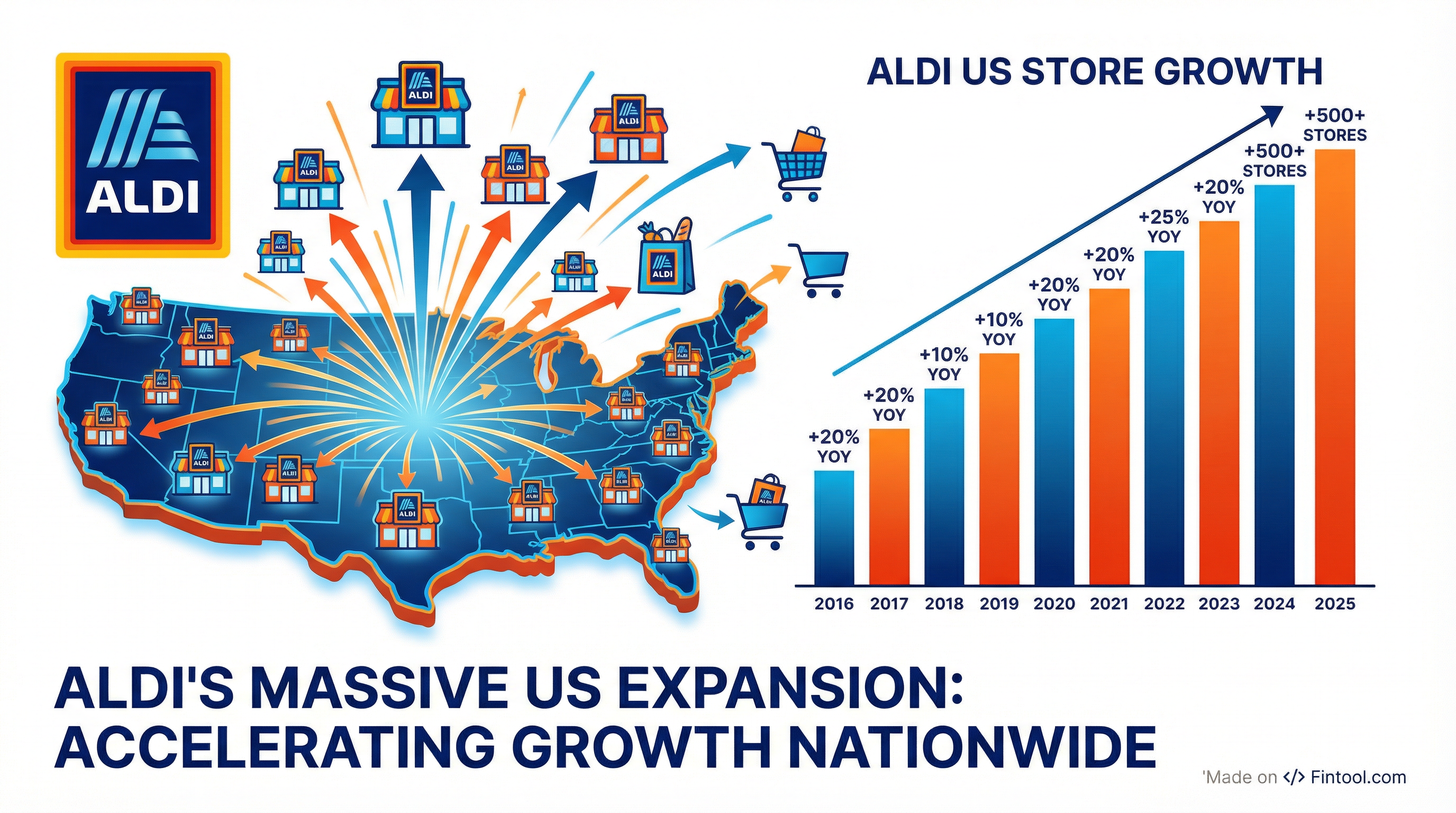
The German discounter announced plans Monday to open more than 180 US stores in 2026—marking its 50th year in America with the most aggressive expansion in company history. The move positions Aldi to potentially overtake Kroger for the #2 grocer spot by store count, intensifying the price war in an industry where incumbents are already scrambling to defend market share.
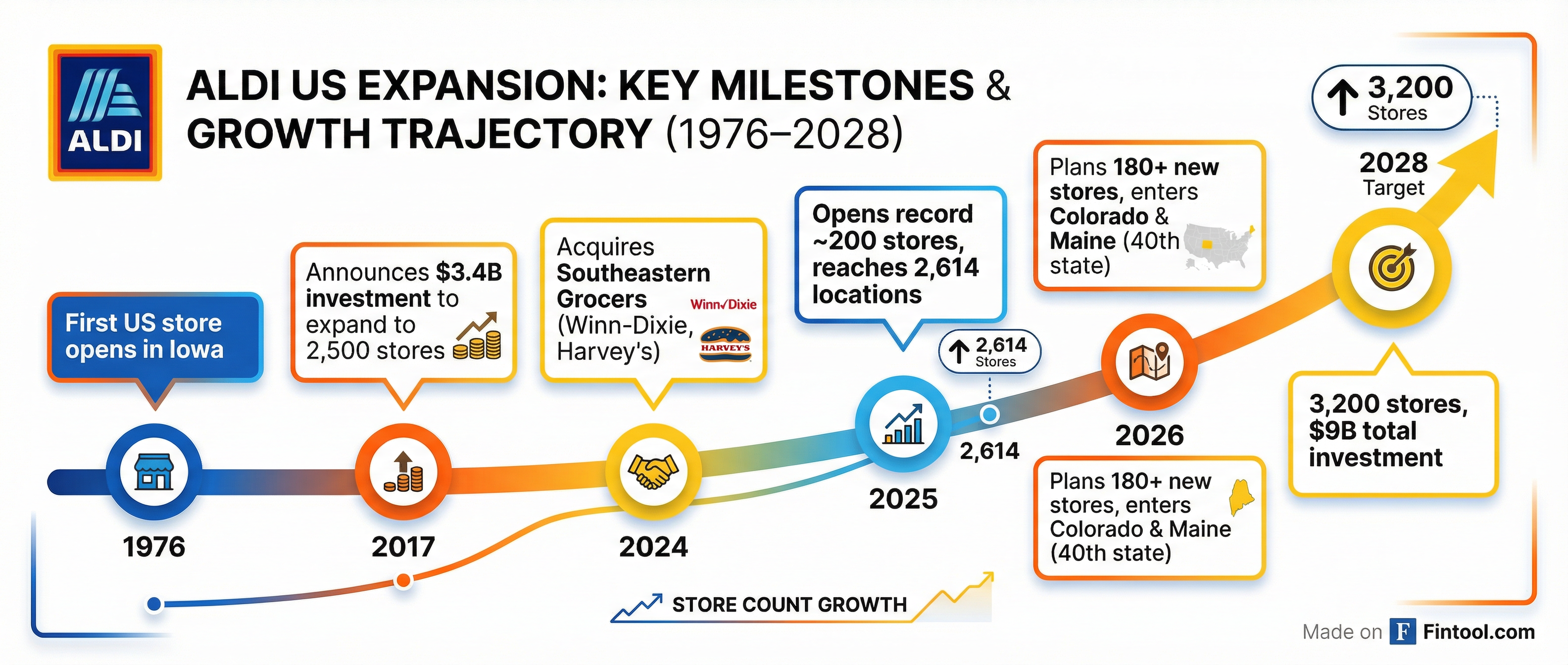
Aldi will reach nearly 2,800 US locations by year-end, with its sights set on 3,200 stores by 2028 as part of a $9 billion investment in stores, distribution, and digital infrastructure.
"In 2026, we're focused on making it even easier for customers to shop our aisles first," Aldi US CEO Atty McGrath said in a statement.
 Ask Fintool AI Agent
The Numbers: A Direct Threat to Kroger
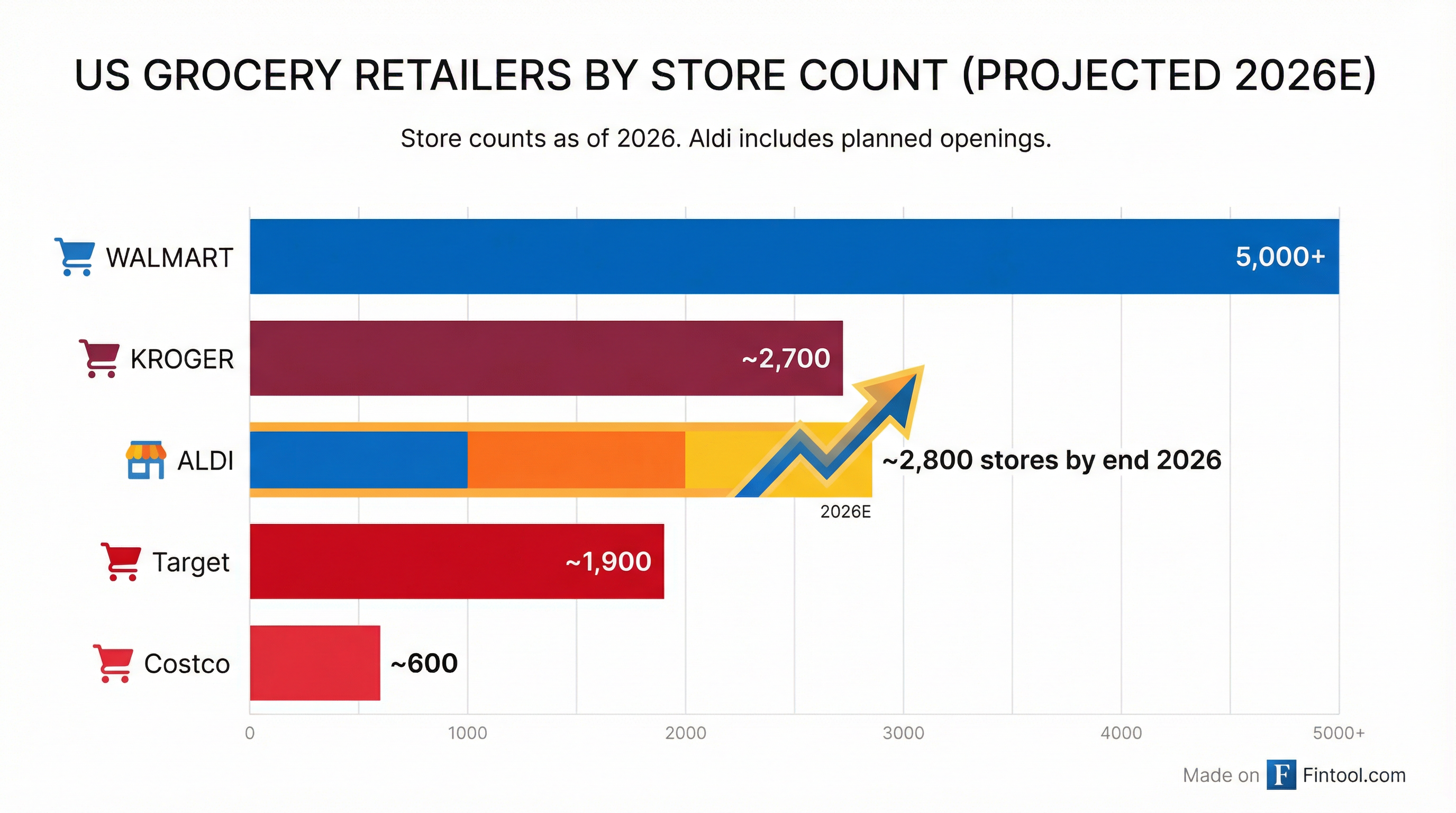
The math is stark. With 180+ openings planned this year, Aldi's trajectory puts it on a collision course with Kroger, which operates approximately 2,700 stores but is closing 60 locations as part of a restructuring announced last year.
| Metric | Aldi (2026E) | Kroger | Walmart |
|---|---|---|---|
| US Store Count | 2,800 | 2,700 | 5,000+ |
| 2026 Store Openings | 180+ | Net closures | 150 |
| 2028 Target | 3,200 | Not disclosed | N/A |
The expansion comes as traditional grocers acknowledge an "undeniably very competitive environment," as Kroger CFO David Kennerley put it on the company's most recent earnings call.
Kroger has responded by lowering prices on more than 3,500 products since the beginning of the year and plans to increase new store openings by 30% in 2026. But the company's strategy is primarily defensive—simplifying promotions and cutting costs—rather than matching Aldi's footprint expansion.
Where Aldi Is Headed
The 2026 expansion spans 31 states with particular focus on underserved western and southern markets:
Colorado (New Market): Aldi will enter the state for the first time with 50 stores planned over five years, starting in Denver and Colorado Springs. A new Aurora distribution center will open in 2029 to support the region.
Maine (New Market): Portland will become Aldi's 40th state in 2026.
Phoenix: Ten new stores in 2026, with 40 total planned by 2030.
Las Vegas: Doubling store count from four (opened 2025) by 2030.
Southeast: Converting approximately 80 Southeastern Grocers locations to the Aldi format this year, following the 2024 acquisition that added Winn-Dixie and Harvey's banners. Nearly 90 conversions have been completed, with 200+ planned by end of 2027.
 Ask Fintool AI Agent
Supply Chain Build-Out
Aldi isn't just adding stores—it's expanding distribution capacity by 20% to keep shelves stocked. Three new distribution centers are planned:
| Location | Expected Opening | Purpose |
|---|---|---|
| Baldwin, Florida | 2027 | Southeast support |
| Goodyear, Arizona | 2028 | Southwest expansion |
| Aurora, Colorado | 2029 | New Colorado market |
The Haines City, Florida distribution center will also add perishable food capabilities to support the Southeast.
The Private-Label Advantage
Aldi's secret weapon isn't just low prices—it's the margin structure that enables them. The company generates roughly 90% of sales from private-label products, compared to 25-30% at traditional grocers. This allows Aldi to price products 30-40% below national brands while maintaining profitability.
New CEO Atty McGrath, who took over from Jason Hart in September, promptly oversaw a refresh of Aldi's private-label portfolio, consolidating 90 brands down to 26 for a cleaner shopping experience.
Impact on Public Grocers
The Aldi expansion creates different pressure points for each public competitor:
Kroger ($40.5B market cap): Most directly threatened. Kroger generated $147.1B in FY 2025 revenue but faces margin pressure from discount competition. Management acknowledges the "very, very competitive" environment and is investing in sourcing improvements and operational efficiency to fund price cuts.
Walmart ($941B market cap): Less exposed due to scale advantages and diversified revenue. Walmart's grocery business benefits from traffic driven by general merchandise, and its 5,000+ store base provides unmatched distribution density.
Target ($48.2B market cap): Grocery represents roughly 20% of Target's sales. The company has been dealing with its own challenges around shrink and discretionary spending softness.
Costco ($419B market cap): Differentiated through membership model and bulk-buying format. Costco's customer base skews higher-income and is less price-sensitive to discount grocer competition.
| Company | Stock Price | YTD Change | Market Cap |
|---|---|---|---|
| Walmart (WMT) | $118.02 | +3.0% (today) | $941B |
| Kroger (KR) | $61.07 | +2.6% (today) | $40.5B |
| Costco (COST) | $943.11 | +2.0% (today) | $419B |
| Target (TGT) | $106.16 | +0.6% (today) | $48.2B |
Ask Fintool AI AgentWhat to Watch
Q1 2026: Watch for any competitive response from Kroger or regional grocers in newly contested markets. Colorado incumbents King Soopers (Kroger-owned) and Safeway (Albertsons) face the most immediate threat.
Website Relaunch: Aldi's redesigned digital experience launches early 2026 with personalized product recommendations, shoppable recipes, and meal planning tools.
Conversion Progress: The pace of Southeastern Grocers store conversions will indicate how effectively Aldi can integrate acquisitions and extend its low-cost model to new formats.
Consumer Spending: Aldi's expansion thesis depends on sustained consumer demand for value. Any improvement in consumer sentiment could slow the trade-down that's driven discount grocer growth.