Amazon Plans 229,000 Sq Ft Big-Box Store—Larger Than Walmart Supercenters
January 9, 2026 · by Fintool Agent


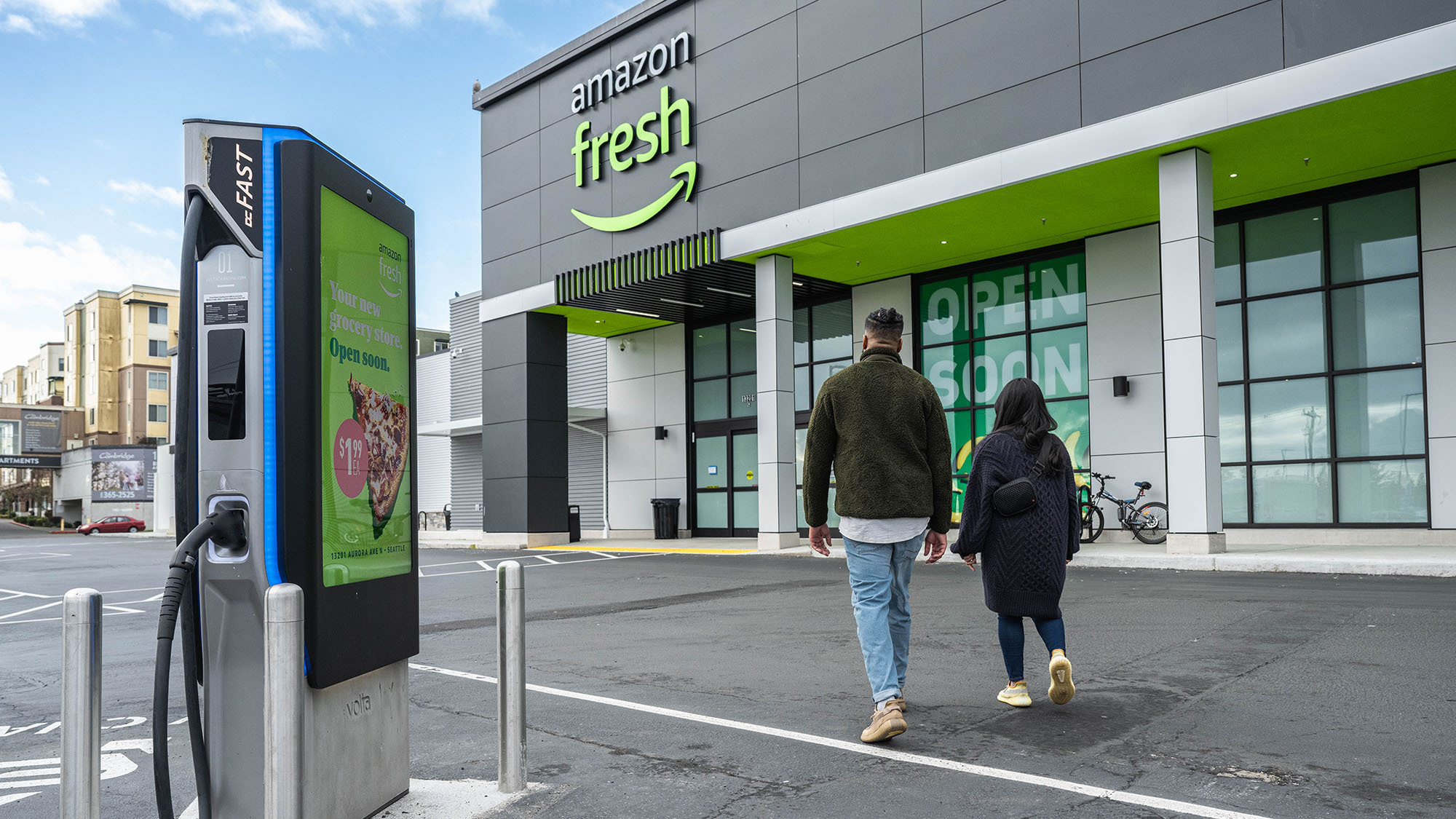
Amazon is planning its most aggressive move yet into physical retail: a 229,000-square-foot big-box store in Orland Park, Illinois, that would be 27% larger than a typical Walmart Supercenter and represent a direct assault on the brick-and-mortar retail format that Walmart and Target have dominated for decades.
The proposal, which cleared Orland Park's Plan Commission on January 6, signals a strategic pivot for the e-commerce giant that has struggled to crack the code on physical retail despite years of experimentation with Whole Foods, Amazon Fresh, and Amazon Go stores.
"When a global retailer of this scale is considering investment in Orland Park, it sends a strong signal about the vitality of our community and the strategic importance of this corridor," Mayor Jim Dodge said in a statement.
The Numbers: A Format 6x Larger Than Amazon Fresh
The scale of this store is unprecedented for Amazon. At 229,000 square feet on a 35-acre site, the proposed development dwarfs every physical retail format Amazon has ever attempted:
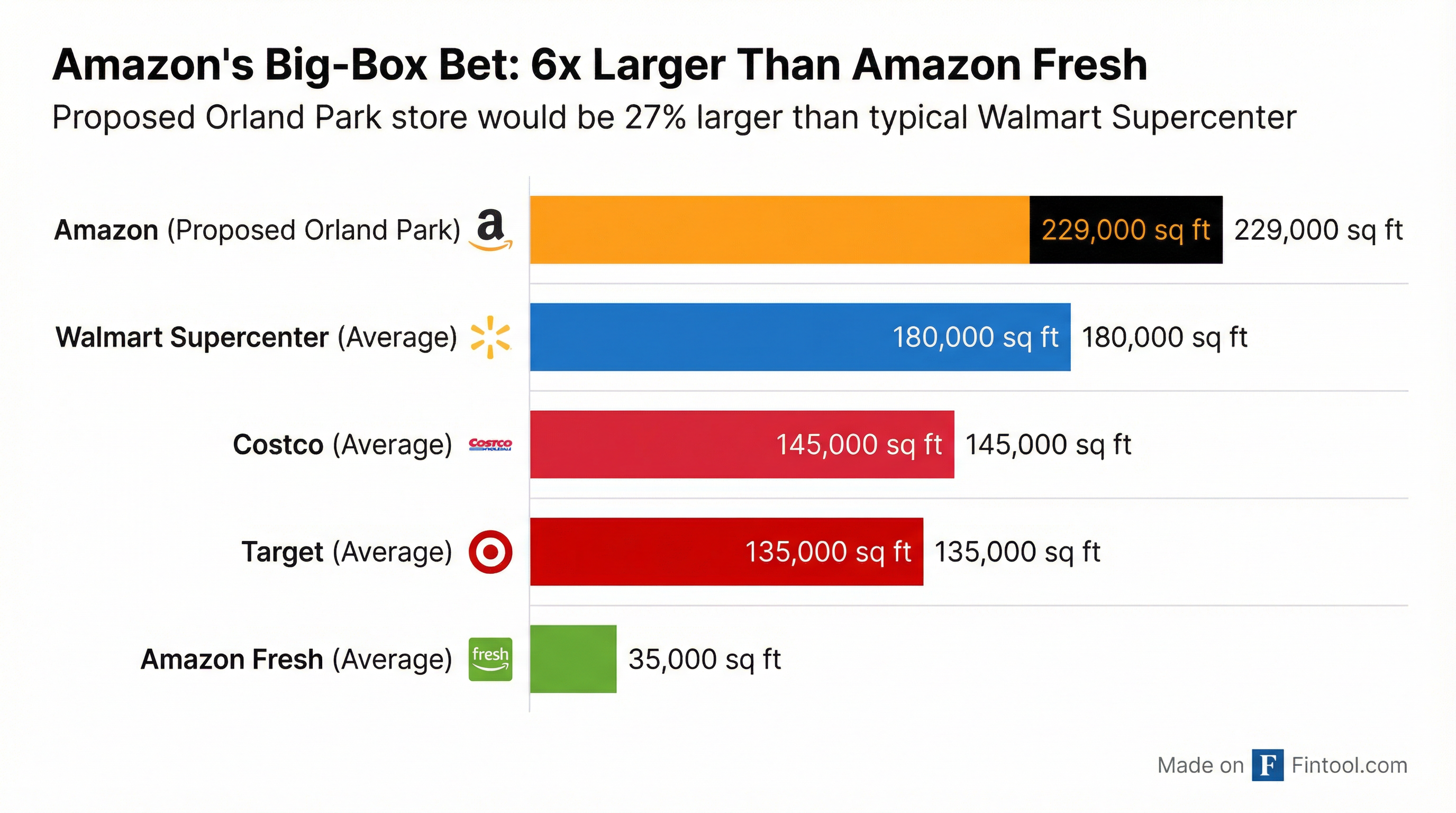
| Retailer | Avg Store Size | Amazon Proposed |
|---|---|---|
| Amazon (Orland Park) | — | 229,000 sq ft |
| Walmart Supercenter | 180,000 sq ft | +27% larger |
| Costco | 145,000 sq ft | +58% larger |
| Target | 135,000 sq ft | +70% larger |
| Amazon Fresh | 35,000 sq ft | +550% larger |
The store would include 837 parking spaces, seven loading docks, and a warehouse component supporting on-site operations—a hybrid model that could enable same-day fulfillment while competing with traditional big-box retailers.
 Ask Fintool AI Agent
Physical Stores: Amazon's Smallest—and Most Challenging—Segment
Amazon's physical store revenue remains a small fraction of its total business. In Q3 2025, physical stores generated $5.6 billion in revenue—just 3.1% of Amazon's $180.2 billion total.
| Segment | Q3 2025 Revenue | % of Total |
|---|---|---|
| Online Stores | $67.4B | 37.4% |
| AWS | $33.0B | 18.3% |
| Third-Party Seller Services | $42.5B | 23.6% |
| Advertising | $17.7B | 9.8% |
| Subscriptions | $12.6B | 7.0% |
| Physical Stores | $5.6B | 3.1% |
Physical stores grew 6.7% year-over-year in Q3 2025 ($5.6B vs $5.2B in Q3 2024), but the segment has struggled to achieve the scale and profitability of Amazon's digital businesses.
The Orland Park proposal represents a fundamental rethinking of Amazon's approach—abandoning the smaller-format experimentation for a head-on challenge to the big-box incumbents.
From Whole Foods to Big-Box: Amazon's Retail Evolution
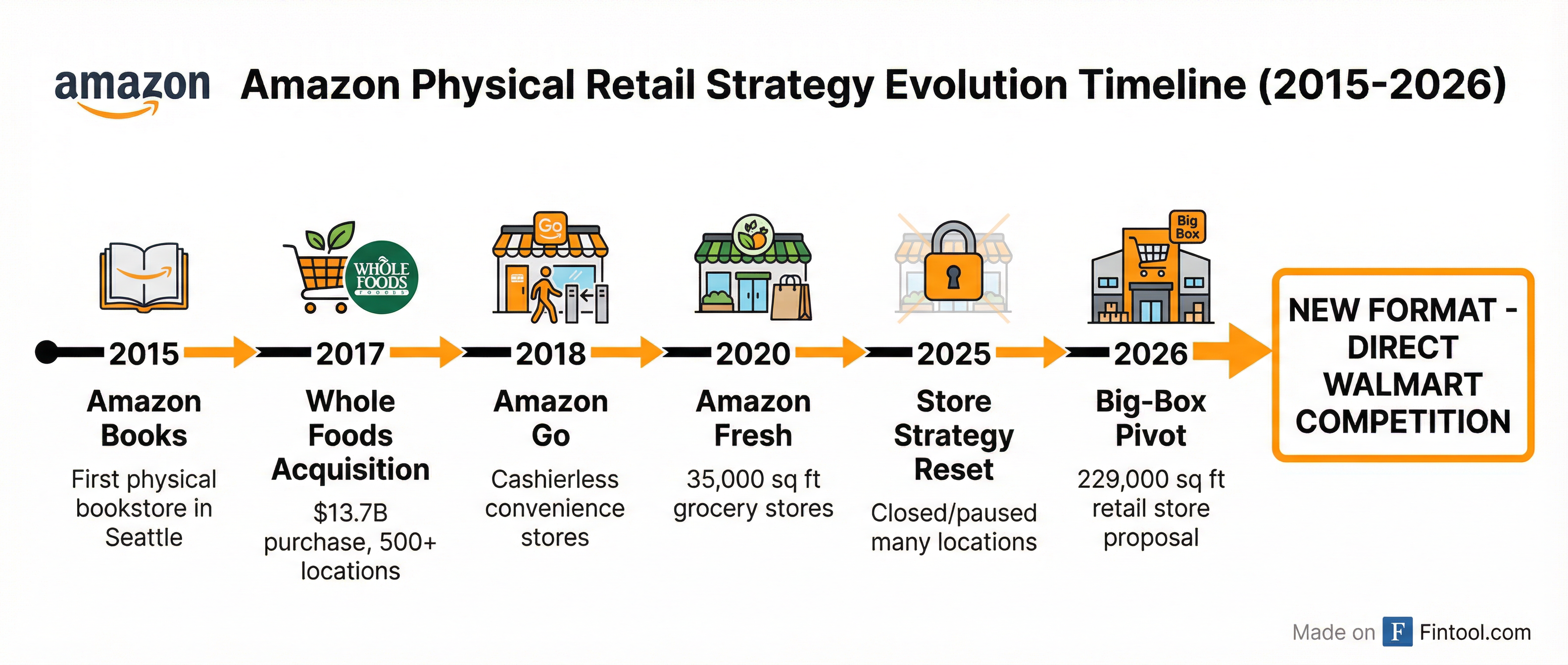
Amazon's physical retail journey has been marked by ambitious bets and strategic retreats:
2015-2017: The Bookstore Era Amazon opened its first physical bookstore in Seattle, eventually expanding to roughly 20 locations before closing them all in 2022.
2017: Whole Foods ($13.7B) The acquisition gave Amazon 500+ grocery locations overnight, but the premium organic positioning limited mass-market appeal.
2018-2020: Amazon Go & Fresh Cashierless convenience stores (Amazon Go) and mid-size grocery stores (Amazon Fresh) represented attempts at technology-differentiated retail. Both formats saw expansion pause in 2023-2024 as Amazon reassessed its physical strategy.
2026: The Big-Box Pivot The Orland Park proposal signals Amazon's willingness to compete directly in the traditional retail format rather than trying to reinvent it.
Ask Fintool AI AgentWhat's in the Store?
According to Amazon's special use permit application, the store would offer:
- Wide selection of products including groceries and general merchandise
- Accessory services and potentially dining locations for prepared food
- Online order pickup for e-commerce purchases
- Limited warehouse component supporting on-site fulfillment operations
The 35-acre site at 159th Street and LaGrange Road was previously home to Petey's II restaurant and sits in one of Orland Park's most heavily trafficked commercial corridors.
Competitive Implications
The timing is notable. Walmart continues to dominate U.S. grocery with over $100 billion in quarterly revenue, while Target has struggled with margin compression and inventory challenges.
| Company | Q3 FY26 Revenue | EBIT Margin |
|---|---|---|
| Walmart | $179.5B | 3.7% |
| Amazon (Total) | $180.2B | 11.1% |
| Target | $25.3B | 4.6% |
| Costco | — | — |
Amazon brings several potential advantages to the big-box fight:
- Prime integration: 200M+ Prime members represent a built-in customer base
- Logistics infrastructure: Existing fulfillment network enables hybrid retail/delivery model
- Technology: Just Walk Out, smart carts, and other retail tech proven at smaller scales
- Capital: $2.6 trillion market cap provides staying power for long-term investment
But the company also faces headwinds. Amazon has struggled to achieve profitability in physical retail, and the Orland Park store would need to demonstrate a viable path to scale before broader rollout.
Ask Fintool AI AgentLocal Reaction: Not Everyone's Onboard
The proposal has drawn mixed reactions from Orland Park residents. Some see the tax revenue potential as a boon for municipal services, while others worry about traffic congestion and the impact on local businesses.
"Amazon is a great company," resident Jim Savage told the Plan Commission, noting he has investments in Amazon stock. "But one of the concerns I have, it's destroying the retail base of America... It's going to cannibalize all these other businesses in Orland Park."
Plan Commissioner John Paul pushed back: "This is a retail community. This location is prime retail location. We could kill this. We could tell Amazon, 'go away and never come back.' But guess what? Couple months later, somebody else is going to be here, pretty much offering the same. This is going to be big."
What to Watch
Near-term:
- Village board approval (required before construction)
- Traffic and environmental impact studies
- Final store design and product mix announcements
Longer-term:
- Whether Amazon announces similar stores in other markets
- Physical store segment profitability in quarterly earnings
- Competitive responses from Walmart, Target, and Costco
The Orland Park proposal is still in early stages—but if Amazon moves forward, it would mark the company's most significant physical retail investment since the $13.7 billion Whole Foods acquisition in 2017. For investors watching AMZN, WMT, and TGT, the implications could be substantial.