AMD Lands $60 Billion Meta Deal, Giving Facebook Parent Option to Own 10% of Chipmaker
February 24, 2026 · by Fintool Agent



Advanced Micro Devices just secured its second transformative AI chip deal in four months. Meta Platforms will purchase up to $60 billion worth of AMD's AI processors over five years—enough to deploy 6 gigawatts of computing power—and gains the option to acquire as much as 10% of the chipmaker.
AMD shares surged 9% to $214 on the news, adding $31 billion to its market cap in a single session.
The Deal
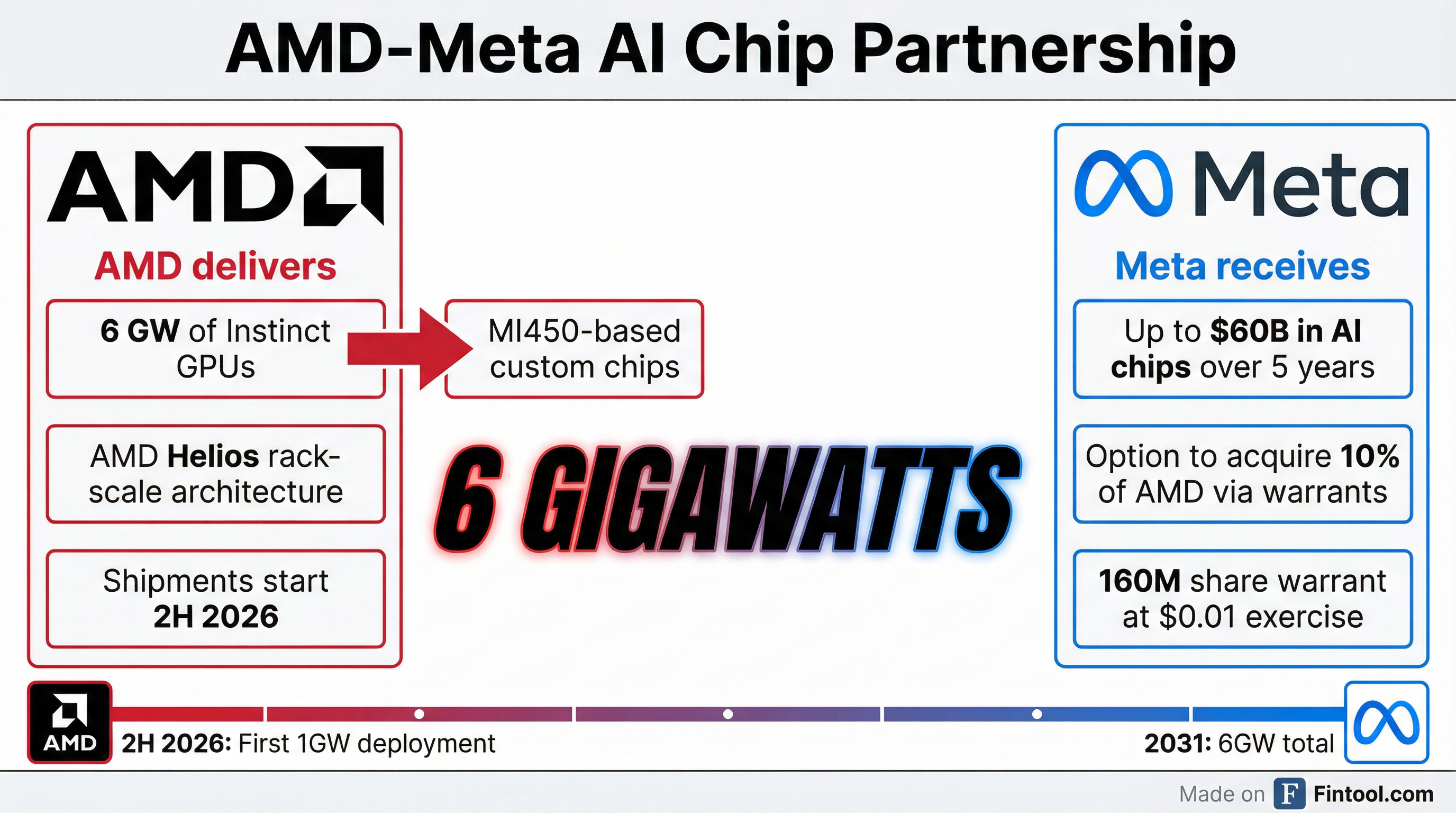
Under the multi-year, multi-generation partnership, AMD will supply Meta with up to 6 gigawatts of Instinct GPUs to power the Facebook owner's AI infrastructure.
Key terms:
| Element | Details |
|---|---|
| Total value | Up to $60 billion over 5 years |
| Computing power | 6 gigawatts of AMD Instinct GPUs |
| First deployment | 1 GW in H2 2026 |
| Chip architecture | Custom MI450-based GPU + 6th Gen EPYC "Venice" CPUs |
| Infrastructure | AMD Helios rack-scale architecture |
| Equity component | 160 million share warrant (10% of AMD) |
| Exercise price | $0.01 per share |
| Vesting triggers | AMD stock price targets up to $600 |
"Meta is making a big bet on AMD," CEO Lisa Su told a news briefing.
The structure mirrors AMD's October 2025 deal with OpenAI, which also involved 6 gigawatts of chips and an option for the AI startup to acquire 10% of AMD. Combined, these partnerships position AMD to supply $100+ billion of AI infrastructure over the next several years.
 Ask Fintool AI Agent
Market Reaction
The announcement sent AMD shares up 9% to $214.19, while Nvidia—set to report earnings Wednesday—slipped 1% as investors recalibrate competitive dynamics.
Meta shares were little changed—the company announced a separate deal to buy millions of Nvidia chips just last week, signaling it is aggressively diversifying its AI supply chain rather than picking winners.
Why Meta Needs the Chips
Meta has been explicit about its compute constraints. On the company's Q4 2025 earnings call, CFO Susan Li told analysts:
"We do continue to be capacity constrained. Our teams have done a great job ramping up our infrastructure through the course of 2025, but demands for compute resources across the company have increased even faster than our supply."
Meta has been working to diversify its chip supply, extending its Andromeda ads retrieval engine to run on Nvidia, AMD, and its own MTIA chips—enabling it to "nearly triple Andromeda's compute efficiency."
Meta's AI infrastructure investments have escalated rapidly:
| Metric | Q1 2025 | Q2 2025 | Q3 2025 | Q4 2025 |
|---|---|---|---|---|
| Capital Expenditure | $12.9B | $16.5B | $18.8B | $21.4B |
| Revenue | $42.3B | $47.5B | $51.2B | $59.9B |
CEO Mark Zuckerberg announced "MetaCompute" as a strategic initiative, stating the company believes "being the most efficient at how we engineer, invest, and partner to build our infrastructure will become a strategic advantage."
Ask Fintool AI AgentAMD's AI Momentum
This deal caps a transformative period for AMD's data center AI business. On the company's Q4 2025 earnings call, Lisa Su highlighted:
"Today, 8 of the top 10 AI companies use Instinct to power production workloads across a growing range of use cases."
AMD's financial performance reflects this momentum:
| Metric | Q1 2025 | Q2 2025 | Q3 2025 | Q4 2025 |
|---|---|---|---|---|
| Revenue | $7.4B | $7.7B | $9.2B | $10.3B* |
| Net Income | $709M | $872M | $1.2B | $1.5B |
| Gross Margin | 53.6% | 43.2% | 54.5% | 56.8%* |
*Values retrieved from S&P Global
Su noted the company is "in active discussions with other customers on at-scale multi-year deployments starting with Helios and MI450 later this year."
The Competitive Landscape
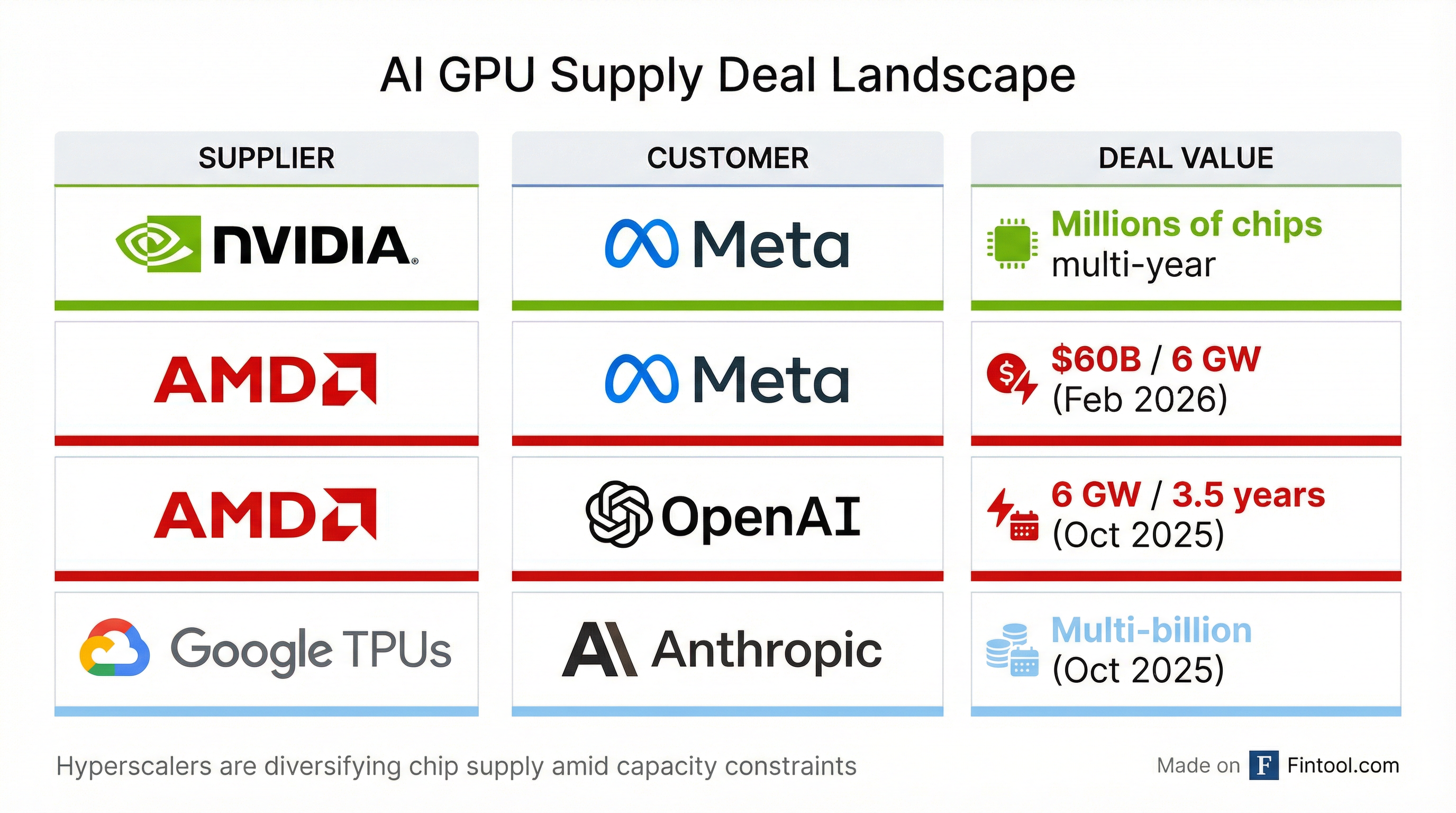
The deal highlights deepening ties among AI industry leaders amid concerns about circular financing arrangements. Meta and OpenAI are both set to own stakes in one of their most significant suppliers, while Nvidia is reportedly eyeing investments in some of its largest customers, including OpenAI.
"Meta is locking in supply, diversifying away from a single vendor, and doing whatever it takes to make sure its AI ambitions aren't bottlenecked by chips," said Matt Britzman, senior equity analyst at Hargreaves Lansdown. "For AMD, this is a vote of confidence in its next-generation AI hardware—but having to give up a 10% stake suggests it could be struggling to generate organic demand."
Nvidia remains the dominant force, with data center revenue exceeding $50 billion quarterly. But the AI chip market is large enough—and demand intense enough—that hyperscalers are securing supply from multiple vendors simultaneously.
Ask Fintool AI AgentWhat to Watch
Near-term catalysts:
- Nvidia earnings (Feb 26): How management responds to AMD gaining ground
- H2 2026: First gigawatt deployment to Meta begins
- MI450 performance: Technical benchmarks against Nvidia's Blackwell architecture
Longer-term questions:
- Can AMD execute on the manufacturing ramp for 6+ gigawatts of chips?
- Will the equity dilution from OpenAI and Meta warrants weigh on AMD shareholders?
- Does Nvidia respond with its own customer investment deals?
The AI chip race just got more interesting.