Anthropic Refuses Pentagon Demand to Strip AI Safety Guardrails, Putting $200M Contract at Risk
January 30, 2026 · by Fintool Agent


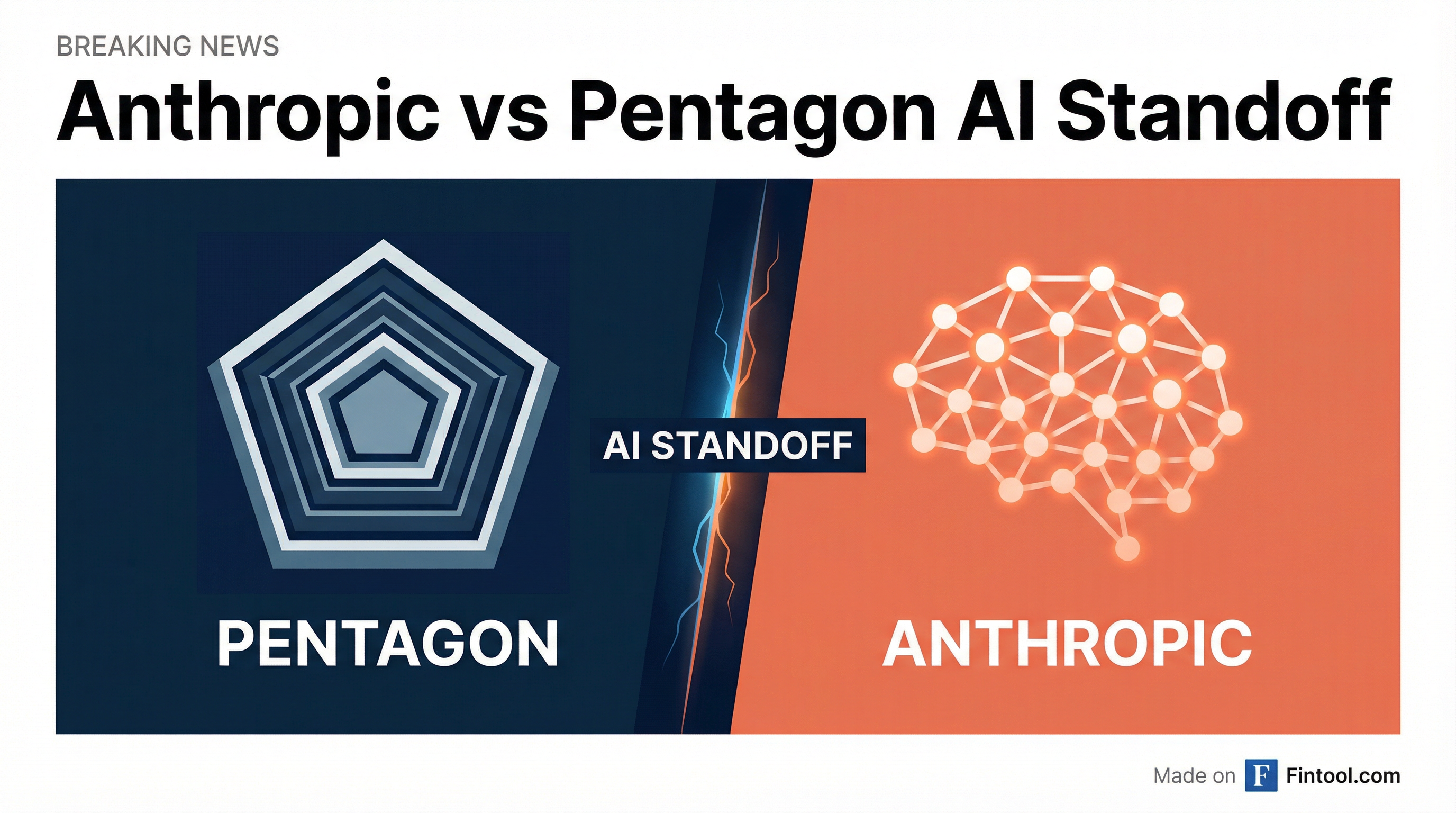
Anthropic has reached a standoff with the Pentagon over demands that the AI startup remove safety guardrails blocking its technology from being used for autonomous weapons targeting and domestic surveillance—putting a contract worth up to $200 million in jeopardy at a critical moment for the company's planned IPO.
The impasse, first reported by Reuters, pits Silicon Valley's AI safety principles directly against the Trump administration's push for unrestricted military AI deployment. After weeks of negotiations, talks have stalled, with Anthropic refusing to strip the safeguards while Pentagon officials insist they should be able to deploy commercial AI however they see fit under U.S. law.
"We will not employ AI models that won't allow you to fight wars," Defense Secretary Pete Hegseth said at a January 12 speech at SpaceX headquarters, in what sources described as a direct reference to Anthropic. "AI will not be woke."
 Ask Fintool AI Agent
The Core Dispute: Weapons and Surveillance
At the heart of the standoff are two red lines Anthropic has drawn: its models cannot be used to target weapons autonomously without sufficient human oversight, and they cannot be deployed for surveillance of American citizens.
Anthropic's Claude models are trained to avoid taking steps that might lead to harm. Company engineers would need to retool the AI before the Pentagon could use it in ways that cross these boundaries—meaning the military needs Anthropic's cooperation to move forward.
Pentagon officials have bristled at these restrictions. A January 9 Department of War memo on AI strategy established that the military should be free to deploy commercial AI systems regardless of company usage policies, so long as they comply with U.S. law. Private sector guardrails, in their view, should not dictate battlefield choices.
"Our warfighters need to have access to the models that provide decision superiority in the battlefield," a Defense Department official told reporters. "We're deploying models free from ideological constraints that limit lawful military applications."
xAI Moves In as Anthropic Stalls
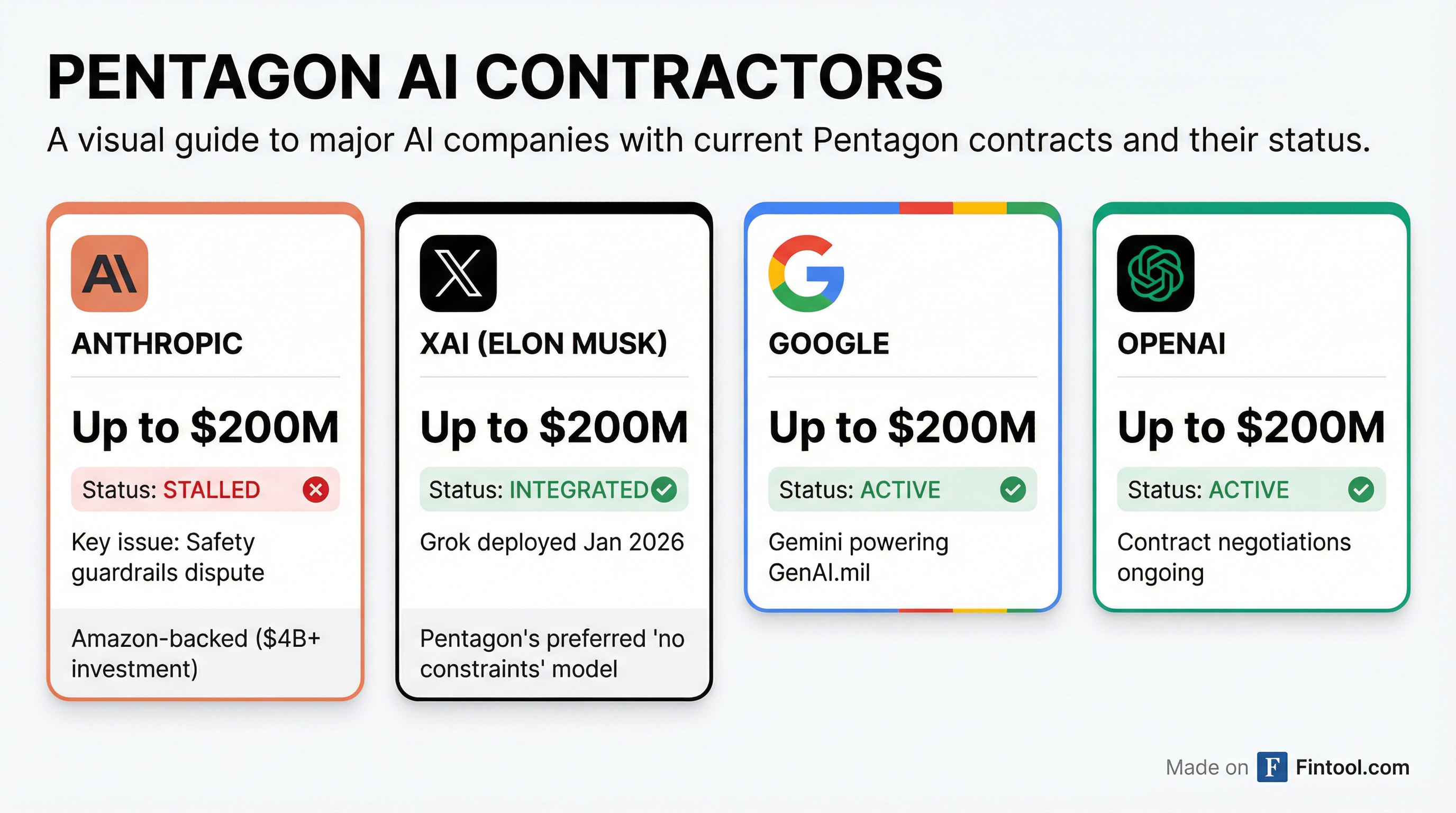
While Anthropic's contract negotiations remain frozen, the Pentagon has moved aggressively to integrate rival AI systems. Hegseth announced on January 12 that Elon Musk's xAI Grok would be deployed across all Defense Department networks—including classified systems—later that month.
"Very soon we will have the world's leading AI models on every unclassified and classified network throughout our department," Hegseth said at SpaceX headquarters in Texas.
Google's Gemini is already powering GenAI.mil, the military's new internal AI platform. OpenAI continues negotiating its own Pentagon arrangements. The four companies—Anthropic, Google, OpenAI, and xAI—each received contracts worth up to $200 million in 2025 to "develop agentic AI workflows across a variety of mission areas."
Anthropic is the only major AI contractor to hit a wall with the Pentagon over safety restrictions. The company has long positioned itself as the responsible alternative in AI development, founded in 2021 by former OpenAI executives including CEO Dario Amodei specifically to focus on AI safety research.
Ask Fintool AI AgentAmodei's Position: Defense Yes, Autocracy No
Anthropic CEO Dario Amodei addressed the tension directly in a blog post this week, writing that AI should support national defense "in all ways except those which would make us more like our autocratic adversaries."
The statement frames Anthropic's position not as anti-military but as drawing a line at specific applications—autonomous killing without human oversight and domestic spying—that the company views as crossing ethical boundaries that separate democracies from authoritarian regimes.
Amodei was also critical of recent federal actions, describing the fatal shootings of U.S. citizens protesting immigration enforcement in Minneapolis as a "horror" in a post on X.
This puts Anthropic in a delicate position. The company needs government revenue to sustain its growth trajectory and justify its valuation. But its entire brand identity is built on being the "safety-first" AI company—a positioning that has helped it attract billions in investment from Amazon, Microsoft, and Nvidia.
What's at Stake for Investors
The timing of this standoff is particularly fraught. Anthropic is in the midst of a blockbuster funding round that closed above $10 billion at a $350 billion valuation, with some reports suggesting the round could reach $20 billion if Microsoft and NVIDIA complete their planned investments.
The company hired lawyers in December to begin IPO preparations, with a potential public offering as early as this year. Going public at a $350+ billion valuation would make Anthropic one of the largest tech IPOs in history.
Key financial context:
| Metric | Value |
|---|---|
| Latest Valuation | $350 billion |
| 2025 Revenue | $10 billion |
| Amazon Investment | $4+ billion |
| Planned Microsoft Investment | Up to $5 billion |
| Planned NVIDIA Investment | Up to $10 billion |
| Pentagon Contract at Risk | Up to $200 million |
The $200 million contract is a small fraction of Anthropic's overall business. But the dispute's significance extends far beyond the immediate dollars. A prolonged fight with the Pentagon could:
- Signal regulatory risk that complicates the IPO narrative
- Create precedent for other government contracts globally
- Invite political scrutiny from an administration that has made "woke AI" a target
- Strain relationships with defense-adjacent enterprise customers
For Amazon, which has invested over $4 billion in Anthropic and made it a cornerstone of AWS's AI strategy through Amazon Bedrock, the situation creates headline risk even if the financial exposure is limited relative to Amazon's $2.6 trillion market cap.
Ask Fintool AI AgentThe Broader Industry Implications
The standoff represents an early test case for whether tech companies can maintain ethical red lines when working with the U.S. government—and what happens when those lines conflict with national security imperatives.
If Anthropic succeeds in enforcing its safeguards, it may embolden other companies to demand similar restrictions. If it fails—or walks away from the contract—firms across the AI industry will have to decide whether to accept broader uses of their technology or forgo lucrative government business.
The outcome could shape Silicon Valley's relationship with Washington for years to come. The Biden administration had established a framework directing national security agencies to expand AI use while prohibiting certain applications, including systems that would automate nuclear weapons deployment or violate constitutional civil rights. It remains unclear whether those prohibitions remain in force under the Trump administration.
For now, the Pentagon has alternatives. xAI's Grok and Google's Gemini are already integrated. OpenAI continues negotiating. Anthropic's Claude may be among the most capable AI models available, but it's not the only option—and the administration has made clear it prioritizes AI systems "free from ideological constraints."
What to Watch
Near-term catalysts:
- Whether Anthropic walks away from the contract or finds a compromise
- Pentagon's 90-day deadline (from January 12 memo) to establish model objectivity benchmarks
- Anthropic's IPO filing timeline and how it addresses government contract risks
- Any public statements from Amazon, Microsoft, or NVIDIA on the dispute
Key questions:
- Will other AI companies face similar demands to remove safety guardrails?
- How will enterprise customers react to Anthropic's Pentagon standoff?
- Does this accelerate or delay Anthropic's path to public markets?
The dispute has no clear resolution path. Anthropic's models are fundamentally designed to avoid harmful outputs—changing that would require significant engineering work and would undermine the company's core identity. But the Pentagon has made clear it won't accept corporate veto power over military AI applications.
Something will have to give. For investors in the AI ecosystem—and for the trajectory of military AI development—the outcome matters.
Ask Fintool AI Agent