Apple Vision Pro Production Halted as Sales Collapse—Only 45,000 Units Expected in Holiday Quarter
January 1, 2026 · by Fintool Agent


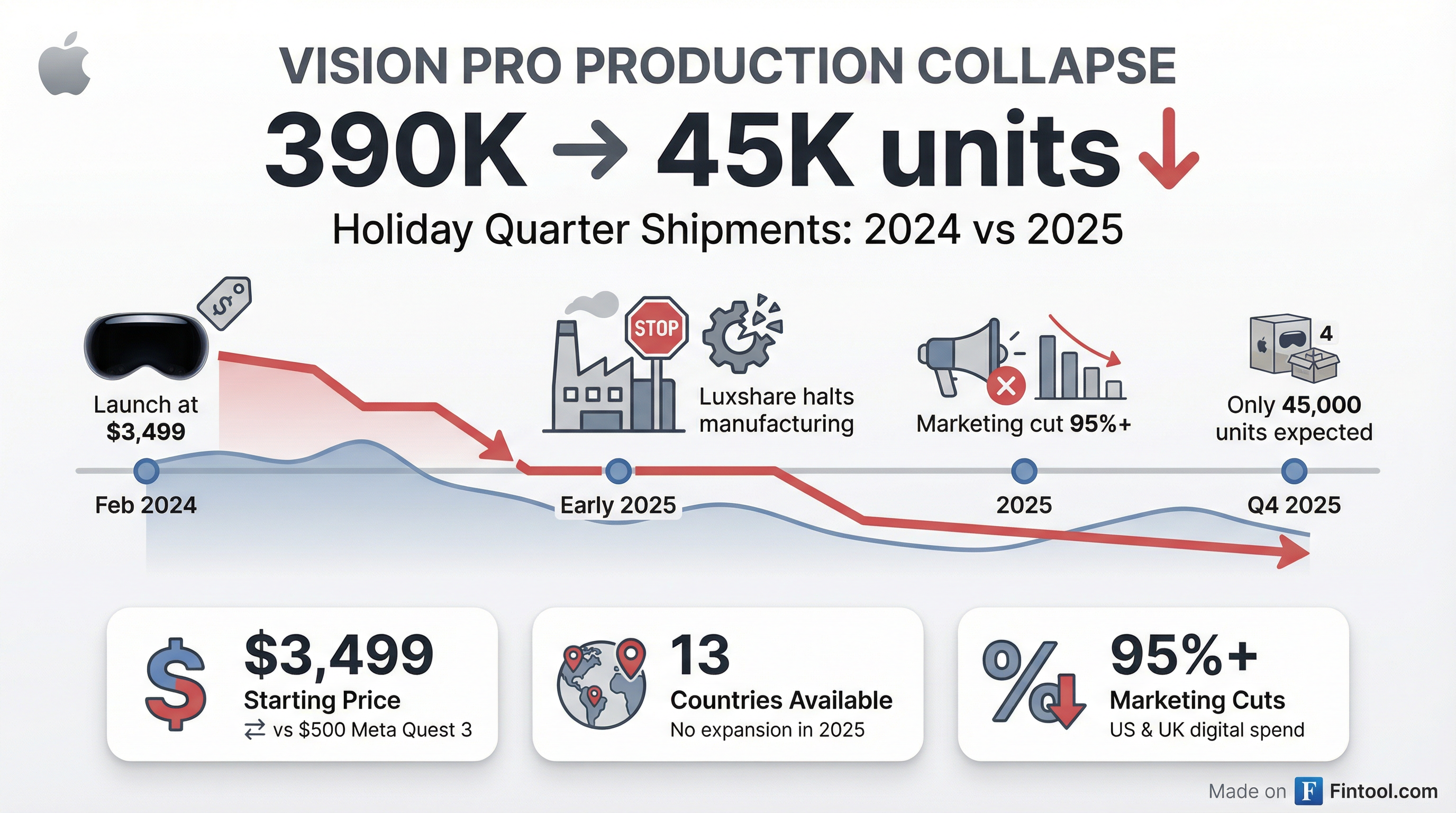
Apple's $3,499 "spatial computing" headset has become one of the company's most notable product misfires in recent memory. Production has halted, marketing has been slashed by more than 95%, and only 45,000 units are expected to ship during the crucial Q4 2025 holiday quarter—down from 390,000 for all of 2024.
The retrenchment marks a stark reversal for a product that CEO Tim Cook heralded as the dawn of "spatial computing" when it launched in February 2024. Apple now appears to be pivoting away from high-end VR toward AI-enabled wearables and a cheaper headset model.
The Numbers Tell the Story
| Metric | 2024 | Q4 2025 | Change |
|---|---|---|---|
| Unit Shipments | 390,000 | 45,000 | -88% (Q4 vs full year) |
| Marketing Spend | Baseline | -95%+ | Gutted |
| Countries Sold | 13 | 13 | No expansion |
| Production Status | Active | Halted | Luxshare stopped manufacturing |
Source: IDC, Sensor Tower
According to market intelligence firm IDC, Apple's Chinese manufacturing partner Luxshare halted Vision Pro production in early 2025. Sensor Tower data shows Apple slashed digital advertising for the headset by more than 95% in the U.S. and U.K. markets.
The Vision Pro remains available in just 13 countries with no expansion planned—a telling sign given Apple's typical global rollout strategy for successful products.
 Ask Fintool AI Agent
What Went Wrong
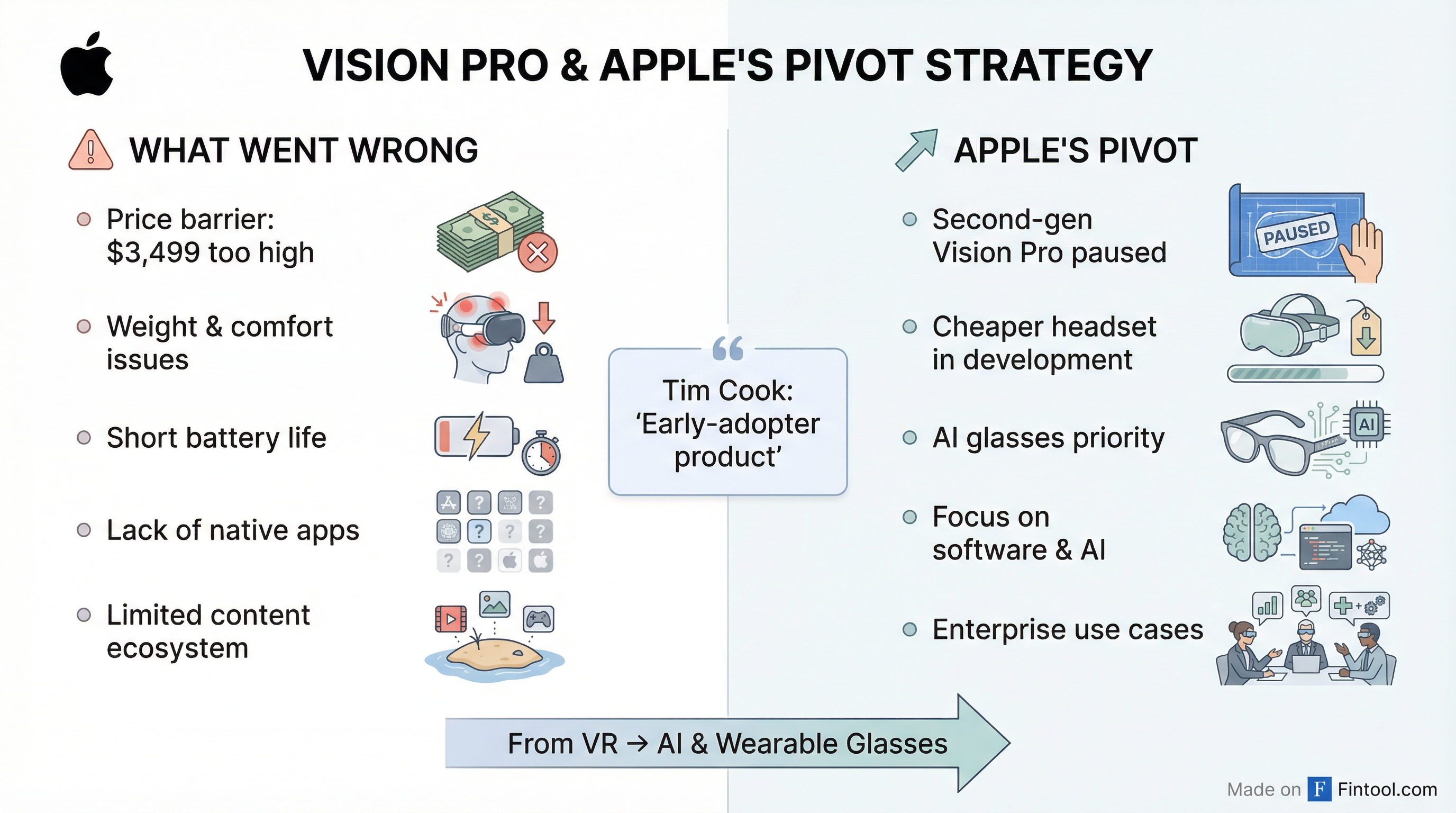
Critics and analysts point to multiple factors behind the Vision Pro's struggles:
Price barrier: At $3,499 for the base model (256GB), the Vision Pro costs seven times more than Meta's Quest 3 at ~$500. The 1TB configuration pushes to $3,899, and Zeiss optical inserts add another $99-$149.
Form factor issues: Users have complained about the headset's weight, discomfort during extended use, and relatively short battery life. Reviews describe it as impressive technology that's impractical for daily use.
App ecosystem deadlock: With only 3,000 apps made specifically for VisionOS—many of which are enterprise-focused tools rather than consumer applications—there simply isn't enough content to justify the purchase. But without users, developers have little incentive to build for the platform.
Tim Cook himself acknowledged the device's limitations, describing it as an "early-adopter product" targeting users interested in cutting-edge technology rather than the mass market.
Meta Dominates as VR Market Shrinks
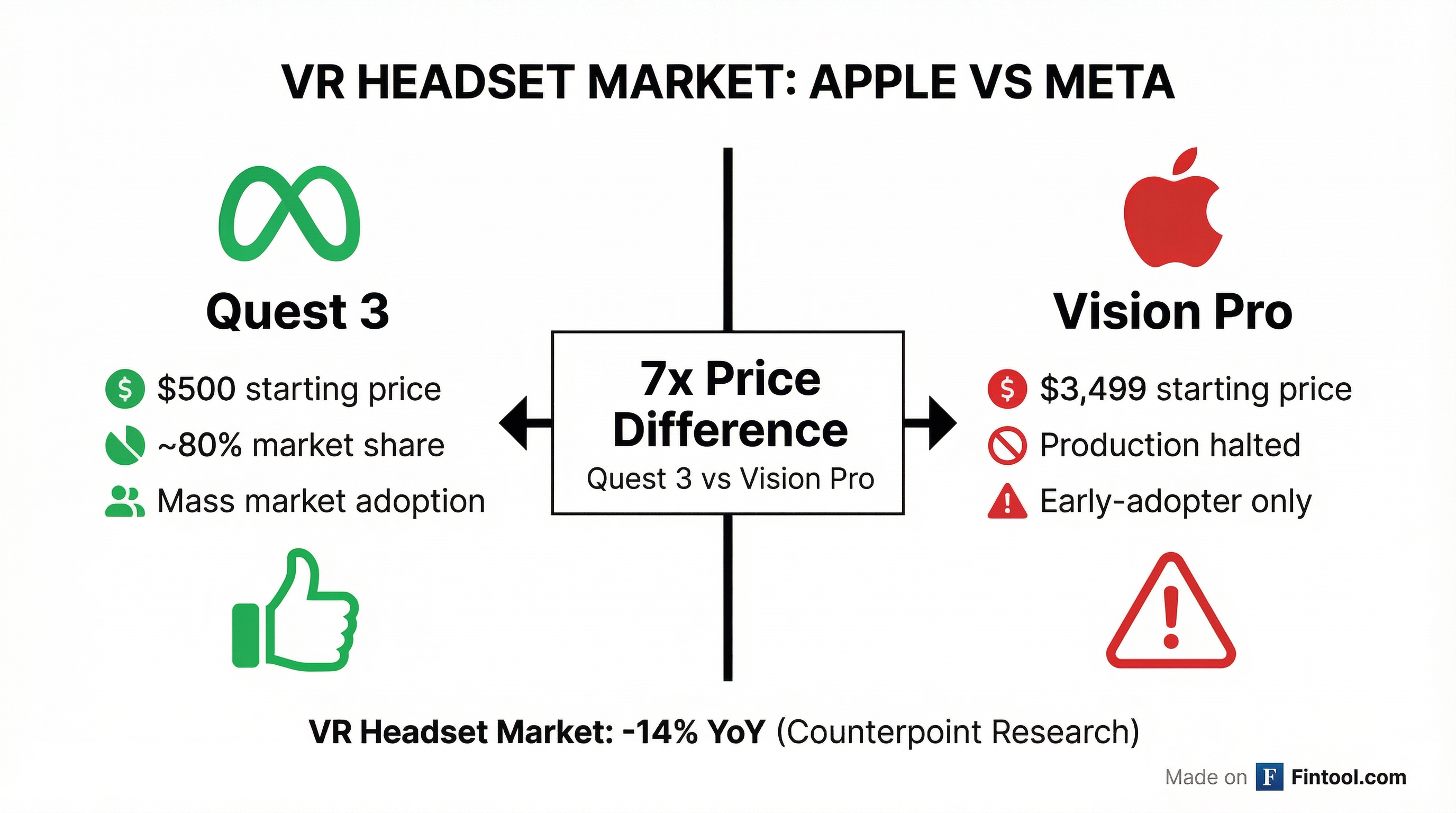
The broader VR headset market declined 14% year-over-year according to Counterpoint Research, but Meta's cheaper Quest lineup continues to dominate with approximately 80% market share.
Even Meta, however, is pulling back from its "metaverse" ambitions. The company confirmed last month it is "shifting some of our investments from metaverse towards AI glasses and other wearables"—a strategic pivot that mirrors Apple's apparent direction.
The Vision Pro's failure echoes the ill-fated Google Glass from 2013, where users were shunned as "glassholes" and the product never found mainstream adoption despite significant hype.
Ask Fintool AI AgentApple's Strategic Pivot
Reports indicate Apple has suspended work on the second-generation Vision Pro for at least a year to focus on developing a lower-cost headset. The company has reportedly told suppliers to prepare for just 4 million units of the cheaper model over its entire product lifespan—half the original Vision Pro target—suggesting even more muted expectations.
Apple is also reportedly developing smart glasses to compete with Meta's Ray-Ban partnership and Snap's Spectacles, pivoting toward AI-enabled wearables rather than immersive VR.
In October 2025, Apple did launch an M5-powered Vision Pro refresh with improved performance and battery life, but it failed to move the sales needle. Management's recent earnings commentary has been notably sparse on Vision Pro, focusing instead on iPhone, Services, and Apple Intelligence.
During Apple's Q4 2025 earnings call, the Vision Pro received only passing mention, with CFO Kevan Parekh noting that Purdue University launched a "spatial computing hub built around Apple Vision Pro" for training students—highlighting the enterprise focus rather than consumer momentum.
Financial Context: Apple Remains a Juggernaut
Despite the Vision Pro stumble, Apple's overall business remains exceptionally strong. The company reported record Q4 2025 revenue of $102.5 billion, up 8% year-over-year, with Services hitting an all-time high of $28.8 billion.
| Metric | Q1 2025 | Q2 2025 | Q3 2025 | Q4 2025 |
|---|---|---|---|---|
| Revenue ($B) | $124.3 | $95.4 | $94.0 | $102.5 |
| Net Income ($B) | $36.3 | $24.8 | $23.4 | $27.5 |
| Gross Margin | 46.9% | 47.1% | 46.5% | 47.2% |
*Values retrieved from S&P Global
The Wearables, Home and Accessories segment—which includes Vision Pro alongside Apple Watch, AirPods, and HomePod—generated $9 billion in Q4 2025, flat year-over-year. Growth in Watch and AirPods offset weakness elsewhere in the category.
Apple's installed base of active devices reached another all-time high across all product categories, suggesting the Vision Pro failure hasn't damaged the broader ecosystem. The company continues to guide for double-digit iPhone revenue growth in Q1 2026, which would be its best iPhone quarter ever.
Ask Fintool AI AgentWhat to Watch
Cheaper headset timing: Reports suggest a lower-cost Vision model could arrive by late 2025 or 2026, priced around $2,000 with reduced features and downgraded displays.
AI glasses development: Apple's pivot toward AI-enabled wearables could produce a Ray-Ban Meta competitor, though timing remains unclear.
Enterprise adoption: Apple appears to be repositioning Vision Pro for enterprise use cases like surgical training, flight simulation, and corporate collaboration rather than consumer entertainment.
Q1 2026 disclosure: Watch for any additional commentary on Wearables segment performance and potential charges related to excess Vision Pro inventory.
Ask Fintool AI Agent