Bob's Discount Furniture Lands $2.2B Valuation in NYSE Debut, Testing PE Exit Window
February 5, 2026 · by Fintool Agent


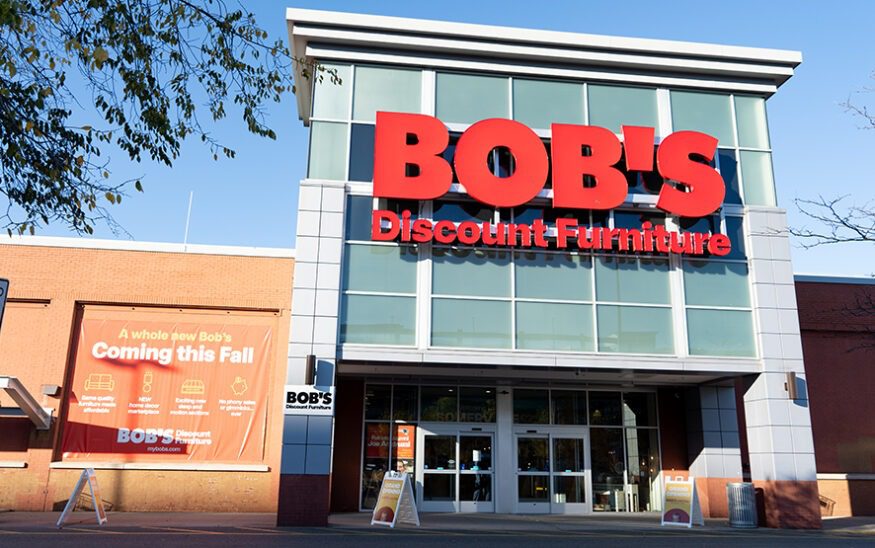
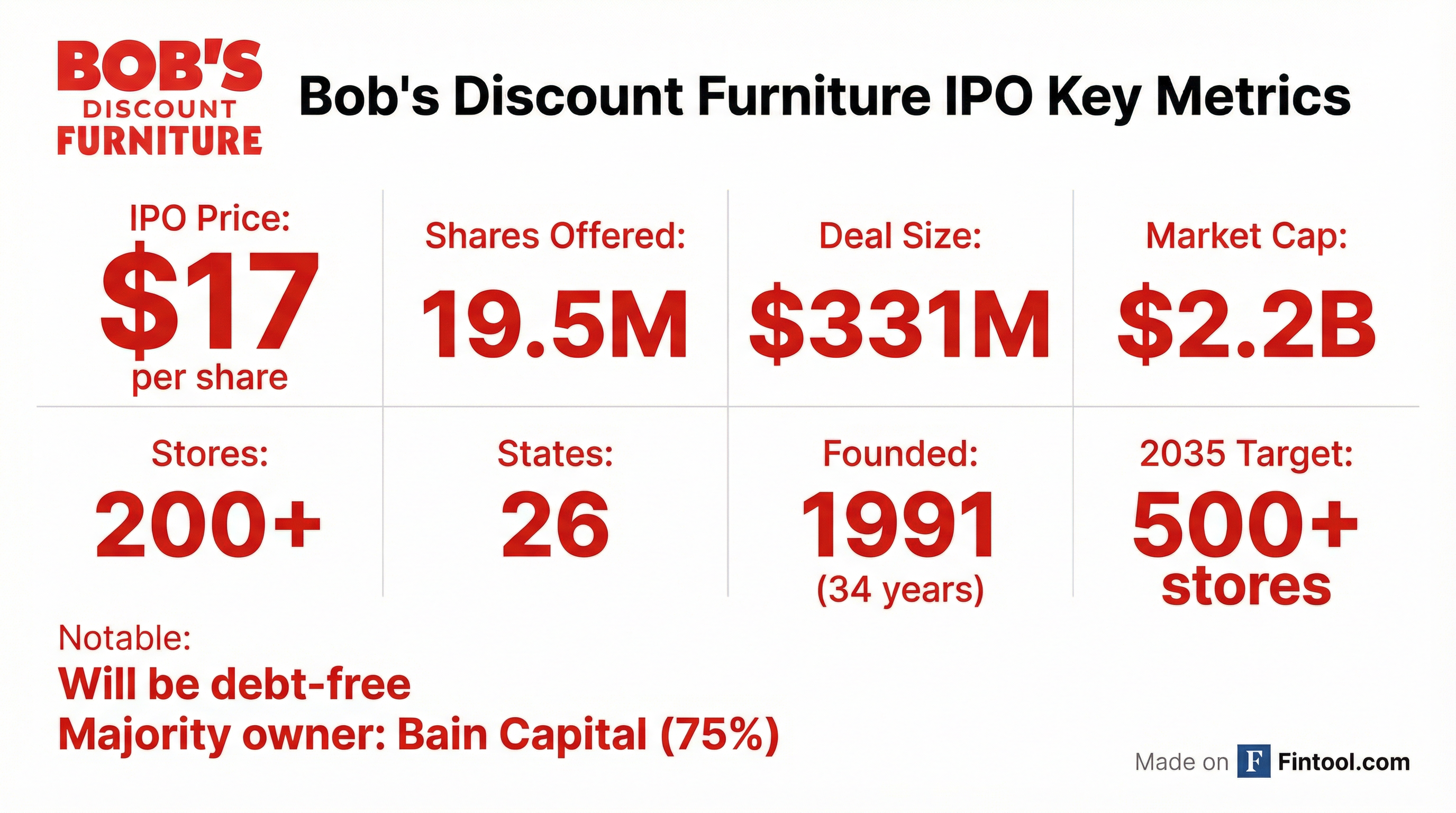
Bob's Discount Furniture+0.12% began trading on the New York Stock Exchange Thursday under ticker "BOBS" after raising $331 million in what stands as the first major private equity-backed retail IPO of 2026. The offering priced at $17 per share—the bottom of its $17 to $19 marketed range—giving the Connecticut-based furniture chain a market capitalization of approximately $2.2 billion.
The stock opened flat at $17, climbed as much as 11% to $18.58 in midday trading before fading into the close at $17.02, just 2 cents above the IPO price. The tepid close reflects investor caution around consumer discretionary names amid tariff uncertainty and higher interest rates—headwinds that have weighed on IPO activity from retailers since 2024.
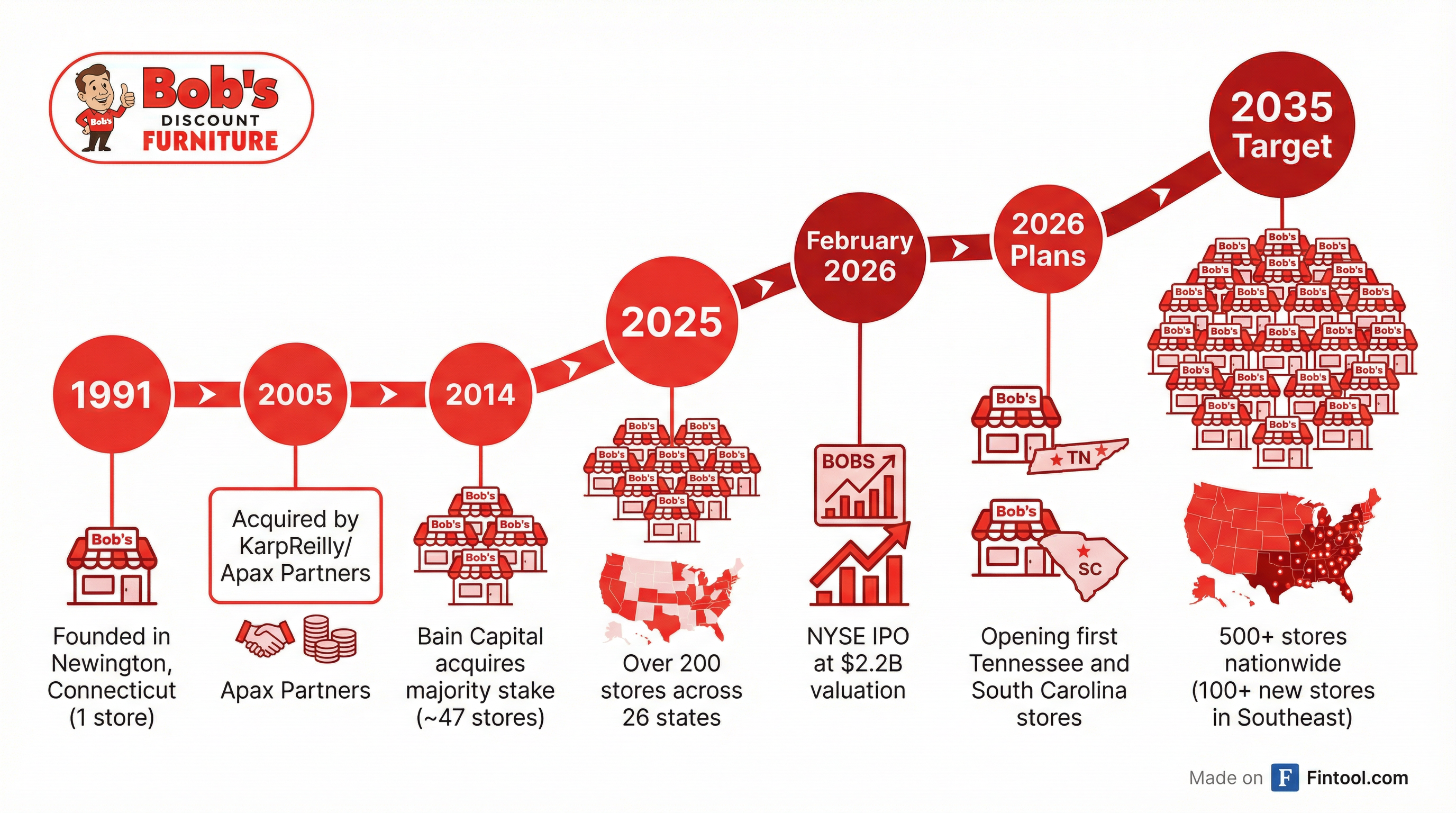
For Bain Capital, the listing represents a long-awaited exit after acquiring Bob's in early 2014 from KarpReilly and Apax Partners. The 12-year holding period far exceeds the typical five-to-seven-year private equity investment horizon, underscoring how volatile markets and depressed consumer spending had delayed liquidity events across the industry.
The Deal Structure
Bob's sold 19.45 million shares, with J.P. Morgan, Morgan Stanley, Royal Bank of Canada, and UBS leading the offering. Bain Capital-advised funds will retain approximately 75% of outstanding shares following the IPO, declining to 73% if underwriters exercise the full greenshoe option.
The company will use IPO proceeds plus cash on hand to repay $339 million of a $350 million term loan, leaving the retailer debt-free.
"We will be completely debt-free as a public company," CEO William Barton told Bloomberg TV on Thursday.
Notably, in October 2025, Bob's paid a $423.3 million dividend to Bain and other shareholders—funded by debt—ahead of the public offering. While pre-IPO dividends are common in PE-backed listings, they can draw scrutiny from investors evaluating long-term value creation versus financial engineering.
 Ask Fintool AI Agent
Financial Performance: Bucking the Trend
Despite a challenging furniture market, Bob's has delivered strong results. In the nine months ending September 28, 2025, the company reported:
| Metric | 9M Ending Sept 2025 | 9M Ending Sept 2024 | Change |
|---|---|---|---|
| Revenue | $1.72 billion | $1.43 billion | +20% |
| Net Income | $80.7 million | $49.3 million | +64% |
| Adjusted EBITDA | $164 million | — | — |
| Comp Store Sales Growth | 11% | — | — |
The profit expansion is particularly notable given the headwinds facing furniture retailers from the housing market slowdown and cautious consumer spending.
The "Trade-In Effect"
One of the more compelling dynamics in Bob's recent performance is what Barton calls the "trade-in effect"—higher-income consumers trading down from premium furniture retailers to value-oriented chains.
Approximately 27% of Bob's customers now have household incomes exceeding $150,000, up about 3 percentage points from 24 months ago. This shift suggests Bob's value proposition is resonating beyond its traditional middle-market customer base as inflationary pressures and economic uncertainty push affluent shoppers to seek bargains.
This phenomenon mirrors trends seen across retail during inflationary periods, where value-oriented retailers like Walmart-0.83%, TJX+0.95%, and Dollar General-2.91% have benefited from consumers prioritizing price over brand.
Expansion Plans: From Regional Player to National Chain
Founded in 1991 in Newington, Connecticut by Bob Kaufman and Gene Rosenberg, the company built its brand on a "no phony gimmicks" approach to furniture retail—everyday low prices without the promotional games common in the industry.
Bob's has grown from a single store to more than 200 locations across 26 states, though it remains heavily concentrated in the Northeast and Mid-Atlantic, where 61% of revenue originates.
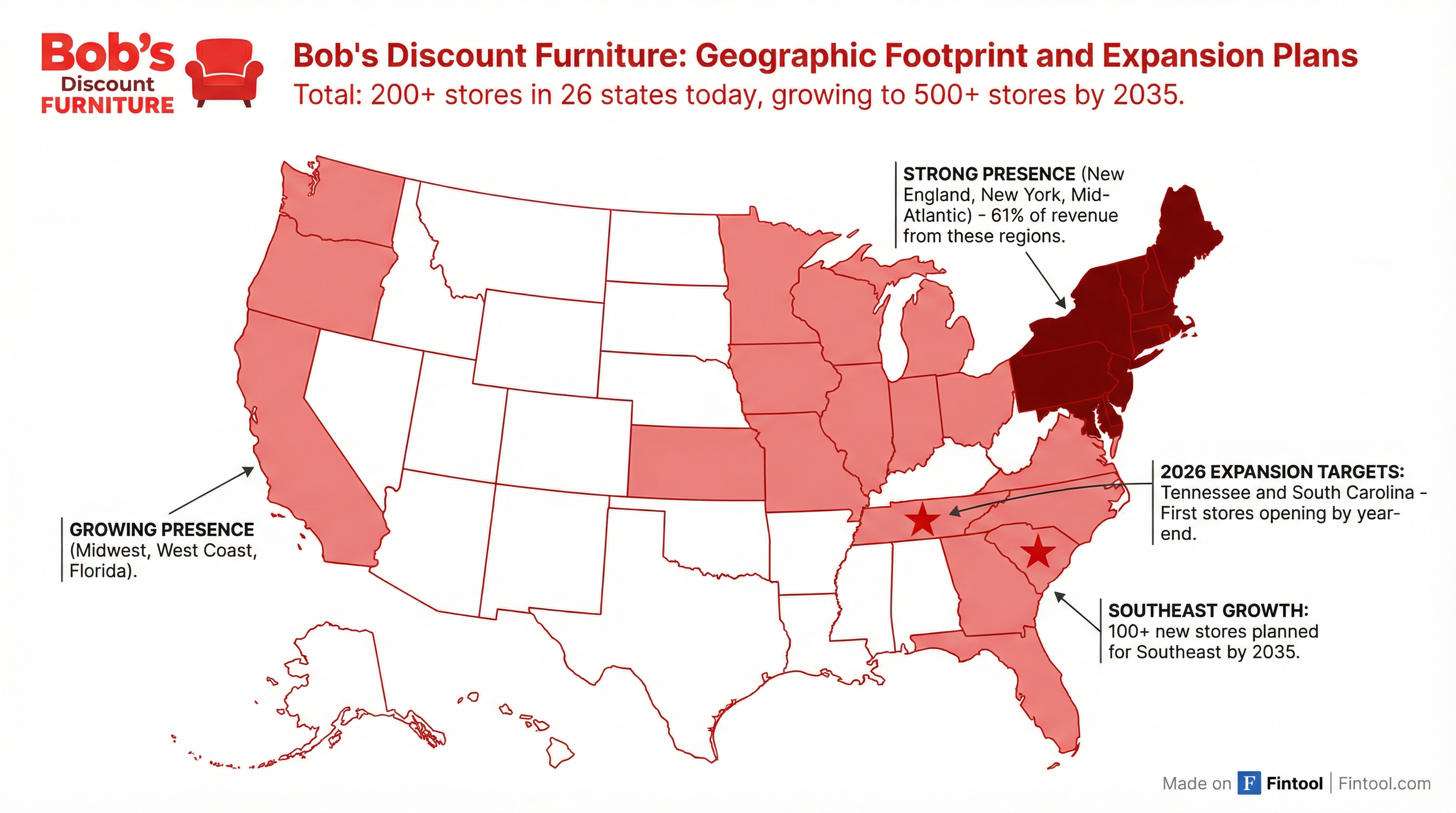
The company's growth strategy centers on aggressive expansion into underpenetrated markets, particularly the Southeast:
- 2026 Plans: Opening first stores in Tennessee and South Carolina by year-end, plus four additional North Carolina locations
- 2035 Target: More than 500 stores nationwide, with approximately 100 new locations in the Southeast
The Southeast represents a significant greenfield opportunity—the region has large population centers, relatively lower cost of living, and less competition from established furniture discounters.
Competitive Landscape
Bob's competes across multiple segments of the furniture market:
| Company | Ticker | Market Cap | Positioning |
|---|---|---|---|
| Williams-sonoma-1.55% | WSM | $25.8B | Premium home furnishings |
| Wayfair-2.76% | W | $13.6B | E-commerce furniture |
| RH-5.45% | RH | $3.7B | Luxury home furnishings |
| Bob's Discount Furniture | BOBS | $2.2B | Value furniture |
| Arhaus-2.55% | ARHS | $1.5B | Premium-contemporary |
| Haverty Furniture | HVT | $428M | Mid-market regional |
Market cap data as of February 5, 2026
Bob's "everyday low price" model positions it as the value alternative to premium chains like RH and Arhaus, while its physical store footprint differentiates it from online-first players like Wayfair-2.76%. The company's in-store "Free Café"—offering complimentary coffee, cookies, and ice cream—has become a signature element of its customer experience strategy.
Ask Fintool AI AgentTariff Risk: Mitigated but Not Eliminated
Like most U.S. furniture retailers, Bob's sources the majority of its products from overseas suppliers. However, the company has proactively reduced its China exposure.
By the end of fiscal 2024, Bob's had shifted key production out of China, with Vietnam now among its major sourcing markets.
"For Bob's, investors are likely to see tariff risk as largely mitigated following its exit from China sourcing," said IPOX vice president Kat Liu. "While tariffs remain across other sourcing regions and freight costs, the stock could still see volatility tied more to sentiment than to actual margin impact."
This supply chain repositioning positions Bob's relatively well compared to competitors who remain more dependent on Chinese manufacturing.
What the IPO Signals for PE Exits
Bob's debut is being closely watched as a bellwether for the broader PE exit backlog. According to Goldman Sachs' Ben Frost, "The number of high-quality companies that are in queue to go public in 2026 is higher than we've seen since 2021."
Other PE-backed consumer companies in the IPO queue include:
- Once Upon a Farm: Jennifer Garner-backed organic baby food company (priced at $18, also debuting this week)
- Caliber Holdings: Hellman & Friedman-backed auto repair chain
- First Student: EQT-backed school bus operator
The furniture industry specifically has seen a wave of dealmaking activity as PE firms seek exits after extended holding periods. Bain's 12-year ownership of Bob's is a stark example of how market volatility delayed liquidity events.
Investment Considerations
Bull Case:
- Proven profitability with 64% net income growth in latest period
- Debt-free balance sheet post-IPO provides flexibility
- "Trade-in effect" expanding customer base to higher-income demographics
- Large Southeast expansion opportunity with 100+ planned stores
- Value positioning resonates in uncertain economic environment
Bear Case:
- Priced at low end of range suggests limited investor appetite
- 75% Bain ownership creates overhang and potential future selling pressure
- Furniture demand remains cyclically sensitive to housing market
- Concentrated regional exposure (61% Northeast/Mid-Atlantic)
- Pre-IPO dividend to sponsors may concern long-term investors
Ask Fintool AI AgentWhat to Watch
Near-term catalysts:
- First quarterly earnings report as a public company
- Same-store sales performance in Q1 2026
- Tennessee and South Carolina store openings
Longer-term:
- Southeast expansion execution and unit economics
- Bain Capital secondary offerings and lockup expiration
- Tariff policy developments under the Trump administration
The successful pricing—if not the spectacular first-day pop—suggests the IPO window is open for quality PE-backed consumer companies with proven profitability. But the soft close and low-end pricing underscore that investors remain selective, demanding value over valuation in a market still digesting tariff uncertainty and interest rate pressure.
Related: