Boeing Delivers 600 Jets in 2025—Its Best Year in Seven as Turnaround Takes Flight
January 13, 2026 · by Fintool Agent


Boeing announced today what investors have been waiting seven years to hear: the company delivered 600 commercial aircraft in 2025, its highest annual total since 2018 and a 72% surge from the crisis-plagued 348 deliveries of 2024.
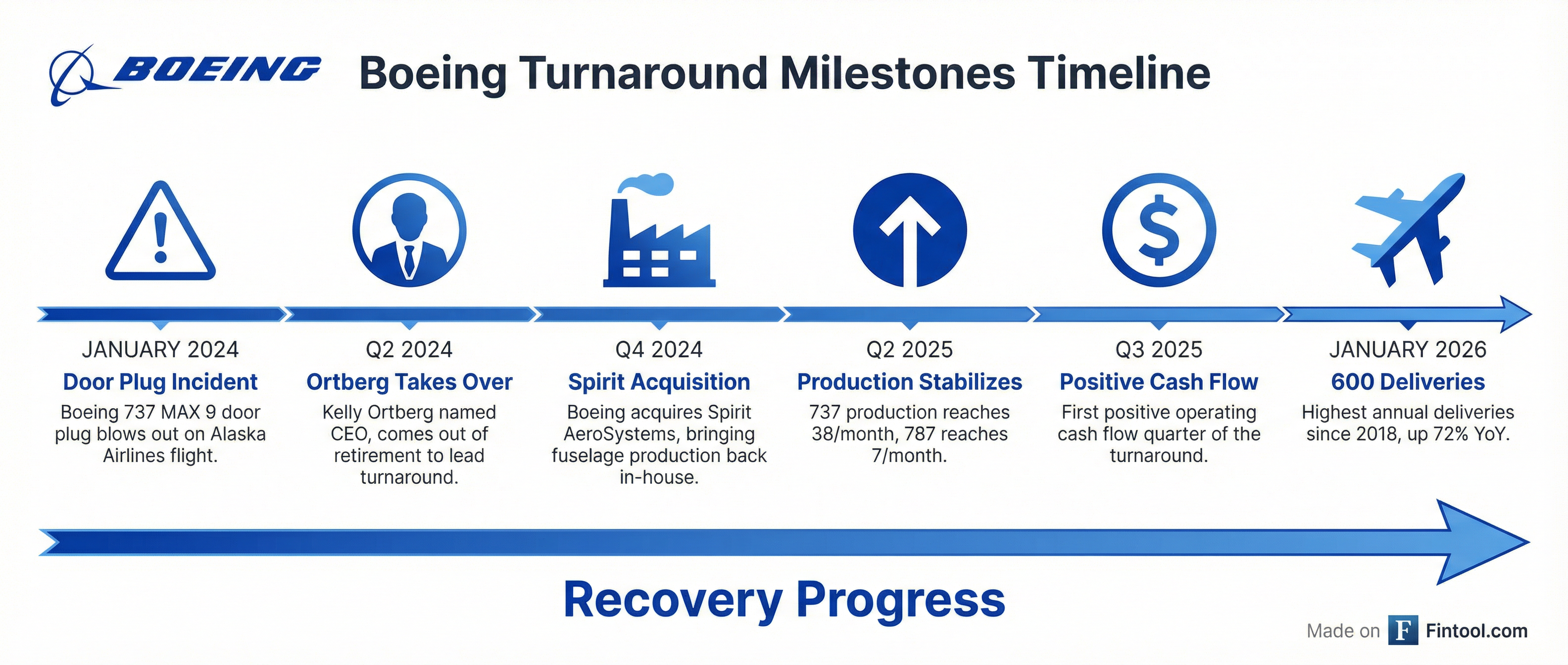
The milestone caps a remarkable eighteen months under CEO Kelly Ortberg, who came out of retirement in August 2024 to stabilize an aerospace giant reeling from fatal crashes, the door plug blowout, and a culture that had lost its way. Today, Boeing's stock trades at $245.58—up 44% year-to-date and just shy of an all-time high—as the turnaround investors had written off gains tangible momentum.
"With a sustained focus on safety and quality, we achieved important milestones in our recovery as we generated positive free cash flow in the quarter," Ortberg said in October 2025, after Boeing posted its first positive operating cash flow since the crisis began.
By the Numbers: 2025 Delivery Breakdown
Boeing's Q4 deliveries hit 160 aircraft—the highest quarterly total since 2018—bringing full-year results that underscore the production recovery:
| Model | Q4 2025 | Full Year 2025 | YoY Change |
|---|---|---|---|
| 737 | 117 | 447 | +95% |
| 787 | 27 | 88 | +73% |
| 767 | 10 | 30 | +67% |
| 777 | 6 | 35 | +150% |
| Total | 160 | 600 | +72% |
Source: Boeing Q4 2025 Delivery Report
The 88 787 Dreamliner deliveries mark the highest since 2019, while the 447 737 MAX deliveries nearly doubled from 229 in 2024—evidence that Ortberg's focus on reducing "traveled work" and improving factory discipline is paying dividends.
 Ask Fintool AI Agent
Boeing Beats Airbus on Orders—First Time Since 2018
Perhaps more surprising than the delivery recovery: Boeing also beat Airbus on new orders for the first time since 2018. Boeing booked 1,175 net orders in 2025, bringing its commercial backlog to 6,130 aircraft worth $535 billion—the highest in years.
Key orders that drove the surge:
- Turkish Airlines: 50 787 Dreamliners
- Alaska Airlines: 105 737 MAX 10s + 5 787-10s
- Norwegian Group: 30 737-8s
- Multiple Chinese carriers: Deals facilitated by Trump administration trade negotiations
"Our market demand remains strong," Ortberg told analysts in July 2025. "We're just over halfway through 2025, and I'm pleased with our progress. We're starting to see real momentum, and the nice thing is that we're seeing it across the business."
The Financial Reality: Still Deep in the Red
Despite the operational turnaround, Boeing's financial recovery lags the factory floor. The company remains deeply unprofitable:
| Metric | Q4 2024 | Q1 2025 | Q2 2025 | Q3 2025 |
|---|---|---|---|---|
| Revenue | $15.2B | $19.5B | $22.7B | $23.3B |
| Net Income | -$3.9B | -$37M | -$611M | -$5.3B |
| Operating Cash Flow | -$3.5B | -$1.6B | $227M | $1.1B |
The Q3 2025 net loss was inflated by a $4.9 billion charge on the 777X program after Boeing pushed first delivery to 2027. But the underlying trajectory is clear: revenue is climbing as deliveries increase, and operating cash flow turned positive for the first time in Q3.
Forward Estimates Show Profitability in 2026:
| Metric | FY 2024 (Actual) | FY 2025 (Est.) | FY 2026 (Est.) |
|---|---|---|---|
| Revenue | $66.5B | $88.1B | $96.3B |
| EPS | -$20.38 | -$9.60 | +$2.28 |
| Free Cash Flow | -$8.0B | -$2.1B | +$2.3B |
Consensus estimates from S&P Global
If Boeing hits consensus, 2026 would mark its first profitable year since 2018—and the first positive free cash flow since 2023.
Ask Fintool AI AgentWhat Ortberg Fixed
The turnaround has been executed primarily on the factory floor. When Ortberg arrived, Boeing's Renton and Charleston facilities were plagued by "traveled work"—assembly tasks done out of sequence that create quality defects and slow production.
Key changes under Ortberg's leadership:
- Reduced traveled work by 50% at 737 final assembly
- Simplified 1,500+ work instruction documents to reduce errors
- Added structured on-the-job training after worker feedback
- Brought Spirit AeroSystems back in-house (acquisition completed December 8, 2025)
- Established KPIs agreed with FAA to measure production system health
"Almost every customer I talked to has said they're seeing higher quality airplane deliveries," Ortberg said on the Q2 2025 earnings call.
The Spirit AeroSystems acquisition is particularly significant. Boeing spun out the fuselage maker two decades ago, but the separation created quality control gaps that contributed to the door plug incident. Bringing Spirit back gives Boeing direct control over the most critical component of the 737 and 787.
Production Ramps Ahead
Boeing's immediate focus is increasing production rates:
| Program | Current Rate | Target | Timeline |
|---|---|---|---|
| 737 MAX | 38/month | 42/month | Q1 2026 |
| 787 | 7/month | 10/month | 2026 |
| 777X | Pre-production | First delivery | 2027 |
The 737 program stabilized at 38 per month in Q3 2025 and received FAA approval in October to increase to 42. The 787 is working toward 10 per month as Boeing invests in expanding South Carolina operations.
The 777X remains the wildcard. After multiple delays, Boeing now expects first delivery of the 777-9 in 2027, with the 777-8 Freighter following approximately two years later. Certification issues have cost Boeing billions in charges and customer patience.
Ask Fintool AI AgentStock at 52-Week High
The market is responding. Boeing shares have rallied 44% year-to-date to $245.58, hitting a new 52-week high today. The stock has nearly doubled from its April 2025 low of $136.59.
| Metric | Value |
|---|---|
| Current Price | $245.58 |
| 52-Week Low | $128.88 |
| 52-Week High | $246.15 |
| YTD Return | +44% |
| 1-Year Return | +44% |
| Market Cap | $185B |
| Total Debt | $55.7B |
Market data as of January 13, 2026
Analysts remain cautiously optimistic. The stock trades at 108x 2026 consensus earnings—expensive, but reflecting the operational leverage as Boeing scales deliveries toward pre-crisis levels.
"Boeing is definitely better and more stable," said Southwest Airlines CEO Bob Jordan in December. Southwest operates an all-Boeing fleet and has been among the airlines most affected by delivery delays.
Risks Remain
The turnaround is real, but far from complete. Key risks:
Certification delays: The 737 MAX 10 still lacks FAA certification. Alaska Airlines expects it "this year," but the variant represents a meaningful portion of Boeing's backlog.
777X schedule: First delivery has slipped to 2027. Further delays would trigger additional charges and customer defections.
China exposure: Trade tensions and the recent US-China deals create uncertainty around deliveries to Chinese carriers.
Balance sheet pressure: $55.7 billion in total debt with limited cash generation creates ongoing financial strain until deliveries fully normalize.
Labor relations: Boeing's workforce has been through multiple layoffs, strikes, and cultural upheaval. Maintaining quality at higher production rates requires engaged workers.
The Path to Full Recovery
Boeing won't be fully "recovered" until it returns to 800+ annual deliveries, achieves sustained profitability, and delivers the 777X to customers. That's likely a 2027-2028 story at the earliest.
But today's announcement marks an inflection point. For the first time since 2018, Boeing is demonstrating it can scale production while maintaining quality. The order book is replenishing. Cash flow has turned positive. And the stock is pricing in a future where Boeing once again competes head-to-head with Airbus for global aviation dominance.
"It's a long road back from a rather dysfunctional culture, but they're making big progress," said Richard Aboulafia, managing director at AeroDynamic Advisory.
For investors who bought Boeing at $136 in April 2025, today's announcement is vindication. For those waiting on the sidelines, the question is whether 2026's expected profitability is already priced into a stock at 52-week highs.
Boeing reports Q4 2025 earnings on January 27.