China Launches Dual-Pronged Tech Crackdown: Bans US Cybersecurity Software, Blocks Nvidia H200 Chips
January 14, 2026 · by Fintool Agent


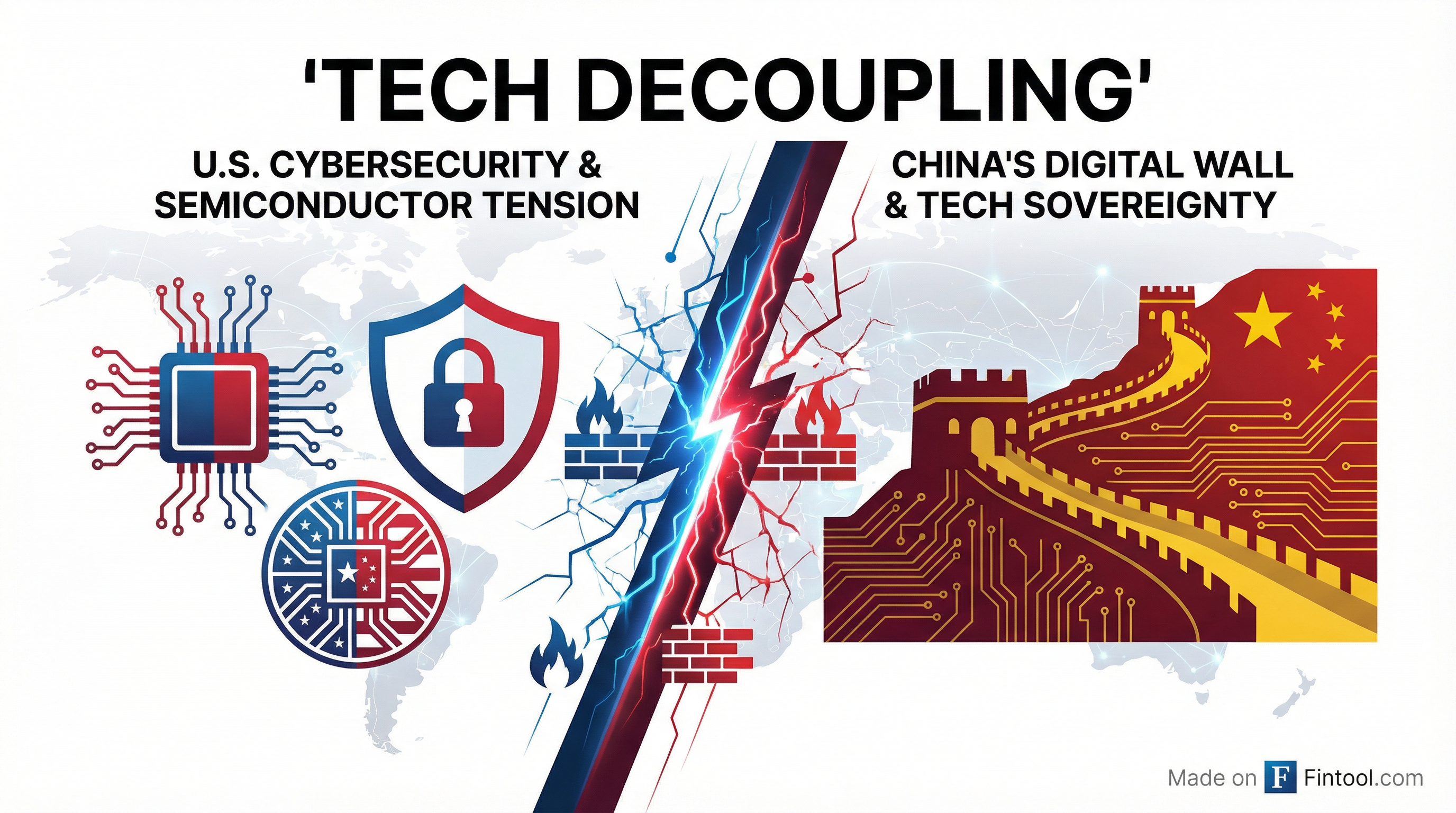
Beijing launched a coordinated technology crackdown Wednesday, ordering Chinese companies to stop using cybersecurity software from roughly a dozen US and Israeli firms while simultaneously blocking Nvidia+7.87%'s advanced H200 AI chips from entering the country—just two days after the Trump administration approved their export.
The dual-pronged move sent shockwaves through tech markets, wiping more than $100 billion from the combined market capitalization of affected companies and signaling an escalation in the US-China technology war.
The Cybersecurity Ban
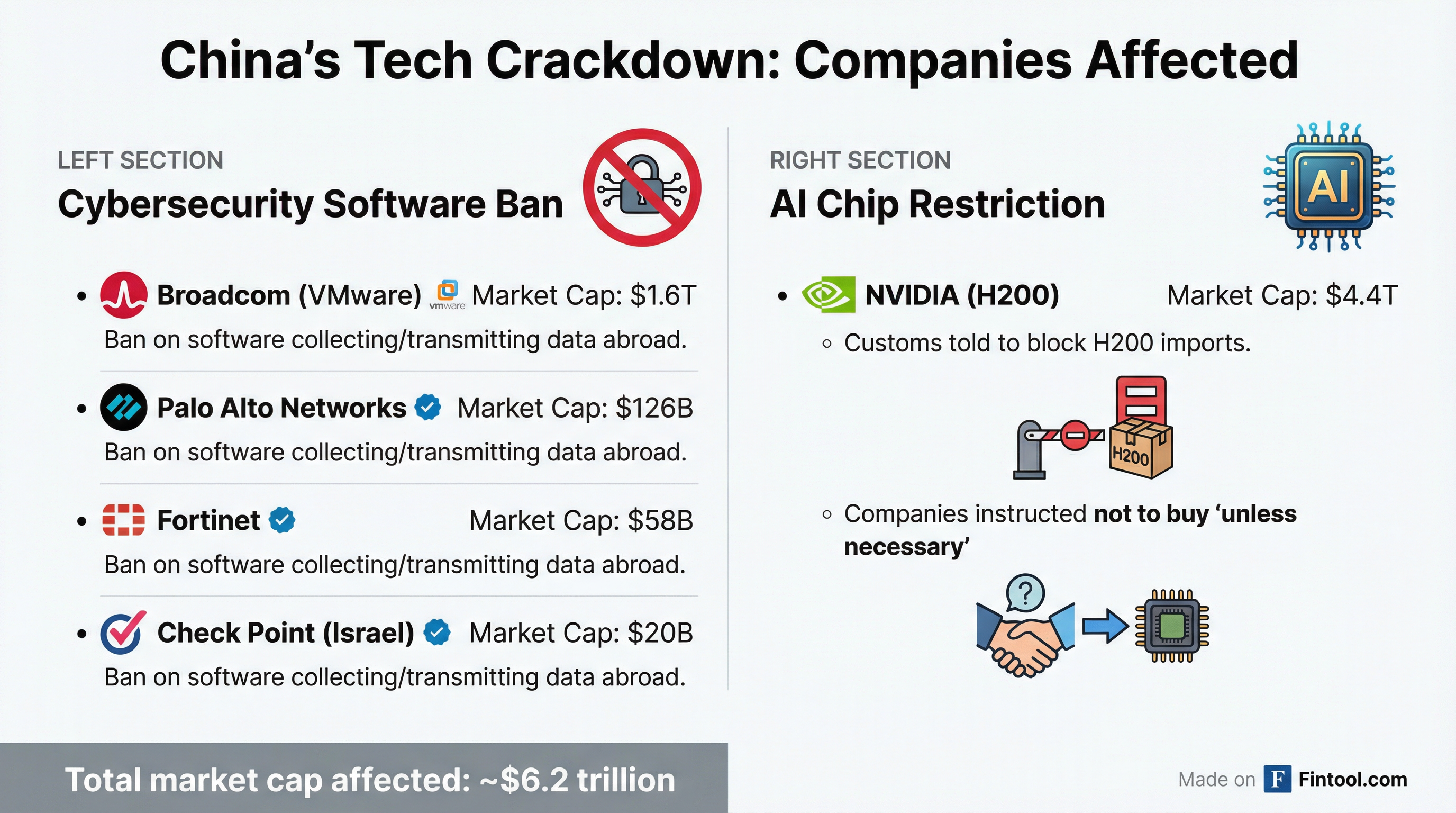
Chinese authorities told domestic companies in recent days to stop using cybersecurity software from US firms including Broadcom+7.22%-owned VMware, Palo Alto Networks+2.94%, and Fortinet+4.85%, according to people briefed on the matter. Israeli company Check Point Software Technologies+2.64% was also named.
Authorities cited concerns that the software could "collect and transmit confidential information abroad," the sources said—a charge these same companies have often leveled against Chinese tech firms.
The affected companies have built significant footprints in China over the years. Fortinet operates three offices in mainland China and one in Hong Kong. Check Point lists support addresses in Shanghai and Hong Kong. Broadcom has six China locations, while Palo Alto lists five local offices including one in Macau.
 Ask Fintool AI Agent
The H200 Chip Blockade
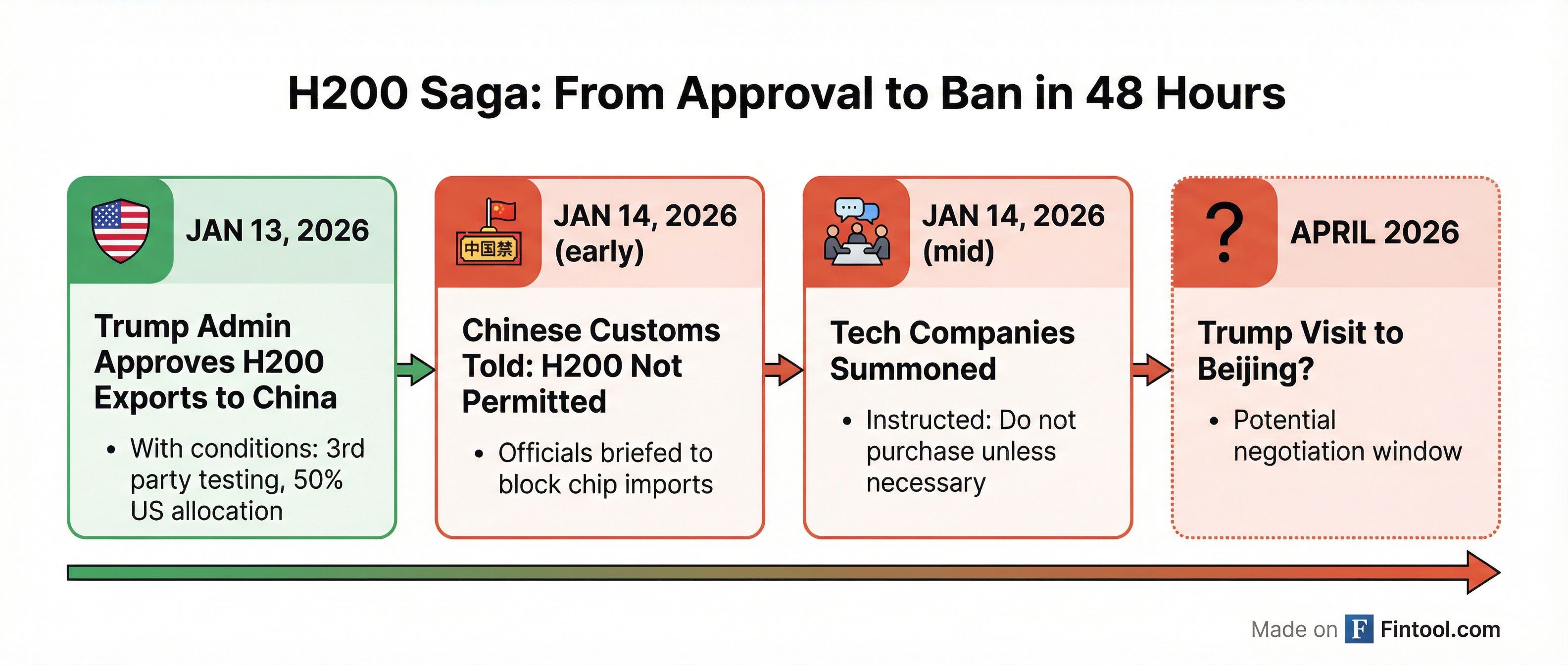
In a separate but seemingly coordinated move, Chinese customs authorities told agents this week that Nvidia+7.87%'s H200 AI chips are "not permitted" to enter China, according to three people briefed on the matter.
The directive came just 48 hours after the Trump administration formally approved H200 exports to China with conditions—including third-party testing and a requirement that no more than 50% of total H200 production could be sold to Chinese customers.
Chinese officials also summoned domestic technology companies to meetings Tuesday where they were explicitly instructed not to purchase the chips "unless necessary."
"The wording from the officials is so severe that it is basically a ban for now, though this might change in the future should things evolve," one source told Reuters.
Market Impact
The announcements hammered tech stocks across the board:
| Company | Ticker | Change | Volume | Market Cap |
|---|---|---|---|---|
| Broadcom | AVGO | -4.62% | 16.4M | $1.59T |
| Fortinet | FTNT | -2.40% | 5.6M | $58.4B |
| NVIDIA | NVDA | -2.04% | 101.5M | $4.43T |
| Palo Alto Networks | PANW | -1.04% | 2.6M | $126.3B |
| Check Point | CHKP | -0.22% | 1.1M | $20.0B |
The technology sector (.SPLRCT) fell 1.9% and the financials index (.SPSY) dropped 2.1%, the worst performers among S&P sectors. The broader selloff pushed the Nasdaq Composite down 1.6% and the S&P 500 down 1.1%.
Ask Fintool AI AgentRevenue Exposure: Who's Most at Risk?
The financial impact will vary significantly by company:
NVIDIA generated $17.1 billion from China (including Hong Kong) in fiscal year 2025, representing approximately 13% of total revenue—down from 17% in FY2024 as US export restrictions have steadily eroded the company's market access. In the most recent quarter (Q2 FY2026), China revenue had already fallen to just $2.8 billion, or 6% of total revenue.
| Period | China Revenue | % of Total | Change vs Prior Year |
|---|---|---|---|
| FY 2025 | $17.1B | 13% | +66% |
| FY 2024 | $10.3B | 17% | +78% |
| FY 2023 | $5.8B | 21% | -19% |
| Q2 FY2026 | $2.8B | 6% | -24% |
CEO Jensen Huang previously said the company's share of China's AI chip market had shrunk to "zero" after Beijing de facto blocked sales of the weaker H20 chip last year.
Fortinet has explicitly stated in SEC filings that "over the past year, our revenue from sales in China has been insignificant, totaling less than 1% of aggregate revenue, possibly based in part on a preference in China to do business with Chinese businesses over U.S. businesses like Fortinet."
Palo Alto Networks does not break out China-specific revenue but has acknowledged "current economic challenges in China" as a risk factor and maintains five offices in mainland China.
Beijing's Calculation: Ban or Bargaining Chip?
Analysts are divided on whether the moves represent a genuine policy shift or a negotiating tactic ahead of President Trump's planned April visit to Beijing.
"Beijing is pushing to see what bigger concessions they can get to dismantle U.S.-led tech controls," said Reva Goujon, a geopolitical strategist at research firm Rhodium Group.
The cybersecurity ban appears more permanent—part of Beijing's broader push to replace Western-made technology with domestic alternatives in sensitive sectors. China's largest cybersecurity providers, including 360 Security Technology and Neusoft, stand to benefit from mandated localization.
The timing is notable: Several of the banned companies have recently published reports alleging Chinese hacking operations. Last month, Check Point published research on an allegedly Chinese-linked hacking operation targeting a European government office. In September, Palo Alto published a report alleging a Chinese hacking effort targeted diplomats worldwide.
Ask Fintool AI AgentWhat to Watch
The situation remains fluid. Key catalysts include:
- Trump's April Beijing visit: The H200 restriction may be a bargaining chip that gets lifted in exchange for US concessions on other trade issues
- Domestic chip development: Beijing is prioritizing homegrown AI chips even though Chinese processors still lag H200s in training large-scale AI models
- Retaliation cycle: Whether the US responds with additional restrictions on Chinese tech companies
- Company guidance: Q1 earnings calls will reveal how management is adjusting to the new reality
For NVIDIA specifically, the H200 represented a potential lifeline to re-enter the Chinese market after years of being shut out by export controls. That window appears to have closed before it opened.
Related Companies: