Credit Spreads Hit 2007 Lows: The $435 Billion Bet That History Won't Repeat
January 16, 2026 · by Fintool Agent


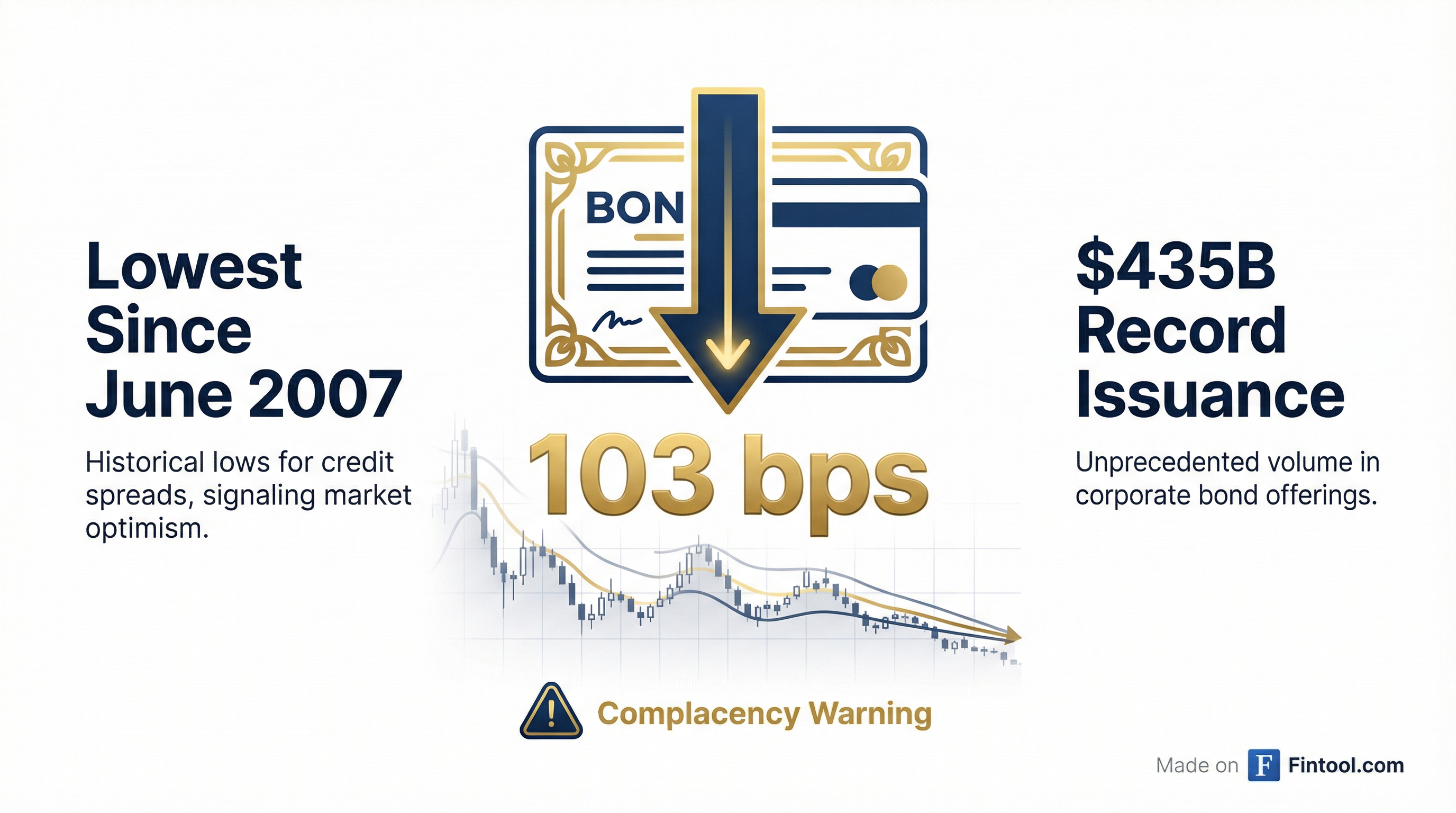
Corporate bond spreads have collapsed to 103 basis points—their narrowest level since June 2007—as investors pile into credit markets with an appetite that two of the world's largest asset managers now call dangerously complacent. The timing is uncomfortable: the last time spreads were this tight, they were months away from a catastrophic blowout that defined the global financial crisis.
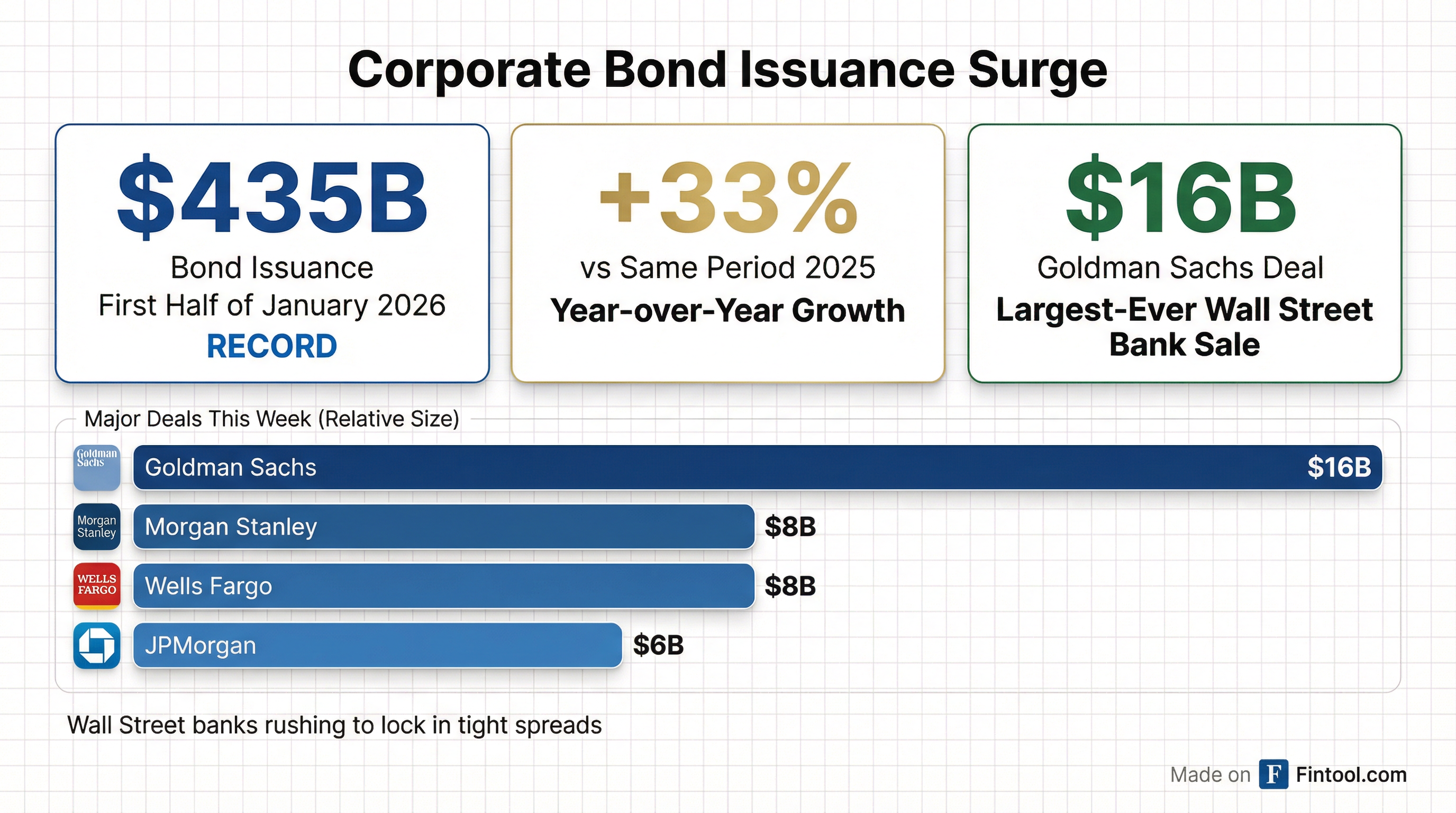
Companies are capitalizing on the euphoria. Bond issuance has hit $435 billion in the first half of January alone—a record for the period and more than 33% above last year's pace—capped by Goldman Sachs+4.31%' $16 billion deal, the largest investment-grade offering ever from a Wall Street bank.
Yet Aberdeen Investments and Pimco are sounding the alarm: the compensation for taking credit risk is now perilously thin.
The Numbers That Should Worry You
The Bloomberg index tracking corporate bonds across currencies and credit ratings shows yield premiums over Treasuries at their tightest in nearly two decades. For context:
| Metric | Current | Historical Context |
|---|---|---|
| Investment-Grade Spread | 103 bps | Lowest since June 2007 |
| High-Yield Spread | Multi-decade lows | Tightest in nearly 20 years |
| Long-Term IG Average | 150 bps | Current is 31% below average |
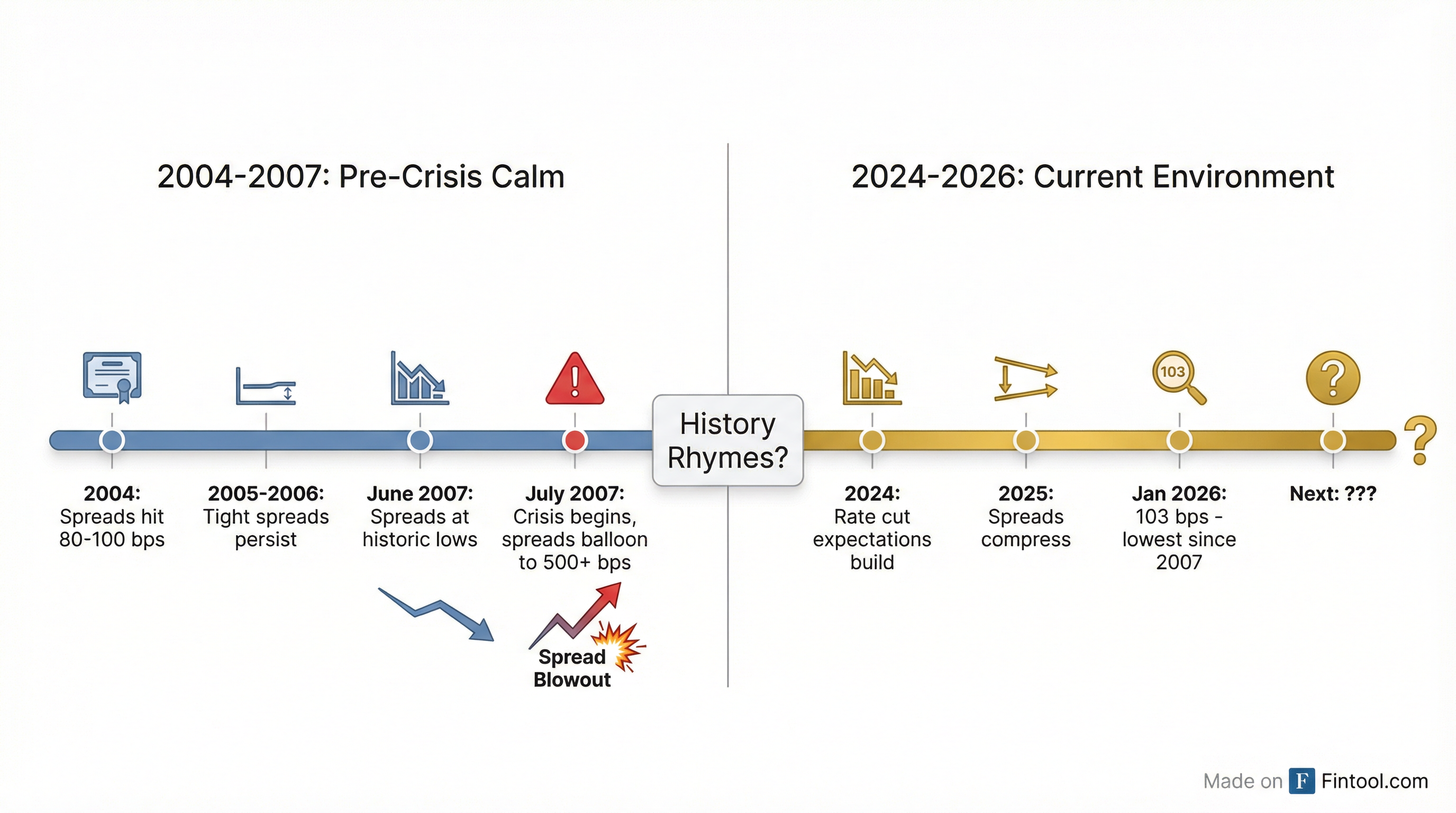
| Pre-Crisis (2004-07) Range | 80-100 bps | Persisted for 3+ years before GFC |
Source: Bloomberg
"Complacency should be the scariest word in risk markets right now," said Luke Hickmore, investment director for fixed income at Aberdeen Investments. "All you can do is not lean too hard into high-risk areas."
 Ask Fintool AI Agent
Wall Street's Borrowing Bonanza
The record issuance reflects both corporate opportunism and genuine financing needs. Wall Street's largest banks rushed to market this week following quarterly earnings, locking in historically cheap funding.
| Issuer | Deal Size | Notes |
|---|---|---|
| Goldman Sachs+4.31% | $16 billion | Largest-ever Wall Street bank IG deal |
| Morgan Stanley+2.34% | $8 billion | Post-earnings issuance |
| Wells Fargo+2.09% | $8 billion | Post-earnings issuance |
| JPMorgan+3.95% | $6 billion | Kicked off bank issuance week |
Goldman's offering—which came in $4 billion larger than the minimum it initially sought—reflects both strong investor demand and the bank's significant debt maturities coming due in 2026. The deal priced at a 1.05 percentage-point premium above Treasuries on the longest-tenored bonds.
The Complacency Problem
Pacific Investment Management Co. strategists Tiffany Wilding and Andrew Balls delivered their own warning in a research note this month: "Strong recent returns have fueled complacency."
Pimco is becoming more selective about where it deploys capital within credit markets, expecting fundamentals to deteriorate over time—a stark contrast to the market's current risk-on posture.
The problem isn't that tight spreads necessarily predict disaster. History shows credit spreads can stay compressed for extended periods when conditions align:
What's supporting tight spreads:
- Rate cut expectations: The Federal Reserve and other central banks are expected to continue easing policy
- Economic resilience: The World Bank raised its 2026 global GDP forecast to 2.6%
- Strong technicals: $6+ trillion in money market fund assets could flow into credit as rates fall
- Solid fundamentals: Corporate defaults have held near long-term averages
What's creating risk:
- Unpredictable U.S. policy: Tariffs, regulatory shifts, and political uncertainty
- Geopolitical tensions: Ongoing global flashpoints
- Hidden leverage: Opaque corporate balance sheets and private credit exposure
- Thin compensation: At 103 bps, spreads offer little cushion for unexpected shocks
Ask Fintool AI AgentThe 2007 Parallel
The 2007 comparison is impossible to ignore. From 2004 to mid-2007, investment-grade spreads traded between 80-100 basis points for more than three years—well below the long-term average of 150 bps. Then came July 2007.
Credit spreads began widening in June 2007, accelerating as the subprime mortgage crisis erupted. By July 30, 2007, spreads had ballooned above 500 basis points. The damage was swift and brutal.
That's not a prediction—it's a reminder that credit markets can reprice violently when complacency gives way to fear. The triggers in 2007 were subprime mortgages and structured credit. Today's potential catalysts look different: private credit opacity, commercial real estate stress, or a policy shock that catches markets off guard.
What To Watch
Near-term:
- Whether the issuance wave continues without disrupting performance
- Any spread widening that tests investor conviction
- Fed communications on the pace and magnitude of rate cuts
Medium-term:
- Private credit losses surfacing in public markets
- Commercial real estate refinancing pressures
- Corporate earnings trends and balance sheet quality
Structural:
- How long money market fund outflows take to materialize as rates fall
- Whether tight spreads encourage excessive leverage
For now, demand shows no sign of cooling. Asian credit markets have been a standout, with high-quality dollar-denominated bonds from Asian issuers returning 8.7% in 2025—outperforming comparable U.S. debt by roughly one percentage point.
The paradox remains: investors don't want to miss out, but the margin for error is shrinking by the day.
Ask Fintool AI AgentRelated: Goldman Sachs+4.31% | Morgan Stanley+2.34% | Wells Fargo+2.09% | JPMorgan Chase+3.95% | Blackrock+0.15% | Bank of America+2.89% | Citigroup+5.98%