DOJ Probes Netflix for 'Exclusionary Conduct' as Warner Deal Faces Antitrust Gauntlet
February 6, 2026 · by Fintool Agent



The Department of Justice is casting a wide net into Netflix's business practices, issuing civil subpoenas that ask entertainment companies to describe "any other exclusionary conduct on the part of Netflix that would reasonably appear capable of entrenching market or monopoly power"—signaling that regulators are examining not just whether the $82.7 billion Warner Bros. Discovery deal would harm competition, but whether Netflix is already engaging in conduct that could create a monopoly.
The probe, revealed Friday through a civil subpoena viewed by The Wall Street Journal, suggests the DOJ's antitrust division is pursuing a more aggressive theory of harm than a standard horizontal merger review—one that could complicate Netflix's path to regulatory approval even as the streaming giant maintains the deal is "pro-consumer, pro-innovation, pro-creator and pro-growth."
What the DOJ Is Asking
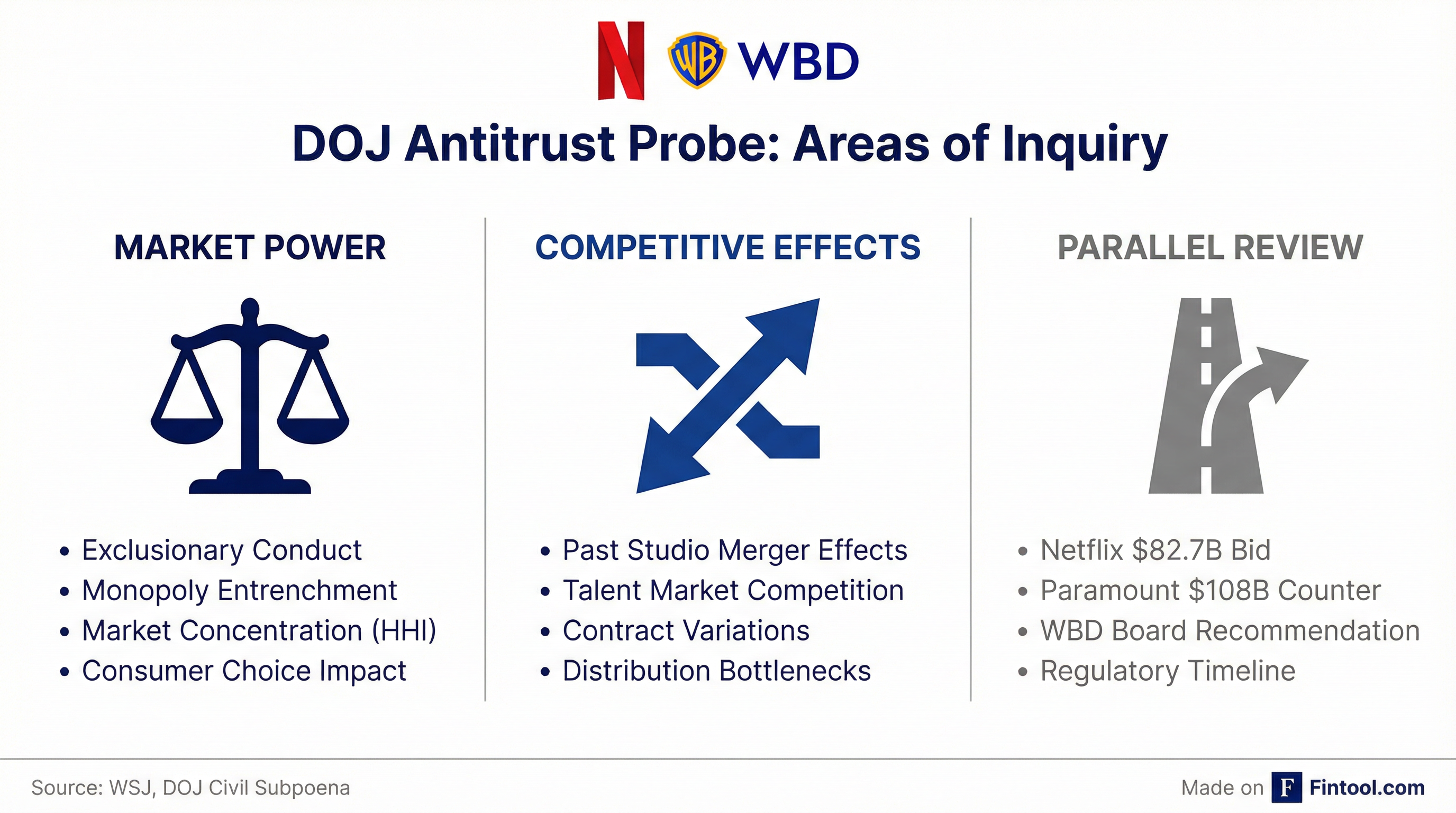
The subpoena sent to an unnamed entertainment company reveals three distinct lines of inquiry beyond typical merger review:
1. Exclusionary Conduct: The DOJ is explicitly asking whether Netflix has engaged in practices that entrench market power—language that suggests regulators may be evaluating Netflix's existing conduct, not just the merger's prospective effects.
2. Past Merger Effects: The agency sought information on "how past mergers of studios or distributors had affected competition for creative talent"—a question that echoes the DOJ's successful 2022 challenge to the Penguin Random House/Simon & Schuster merger, where regulators argued the deal would harm authors, not consumers.
3. Talent Contracts: The DOJ asked how talent contracts vary between studios—suggesting concern that a combined Netflix-WBD could leverage its scale to disadvantage writers, directors, and actors in negotiations.
The focus on labor market effects is significant. The DOJ's 2023 Merger Guidelines, issued under the Biden administration, explicitly allow regulators to block deals that harm workers, not just consumers. Whether the Trump DOJ will apply these guidelines aggressively remains an open question.
 Ask Fintool AI Agent
The Market Power Question
The core antitrust question is deceptively simple: Is Netflix a monopoly?
Netflix co-CEO Ted Sarandos testified before the Senate on February 3 that the combined company would hold approximately 21% of the U.S. SVOD market—below the 30% threshold that triggers presumptive antitrust concern under DOJ guidelines.
But the answer depends entirely on how regulators define the market:
| Market Definition | Netflix Share | Netflix + WBD | Antitrust Risk |
|---|---|---|---|
| All TV viewing (cable + streaming + broadcast) | 9% | 10% | Low |
| Streaming only (incl. YouTube, ad-supported) | 9% | 10.4% | Low |
| SVOD only (subscription streaming) | 38% | 55%+ | High |
| Premium scripted content | Higher | Higher | Very High |
Critics argue that Netflix's defenders cherry-pick the broadest possible market definition. The American Action Forum notes that using a narrow SVOD-only market—the most natural comparison for a subscription-versus-subscription analysis—would produce HHI figures well above the DOJ's structural presumption thresholds.
"Netflix has long been a monopoly under even the most generous market definition," argues one antitrust paper. "Allowing it to take control of Warner Bros. would hand it overwhelming dominance of the video streaming space."
Competing Bids Complicate the Picture
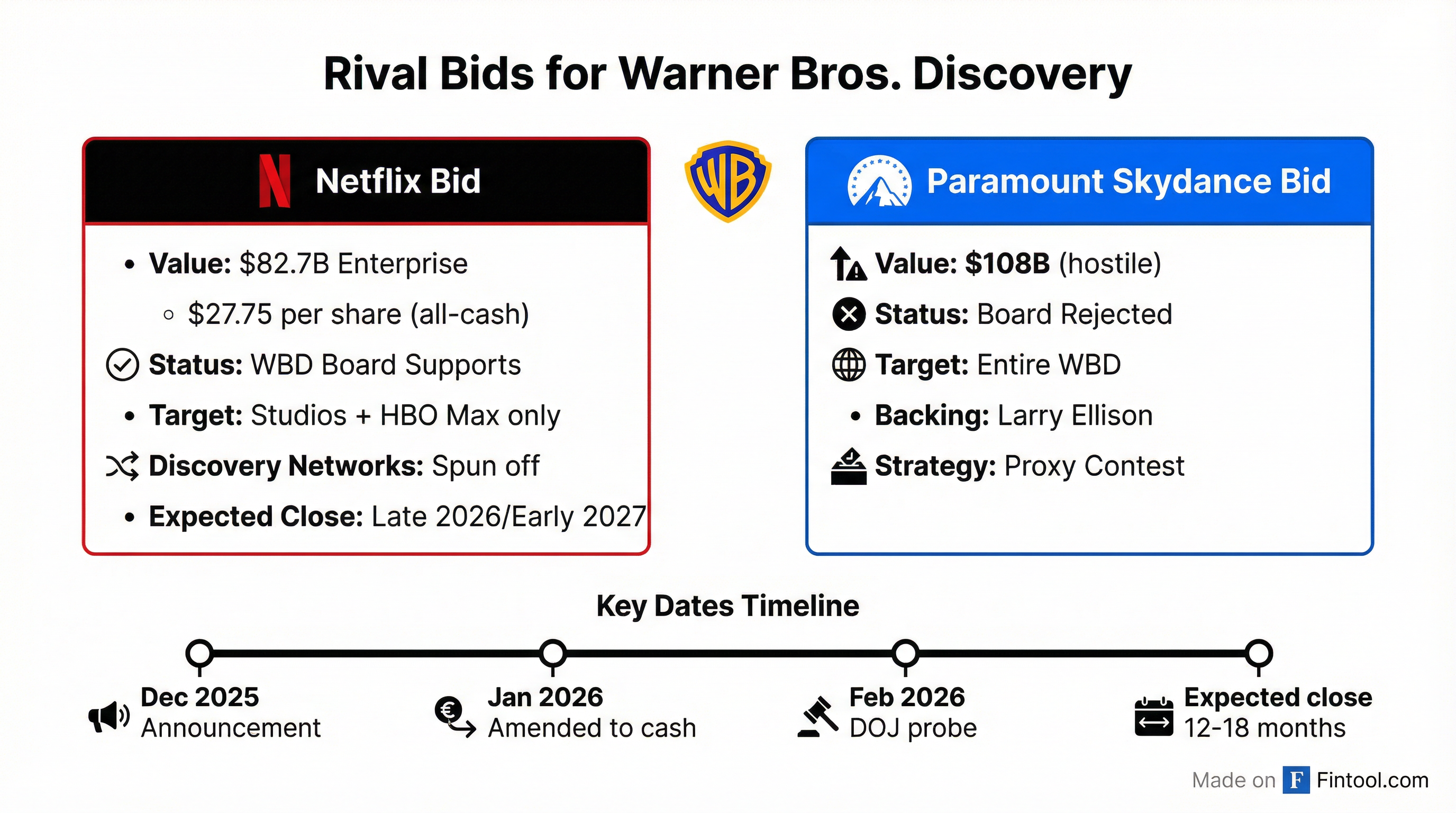
The DOJ is conducting a parallel review of Paramount Skydance's hostile $108 billion bid for all of Warner Bros. Discovery—not just the streaming and studios assets Netflix is targeting.
| Feature | Netflix Bid | Paramount Skydance Bid |
|---|---|---|
| Deal Value | $82.7B enterprise ($72B equity) | $108B (all of WBD) |
| Structure | All-cash, $27.75/share | Hostile |
| Target Assets | Studios + HBO Max | Entire company |
| Linear Networks | Spun off as Discovery Global | Included |
| Board Support | Yes (unanimous) | No (recommends reject) |
| Political Support | Faces MAGA opposition | Larry Ellison backing |
The Paramount bid's backers include Larry Ellison, who has cultivated a close relationship with President Trump—a factor that could influence regulatory outcomes if the administration views antitrust through a political lens.
Netflix spokesperson says the DOJ is conducting a "standard review" and the company expects approval. But the breadth of the subpoena questions suggests anything but standard.
Ask Fintool AI AgentWhy It Matters for Investors
The DOJ's inquiry into Netflix's existing conduct—not just the merger's effects—introduces a new layer of risk:
Deal Break Risk: Netflix faces a $5.8 billion reverse termination fee if the deal fails due to regulatory issues. If the DOJ pursues a theory that Netflix's pre-merger conduct is anticompetitive, defending that position could take years.
Timeline Uncertainty: The transaction was expected to close 12-18 months from December 2025, targeting late 2026 or early 2027. A protracted antitrust battle could push this well into 2028.
Precedent: If the DOJ successfully argues that Netflix's scale creates exclusionary effects on talent and content markets, it would establish a template for blocking future streaming consolidation—with implications for Amazon, Disney, and Comcast.
Political Overlay: President Trump has repeatedly demanded CNN's sale in connection with any WBD transaction. The Heritage Foundation's Oversight Project has distributed a report to the White House attacking Netflix as a "propaganda state." These political currents could influence how aggressively regulators pursue the case.
What to Watch
-
DOJ Second Request: Has the department issued a formal "second request" for additional information—the clearest signal of a deep-dive investigation?
-
Testimony from Talent: Will writers, directors, or actors testify about Netflix's negotiating practices?
-
European Commission: The EC is conducting its own competition inquiry. A negative ruling there could complicate U.S. approval.
-
Paramount's Proxy Fight: Paramount Skydance is preparing director nominations for a proxy contest. If WBD shareholders show interest in the hostile bid, it could pressure the Netflix deal.
-
WBD Stockholder Vote: Expected April 2026. The merger agreement includes a $2.8 billion termination fee if WBD accepts a superior proposal.
Netflix, Paramount, Warner Bros. Discovery, and the DOJ declined to comment or did not immediately respond to requests for comment.
Ask Fintool AI AgentRelated companies: Netflix · Warner Bros. Discovery · Paramount Skydance · Walt Disney · Comcast · Amazon