Expeditors Webinar Warns Importers: Don't File for IEEPA Refunds Yet as $175B Recovery Remains Unclear
February 24, 2026 · by Fintool Agent


Expeditors International hosted an emergency webinar yesterday for importers scrambling to understand the fallout from Friday's Supreme Court ruling that struck down President Trump's IEEPA tariffs. The message from the $21 billion freight forwarder's customs experts was blunt: wait before filing for refunds, even as over $175 billion in collected duties may eventually need to be returned.
"If I had $1 for all the emails that I've gotten so far with companies telling me they want to be first in line, I completely understand that," said Stephanie Holloway, Expeditors' Director of Customs Operations for the Americas. "However, we're in a bit of a pickle."
The "pickle" is that CBP has not issued guidance on how to process refunds for unliquidated entries, and filing incorrectly could jeopardize claims entirely.
The 72-Hour Tariff Scramble
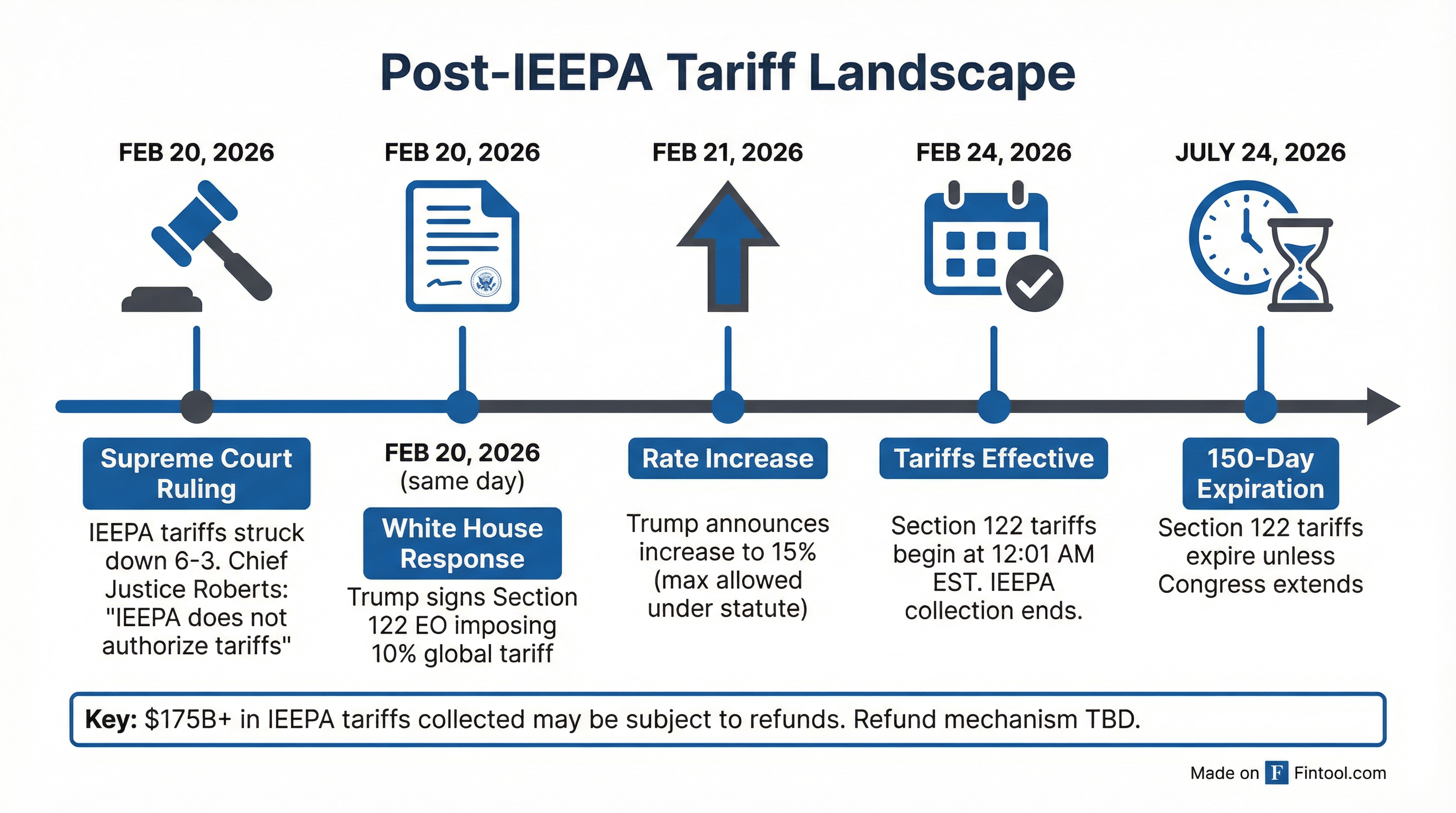
The Supreme Court's 6-3 ruling on February 20 invalidated all IEEPA-based tariffs—including the fentanyl tariffs on China, Mexico, Canada, and Hong Kong, the reciprocal tariffs across most trading partners, and specific levies on Brazil and India.
Within hours, President Trump signed an executive order imposing a replacement 10% global tariff under Section 122 of the Trade Act of 1974—a never-before-used statute. By February 21, Trump announced via social media that the rate would increase to 15%, the statutory maximum.
The new tariffs took effect at 12:01 AM EST today, February 24. They expire in 150 days—July 24, 2026—unless Congress votes to extend them.
"We know we're in pretty confident that [CBP updating systems] will happen before midnight tonight," Expeditors' Senior Customs Advisor Ted Henderson said during the webinar, "but there's a lot of action that CBP has to do in order to make these various orders happen."
Adding to the complexity: DHS isn't funded right now, meaning the majority of CBP personnel are working without pay.
 Ask Fintool AI Agent
The $175 Billion Refund Question
The Supreme Court did not establish any mechanism for refunds. It did not require the government to return the duties. It said nothing about timelines.
"Unfortunately, the Supreme Court decision did not address, and that is refunds for tariffs already paid by importers," Henderson acknowledged.
Justice Kavanaugh, in his dissent, warned that returning the estimated $175 billion collected under IEEPA "is likely to be a mess." President Trump echoed this at a press conference, stating that "the fight over repayment could take years and would likely be subject to significant litigation."
| Stakeholder | Position on Refunds |
|---|---|
| Supreme Court | Silent—no mechanism or requirement established |
| DOJ (prior statement) | Committed to refund process if IEEPA found unlawful |
| Justice Kavanaugh | "Likely to be a mess" |
| President Trump | "Could take years... subject to significant litigation" |
| Sen. Cantwell (D-WA) | Sent letter demanding "fair and expeditious" repayment |
Two Democrats have already introduced legislation requiring CBP to complete refunds within 90 days, though passage is unlikely.
All IEEPA-related litigation will be handled by the Court of International Trade, which has "unique jurisdiction and unique decision-making power."
What Importers Should Do Now
Expeditors laid out a clear two-track approach depending on entry status:
Unliquidated Entries (Filed Within ~314 Days)
Wait. "Guessing right now and shooting in the dark is a terrible idea," Holloway emphasized.
Post Summary Corrections (PSCs)—the normal mechanism to request refunds—should not be filed until CBP issues guidance. Filing incorrectly means the correction enters "CBP control" and cannot be retrieved.
Liquidated Entries (Already Closed by CBP)
File timely protests. Importers have 180 days from liquidation to file.
"If you're getting close to that 180-day window, I would absolutely file a protest," Holloway advised. She noted importers can file their own protests through the ACE system—"It's just like filing your own taxes. You are allowed to do that."
For larger exposures, companies should discuss Court of International Trade litigation options with legal teams. The window is up to 2 years from when tariffs were enacted—roughly one year remaining for the earliest IEEPA duties from February 2025.
Ask Fintool AI AgentSection 122: The New Tariff Regime
The replacement tariffs under Section 122 are structurally different from IEEPA:
| Feature | IEEPA Tariffs (Invalidated) | Section 122 Tariffs (New) |
|---|---|---|
| Legal Basis | Emergency powers | Balance of payments |
| Rate Flexibility | Unlimited | Max 15% |
| Duration | Indefinite | 150 days unless Congress extends |
| Country-Specific | Yes (varied by country) | No (flat global rate) |
| USMCA Exemption | Partial | Full exemption |
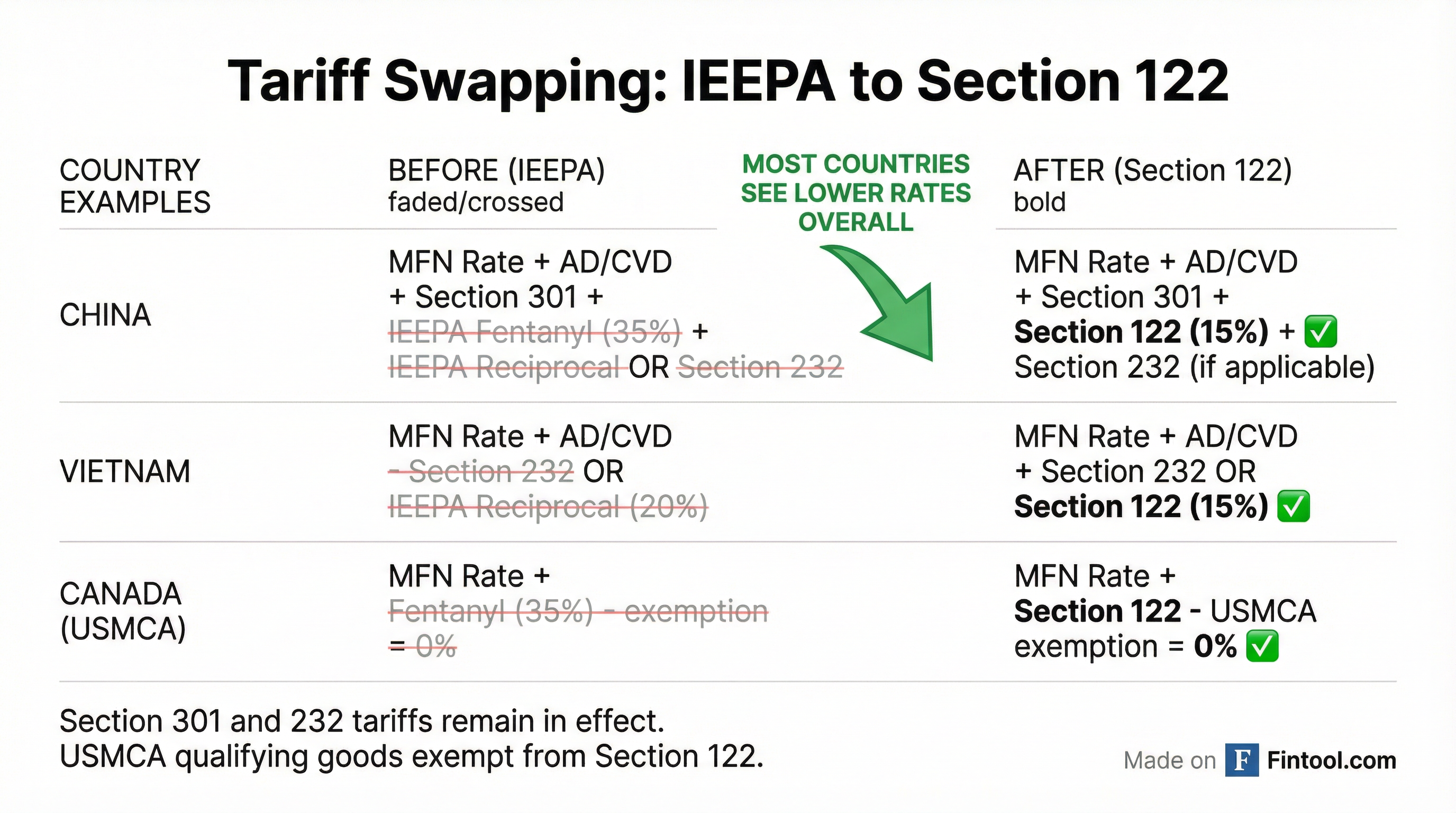
For most countries, the net effect is lower total tariffs—Vietnam drops from 20% reciprocal to 15% Section 122, for example. But countries like Japan and Korea that had lower negotiated rates may see slight increases.
Section 301 and Section 232 tariffs remain fully in effect.
A narrow transit exemption applies: goods loaded onto vessels before midnight tonight (February 24) and entered before February 28 are temporarily exempt.
Legal Vulnerabilities and What's Next
Expeditors' Henderson was candid about Section 122's legal weaknesses: "This question of whether a trade deficit lines up with a balance of payment deficit is a huge question."
The government's own lawyers argued during the IEEPA litigation that Section 122 "really didn't have application if the president declared an emergency around trade deficits." Trade policy experts expect legal challenges, though the 150-day tariffs may expire before courts rule.
The administration is already preparing for this scenario. USTR has announced new Section 301 investigations targeting:
- Industrial excess capacity (likely China)
- Forced labor practices
- Discrimination against U.S. technology companies (likely EU)
- Sector-specific practices in rice, seafood, and agricultural products
"We should anticipate more of that coming at us as things go," Henderson warned.
Ask Fintool AI AgentMarket Reaction
Expeditors shares rallied 4.1% on Friday following the Supreme Court ruling, reaching $156.30. The stock gave back some gains yesterday, closing at $149.63 (-3.3%), as markets digested the implementation details and refund uncertainty.
| Ticker | Company | Price | Change |
|---|---|---|---|
| Expd | Expeditors International | $149.63 | -3.3% |
| Ups | United Parcel Service | $115.02 | -1.5% |
| FDX | FedEx | — | — |
| CHRW | C.H. Robinson | $177.20 | -6.8% |
The trade-weighted average U.S. tariff rate under the new Section 122 regime at 15% is 13.2%, compared with 15.3% before the Supreme Court ruling and 8.3% if no replacement had been enacted.
The Bottom Line
Expeditors' Holloway summed up the situation for importers: "You're going to be playing that whole game again of what is going to be my duty rate."
The immediate priorities:
- Track all IEEPA-affected entries across all brokers using ACE reporting
- Segment by liquidation status to determine protest timelines
- Wait for CBP guidance before filing for refunds on unliquidated entries
- Engage legal teams on CIT litigation options for larger exposures
- Monitor the 301 investigations that will determine tariff rates post-July
"We know the 122 is temporary, and that it will come with... more durable sections," Holloway noted. "We know the administration will make good on that."