GDP Surges to 4.3% While Consumer Confidence Sinks to 8-Month Low
December 23, 2025 · by Fintool Agent


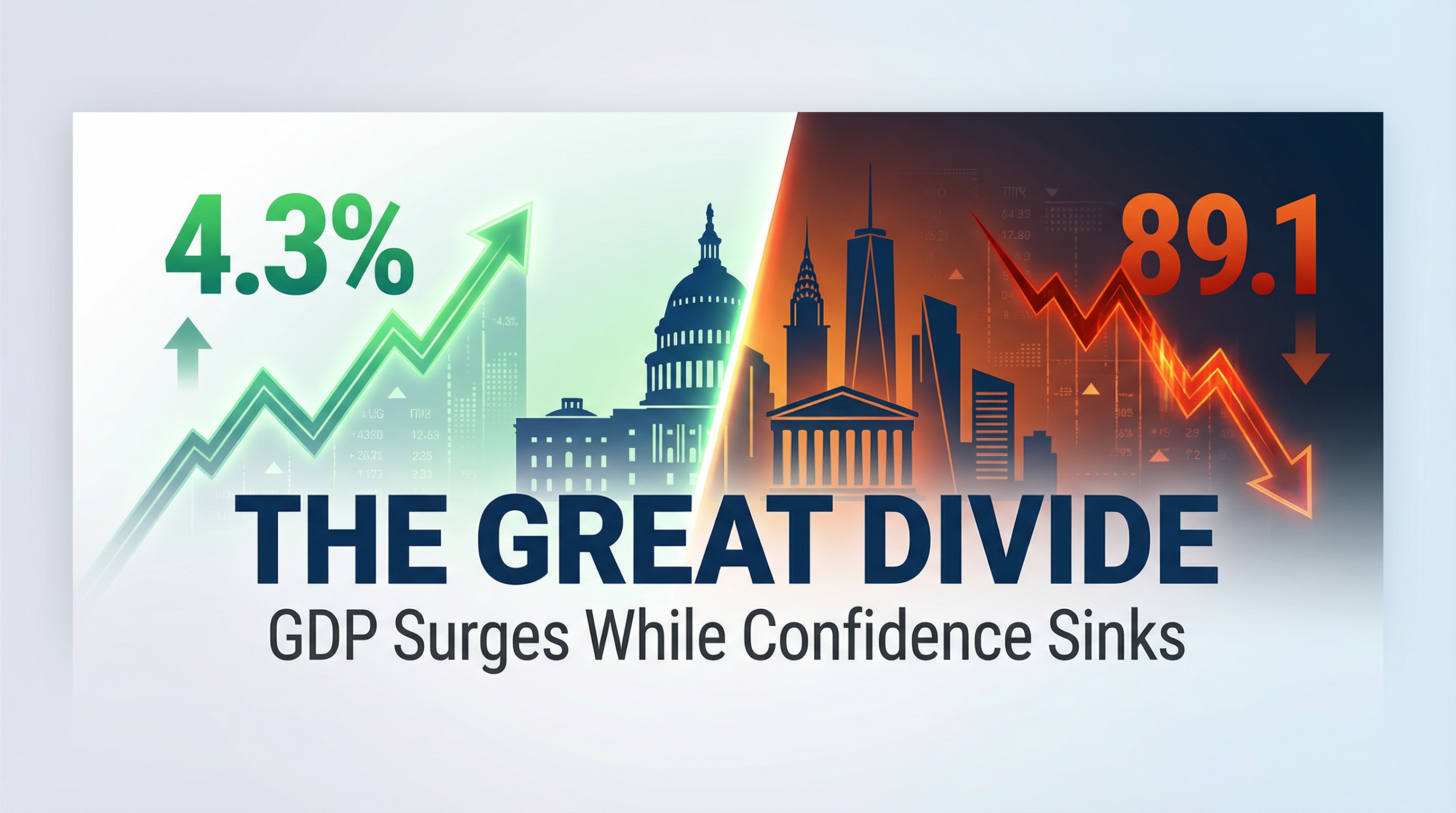
The U.S. economy posted its strongest growth in two years during the third quarter, yet consumer confidence just recorded its fifth consecutive monthly decline—a divergence that encapsulates the increasingly bifurcated nature of America's K-shaped recovery.
Third-quarter GDP rose at a 4.3% annualized rate, the Bureau of Economic Analysis reported Tuesday, far exceeding the 3.3% consensus estimate and accelerating from Q2's 3.8% pace. Hours later, the Conference Board revealed that consumer confidence fell to 89.1 in December—the lowest reading since April when tariffs roiled markets—as the Present Situation Index plunged 9.5 points and the Expectations Index remained stuck below the 80-point recession threshold for an 11th consecutive month.
The S&P 500+1.92% closed at a fresh record high of 6,909, up 0.4%, as markets chose to focus on the growth data. The 10-year Treasury yield rose 3 basis points to 4.20%, while January rate-cut odds fell to 13% from 20% a day earlier.
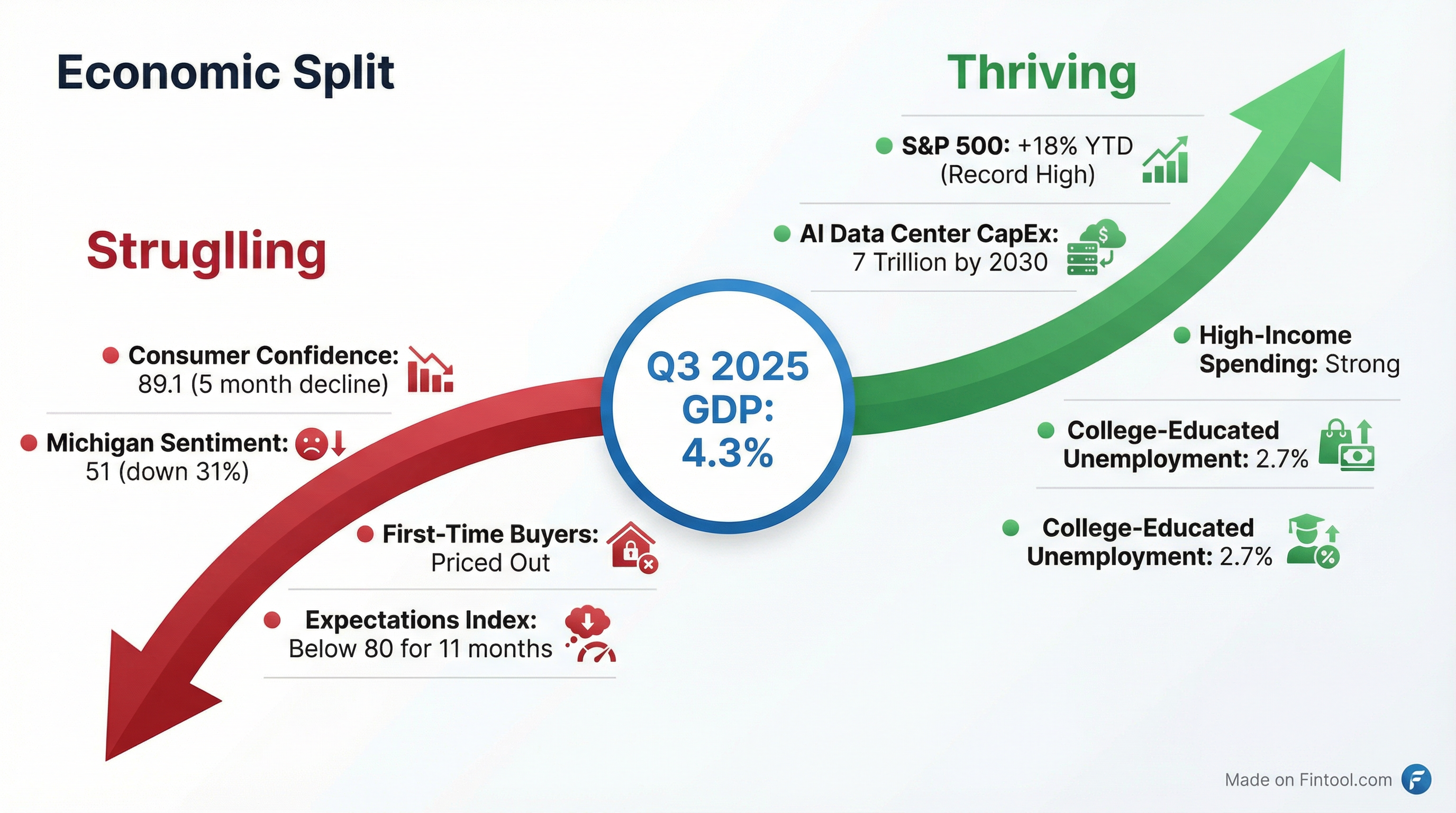
The K-Shaped Reality
The headline numbers tell two starkly different stories depending on where you sit in the economy.
For the top tier, the picture is rosy. Corporate profits surged $166 billion in Q3, up from just $6.8 billion the prior quarter. The S&P 500 is up 18% year-to-date and has risen for eight consecutive months. Unemployment for college-educated workers sits at just 2.7%, well below the national average. AI infrastructure spending continues at a breathtaking pace—industry estimates suggest $7 trillion in data center capex through 2030.
For everyone else, anxiety is mounting. The University of Michigan Consumer Sentiment Index has collapsed to 51.0—down 31% from 74.0 in December 2024. Consumers' views of their family's current financial situation turned negative for the first time in nearly four years. Middle and lower-income consumers are trading down, delaying purchases, or waiting for promotional opportunities.
| Indicator | Current | Year Ago | Change |
|---|---|---|---|
| Real GDP Growth (Q3 Ann.) | 4.3% | 3.4% | +0.9pp |
| Consumer Confidence | 89.1 | 104.7 | -14.9% |
| Michigan Sentiment | 51.0 | 74.0 | -31.1% |
| Expectations Index | 70.7 | 82.5 | -14.3% |
| S&P 500 YTD | +18% | +23% | - |
| Fed Funds Rate | 3.75% | 4.75% | -100bp |
Source: BEA, Conference Board, University of Michigan, FRED
 Ask Fintool AI Agent
What Companies Are Saying
The bifurcation is showing up clearly in corporate earnings calls. Pultegroup+0.78% CEO Ryan Marshall captured the tension directly:
"Weaker consumer confidence and stretched affordability are limiting opportunities with first-time buyers... Interest rates are a positive for housing demand, but rates don't operate in a vacuum. There is a clear offset if rates are coming down because the economy is slowing and people are worried about their jobs. I believe that is the scenario we are experiencing right now."
Toll Brothers+1.78% CEO Douglas Yearley echoed the sentiment, noting that "consumer confidence for us, for our client, is the number one driver." He added: "There's issues around job growth... we're staying conservative in our 2026 guide."
Meanwhile, on the other side of the K, companies tied to AI infrastructure are seeing record demand. Ciena+7.25% CEO Gary Smith reported that "AI continues to drive network expansion across all our customer segments, and the scale of investment currently underway is massive and accelerating faster than anything we, or indeed the industry, have seen to date."
Celestica+4.29% called it a "generational secular investment cycle in data center infrastructure," with annual data center capex forecast to surpass $1 trillion by 2028.
Ask Fintool AI AgentThe Fed's Dilemma
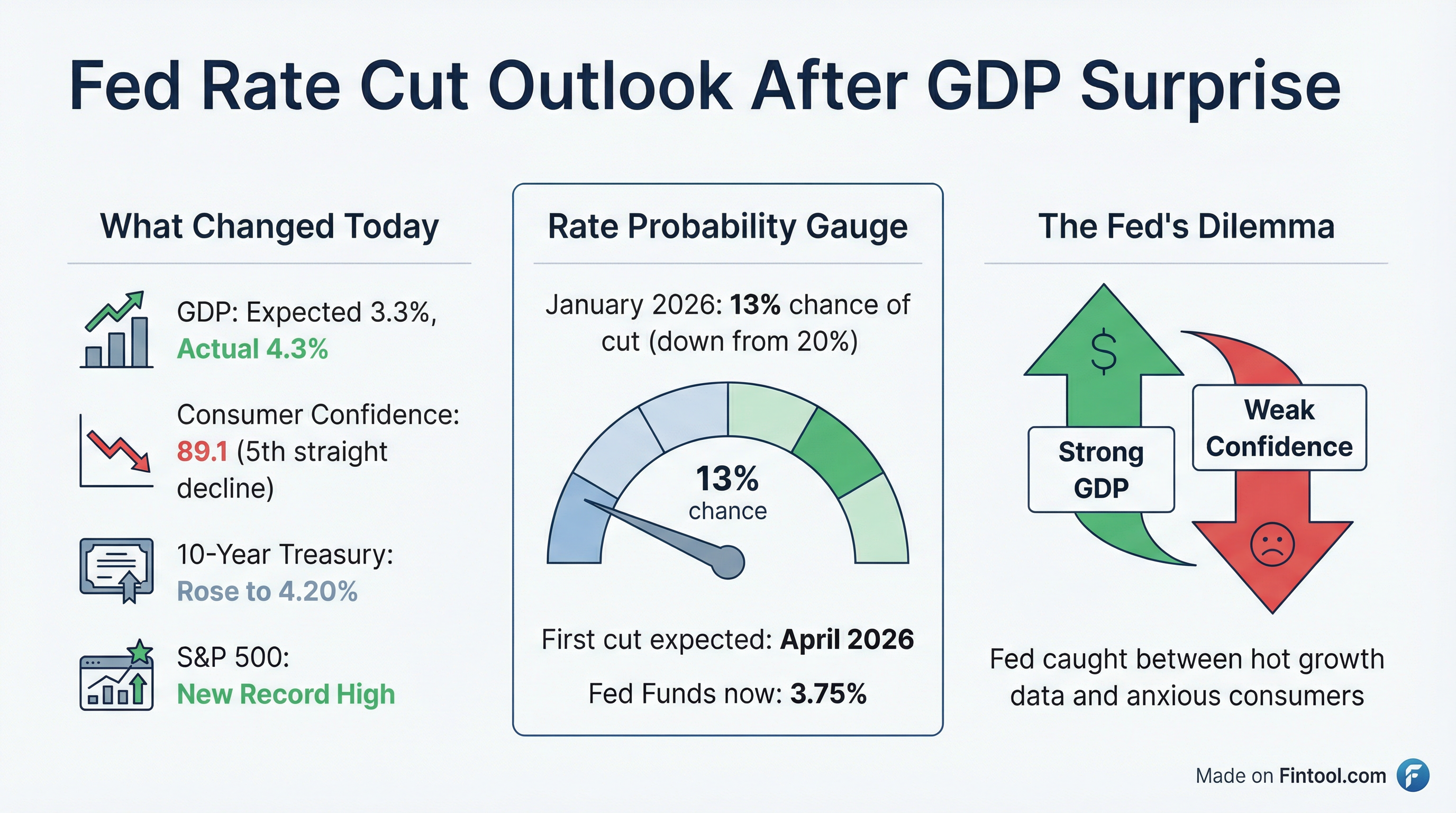
The data dump puts the Federal Reserve in a difficult position. The GDP strength argues against further rate cuts, but the confidence readings suggest underlying fragility in consumer spending—which accounts for roughly 70% of economic activity.
| Fed Outlook | January 2026 | March 2026 | April 2026 |
|---|---|---|---|
| Hold at 3.50-3.75% | 85% | 55% | 42% |
| 25bp Cut | 15% | 37% | 44% |
| 50bp Cut | 0% | 8% | 14% |
Source: CME FedWatch, December 23, 2025
The Expectations Index remaining below 80 for 11 consecutive months is particularly concerning—historically, sustained readings below this threshold have preceded recessions. Yet the strong GDP print and equity market near all-time highs make it politically and economically difficult to justify aggressive easing.
"Given the economy's resilience, softness in both employment and inflation might be needed to spur rate cuts in 2026," noted Sal Guatieri, senior economist at BMO Capital Markets.
Ask Fintool AI AgentLabor Market: Cracks Beneath the Surface
While the unemployment rate remains historically low at 4.6%, the trajectory has been concerning. November payrolls rose just 64,000 after a 105,000 decline in October. The labor market is cooling—the question is whether it's a soft landing or the beginning of something worse.
| Month | Unemployment Rate | Nonfarm Payrolls Change |
|---|---|---|
| Nov 2025 | 4.6% | +64K |
| Oct 2025 | 4.5% | -105K |
| Sep 2025 | 4.4% | +108K |
| Aug 2025 | 4.3% | -26K |
| Jul 2025 | 4.2% | +72K |
| Jun 2025 | 4.1% | +156K |
Source: FRED, Bureau of Labor Statistics
Equity Residential+3.43% CEO Mark Parrell noted the disconnect: "We see our existing residents as having a generally stable employment situation and good wage growth... the unemployment rate for the college-educated, our key renter demographic, was 2.7%, considerably below the national average." But he also acknowledged that traffic began weakening in September, manifesting across multiple markets.
Ask Fintool AI AgentMarket Implications
The S&P 500's record close suggests equity markets are betting on the "good" economy winning out. But the divergence creates both risks and opportunities:
Bulls point to:
- GDP growth accelerating, not decelerating
- Corporate profits surging
- AI investment cycle just beginning
- Fed still has room to cut if needed
- Yield curve has un-inverted (now +73bp)
Bears counter:
- Confidence surveys leading GDP, not lagging
- Expectations Index screaming recession warning
- Q3 strength may be backward-looking
- Consumer spending likely to slow in Q4
- K-shaped recovery inherently unstable
The 10-year Treasury yield at 4.20% reflects this tension—high enough to suggest growth concerns are limited, but not so high as to price out all future cuts.
Ask Fintool AI AgentWhat to Watch
January 10: December employment report—will the labor market continue cooling?
January 26: Next FOMC meeting—markets pricing 85% chance of hold
January 30: Q4 GDP advance estimate—will the momentum continue?
Ongoing: Retail and homebuilder earnings for real-time consumer read-through
The coming weeks will determine whether the GDP surge or the confidence collapse proves more predictive. History suggests confidence matters more over the medium term—but in a K-shaped economy, averages can be misleading.