Goldman Sachs Energy Conference 2026: Nuclear Renaissance, AI Power Demand, and the New Energy Playbook
January 08, 2026 · by Fintool Agent


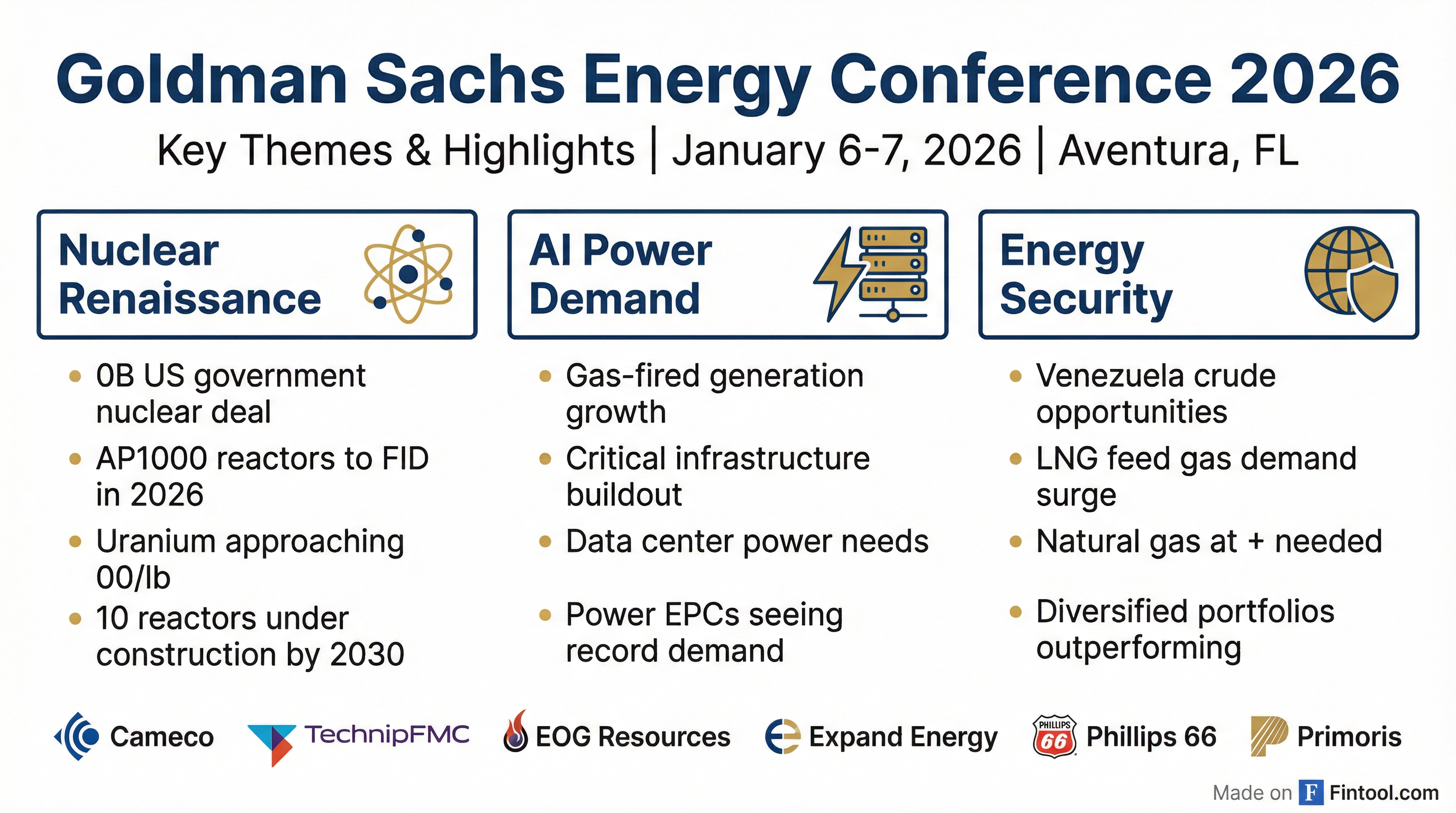
The 2026 Goldman Sachs Energy, CleanTech & Utilities Conference in Aventura, Florida delivered a clear message: the energy industry is at an inflection point where nuclear power, AI-driven electricity demand, and offshore capital flows are reshaping investment priorities. Over two days of executive presentations, three dominant themes emerged—and they point to a fundamentally different energy landscape than investors anticipated even 12 months ago.
The $80 Billion Nuclear Bet
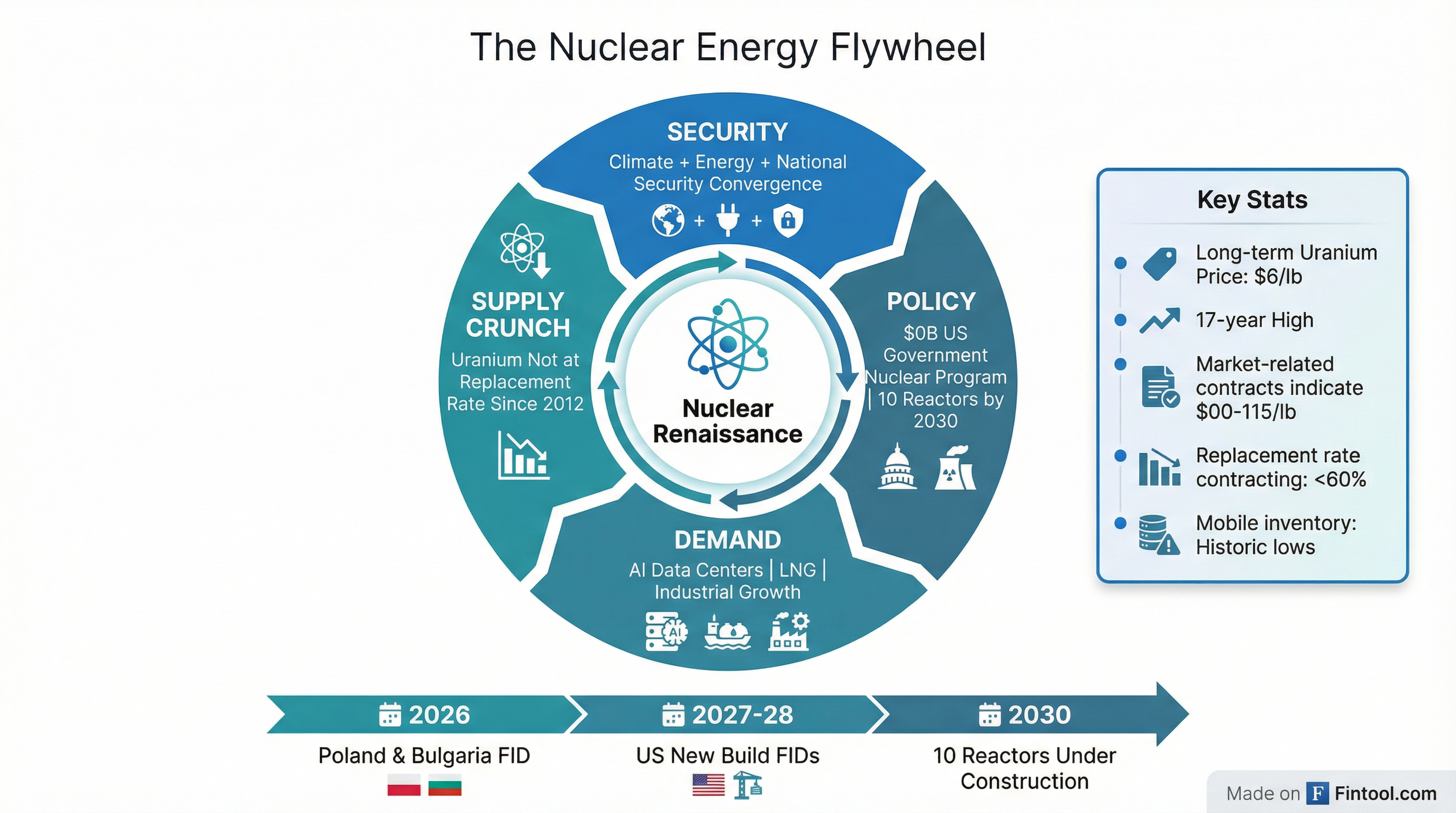
The most striking development came from Cameco's Grant Isaac, who outlined what may be the most significant nuclear policy shift since the Atoms for Peace program. The U.S. government has committed $80 billion to kickstart new builds of AP1000 reactors—a direct response to the reality that smaller economies like Poland and Bulgaria are moving faster on nuclear than the world's largest economy.
"Nuclear went from being in the wilderness post-Fukushima, to part of the climate security solution, to energy security after Russia invaded Ukraine, and now it's fully emerged as part of a national security solution," Isaac explained. "It's that triumvirate of security issues that nuclear is incredibly well placed for."
The timeline is aggressive: 10 reactors under construction by 2030 requires long-lead items to be ordered in 2026 and site selection to begin immediately. Isaac expects Poland and Bulgaria to reach final investment decisions this year on AP1000 reactors, signaling global validation of the technology.
Uranium: The Hidden Three-Digit Market
Perhaps more surprising than the reactor announcements was Isaac's revelation about uranium pricing. While the reported long-term price sits at $86 per pound—a 17-year high—the real market tells a different story.
"70% of the contracting in the market in 2025 was market-related. Only 30% was base escalated," Isaac disclosed. "Price reporters do not account for that 70% at all. What the market is missing is 70% of the information that is basically suggesting uranium is already at three-digit pricing."
Cameco's market-related contracts feature escalated floors in the mid-$70s and ceilings as high as $150. The midpoint? Already $100-$115 per pound. Utilities running value-at-risk analyses between these collars are implicitly accepting three-digit uranium—it's just not showing up in spot price reporting.
The setup is stark: utilities have not contracted at replacement rate since 2012. Mobile inventory positions have never been lower. And the historic shock absorbers—government inventories, the HEU agreement—are gone.
"This market will hit a shock. And when it hits a shock, it has no shock absorbers anymore," Isaac warned.
 Ask Fintool AI Agent
The Offshore Transformation: TechnipFMC's 80% Rule
If nuclear was the surprise of the conference, Technipfmc was the validation story. CEO Doug Pferdehirt delivered perhaps the most confident presentation of the two days, grounded in a single, stunning statistic: 80% of TechnipFMC's business is now directly awarded—never going to competitive tender.
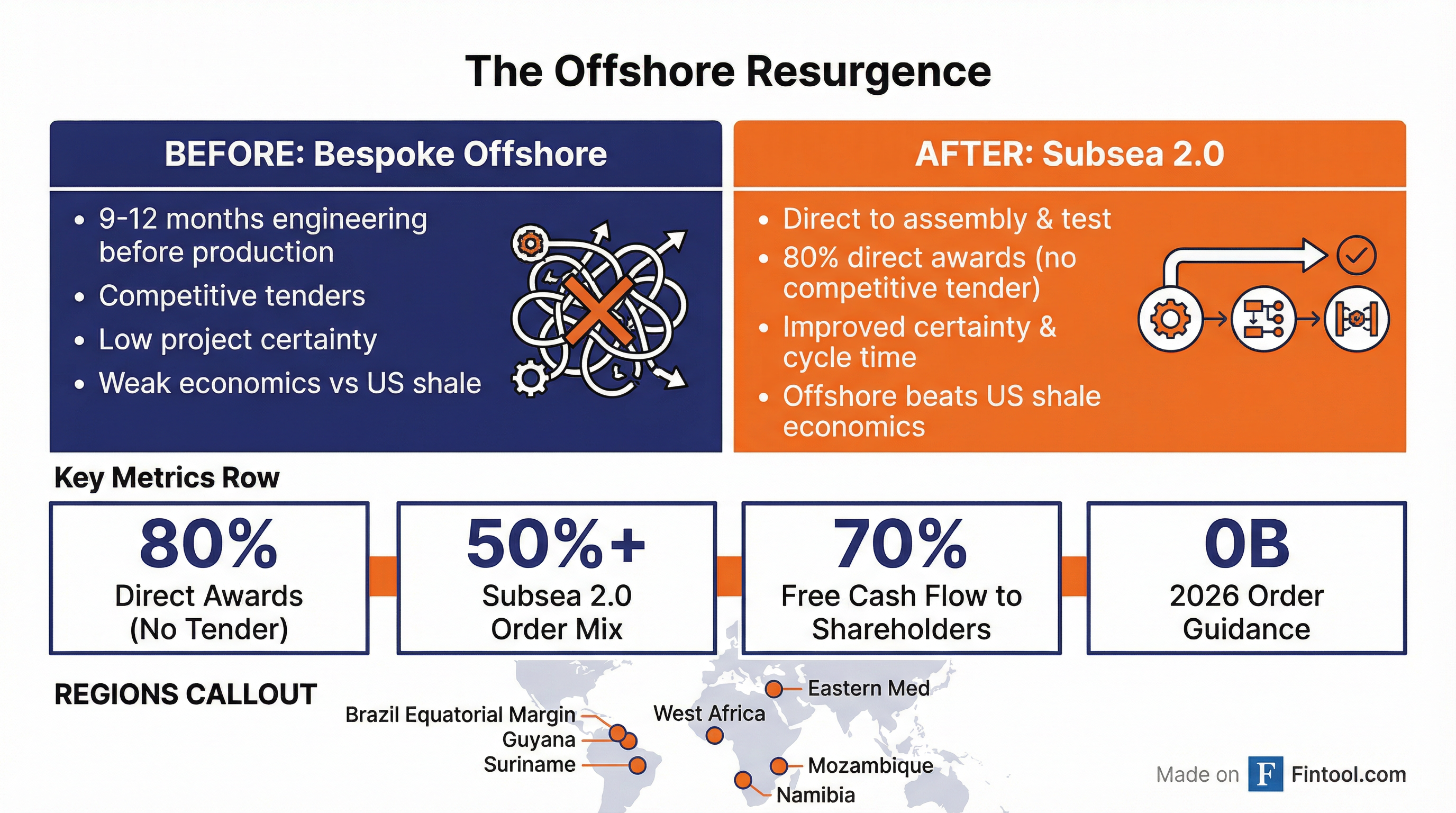
"To me, that really speaks to the differentiation and the success that we've created," Pferdehirt said. The transformation has been a decade in the making, starting with the Forsys Subsea joint venture in 2015 and culminating in the Subsea 2.0 architecture that now represents over 50% of orders.
The value proposition is simple: cycle time reduction that improves customer project economics while allowing TechnipFMC to capture more of the value created. Where offshore projects once required 9-12 months of engineering before cutting steel, Subsea 2.0 goes "straight into assembly and test, much like the automotive industry."
Where the Offshore Action Is
Pferdehirt outlined a global opportunity set that contradicts any narrative of offshore maturity:
- Brazil's Equatorial Margin: "A whole incremental leg of growth... Petrobras is extremely excited. All indications from the seismic are it could be very meaningful."
- Guyana: ExxonMobil's unprecedented success continues, with TechnipFMC doing "all of ExxonMobil's work" and receiving continued direct awards.
- Suriname: Block 58 (GranMorgu) awarded as "iEPCI 2.0, first project in Suriname." Multiple additional projects anticipated.
- Namibia: Active tendering underway with "all reasons to believe there'll be multiple projects."
- Mozambique: Went from one project to multiple projects in 12 months.
The company also disclosed a major win: "Just last night, we were awarded from BP a direct award for the Tiber project," following the Kaskida deepwater project.
On cycle time potential, Pferdehirt was blunt: "We're in the first period intermission. We're about a third of the way there." Two-thirds of cycle time improvement opportunities remain untapped across umbilicals, risers, flowlines, and installation processes.
Ask Fintool AI AgentEOG Resources: The Shale Discipline Playbook
Eog Resources CFO Ann Janssen struck a notably different tone than the excitement around nuclear and offshore. Her message: disciplined capital allocation in a maturing shale environment, with international optionality as the growth kicker.
The headline: EOG is trimming its 2026 capital budget to $6.5 billion from an earlier $6.6 billion run rate, driven by faster-than-expected integration of the Encino acquisition and Delaware Basin cost efficiencies. Oil growth? "Low to no growth" versus Q4 2025.
"We do see some maturation in shale in the US," Janssen acknowledged. The evidence: slowing growth through the drill bit, consolidation for cost structure benefits, and exploration of previously overlooked basins like Western Haynesville and Uinta.
The Encino Integration Story
The acquisition of Encino has "gone really well"—EOG has already identified $150 million in synergies and is looking for more. The strategic rationale centers on the volatile oil window in the Utica, where EOG doubled its acreage position.
"From day one, it's been very exciting. We've been able to put all our proprietary apps on it, already been able to immediately make it be a part of our portfolio."
UAE and Bahrain: The International Wild Card
EOG's entry into the Gulf states represents a significant strategic pivot for a company built on organic U.S. exploration. The UAE concession spans 900,000 acres—EOG was the first U.S. company awarded an unconventional concession in the country.
The timeline for clarity: "We have three years to declare commerciality" on the UAE oil asset. Bahrain is a smaller-scale gas asset with fixed pricing into the local market, where results could come "in maybe like the next year, year and a half."
On M&A appetite going forward, Janssen was clear: "I wouldn't sit there and think that we have an appetite for a large scale M&A... We're creating more value by doing organic."
Natural Gas: The $4 Question
Expand Energy CEO Nick Dell'Osso delivered the conference's most specific forecast on natural gas pricing—and it suggests the commodity needs to move significantly higher to balance supply and demand.
"We remain pretty constructive on the macro for gas," Dell'Osso said, though he cautioned: "We expect there to be a lot of volatility. And that volatility, we think, comes with opportunity."
Why $4-$4.50 Gas Is Coming
The math is straightforward: between now and the end of the decade, the U.S. faces roughly 18 Bcf/d of additional gas demand from LNG exports, power generation, and industrial consumption. Even with Permian growth of 8-10 Bcf/d, that leaves a significant gap.
Dell'Osso's view: Haynesville's traditional core "can grow a few more Bcf a day, but it cannot grow eight." Production will need to come from higher-cost East Texas, Mid-Continent, and other areas—which requires pricing above $4.
"I think you're going to need to see $4-$4.50 to really see that supply growth to meet that demand initially," he said.
Expand Energy's position is enviable: 15-20 years of inventory at $2.75 breakeven in the Haynesville. "We sit in a great place to see our margins grow while the marginal break-even of the industry moves into other plays."
Power Infrastructure: The AI Beneficiaries
One of the more under-the-radar discussions involved Primoris and Argan, two power infrastructure contractors positioned for the AI data center buildout.
"Gas-powered gen has come to the forefront in the last couple of years. That's an area that we've been historically active in, maintaining their capability. That's going to be a growth driver for us in the coming years," said Primoris President Jeremy Kinch.
Argan CEO David Watson positioned his company as a "pure play" in gas-fired power generation: "We look forward to building for the next 20 years."
The common theme: AI-driven electricity demand is creating multi-decade demand visibility for power generation infrastructure that didn't exist 24 months ago.
Venezuela: The Heavy Crude Opportunity
Phillips 66 CEO Mark Lashier addressed the elephant in the room: the potential for Venezuelan crude to reshape Gulf Coast refining economics.
"We do have two Gulf Coast refineries that can turn and process Venezuelan crudes as they ramp up," Lashier noted. Combined capacity: "a couple hundred thousand barrels per day."
The broader impact extends beyond direct Venezuelan processing. As those barrels enter the market, they'll compete with Western Canadian crude currently flowing to Gulf Coast refineries—potentially widening WCS differentials back into the "higher teens" under WTI.
"The system's going to rebalance, but fortunately, I think we're positioned to benefit from that rebalancing," Lashier said.
Ask Fintool AI AgentConference Takeaways
The 2026 Goldman Sachs Energy Conference revealed an industry in transition:
-
Nuclear is real this time: The $80 billion U.S. commitment, combined with Poland/Bulgaria FIDs expected this year, creates a visible path to new reactor construction. Uranium supply-demand fundamentals suggest prices significantly above reported levels.
-
Offshore has transformed: TechnipFMC's 80% direct-award rate and cycle time improvements have made deepwater competitive with—or superior to—U.S. shale economics. The global opportunity set is expanding, not contracting.
-
Shale is mature, not dead: Companies like EOG are generating strong returns but pivoting internationally for growth optionality. Capital discipline remains paramount.
-
Natural gas needs to reprice: $4+ gas is required to incentivize the supply growth needed to meet LNG and power demand. Haynesville operators with low breakevens are positioned to benefit from margin expansion.
-
AI is an energy story: The through-line connecting nuclear, gas-fired power, and infrastructure spending is AI-driven electricity demand—a theme that surfaced in nearly every presentation.
For investors, the conference made clear that the energy playbook has evolved. The question is no longer whether these transitions are happening, but how quickly capital can be deployed to capture them.
Related
- Cameco - Nuclear fuel and reactor services
- Technipfmc - Offshore subsea technology
- Eog Resources - Shale oil & gas producer
- Expand Energy - Natural gas producer
- Phillips 66 - Refining and midstream
- Primoris - Infrastructure services
- Argan - Power generation construction