Ex-Google Engineer Convicted on 14 Espionage Counts for Stealing AI Chip Secrets for China
January 30, 2026 · by Fintool Agent


A federal jury in San Francisco convicted former Alphabet-0.07% software engineer Linwei Ding on Thursday of stealing AI trade secrets worth potentially billions of dollars and transferring them to China-based companies—marking one of the most significant economic espionage cases in the ongoing US-China technology competition.
Ding, 38, was found guilty on all 14 counts—seven for economic espionage and seven for theft of trade secrets—after an 11-day trial. The stolen documents contained detailed blueprints for Google's custom Tensor Processing Unit (TPU) chips, the proprietary AI accelerators that analysts believe could represent a $900 billion opportunity for Alphabet.
The conviction sends a clear warning to Silicon Valley: as AI becomes the most valuable frontier in technology, protecting intellectual property from state-sponsored theft is now a material investment consideration for the world's largest tech companies.
 Ask Fintool AI Agent
The Theft: 2,000+ Pages of AI Crown Jewels
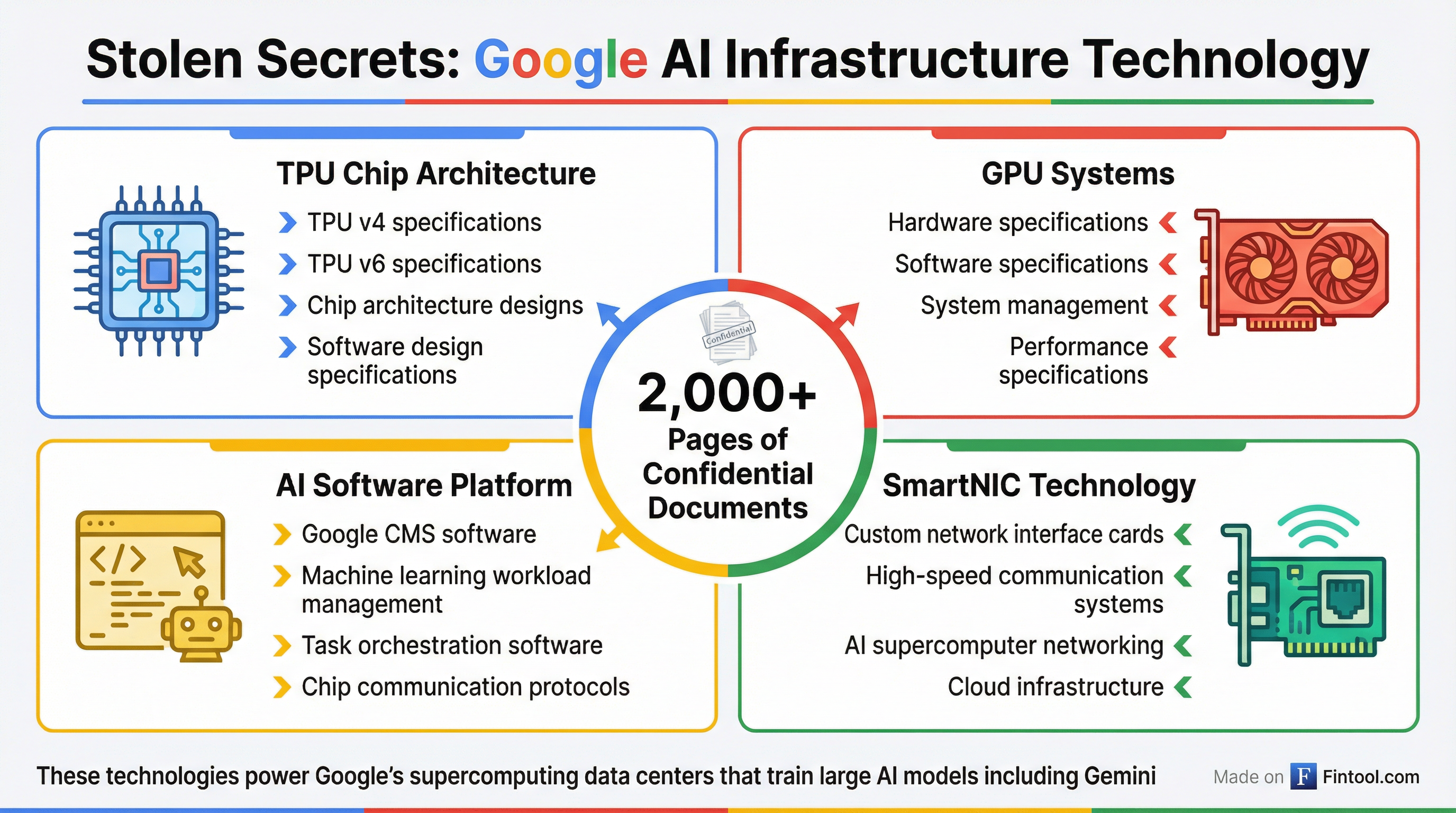
Prosecutors presented evidence that Ding, while employed at Google between May 2022 and April 2023, uploaded more than 2,000 pages of confidential information to his personal Google Cloud account. The stolen trade secrets included:
- TPU v4 and v6 chip architecture specifications — detailed designs for Google's custom AI accelerators
- GPU systems documentation — hardware, software, and performance specifications
- Google CMS software — the platform managing machine learning workloads across thousands of chips
- SmartNIC technology — custom network interface cards enabling high-speed communication in AI supercomputers
"The defendant wanted more from himself than what his knowledge and experience could get him, so he stole, cheated, and lied," Assistant US Attorney Molly Priedeman told the jury during closing arguments.
This infrastructure powers Google's supercomputing data centers that train large AI models including Gemini. The TPU is considered "really attractive by many of the leading labs because it gets their training runs to get much more throughput through the system," Google Cloud CEO Thomas Kurian said at a recent investor conference.
A Double Life: CTO by Day, Spy by Night
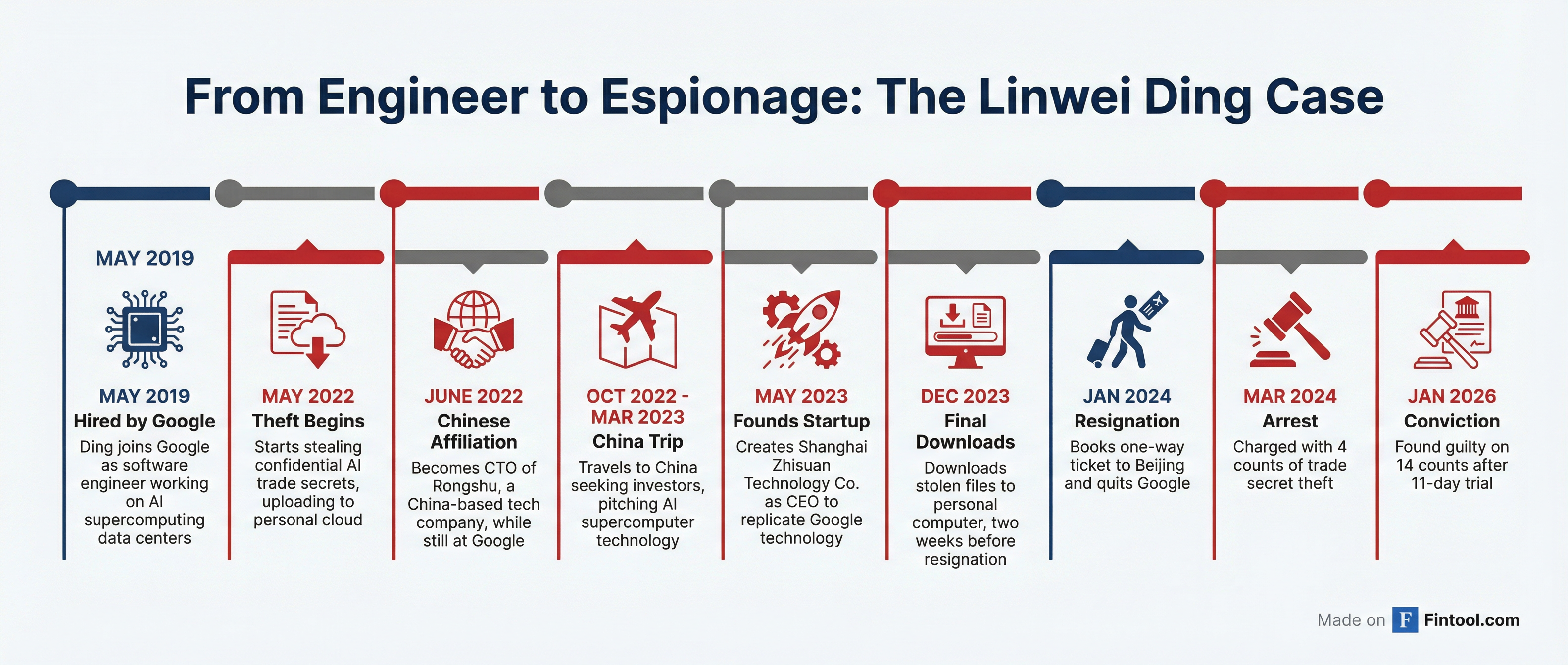
The evidence revealed Ding led a double life. While still on Google's payroll, he secretly became Chief Technology Officer of Rongshu, a China-based AI company, at a salary of 100,000 RMB (approximately $14,800) per month plus stock.
By May 2023, Ding had founded his own startup—Shanghai Zhisuan Technology Co.—and was pitching investors on building an AI supercomputer by copying Google's technology. In one presentation, he told Chinese investors he was "one of 10 people in the world" who could replicate Google's AI infrastructure.
Ding also applied for a Shanghai-based "talent plan" sponsored by the Chinese government, stating his intention to "help China to have computing power infrastructure capabilities that are on par with the international level."
In December 2023—just two weeks before booking a one-way ticket to Beijing and resigning—Ding downloaded the stolen files to his personal computer. He was arrested three months later.
Ask Fintool AI AgentWhy This Matters for Investors
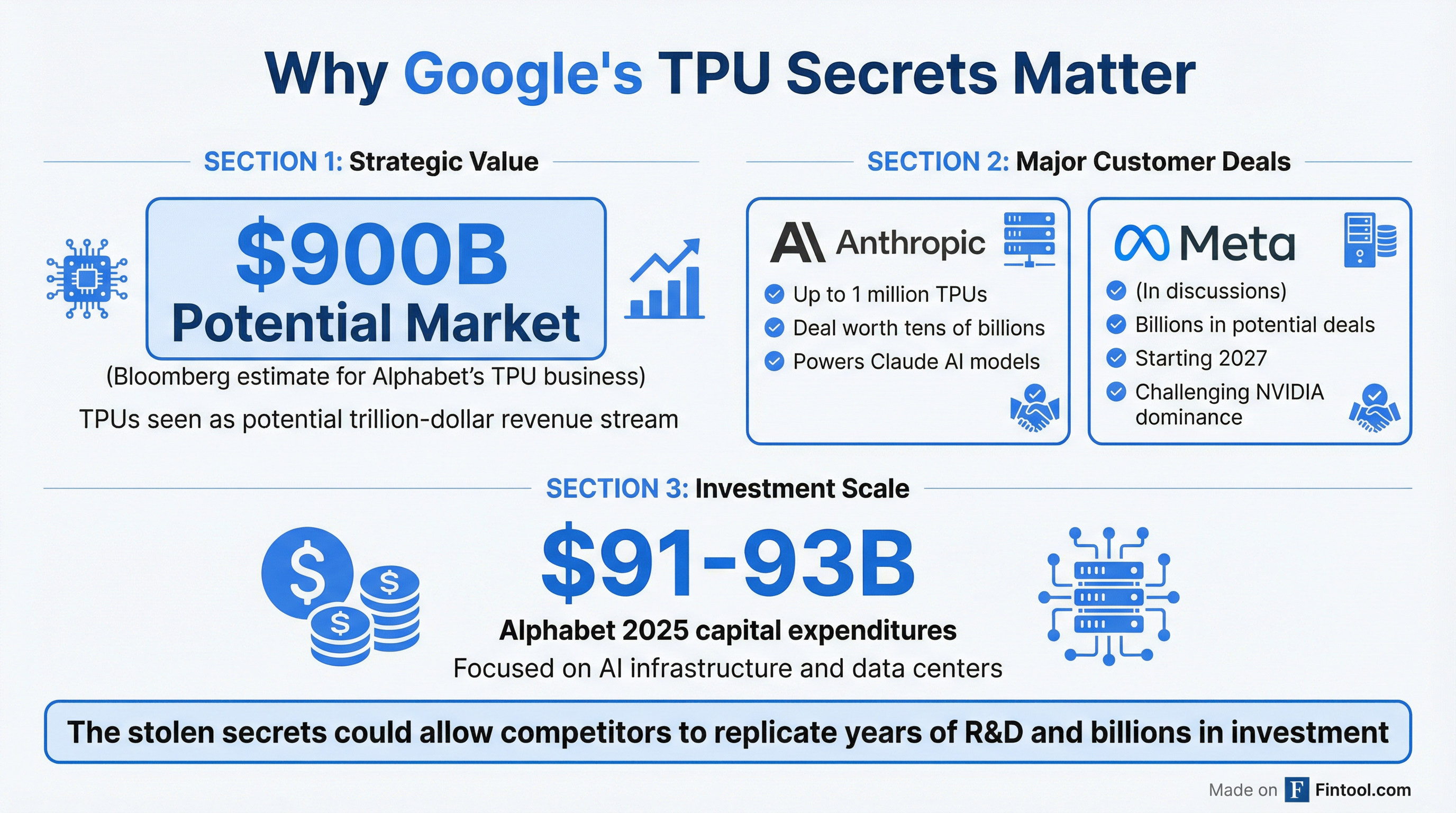
Google's TPU technology represents far more than engineering prowess—it's becoming a significant revenue driver. Bloomberg recently estimated that Alphabet's TPU chips could represent a "$900 billion secret sauce" for the company, potentially rivaling Nvidia-0.72%'s dominance in AI accelerators.
The financial stakes are enormous:
| Metric | Value | Context |
|---|---|---|
| Alphabet 2025 Capex | $91-93B | Record spending on AI infrastructure |
| Google Cloud Q3 2025 Growth | +35% | Driven by TPU differentiation |
| Anthropic TPU Deal | Tens of billions | Up to 1 million TPUs committed |
| Potential Meta Deal | Billions | Negotiations for 2027 deployment |
The stolen secrets could have allowed a Chinese competitor to "skip huge parts of the design process" for an AI supercomputer and undercut a decade of Google's work and billions of dollars in R&D investments.
Morgan Stanley estimates that Alphabet could see an 11% increase in revenue and a 3% increase in earnings per share for every 500,000 TPUs sold externally.
National Security Implications
The case was coordinated through the Disruptive Technology Strike Force, an interagency task force created by the Biden administration in 2023 to combat foreign theft of critical technologies.
"The theft and misuse of advanced artificial intelligence technology for the benefit of the People's Republic of China threatens our technological edge and economic competitiveness," said FBI Special Agent in Charge Sanjay Virmani.
The conviction arrives as US-China tensions over AI technology continue to escalate. The US has imposed sweeping export controls on advanced chips, while China pushes to develop indigenous alternatives. The theft of designs for Google's most advanced AI chips would have represented a significant shortcut for Chinese companies seeking to close the gap.
"Silicon Valley is at the forefront of artificial intelligence innovation, pioneering transformative work that drives economic growth and strengthens our national security," said US Attorney Craig Missakian. "We will vigorously protect American intellectual capital from foreign interests that seek to gain an unfair competitive advantage."
Ask Fintool AI AgentWhat's Next
Ding faces a maximum sentence of 10 years in prison for each trade secret theft count and 15 years for each economic espionage count—a theoretical maximum of 175 years, plus millions in potential fines. His next court appearance is scheduled for February 3, 2026, when sentencing proceedings are expected to begin.
US District Judge Vince Chhabria ordered Ding released pending sentencing, determining he was not a flight risk.
Google cooperated with the FBI investigation and praised the verdict. "We're grateful to the jury for making sure justice was served today," said Lee-Anne Mulholland, Google's vice president of regulatory affairs.
For investors, the case underscores a new reality: as AI technology becomes the most valuable asset in corporate America, insider threats and state-sponsored espionage represent material risks that companies—and their shareholders—must now factor into their calculus.
Related: