JPMorgan's Troy Rohrbaugh 'Shocked People Are Shocked' by Private Credit Stress as Bank Guides Q1 Up Mid-Teens
February 23, 2026 · by Fintool Agent



JPMorgan Chase delivered a pointed warning on private credit stress Monday evening even as it guided first-quarter banking and markets revenue up double digits—with Co-CEO of the Commercial & Investment Bank Troy Rohrbaugh telling investors at the bank's Company Update 2026 that he's "shocked that people are shocked" by recent distress in the $3 trillion private credit market .
The remarks came during a wide-ranging Q&A session at JPMorgan's new 270 Park Avenue headquarters in Manhattan, where CEO Jamie Dimon and his executive team laid out both optimism about near-term business momentum and caution about late-cycle credit risks that could catch investors off guard .
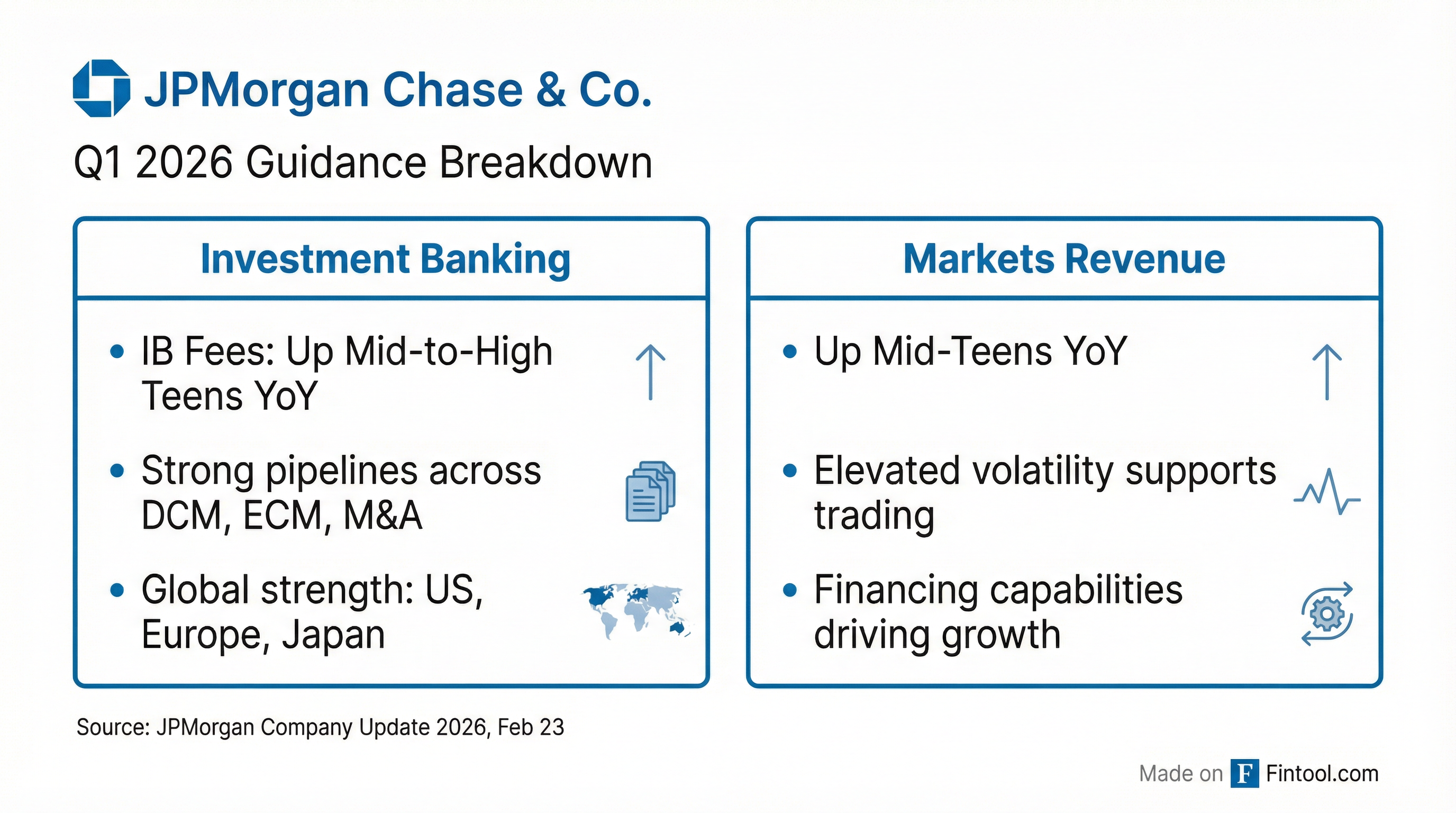
Q1 Guidance: Banking and Markets Both Up Mid-Teens
Before addressing credit concerns, Rohrbaugh set the tone with strong first-quarter guidance:
Investment Banking Fees: Up mid-teens year-over-year, with potential to reach high teens "if the quarter remains constructive" . Rohrbaugh cited strong pipelines across debt capital markets, equity capital markets, and M&A, noting strength is not limited to the U.S.: "We're seeing strength in Europe, we're seeing tremendous activity in Japan. It's very much a global opportunity right this moment" .
Markets Revenue: Also tracking up mid-teens year-over-year. "Volatility continues to pick up almost every day," Rohrbaugh noted, adding that the quarter "started well, but there's definitely plenty left of it" .
The guidance stands in stark contrast to the broader financial sector's 4% selloff Monday, driven by AI disruption fears and tariff uncertainty. JPM shares closed down 4.2% at $297.67.
 Ask Fintool AI Agent
'Shocked People Are Shocked': The Private Credit Warning
The most quotable moment came when Gerard Cassidy of RBC asked about disruption in private credit markets. Rohrbaugh's response was blunt:
"I won't comment on any specific player in the market. They're all our clients, and, you know, you can read the press just like we do. I would say, I mean, people should be—I'm shocked that people are shocked. I mean, the reality is, in this environment, as the world gets more volatile, as you get towards the end of a cycle, this outcome should be expected."
He went further, warning that current stress—which appears isolated to "a handful of situations"—could easily spread:
"We don't think about it as just private credit. We think about it as the whole credit ecosystem. As Doug mentioned, we use the same underwriting standards. Yes, we understand each space is different. They all have their own characteristics, but ultimately, it's credit. It's going to be across the whole spectrum if we get a more significant downturn, it won't be isolated there."
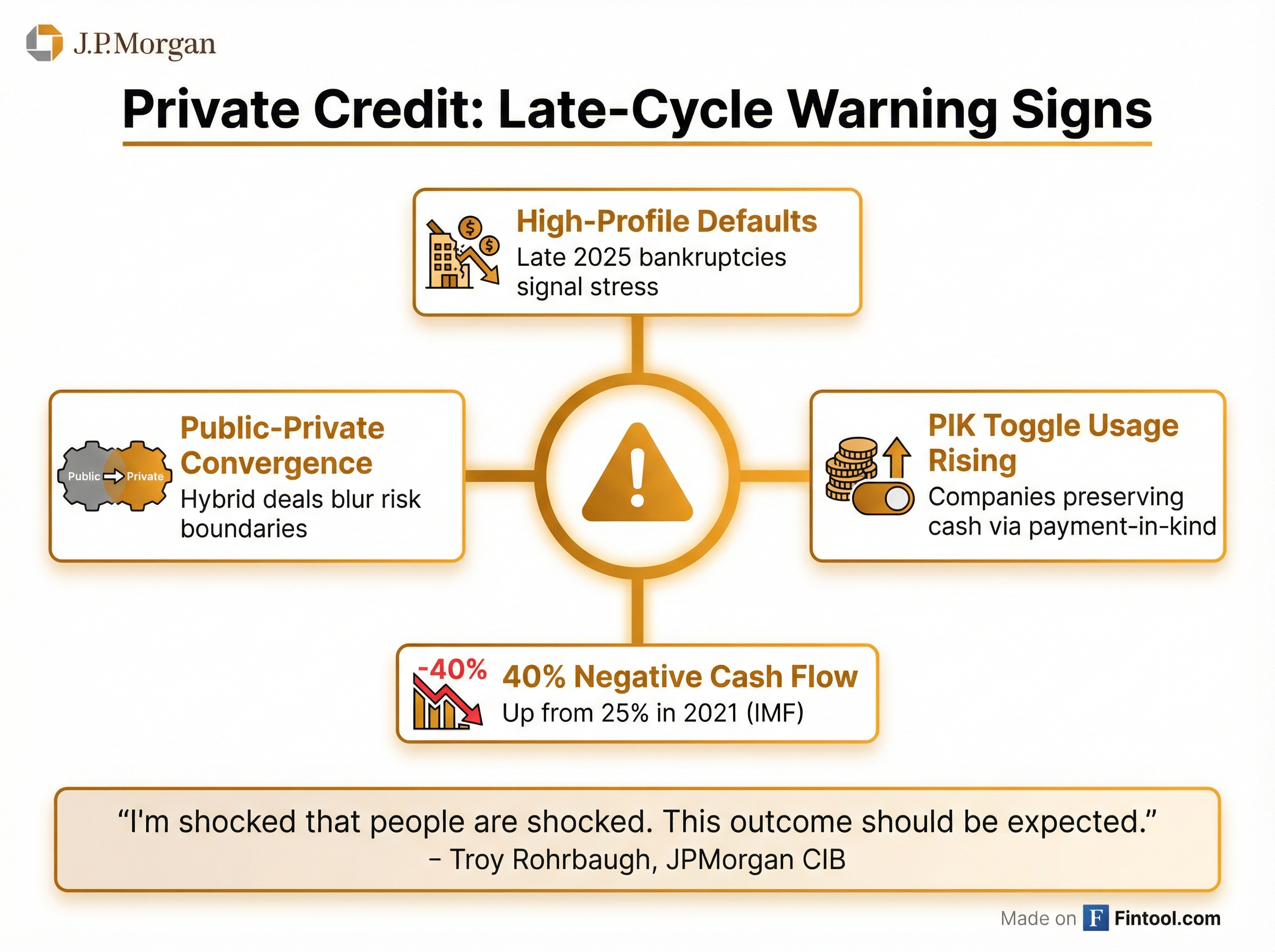
The warning arrives as the private credit market faces its most challenging environment since 2008, according to industry research. The IMF's 2025 Financial Stability Report found that approximately 40% of private credit borrowers have negative free cash flow—up from 25% in 2021 . High-profile leveraged loan defaults in late 2025 and rising use of payment-in-kind (PIK) toggles have signaled mounting stress .
Dimon: Competition Feels Like 2005-2007 Again
CEO Jamie Dimon amplified the cautionary tone during his closing Q&A session, drawing explicit parallels to the pre-crisis era:
"Unfortunately, we did see this in 2005, in 2006, in 2007. Almost the same thing. The rising tide lifts all boats. Everyone was making a lot of money. People were leveraging to the hilt. The sky was the limit. Yeah, I think you're absolutely correct. I think today, the rising tide is lifting all boats."
Dimon said competition is "tougher than" the 2005-2007 period when factoring in non-bank players. "It's not just the large traditional banks," he noted. "It's also other types of competitors. It's everywhere... I see a couple of people doing some dumb things" .
When asked about potential credit surprises, Dimon pointed to software companies as a possible casualty of AI disruption:
"This time around, it might be software because of AI. That, we've always talked about there's a moving tectonic plates underneath that cause an industry to be challenged. You'd be shocked about what these guys have already been through on software. Loan by loan, name by name, customer by customer, to look at what it means for us, what happens if they were downgraded, and what happens to their ecosystems."
Ask Fintool AI AgentJPMorgan's Differentiated Direct Lending Approach
Despite the warnings, JPMorgan emphasized its own conservative positioning in direct lending. Doug Petno, Co-CEO of the Commercial & Investment Bank, drew a clear distinction between JPMorgan's client-focused model and pure asset aggregators:
"Our strategy is to serve clients, and lending is an outcome, not the strategy. We went into direct lending product specifically, so we'd have a broader base of debt solutions, credit solutions that could provide an agnostic capital structures financing alternative. We're not trying to acquire loans, we're building relationships."
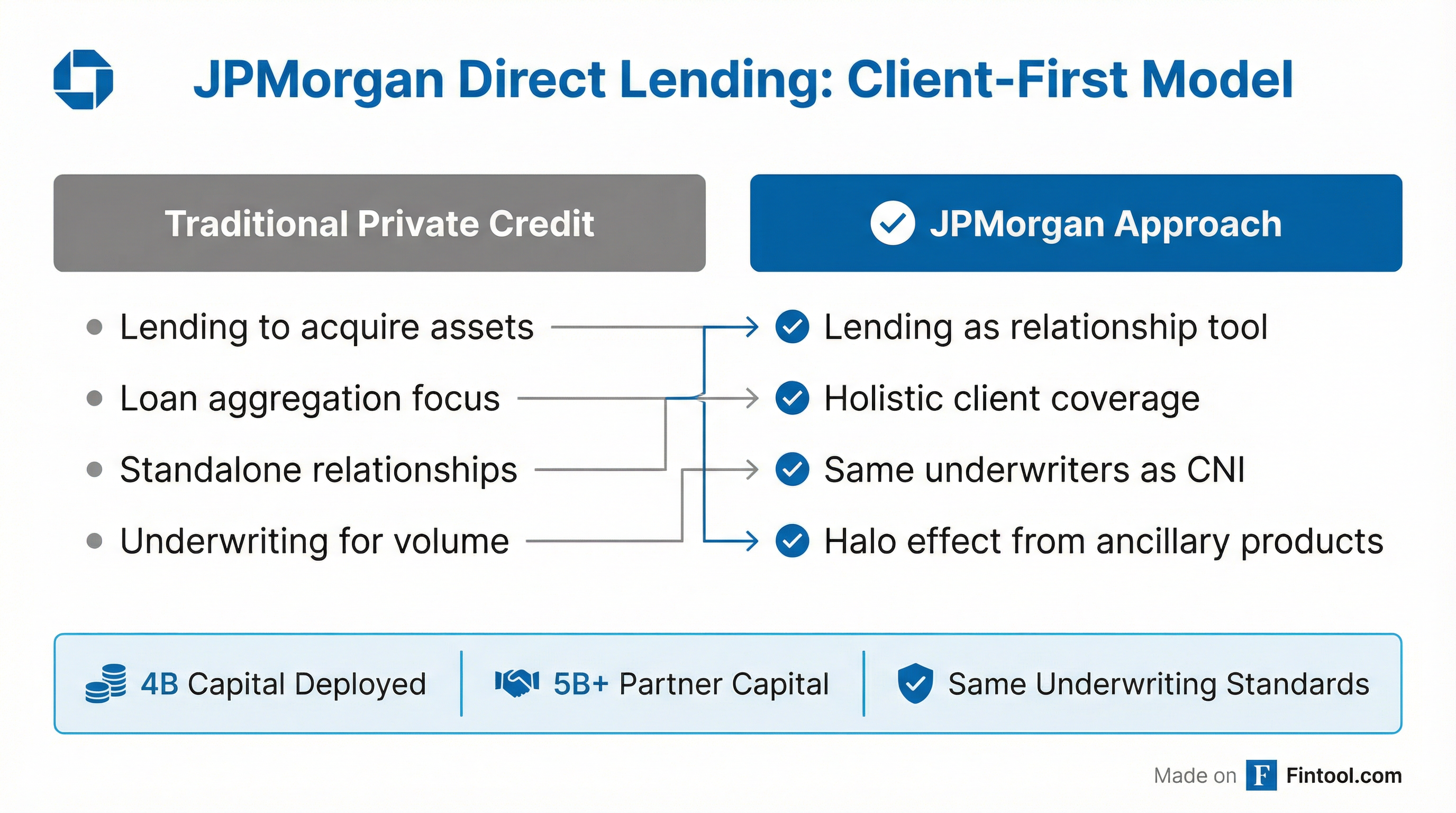
The bank has deployed approximately $14 billion in direct lending capital, with over $25 billion in partner capital available . Critically, Petno noted that "the underwriters that are underwriting those direct lending assets for us are the same underwriters that underwrite our CNI loans generally, bringing all the level of expertise, the industry knowledge, the through-the-cycle judgment" .
| JPMorgan Direct Lending Metrics | Amount |
|---|---|
| Capital Deployed | $14B |
| Partner Capital Available | $25B+ |
| Underwriting Standard | Same as CNI book |
| Strategy | Client relationships, not asset acquisition |
Macro Outlook: 'Cautiously Optimistic' with High Anxiety
Dimon described his outlook as "cautiously optimistic" but with elevated anxiety:
"I'm not quite that optimistic about the year. Okay, we know, and Jeremy had the chart up there, that there are all these tailwinds... But at the bottom of this chart, geopolitics, global deficits, trade issues, remilitarization of the world, those are longer-term things that may affect the economy, but they could be harsh."
He emphasized that JPMorgan is prepared for a range of outcomes:
"We are adults. If our ROE goes to 10% next year under one of the scenarios, we are completely fine. It will make no difference to the future of JPMorgan Chase. In fact, I would tell our people, I've said before, if and when that happens, our opportunity will be bigger."
Ask Fintool AI AgentWhat to Watch
The JPMorgan Company Update 2026 delivered a nuanced message: strong near-term momentum (Q1 up mid-teens in both banking and markets) paired with explicit warnings about late-cycle credit risks that management believes are being underappreciated by the market.
For investors, the key questions are:
-
How quickly does private credit stress spread? JPMorgan's leadership believes current isolated distress could broaden in a downturn. The bank's conservative positioning and disciplined underwriting may prove prescient.
-
Software as the surprise casualty? Dimon's warning about AI-driven disruption to software companies—and JPMorgan's detailed review of its exposure—suggests this is a sector to watch for credit deterioration.
-
Competition and dumb behavior: When JPMorgan's CEO publicly says he sees competitors "doing some dumb things," it's worth paying attention. The parallel to 2005-2007 is ominous.
The Q1 guidance provides a near-term bullish catalyst, but management's credit warnings suggest the real test lies ahead.