KKR CFO Defends $7+ ANI Target at UBS Conference, Says Arctos Deal Will Build $100B Franchise
February 9, 2026 · by Fintool Agent


KKR-3.75% CFO Rob Lewin took the stage at the 2026 UBS Financial Services Conference on Monday to defend the firm's $7+ per share Adjusted Net Income target for 2026—a goal that has drawn investor skepticism amid recent market turmoil.
The presentation came just four days after KKR announced its $1.4 billion acquisition of Arctos Partners and reported softer-than-expected Q4 2025 earnings, which sent shares tumbling 5.4% on the day. The stock has since staged a partial recovery, closing at $108.11 on Monday—up 4.8% on the day but still down 30% from its February 2025 all-time high of $153.87.
 Ask Fintool AI Agent
The $7+ ANI Bridge: What Needs to Happen
Lewin walked investors through the building blocks required to hit the firm's 2026 earnings target—a goal first set in 2021 and reaffirmed at the April 2024 investor day.
"We know what we need to achieve over the course of the next 11 months in order to be able to hit it," Lewin said.
The components break down as follows:
| Earnings Component | 2026 Target | Key Drivers |
|---|---|---|
| Fee-Related Earnings | $5.50/share implied | Management fees up 24% YoY in Q4; capital markets and K-Series growth |
| Insurance (Global Atlantic) | $1B operating income | Pursuing alternative asset allocation; $350M mark-to-market accrued returns not in P&L |
| Strategic Holdings | >$350M operating earnings | Expected to exceed guidance; >100% YoY growth |
| Realized Performance + Investment Income | Variable | $18.6B embedded gains (up 20% YoY); $900M+ visible monetization revenue |
The catch: "In order to achieve the investing earnings component, we do need a conducive market environment," Lewin acknowledged. "We're not going to force anything into the market."
Arctos: Building a $100B Solutions Franchise
The headline announcement from last week's earnings call was KKR's acquisition of Arctos Partners—a deal Lewin described as being "at the top of our priority list for some time."
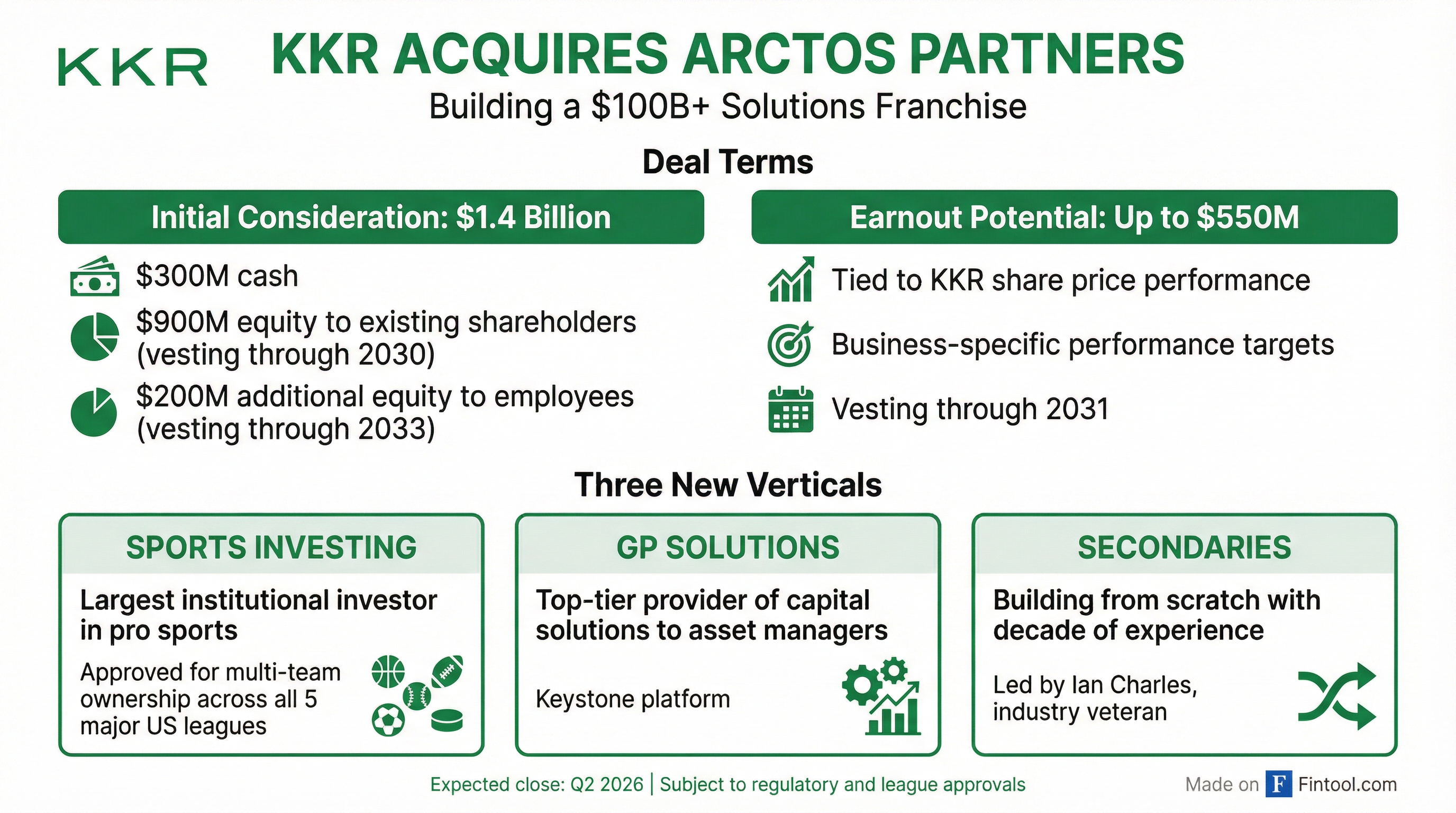
Arctos brings three distinct capabilities to KKR:
Sports Franchise Investing: Arctos is the largest institutional investor in professional sports franchise stakes and the only firm approved for multi-team ownership across all five major U.S. leagues (NBA, NFL, MLB, NHL, MLS).
GP Solutions: Through its Arctos Keystone platform, the firm provides growth capital and liquidity solutions to alternative asset managers—a "rapidly growing asset class" according to Lewin.
Secondaries Platform: While Arctos isn't currently in the secondaries business, co-founder Ian Charles spent nearly 14 years at Landmark Partners and brings deep experience in the $226 billion market.
"We've evaluated most of the secondaries asset managers that have traded over the last decade," Lewin revealed. "For a variety of reasons, we did not pursue any of those opportunities. However, we knew that when we found that right partner... we would be all in."
The cultural connection runs deep: KKR first met Arctos co-founder Ian Charles over a decade ago and collaborated on one of the industry's first structured secondaries transactions.
Ask Fintool AI AgentAddressing the AI Elephant in the Room
The UBS conference came against the backdrop of a brutal week for alternative asset managers. A software sector selloff—triggered by fears that AI could render enterprise software obsolete—wiped nearly $1 trillion from software and services stocks and dragged down PE firms with it.
KKR fell 9.7% on February 3 alone, with peers Apollo-1.24%, Blackstone-2.77%, Ares-2.50%, and Blue Owl-0.99% down between 5% and 10%.
Lewin addressed the selloff head-on:
"What the market got very nervous about in the past 10 or so days was not something that was new for us as we've thought about portfolio construction," he said. "I was with somebody this weekend who said... the alternatives last week were actually down greater than the software index was down last week, which again does not tie together in any way to the durability and diversity of all the alternative asset managers."
KKR's actual software exposure is modest: approximately 7% of total AUM across the firm and 15% in the private equity business—numbers Lewin said were calculated expansively.
"We've sold businesses over the past few years for sure that we were worried about... even though we saw near-term risk," he added. "We sit on roughly $120 billion of dry powder to be able to invest into the dislocation."
The Diversification Defense
Lewin's core argument for why KKR is mispriced: the market doesn't fully appreciate the firm's diversification.
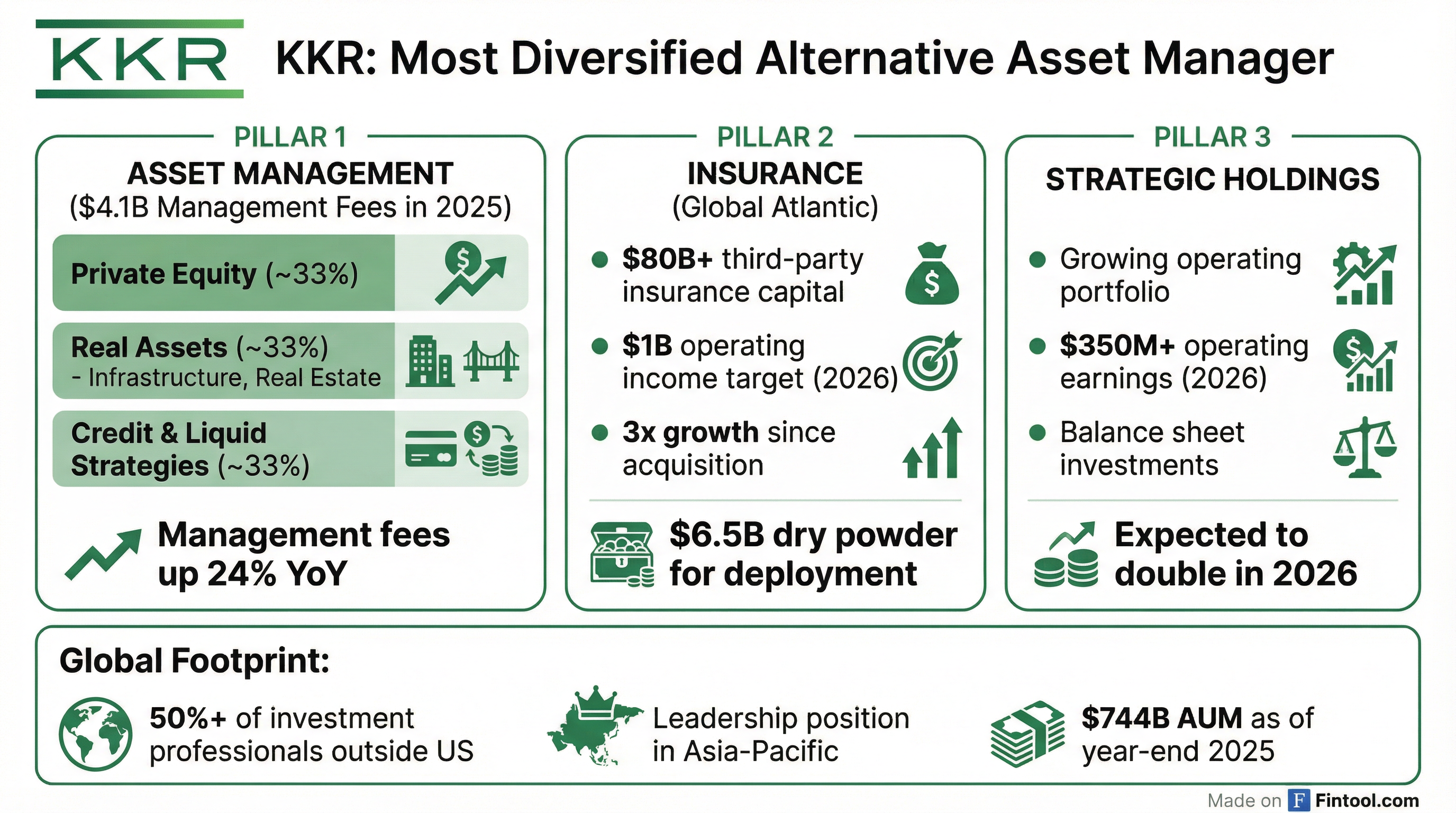
"The business model that we've created at KKR is the most diverse in the alternative asset manager space," Lewin said. "Look at our asset management strategy, what we're doing in insurance, and strategic holdings. But even if you just looked at our asset management business... $4.1 billion of management fees last year, roughly a third came from each of our three business lines: private equity, real assets, and credit and liquid strategies."
The geographic diversification is equally notable: more than half of KKR's investment professionals sit outside the United States, with significant presence in Asia-Pacific—a region Lewin expects to drive more than half of global GDP growth over the next decade.
| Metric | Two Years Ago | Today | Change |
|---|---|---|---|
| Management Fees | $3.0B | $4.1B | +35% |
| Fee-Related Earnings | N/A | N/A | +50%+ |
| Adjusted Net Income | N/A | N/A | Mid-40s % increase |
| Capital Raised (12-mo) | $70B | $130B | +90% |
| K-Series AUM | $18B | $35B | +94% |
Ask Fintool AI AgentFundraising Momentum Continues
Despite market volatility, KKR's fundraising engine continues to fire. The firm raised approximately $130 billion in 2025—up 90% from two years prior—and is already 80%+ of the way to its $300 billion target for 2024-2026.
Flagship funds:
- Americas Private Equity XIV: $19B raised, already larger than predecessor fund, less than a year from first close
- Global Infrastructure V: $16B+ raised, well on track to exceed predecessor
Wealth channel: K-Series products now manage $35B, up from $18B just 12 months ago—a 94% increase. January 2026 saw roughly 20% higher capital raising than January 2025 despite market volatility.
Insurance: KKR manages $80B+ for third-party insurance clients, up more than 3x since acquiring Global Atlantic five years ago.
What to Watch
Several catalysts could determine whether KKR hits its 2026 targets:
Near-term:
- Arctos deal closing (expected Q2 2026, pending regulatory and league approvals)
- Monetization activity through quarterly calls and intra-quarter press releases
- Software sector stabilization and private credit market conditions
Medium-term:
- Global Atlantic's alternative asset allocation ramping into 2027-2028
- Infrastructure flagship fundraising completion
- KKR Solutions buildout (sports, GP solutions, secondaries)
The market is giving KKR little credit for its transformation over the past two years. At ~$108 today, the stock trades at the same level it did in early 2024—despite 35% higher management fees, 50%+ higher fee-related earnings, and 90% higher capital raising.
"Maybe the market got it very wrong two years ago," Lewin mused. "More than likely, it's somewhere in between."
Related: