Meta's Superintelligence Lab Delivers First AI Models, CTO Says 'Very Good' Progress
January 21, 2026 · by Fintool Agent



Meta Platforms-1.31% has reached an early milestone in its AI ambitions, with Chief Technology Officer Andrew Bosworth confirming at the World Economic Forum in Davos that the company's Superintelligence Labs team has delivered its first high-profile AI models internally this month.
"They're basically six months into the work, not quite even," Bosworth told reporters, adding that the team's AI models were "very good."
The announcement comes at a critical juncture for Meta, which has faced criticism over its Llama 4 model launch last April and is racing to regain momentum in the intensely competitive AI landscape dominated by OpenAI, Google-2.53%, and emerging players like DeepSeek.
 Ask Fintool AI Agent
The Turnaround Effort
Meta's Superintelligence Labs was established in mid-2025 after CEO Mark Zuckerberg grew frustrated with the company's AI progress, particularly after Llama 4's lukewarm reception. The new lab represents a reorganization of Meta's AI efforts, combining foundations, product, and FAIR teams with a new group focused on developing next-generation models.
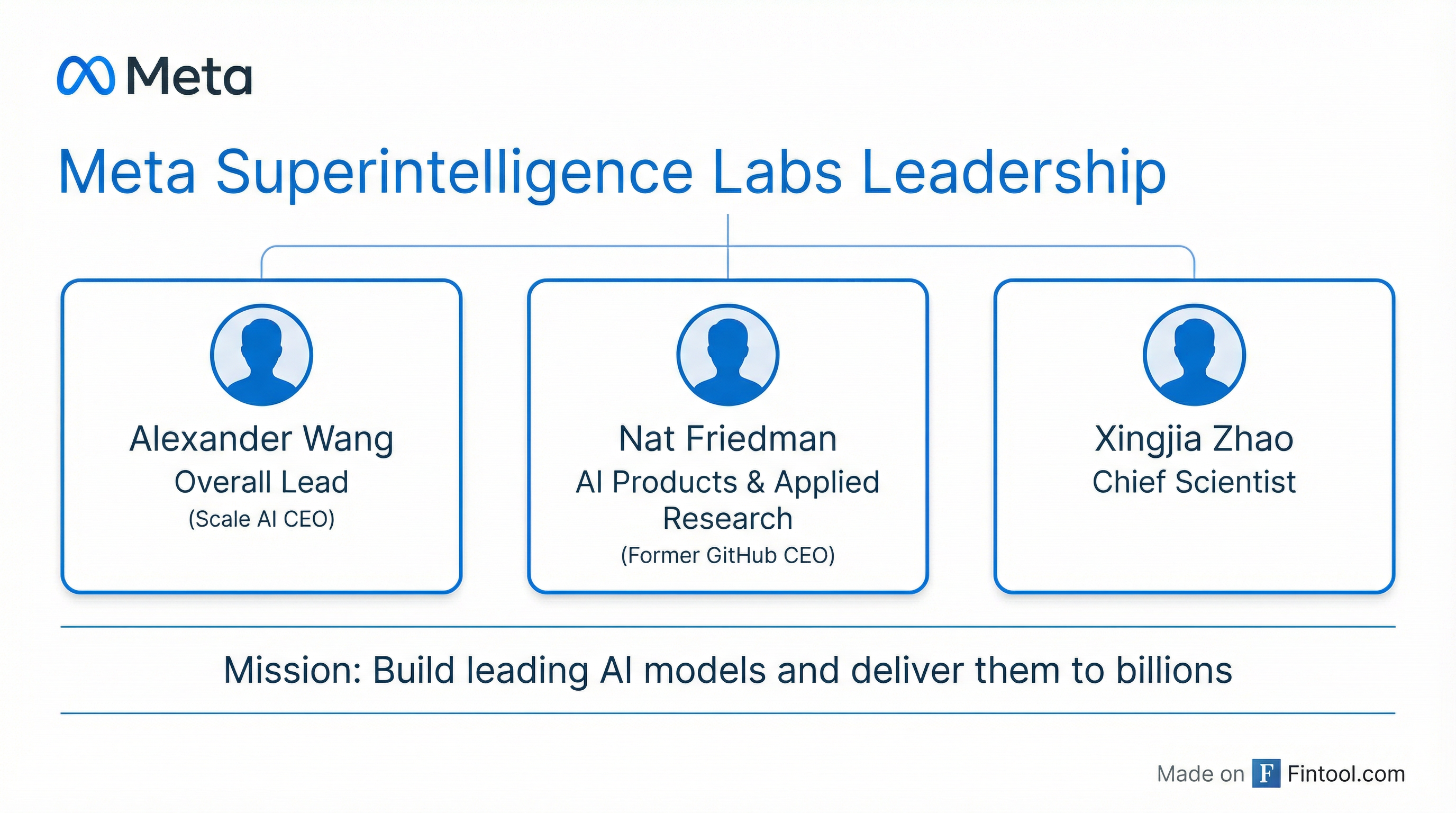
The lab has attracted elite talent through aggressive compensation packages:
- Alexander Wang (Scale AI CEO) leads the overall team
- Nat Friedman (former GitHub CEO) leads AI products and applied research
- Xingjia Zhao serves as chief scientist
"I spent a lot of time building this team this quarter, and the reason that so many people are excited to join is because Meta has all of the ingredients that are required to build leading models and deliver them to billions of people," Zuckerberg said on Meta's Q2 2025 earnings call.
Models in Development
While Bosworth did not specify which models were delivered internally, media reports have identified two projects:
- Avocado: A text-based large language model slated for a first-quarter release
- Mango: An image and video-focused model
The CTO emphasized that significant work remains before public release. "There's a tremendous amount of work to do post-training for AI, to actually deliver the model in a way that's usable internally and by consumers," Bosworth said.
Ask Fintool AI AgentInfrastructure at Scale
The AI push is backed by unprecedented infrastructure investment. Meta has committed to "notably larger" capital expenditure in 2026 compared to 2025's already elevated $70-72 billion guidance.
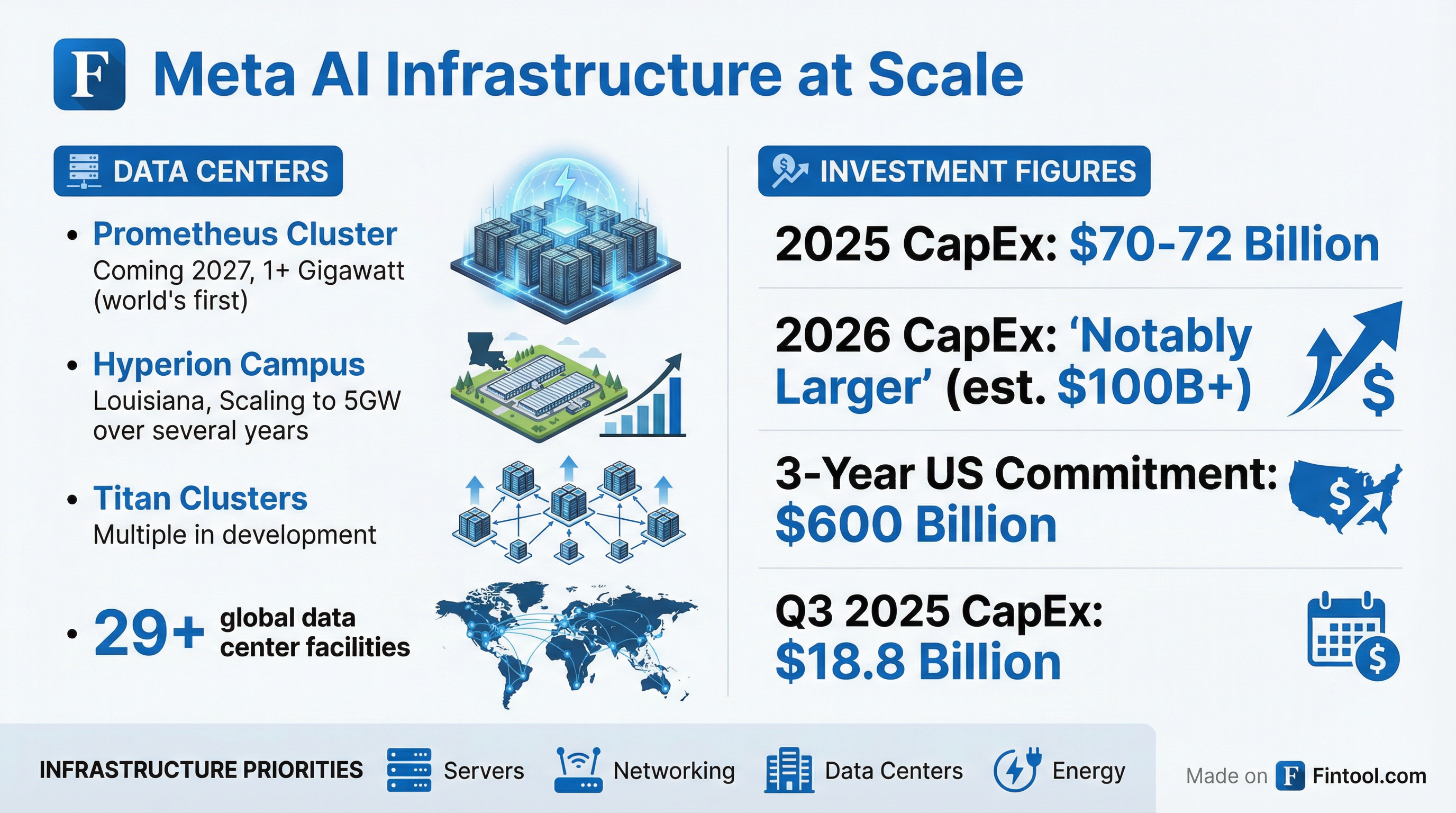
The company is building multiple gigawatt-scale data center clusters:
| Project | Location | Capacity | Timeline |
|---|---|---|---|
| Prometheus | TBD | 1+ GW | 2027 |
| Hyperion | Louisiana | Up to 5 GW | Multi-year |
| Titan Clusters | Multiple | TBD | In development |
"The people who are joining us are gonna have access to unparalleled compute as we build out several multi gigawatt clusters. Our Prometheus cluster is coming online next year, and we think it's going to be the world's first gigawatt plus cluster," Zuckerberg said in Q2 2025.
Meta's Q3 2025 capex reached $18.8 billion, up 111% year-over-year.
CFO Susan Li outlined the drivers for 2026 expense growth: "Infrastructure will be the single largest contributor to 2026 expense growth. That's driven primarily by a sharp acceleration in depreciation expense growth in 2026."
The Llama 4 Setback
Meta's new models are expected to address shortcomings from the Llama 4 launch, which was marred by controversy:
- Unusual timing: Released on a Saturday (April 5, 2025), partially burying the announcement
- Benchmark gaming allegations: LMArena noted Meta provided "a customized model to optimize for human preference" that differed from the public release
- Performance gaps: The touted 10-million-token context window underperformed in independent testing
- Missing components: No reasoning model at launch
Despite the criticism, Meta defended Llama 4. VP of Generative AI Ahmad Al-Dahle said it was "simply not true" that Meta trained models on test sets.
Ask Fintool AI AgentInvestment Implications
Meta shares rose 1.5% on Wednesday to $612.96, benefiting from broader market gains as President Trump announced a Greenland deal framework. The stock remains well below its 52-week high of $796.25.
| Metric | Q3 2025 | Q2 2025 | Q1 2025 | Q4 2024 |
|---|---|---|---|---|
| Revenue | $51.2B | $47.5B | $42.3B | $48.4B |
| Net Income | $2.7B | $18.3B | $16.6B | $20.8B |
| CapEx | $18.8B | $16.5B | $12.9B | $14.4B |
| EBITDA Margin | 49.8%* | 52.2%* | 50.7%* | 54.5%* |
*Values retrieved from S&P Global
Meta has disclosed significant AI-related risks in its filings: "We have made significant investments in AI initiatives, including generative AI and superintelligence, to, among other things, recommend relevant content across our products, enhance our advertising tools, develop new products, and develop new features for existing products. In particular, we expect our AI initiatives will require increased investment in infrastructure and headcount. If our investments are not successful longer-term, our business and financial performance could be harmed."
What to Watch
Near-term catalysts:
- Public release timing for Avocado and Mango models (expected H1 2026)
- Prometheus cluster coming online in 2027
- Q4 2025 earnings (late January) for updated 2026 capex guidance
Key questions:
- Can the new models match or exceed GPT-5 and Gemini 2.5 performance?
- Will the elite talent team deliver differentiated capabilities?
- How quickly can Meta monetize AI through advertising improvements?
Bosworth called 2025 "a tremendously chaotic year" for building the lab, infrastructure, and procuring power—but suggested returns are beginning to emerge. The next 12-18 months will determine whether Meta's hundreds of billions in AI investment translate into competitive advantage.
Related Companies: Meta Platforms-1.31% · Alphabet-2.53% · Nvidia+7.87% · Microsoft+1.90%