Microsoft Launches Maia 200 AI Chip, Taking Direct Aim at NVIDIA's Dominance
January 26, 2026 · by Fintool Agent


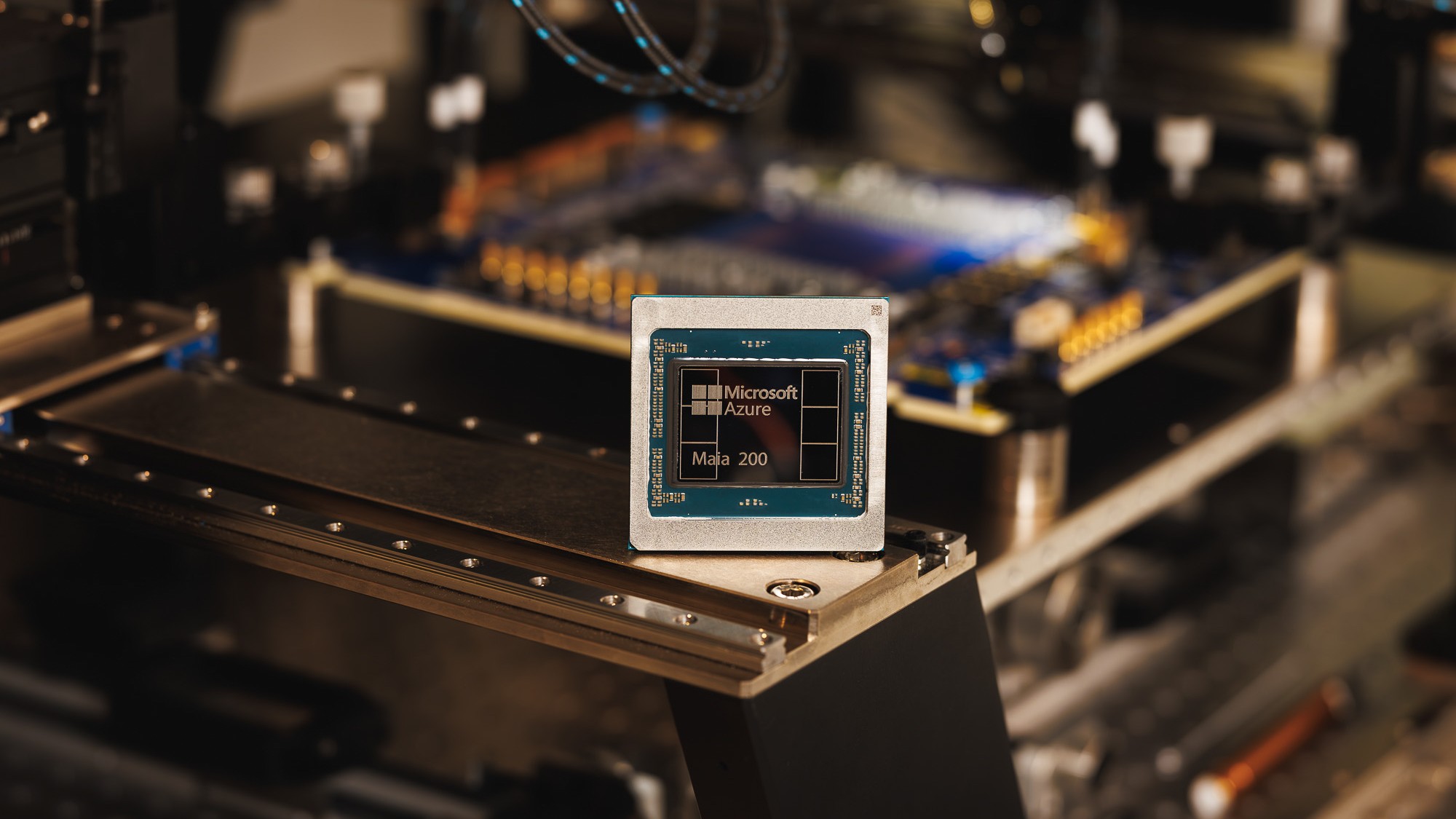
Microsoft-2.87% is no longer content to be Nvidia's-2.84% biggest customer. The $3.5 trillion software giant unveiled Maia 200 today, its second-generation custom AI chip that the company claims is the most performant first-party silicon from any cloud provider—delivering three times the FP4 performance of Amazon's-1.79% Trainium 3 and outperforming Google's-1.16% TPU v7 on FP8 workloads.
The chip is already live in a data center in Iowa, with Arizona coming next. Microsoft says it delivers 30% better performance per dollar than the latest generation NVIDIA hardware in its current fleet.
This is the clearest signal yet that the world's largest cloud providers—each spending more than $50 billion annually on AI infrastructure—are serious about reducing their dependence on NVIDIA's GPUs.
The Specs: A Chip Built for Inference
Maia 200 isn't trying to be everything to everyone. Microsoft has made a deliberate bet on AI inference—the process of generating predictions and outputs from trained models—where the company sees the biggest opportunity to improve economics.
| Specification | Maia 200 |
|---|---|
| Process | TSMC 3nm |
| Transistors | 140+ billion |
| FP4 Performance | 10+ petaFLOPS |
| FP8 Performance | 5+ petaFLOPS |
| Memory | 216GB HBM3e @ 7 TB/s |
| On-chip SRAM | 272MB |
| TDP | 750W |
The SRAM specification is particularly notable. Unlike NVIDIA's chips, which rely heavily on high-bandwidth memory, Microsoft has packed Maia 200 with 272MB of on-chip SRAM—a type of memory that can provide significant speed advantages for chatbots and AI systems fielding requests from large numbers of users.
 Ask Fintool AI Agent
The Real Target: NVIDIA's Software Moat
The hardware specs matter, but Microsoft's most ambitious move is targeting CUDA—the software platform that many Wall Street analysts consider NVIDIA's most durable competitive advantage. Alongside Maia 200, Microsoft is offering Triton, an open-source software tool with major contributions from OpenAI that directly competes with CUDA.
NVIDIA CEO Jensen Huang has repeatedly emphasized CUDA's importance. At the company's Q2 2026 earnings call, he noted that "CUDA library contributions from the open source community along with NVIDIA's open libraries and frameworks are now integrated into millions of workflows."
Microsoft is attempting to chip away at that ecosystem lock-in. If developers can port their workloads to Triton with minimal friction, the cost advantages of Maia 200 become much more attractive.
Microsoft's AI Infrastructure Spend
Microsoft isn't making this bet lightly. The company has dramatically ramped its AI infrastructure investments:
| Period | Capital Expenditure |
|---|---|
| Q2 2025 | $15.8B |
| Q3 2025 | $16.7B |
| Q4 2025 | $17.1B |
| Q1 2026 | $19.4B |
Values retrieved from S&P Global
That's $69 billion in capital expenditure over the past year alone, with the company explicitly stating these investments "will continue to increase our operating costs and may decrease our operating margins."
But Microsoft sees the spending as necessary. On its Q4 2025 earnings call, CFO Amy Hood noted that Azure demand "remains higher than supply" even as the company brings new capacity online.
The Hyperscaler Chip Race
Microsoft joins Google and Amazon in developing custom AI silicon, reflecting a broader industry shift away from pure NVIDIA dependency:
Google has been developing TPUs since 2015 and is now on its seventh generation. The company has been particularly aggressive in the software layer, working closely with Meta to close the gap with NVIDIA's CUDA.
Amazon launched Trainium 2 in 2025, which AWS CEO Andy Jassy called "the backbone of Anthropic's newest generation Claude models." Amazon claims its custom silicon delivers 30-40% better price performance than competing GPUs and is already working on Trainium 3.
All three hyperscalers are using Tsmc's-1.64% cutting-edge 3nm process, the same technology powering NVIDIA's upcoming Vera Rubin chips.
What It Means for NVIDIA
NVIDIA isn't standing still. The company reported Q3 2026 revenue of $57 billion, up 56% year-over-year, with data center compute driving most of the growth. CEO Jensen Huang emphasized at the Q2 2026 earnings call that hyperscaler capex has doubled in two years to roughly $600 billion annually, creating room for both NVIDIA and custom silicon.
The key question is whether this becomes a zero-sum game. When asked directly about ASIC competition from hyperscalers at his Q2 2026 call, Huang was characteristically confident: "We have a very deep partnership with NVIDIA and will for as long as I can foresee," is how Amazon's Jassy described the relationship—even while touting Trainium's advantages.
Ask Fintool AI AgentThe Inference Opportunity
Microsoft's focus on inference rather than training reflects where the economics are heading. As Amazon's Jassy explained: "In at scale, 80 to 90% of the cost will be in inference because you only train periodically, but you're spitting out predictions and inferences all the time."
Maia 200 will initially run workloads including:
- GPT-5.2 models from OpenAI in Microsoft Foundry and Microsoft 365 Copilot
- Synthetic data generation for the Microsoft Superintelligence team
- Reinforcement learning to improve next-generation in-house models
Microsoft claims that time from first silicon to first data center rack deployment was reduced to less than half that of comparable AI infrastructure programs—a critical advantage in a market where demand continues to outstrip supply.
Market Reaction
Microsoft shares rose 1.3% to $472.12 on Monday, adding roughly $46 billion in market cap. NVIDIA edged down 0.4% to $186.87. Both stocks remain well off their 52-week highs—Microsoft at $555.45, NVIDIA at its peak above $400.
The muted reaction suggests investors are taking a wait-and-see approach. Custom chips from hyperscalers have been promised before, and NVIDIA has repeatedly demonstrated an ability to stay ahead of the competition.
What to Watch
Near-term catalysts:
- Microsoft's deployment scale and cost savings data in Q2 2026 earnings
- NVIDIA's next-generation Rubin platform, already in fab with six new chip designs
- OpenAI's choice of infrastructure for its next frontier model
Long-term questions:
- Can Triton gain developer adoption against CUDA's decade-long head start?
- Will other cloud customers demand access to Maia 200, or does Microsoft keep it internal?
- How will NVIDIA defend its moat as its biggest customers become competitors?
Microsoft has made its boldest chip move yet. Whether it shifts the AI infrastructure landscape or becomes another footnote in NVIDIA's dominance remains to be seen.
Ask Fintool AI AgentRelated Companies:
- Microsoft-2.87% - Maia 200 chip developer
- Nvidia-2.84% - Dominant AI chip supplier
- Alphabet-1.16% - TPU developer
- Amazon-1.79% - Trainium developer
- Taiwan Semiconductor-1.64% - Fab partner for all major AI chips