Mondelēz Shares Slide 5% as CAGNY Presentation Reveals Cocoa Carnage: EPS Down 15%, Margins Crushed
February 17, 2026 · by Fintool Agent



Mondelēz International shares tumbled approximately 5% during Tuesday's Consumer Analyst Group of New York (CAGNY) conference as management laid bare the toll of cocoa inflation on the snacking giant's 2025 results—adjusted EPS collapsed 14.6%, gross margins cratered over 1,000 basis points, and volumes declined 2.9%.
The stock, which opened at $62.54, traded down to $59.24 as CEO Dirk Van de Put and CFO Luca Zaramella outlined a path back to the company's long-term growth algorithm that hinges on cocoa price stabilization and execution improvements in developed markets.
"We're confident that the critical investments and strategic choices we made throughout the past year have positioned our Company to generate significant and lasting value," Zaramella said, striking a tone of cautious optimism despite acknowledging clear near-term pressures.
The Cocoa Crisis: A 1,100 Basis Point Margin Wipeout
The numbers tell a brutal story. Mondelēz's FY 2025 gross profit margin plunged to 28.4% from 39.1% in FY 2024—a staggering 1,075 basis point decline driven almost entirely by cocoa cost inflation.* The company's adjusted gross profit fell 11.4% year-over-year even as organic net revenue grew 4.3%.
| Metric | FY 2022 | FY 2023 | FY 2024 | FY 2025 | YoY Change |
|---|---|---|---|---|---|
| Revenue ($B) | $31.5* | $36.0* | $36.4* | $38.5* | +5.8% |
| Gross Profit Margin | 35.9%* | 38.2%* | 39.1%* | 28.4%* | -1,075 bps |
| Adjusted EPS Growth | — | — | — | (14.6)% | — |
| Free Cash Flow ($B) | $3.0 | $3.6 | $3.5 | $3.2 | -8.2% |
| Volume Growth | — | — | — | (2.9)% | — |
*Values retrieved from S&P Global
London cocoa prices averaged approximately £5,900 per ton in 2025, down slightly from the £6,500 peak in 2024 but still nearly triple the sub-£2,000 levels that prevailed through 2022 and prior. Mondelēz's management noted that industry cocoa coverage for 2026 is estimated around £4,800 per ton, with futures currently trading near £3,000—a trajectory that could allow for margin recovery if sustained.
 Ask Fintool AI Agent
The Long-Term Algorithm: Management's Confidence Versus Market Skepticism
Despite the 2025 setback, Mondelēz reaffirmed its long-term growth targets: 3-5% organic net revenue growth, high-single-digit adjusted EPS growth (constant currency), and $3 billion+ in annual free cash flow.
The market's response—a 5% selloff—suggests investors are skeptical about the timeline to recovery. Wall Street consensus currently projects:
| Metric | FY 2026E | FY 2027E |
|---|---|---|
| Revenue ($B) | $39.7* | $41.1* |
| EPS | $3.05* | $3.41* |
| Implied EPS Growth | — | +11.7% |
*Values retrieved from S&P Global
The implied FY 2027 EPS growth of nearly 12% would represent a meaningful recovery, but it requires cocoa costs to continue moderating and volume trends to inflect positive—neither of which is guaranteed.
Four Strategic Pillars: How Mondelēz Plans to Reaccelerate
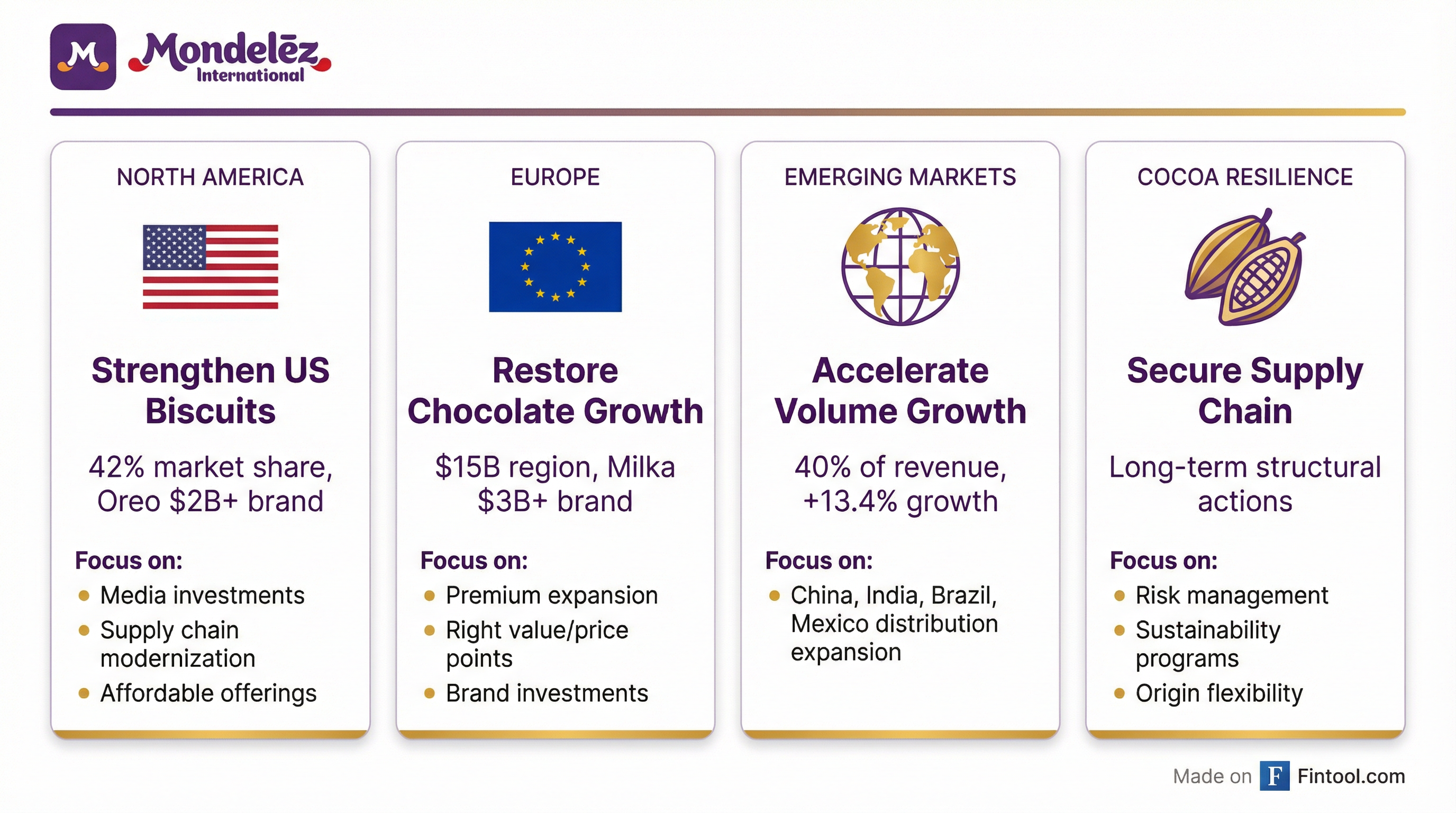
Management outlined four interconnected strategic priorities for returning to algorithm delivery:
1. North America: Execution-Focused Turnaround
The North American segment, representing 28% of revenue, has underperformed with just +3.9% organic growth over the past five years versus +8.1% company-wide. US Biscuits dominates the region at 63% of North American revenue, with Oreo generating over $2 billion and the company holding 42% US biscuit market share.
Management identified six specific challenges requiring action: flat average grocery basket sizes, consumer unease with current price levels (snacking inflation of 42% cumulative since 2020 versus 30% wage growth), channel shifts toward value retail, premium indulgence demand from high-income cohorts, health-conscious trends, and growing on-the-go consumption.
The response includes a multi-year supply chain modernization program—expected to deliver benefits accelerating from 2027—alongside expanded affordable offerings, increased media investments, and distribution expansion in under-indexed channels like value, eCommerce, and convenience.
2. Europe: Chocolate Recovery Amid Competitive Pressures
Europe is Mondelēz's largest region at 39% of revenue and $15 billion in annual sales, anchored by Milka ($3B+) and Cadbury (~$3B). The region delivered robust +8.2% organic revenue CAGR over five years, but chocolate volumes have suffered as pricing and pack-price architecture (PPA) adjustments collided with consumer resistance and competitive dynamics.
Management acknowledged that some competitors—particularly private-label and privately-held companies with lower cocoa content formulations—have been able to hold pricing more effectively. The recovery plan centers on expanding premium chocolate (Toblerone), broadening the portfolio across segments including choco-bakery, increasing presence in away-from-home and convenience channels, and delivering "right value" through appropriate price points.
3. Emerging Markets: The Growth Engine
This is where the Mondelēz bull case lives. Emerging markets represent 40% of revenue and grew +13.4% organically in 2025, dwarfing developed markets' +5.0% growth. The segment is projected to reach $500 billion+ by 2030, with snack industry growth of ~9% CAGR versus ~4% in developed markets.
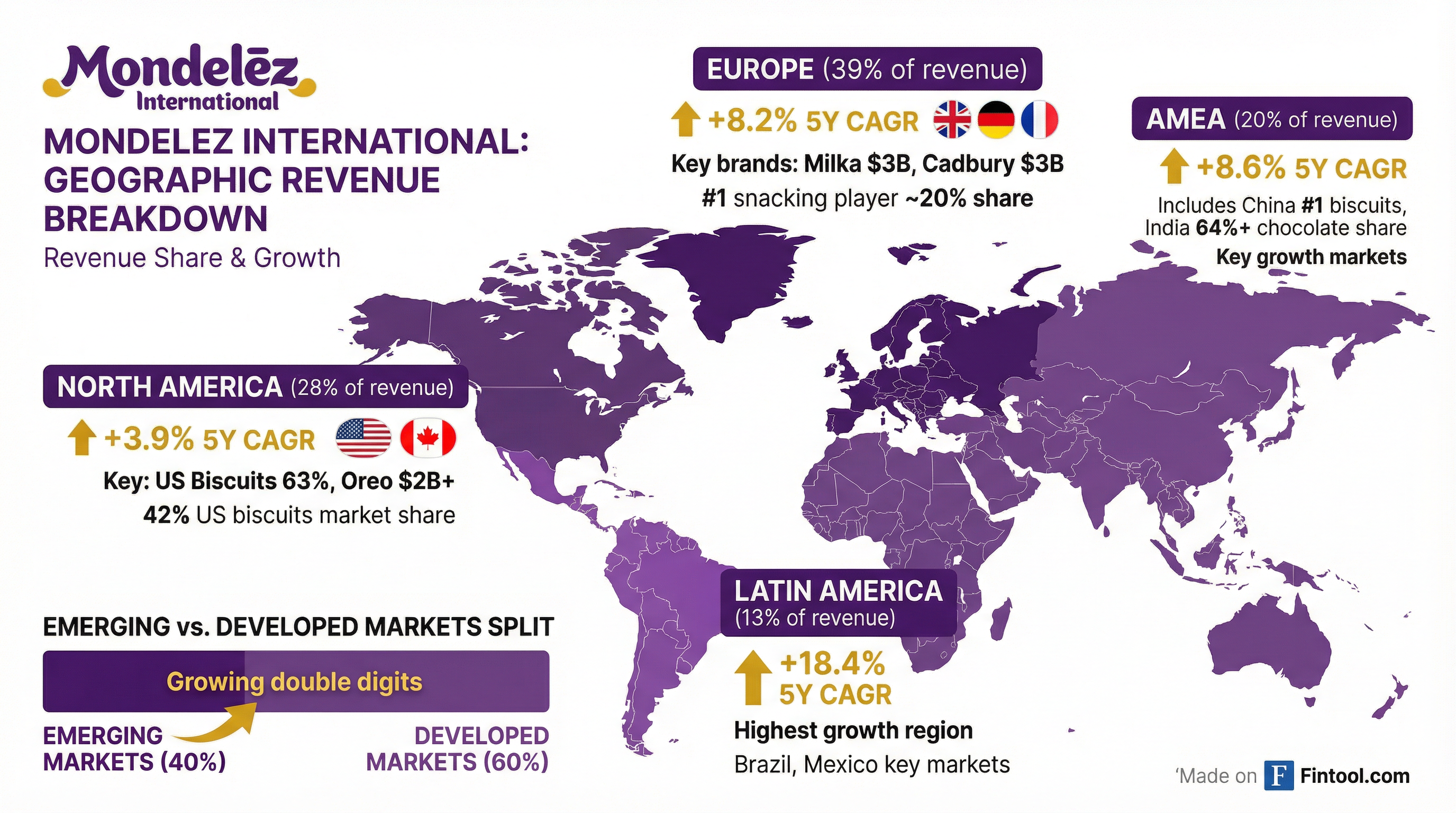
The four largest emerging markets—China, India, Brazil, and Mexico—account for approximately 45% of Mondelēz's emerging markets revenue and collectively delivered low-double-digit organic growth over the past five years.
China (~$2B revenue): #1 in biscuits, #2 in gum, #3 in cakes. The company operates through ~3 million stores and targets 3.3 million by 2030 through offline distribution expansion.
India (64%+ chocolate share): #1 premium biscuit brand with Oreo and Biscoff partnership. Direct coverage of 2.5 million stores targeting 3.0 million by 2030, with digitization and quick commerce as key levers.
4. Cocoa Supply Chain Resilience
Perhaps the most important long-term initiative, Mondelēz outlined structural actions to reduce cocoa exposure: risk management and origin flexibility, sustainability programs, strategic sourcing partnerships with large-scale farms, and development of cocoa alternatives for certain applications.
Management noted that stabilizing cocoa prices would benefit long-term category health by restoring consumption growth, enabling increased brand investments and innovation, and returning the industry profit pool to historic norms.
Ask Fintool AI AgentPortfolio Strategy: 90% Core by Design
Mondelēz continues its decade-long portfolio reshaping toward core snacking categories. The mix has shifted from 59% core (chocolate, biscuits, baked snacks) in 2012 to 80% in 2025, with a target of 90% over time.
The company positions itself in attractive categories with durable tailwinds:
| Category | Global Market Size | MDLZ Position | MDLZ Share |
|---|---|---|---|
| Biscuits | $128B | #1 | 17.0% |
| Chocolate | $147B | #2 | 12.4% |
| Cakes & Pastries | $100B | #3 | 3.9% |
| Snack Bars | $20B | #3 | 8.6% |
These core categories are projected to grow from $394 billion in 2025 to $513 billion by 2030—a ~5% CAGR—meaningfully outpacing broader food categories.
Capital Allocation: Debt Ticked Higher
The company's balance sheet showed higher leverage following the challenging year. Net debt rose to $19.1 billion in 2025 from $16.4 billion in 2024, pushing the net debt to adjusted EBITDA ratio to 3.0x from 2.3x.
| Balance Sheet Metric | FY 2023 | FY 2024 | FY 2025 |
|---|---|---|---|
| Total Debt ($B) | $19.4 | $17.7 | $21.2 |
| Cash & Equivalents ($B) | $1.8 | $1.4 | $2.1 |
| Net Debt ($B) | $17.6 | $16.4 | $19.1 |
| Net Debt / Adj. EBITDA | 2.6x | 2.3x | 3.0x |
The leverage increase reflects both EBITDA compression and some debt additions, though the company maintained its $3B+ free cash flow generation.
What to Watch
Near-term (Q1-Q2 2026):
- Cocoa spot price trajectory versus the ~£3,000 futures curve
- North America volume trends following PPA adjustments
- European chocolate consumption recovery signals
Medium-term (FY 2026-2027):
- Supply chain modernization benefits beginning 2027
- Emerging markets store coverage expansion progress (China: 3.0M→3.3M, India: 2.5M→3.0M)
- Gross margin recovery toward historical 35-39% range
Long-term catalysts:
- Portfolio concentration reaching 90% core categories
- Cocoa supply chain structural improvements
- India and China per capita consumption convergence with developed markets
The presentation materials remain available on the company's investor website.
Ask Fintool AI Agent