Mondelez Reaffirms Growth Targets at CAGNY as Cocoa Costs Ease—But Stock Falls 5%
February 17, 2026 · by Fintool Agent


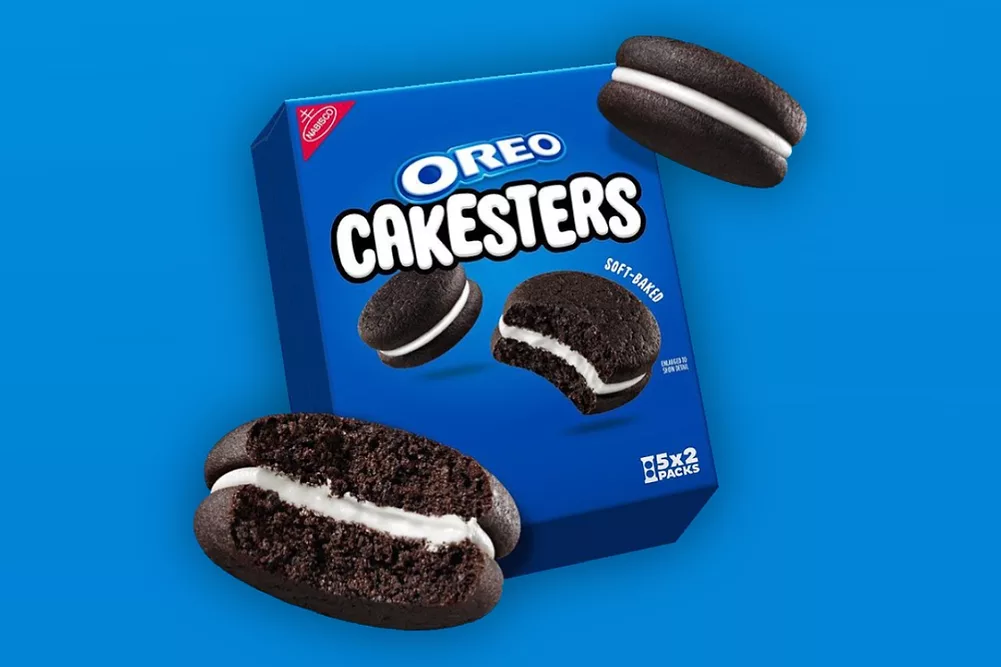
Mondelez International shares fell nearly 5% on Monday as CEO Dirk Van De Put and CFO Luca Zaramella laid out an ambitious turnaround strategy at the 2026 Consumer Analyst Group of New York (CAGNY) conference—but investors appeared unconvinced that the world's second-largest chocolate maker can quickly recover from a brutal cocoa-driven margin collapse.
The stock closed at $59.46, down 4.9% from Friday's close, even as management reaffirmed the company's long-term growth algorithm and outlined detailed plans to reignite volume growth in developed markets.
"We remain convinced of the long-term potential of our core snacking categories," Van De Put told the audience. "Year after year, consumer research demonstrates that snacking remains the most dynamic and attractive space in food."
The Cocoa Hangover
The presentation came just two weeks after Mondelez reported FY 2025 results that starkly illustrated the damage from record cocoa prices. While revenue grew 5.8% to $38.5 billion, the commodity surge crushed profitability:
| Metric | FY 2021 | FY 2022 | FY 2023 | FY 2024 | FY 2025 |
|---|---|---|---|---|---|
| Revenue ($B) | $28.7 | $31.5 | $36.0 | $36.4 | $38.5 |
| Gross Margin (%) | 39.2% | 35.9% | 38.2% | 39.1% | 28.4% |
| EBITDA Margin (%) | 21.3% | 18.5% | 19.2% | 21.2% | 12.9% |
| Diluted EPS | $3.04 | $1.96 | $3.62 | $3.42 | $1.89 |
*Values retrieved from S&P Global
The numbers tell a painful story: gross margin collapsed over 1,000 basis points in a single year as cocoa prices—which peaked above $12,000 per metric ton in late 2024—worked through Mondelez's inventory and hedging positions. Diluted EPS fell 45% year-over-year.
While cocoa futures have since fallen nearly 70% from their peak to around $5,800 per ton, the relief won't flow through immediately. "In the short term, this rapid rate of decline is causing a discrepancy between industry coverage and market prices," Van De Put acknowledged. "We may need to respond to possible competitive action or client disruption, which might require some price reinvestment ahead of our actual pipeline costs."
 Ask Fintool AI Agent
The Long-Term Algorithm
Management used the CAGNY stage to reaffirm Mondelez's long-term financial targets, which have remained unchanged despite the cocoa volatility:
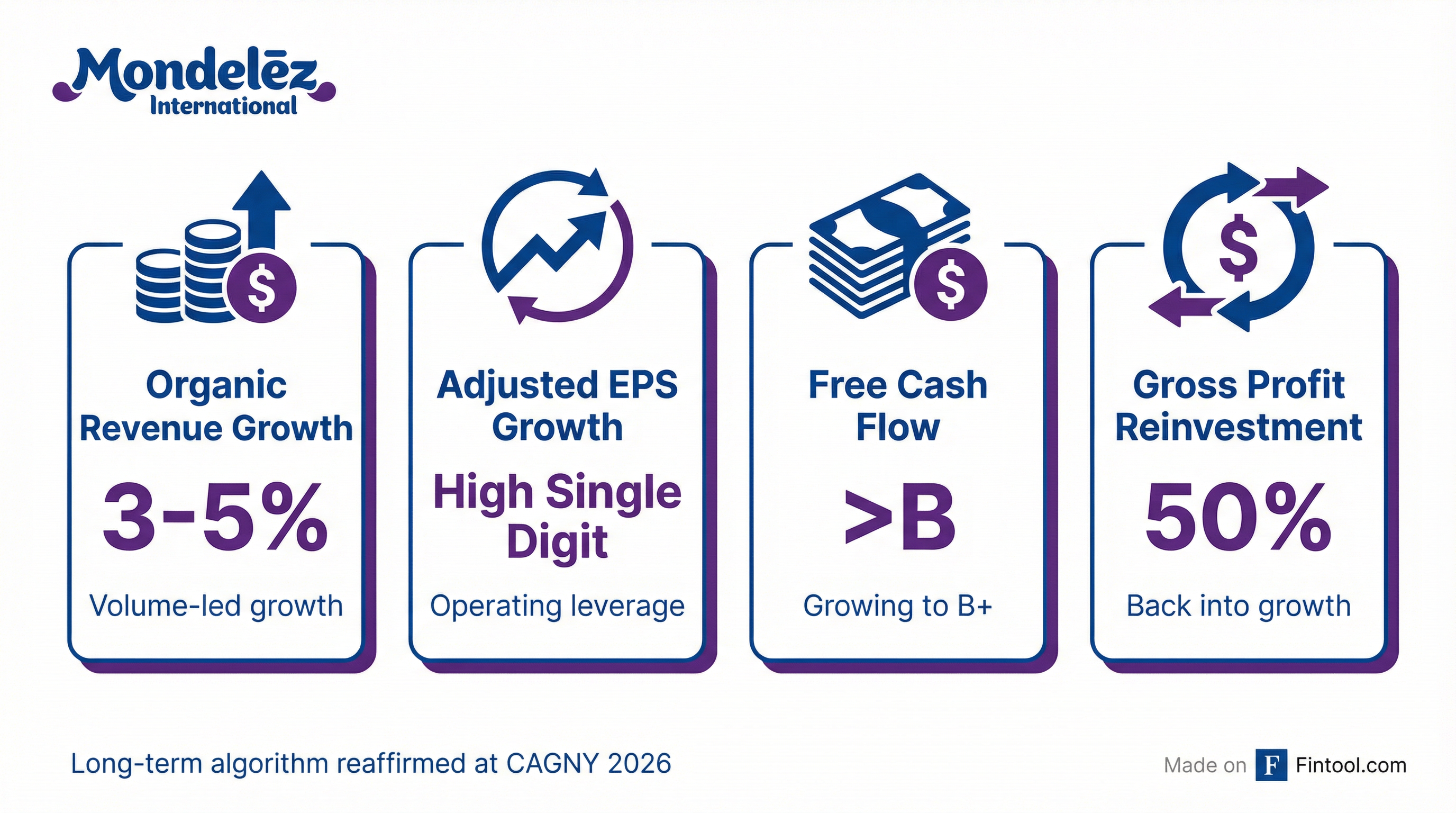
CFO Zaramella expressed optimism for 2027: "Strong EPS growth, driven by improving performance in developed markets, continued strong growth in emerging markets, productivities across supply chain and SG&A, and continued stabilization of cocoa."
Consensus estimates reflect cautious optimism, with analysts modeling:
| Metric | FY 2026E | FY 2027E |
|---|---|---|
| Revenue | $39.7B | $41.1B |
| Primary EPS | $3.05 | $3.41 |
| EBITDA | $6.8B | $7.4B |
| LT EPS Growth | 7.4% | 7.4% |
*Values retrieved from S&P Global
The implied FY 2026 EPS would represent a 61% rebound from FY 2025's depressed level—but would still sit 11% below FY 2024's $3.42.
North America: Six Trends to Address
Van De Put identified six consumer trends requiring strategic responses in the North American biscuits business, which generates approximately $11 billion in annual revenue:
- Flat grocery basket sizes — Increasing working media investment to boost brand visibility
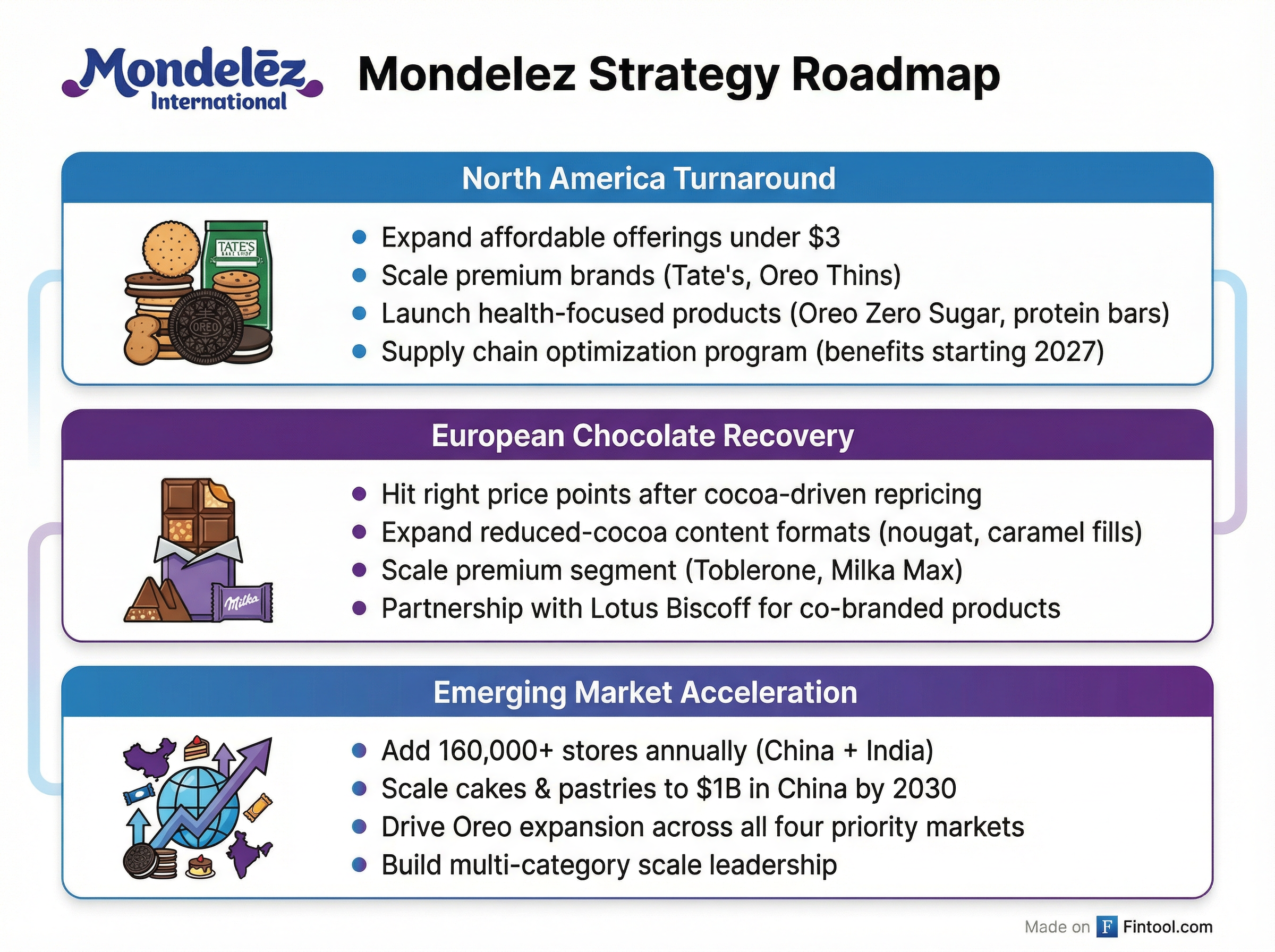
- Consumer unease with prices — Expanding affordable offerings under $3, such as Fresh Stack portable packs
- Channel shifts to value — Aggressive expansion in club, value, convenience, and e-commerce
- Premium demand from higher-income consumers — Scaling Tate's Bake Shop nationally and expanding Oreo Thins
- Better-for-you trends — Launching Oreo Zero Sugar and expanding protein bars (Perfect Bar, Builders, Z Bar)
- On-the-go consumption growth — Expanding Oreo Minis, Ritz Bits, and portable morning snacks
"We are already starting to see the first effects, with strong growth over the last 3 months in both our largest mass retail partner and in the value chains," Van De Put said.
The company also announced a "robust multi-year supply chain capability improvement program" to modernize U.S. biscuit operations, with benefits expected to materialize in early 2027.
Ask Fintool AI AgentEuropean Chocolate: Finding the Right Price Points
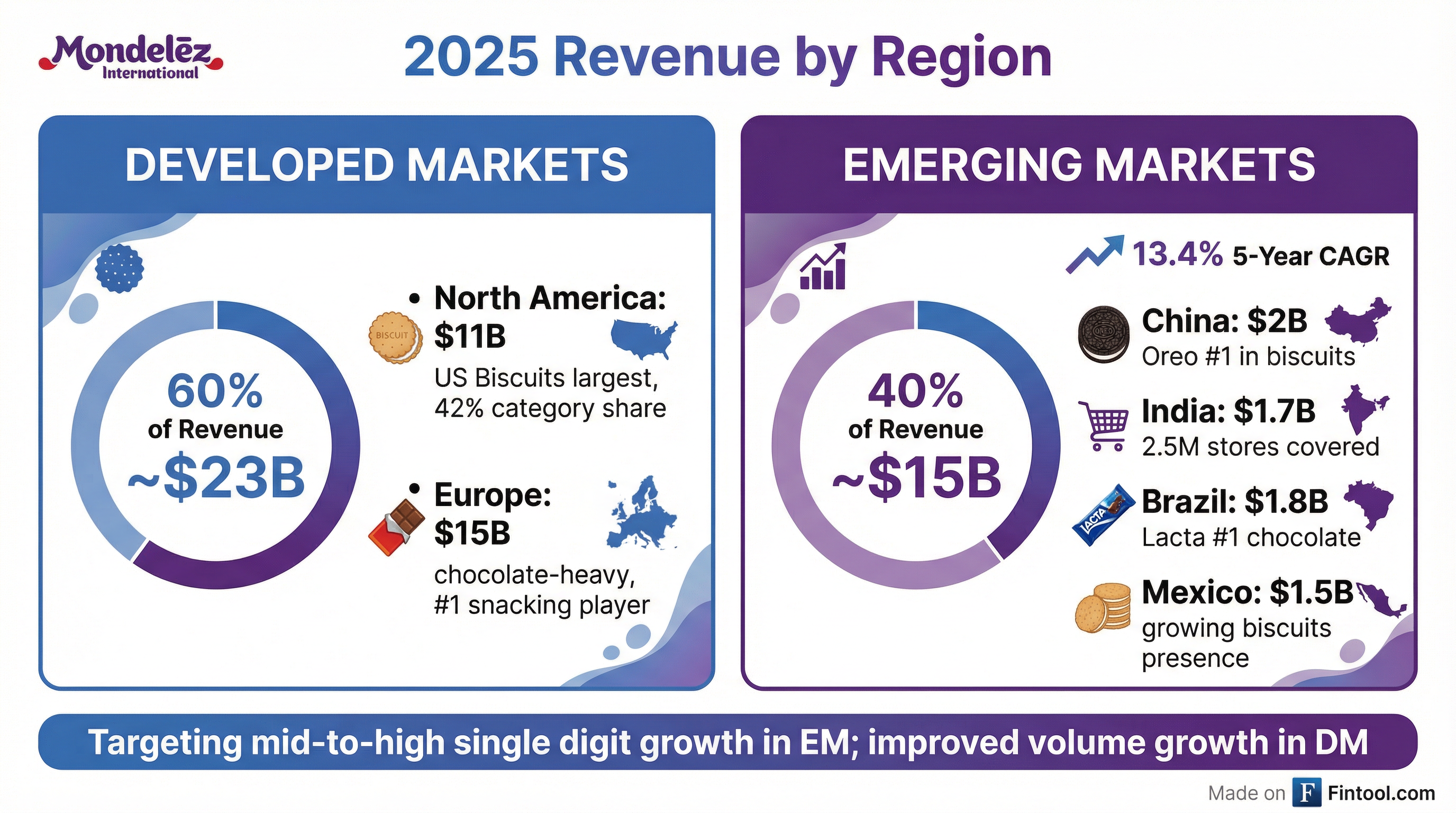
Europe, which accounts for roughly $15 billion in revenue (approximately 40% of total sales), remains the company's most chocolate-exposed region. Management acknowledged several headwinds:
- Cocoa-led pricing and pack resizing impacted volumes more than expected, though elasticity remained "acceptable" at 0.7
- Competitors less dependent on cocoa used aggressive pricing tactics
- Some price pack innovations failed to meet consumer expectations
The strategic response centers on five pillars:
- Hitting critical price points with refined pack formats
- Expanding formats with reduced cocoa content (nougat, caramel, and nut-filled tablets)
- Scaling premium offerings (Toblerone personalization, Milka Max)
- Growing presence in under-indexed channels with on-the-go products
- Improving cocoa supply chain resilience through expanded sourcing and alternative technologies
"We are continuing to grow Chocol Bakery with both new innovation and expanded distribution. And in cakes and pastries, our Milka croissant is performing very well," Van De Put noted, adding that the croissant alone delivered approximately one point of share gain in European cakes and pastries.
The company also highlighted its partnership with Lotus Bakeries to develop co-branded chocolate bars and pralines combining Biscoff with Milka and Cadbury.
Emerging Markets: The Growth Engine
Perhaps the most compelling portion of the presentation focused on emerging markets, which represent 40% of revenue (~$15 billion) and have delivered a 13.4% revenue CAGR over the past five years.
Zaramella outlined the company's "winning recipe": aspirational brands, affordable price points, well-established route-to-market capabilities, localized supply chains, and strong local market expertise.
The four priority markets—China, India, Brazil, and Mexico—together represent approximately $7 billion in revenue:
China ($2B Revenue)
- Oreo commands 18% biscuit market share—the highest globally for the brand
- Currently covers 3 million stores with an addressable universe of 6 million
- Targeting $1 billion in cakes and pastries revenue by 2030
India ($1.7B Revenue)
- 2.5 million stores covered, with more than 9 million addressable
- Adding 100,000 stores per year through machine learning-optimized ordering
- Expanding "easy coolers" for in-store Cadbury Dairy Milk presence
Brazil ($1.8B Revenue)
- Lacta is the #1 chocolate brand in Brazil
- Oreo designated a priority market for awareness-building
- Scaling cakes and pastries platform
Mexico ($1.5B Revenue)
- Recently added Ricolino candy business
- Expanding Oreo presence with tailored marketing
- Growing traditional trade on acquired DSD routes
Management is targeting mid-to-high single-digit organic revenue growth from emerging markets, led by volumes with attractive profitability.
Ask Fintool AI AgentCapital Allocation: Buybacks and Bolt-Ons
Zaramella reiterated the company's capital allocation priorities: returning capital to shareholders through dividends and buybacks while pursuing bolt-on acquisitions.
Key highlights from the past eight years:
- Double-digit dividend growth in 9 of the last 10 years
- ~$15 billion in share repurchases (nearly 20% reduction in share count)
- $30+ billion total returned to shareholders
- 10 bolt-on acquisitions since 2018, including Chipita (cakes/pastries), Give and Go, Tate's, Perfect Snacks, and most recently Evurt (low-twenties growth since acquisition)
The company aims to grow free cash flow from approximately $3.6 billion in FY 2025 to "$4 billion plus plus" over time.
The Cocoa Wild Card
The elephant in the room remains cocoa. While prices have normalized significantly—down to around $5,800 per metric ton from peaks above $12,000—they remain well above the sub-$4,500 levels seen in early 2024.
Chocolate prices at U.S. retail rose 14% in early 2026 compared to the prior year, on top of 7.8% increases in 2025. European prices climbed even more sharply, with German chocolate prices up 18.9% in 2025.
Van De Put acknowledged Mondelez has already begun "price reinvestment" in some European markets, including the UK and Germany, after significant volume declines. "In Europe, the company hiked prices by even more and saw a significant decrease in the amount of its products sold," per recent reporting.
On supply chain resilience, management outlined several initiatives:
- Improved crop forecasting and robust hedging frameworks
- Expanded sourcing to Latin America
- Partnerships to scale large-scale farming practices in West Africa
- Investments in alternative technologies, including cell-cultured and fermented cocoa
"While still early, we view these investments in next-generation cocoa as a strategic insurance policy against traditional sourcing risk," Van De Put said.
What to Watch
Investors will be monitoring several catalysts in the coming quarters:
- Q1 2026 results — First look at whether volume trends are inflecting in developed markets
- Cocoa hedge roll-offs — Timing of when lower spot prices flow through to COGS
- European competitive dynamics — Whether competitors reinvest falling cocoa costs into pricing
- Emerging market execution — Continued momentum in China, India, Brazil, and Mexico
- Supply chain benefits — Management targets early 2027 for U.S. optimization gains
With shares trading at approximately 19.5x forward EPS (FY 2026E of $3.05), Mondelez is valued at a modest discount to historical averages but above distressed levels. The market appears to be pricing in a recovery—but today's selloff suggests skepticism about the pace.
Ask Fintool AI AgentRelated Companies: Mondelez International · Hershey · General Mills · Kraft Heinz · Nestlé