Nike's Turnaround Enters 'Middle Innings': North America Surges But China Becomes a $1.4 Billion Problem
December 19, 2025 · by Fintool Agent


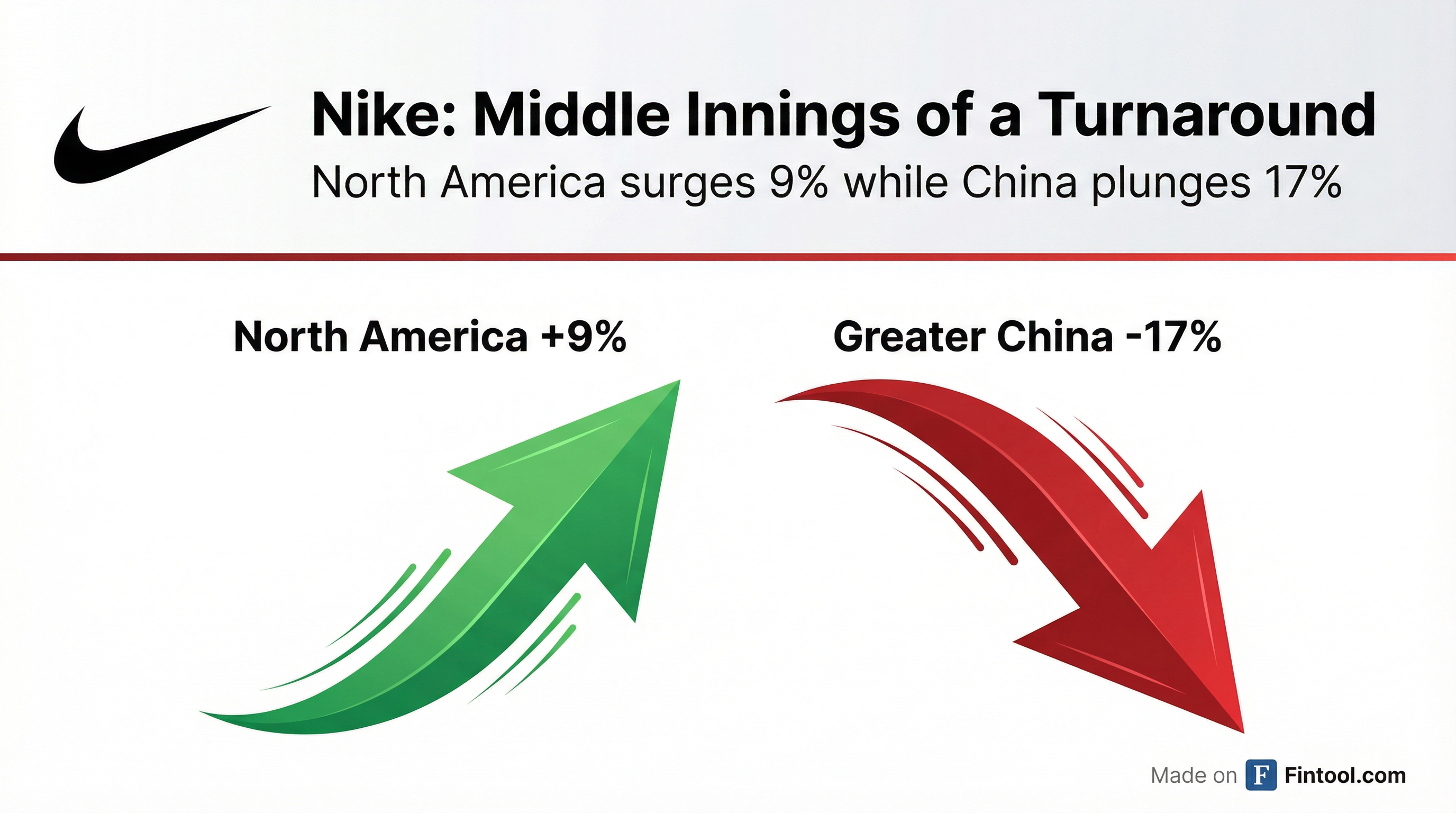
Nike+1.95% beat Wall Street estimates on both revenue and earnings Thursday night, yet the stock plunged more than 10% in after-hours trading as investors confronted a sobering reality: the world's largest sportswear company has a China problem that CEO Elliott Hill admits isn't "happening at the level or the pace we need."
The results encapsulate the challenge facing Nike a year into Hill's tenure—pockets of genuine momentum, particularly in North America where wholesale revenue surged 24%, colliding with persistent weakness in Greater China where sales cratered 17% and profitability collapsed 49%. Adding $1.5 billion in annualized tariff costs to the mix, and investors see a turnaround story that still has significant risk.
"I'd say we're in the middle innings of our comeback," Hill told analysts on the earnings call. "We started with the Win Now Actions... and now our Sport Offense is the accelerator."
Middle innings, as it turns out, can be uncomfortable—particularly when one of your most important markets is going the wrong direction.
The Numbers: A Tale of Two Geographies
Nike posted fiscal Q2 2026 results that topped consensus expectations:
| Metric | Actual | Estimate | vs. Estimate |
|---|---|---|---|
| Revenue | $12.43B | $12.22B | +1.7% |
| EPS (Adjusted) | $0.53 | $0.37 | +43% |
| Gross Margin | 40.6% | 43.6% (prior year) | -300 bps YoY |
But the headline numbers mask a stark geographic divergence that has investors concerned:
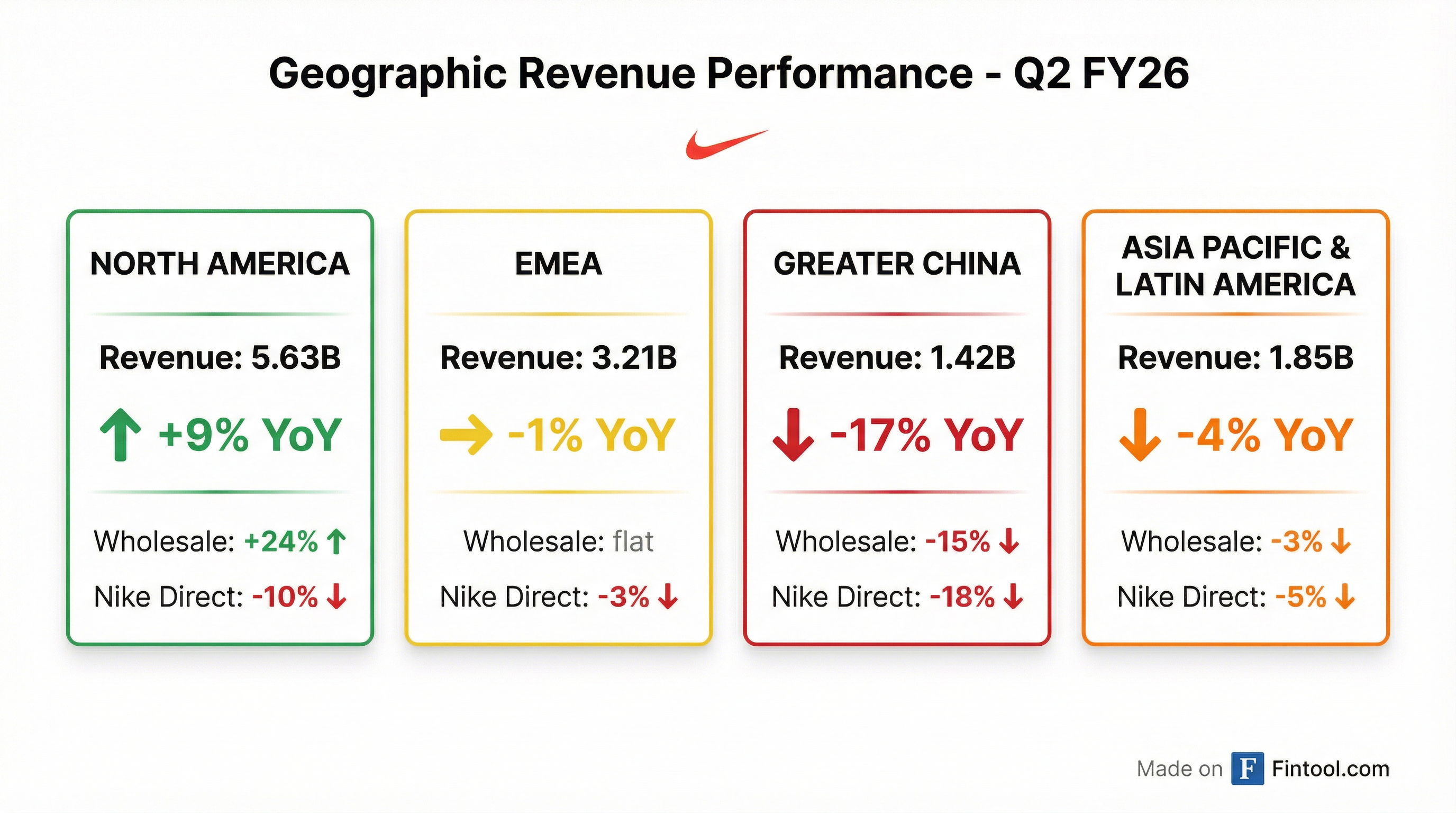
| Geography | Q2 Revenue | YoY Change | EBIT Change |
|---|---|---|---|
| North America | $5.63B | +9% | -8% |
| EMEA | $3.21B | -1% | -12% |
| Greater China | $1.42B | -17% | -49% |
| Asia Pacific & Latin America | $1.85B | -4% | -15% |
North America is working. Everything else remains in various stages of distress.
The China Conundrum
China has now declined for six consecutive quarters, and Hill's candid assessment suggests the path to recovery will be longer than many hoped.
"The reality is we had become a lifestyle brand competing on price in China," Hill acknowledged on the call. "We also reduced the feet on the ground, people on the ground... and we weren't making the investment in our store fleet, so our stores aren't compelling."
The numbers paint a grim picture for Nike's second-largest market:
| China Metric | Q2 FY26 | YoY Change |
|---|---|---|
| Revenue | $1.42B | -17% |
| Nike Digital | — | -36% |
| Wholesale | — | -15% |
| Nike Stores | — | -5% |
| EBIT | — | -49% |
CFO Matt Friend explained the vicious cycle that has taken hold: "We faced consistent challenges with declining store traffic, softer in-season sell-through rates, and higher levels of aged inventory across the marketplace. Our brands have consistently been off price for consumers, especially in digital, affecting our premium positioning across the entire integrated marketplace."
Nike pulled back sharply during China's Singles Day (11/11) shopping event, with sales down approximately 35% year-over-year—but this was "in line with our plans" as management prioritizes brand health over volume.
The company accelerated returns of aged inventory from partners, wrote off partner and Nike inventory, cut sell-in plans for spring, and reduced summer buys. Hill emphasized China remains "one of the most powerful long-term opportunities in sport," but warned it will require "a fresh perspective, a new approach, and ultimately some new capabilities."
The Wholesale Renaissance
The most encouraging signal in Nike's results is the wholesale channel's resurgence—and it's no accident. Hill has deliberately reversed his predecessor's strategy of prioritizing direct-to-consumer sales at the expense of wholesale partners.
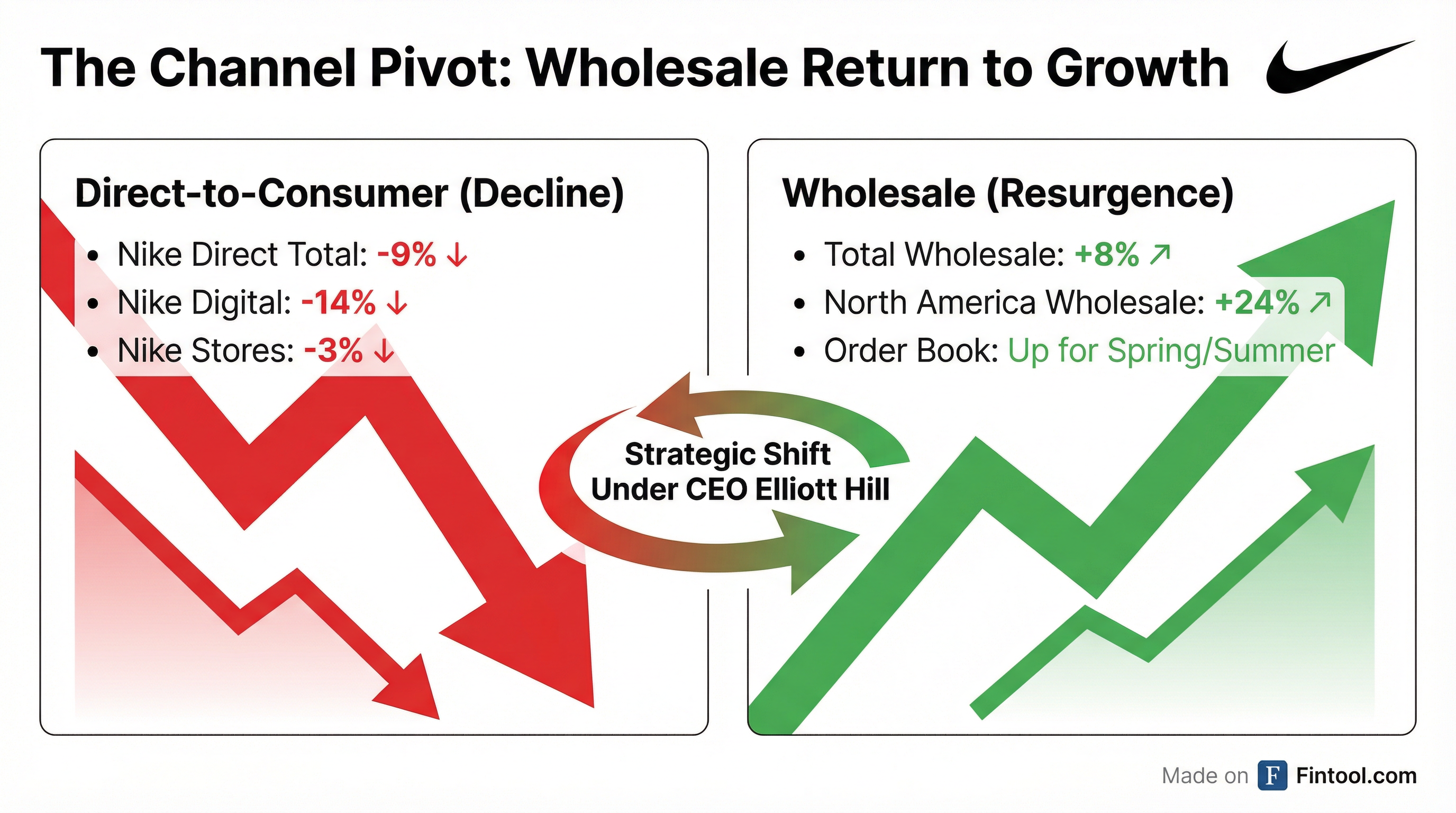
| Channel | Q2 FY26 Revenue | YoY Change |
|---|---|---|
| Wholesale | $7.5B | +8% |
| Nike Direct | $4.6B | -9% |
| — Nike Digital | — | -14% |
| — Nike Stores | — | -3% |
In North America specifically, wholesale growth hit 24%, driven by both new and existing partners. Friend noted the order book "is very balanced in terms of growth between new partners and existing partners."
The strategic pivot isn't just about revenue—it's about profitability. Wholesale creates meaningful cost leverage: "You're shipping pallets of product to partners versus shipping one-on-one units to consumers," Friend explained.
The wholesale recovery comes as Nike actively reduces promotional activity in its digital channel. Nike.com posted its "best Black Friday ever" this year, partially driven by strong sell-through of the Jordan Black Cat launch. Days of promotion and markdown rates both declined.
Running Hot, Classics Cooling
Nike's product mix is shifting dramatically. The company has deliberately reduced its classic footwear franchises by more than $4 billion from peak levels, creating a near-term revenue headwind but positioning the brand for healthier long-term growth.
Running has emerged as the bright spot, growing more than 20% for the second consecutive quarter and taking market share. The category is up double digits in every channel, including Nike Direct.
| Product Performance | Q2 Trend |
|---|---|
| Running | +20%+ (2nd consecutive quarter) |
| Classic Franchises | -20%+ (intentional) |
| Global Football Order Book | +40% vs. World Cup '22 |
| Converse | -30% |
The pipeline appears robust. Hill highlighted upcoming launches including Nike Mind (a new footwear platform for athletic preparation), AeroFit apparel (temperature-regulating technology for national team kits), and expanded NikeSKIMS internationally.
"Our order book for spring and summer is up," Hill noted. "We're building a healthier base for top-line growth."
The Tariff Headwind
Layered on top of the turnaround challenges, Nike faces an estimated $1.5 billion in annualized incremental product costs from higher U.S. tariffs—a gross margin headwind of approximately 320 basis points in fiscal 2026.
While Nike has begun taking actions to reduce the net impact to approximately 120 basis points, it remains "a significant factor impacting our near-term EBIT margins amidst a turnaround in a very dynamic operating environment."
North America illustrates both the problem and Nike's ability to manage it: gross margins there declined 330 basis points versus prior year, despite absorbing a 520-basis-point tariff impact. The implication is that underlying operational improvements drove nearly 200 basis points of offset.
Financial Trajectory: The Long Road Back
Nike's profitability has eroded significantly over the past two years as turnaround costs, tariffs, and China weakness compound:
| Period | Revenue | Net Income | EPS | Gross Margin |
|---|---|---|---|---|
| Q3 2024 | $12.43B | $1.17B | $0.77 | 45.3% |
| Q4 2024 | $12.61B | $1.50B | $0.99 | 44.7% |
| Q1 2025 | $11.59B | $1.05B | $0.70 | 45.4% |
| Q2 2025 | $12.35B | $1.16B | $0.78 | 43.6% |
| Q3 2025 | $11.27B | $0.79B | $0.54 | 41.5% |
| Q4 2025 | $11.10B | $0.21B | $0.14 | 40.3% |
| Q1 2026 | $11.72B | $0.73B | $0.49 | 42.2% |
| Q2 2026 | $12.43B | $0.79B | $0.53 | 40.6% |
Hill was explicit about the margin goal: "Margin expansion is a top priority for me and my leadership team. While it will take time, we see the path back to double-digit EBIT margins for Nike Inc." But he declined to provide a timeline, noting the company is "operating in a dynamic environment" and needs "flexibility to make the right decisions every week."
What's Next: Q3 Guidance
Nike's outlook for the current quarter reflects continued turbulence:
| Q3 FY26 Guidance | Expectation |
|---|---|
| Revenue | Down low single digits |
| Gross Margin | Down 175-225 bps |
| — Tariff Impact | -315 bps |
| — Ex-Tariff | Positive expansion |
| SG&A | Up low single digits |
The guidance implies modest North America growth offset by continued weakness in China and Converse, with performance "similar to Q2."
Notably, Friend highlighted that excluding tariff impacts, gross margins would expand in Q3—a signal that the underlying business improvements are beginning to show through.
The Investment Case
Nike's stock is down more than 13% year-to-date versus a market that has rallied substantially. At roughly $59 post-earnings (assuming ~10% after-hours decline from Thursday's $65.74 close), the company trades at a significant discount to its historical multiples.
The bull case rests on:
- North America demonstrating the turnaround playbook works
- Running gaining market share with strong sell-through
- Wholesale partnerships rebuilding successfully
- Product innovation pipeline improving
- $4 billion+ in classic franchise reductions nearly complete
The bear case focuses on:
- China showing no signs of bottoming after six quarters of decline
- $1.5 billion in structural tariff costs with limited offset
- Margins structurally impaired for the foreseeable future
- Increasing competition from On+1.28%, Hoka (deckers)+3.85%, and others
- No timeline for return to double-digit EBIT margins
Hill closed the call with a baseball metaphor: "Nike is in a similar moment [to the Dodgers winning back-to-back World Series titles]. We're the industry leader. Expectations are high. And yes, we face pressure and setbacks. But like the Dodgers, we're leaning on each other, focused on the fundamentals, making the hard calls, and building for the long game."
Whether investors have the patience for a long game is the question the stock price is answering today.
Related Companies