Tim Cook and Robert Swan Buy $3.5M in Nike Stock After Post-Earnings Plunge
December 24, 2025 · by Fintool Agent


Two of America's most respected tech executives just bet big on Nike's+1.95% turnaround—with their own money.
Apple+0.80% CEO Tim Cook purchased 50,000 shares of Nike Class B stock at $58.97 per share on December 22, a $2.95 million open-market buy that boosted his holdings to 105,480 shares. The same day, former Intel CEO Robert Swan added 8,691 shares at $57.54, spending approximately $500,000 and raising his stake to 43,293 shares.
The coordinated purchases came just four days after Nike reported Q2 FY2026 results that disappointed investors, sending the stock down 13% from its pre-earnings close of $65.69 to $57.22 by the time Cook and Swan pulled the trigger.
 Ask Fintool AI Agent
Buying Into the Pain
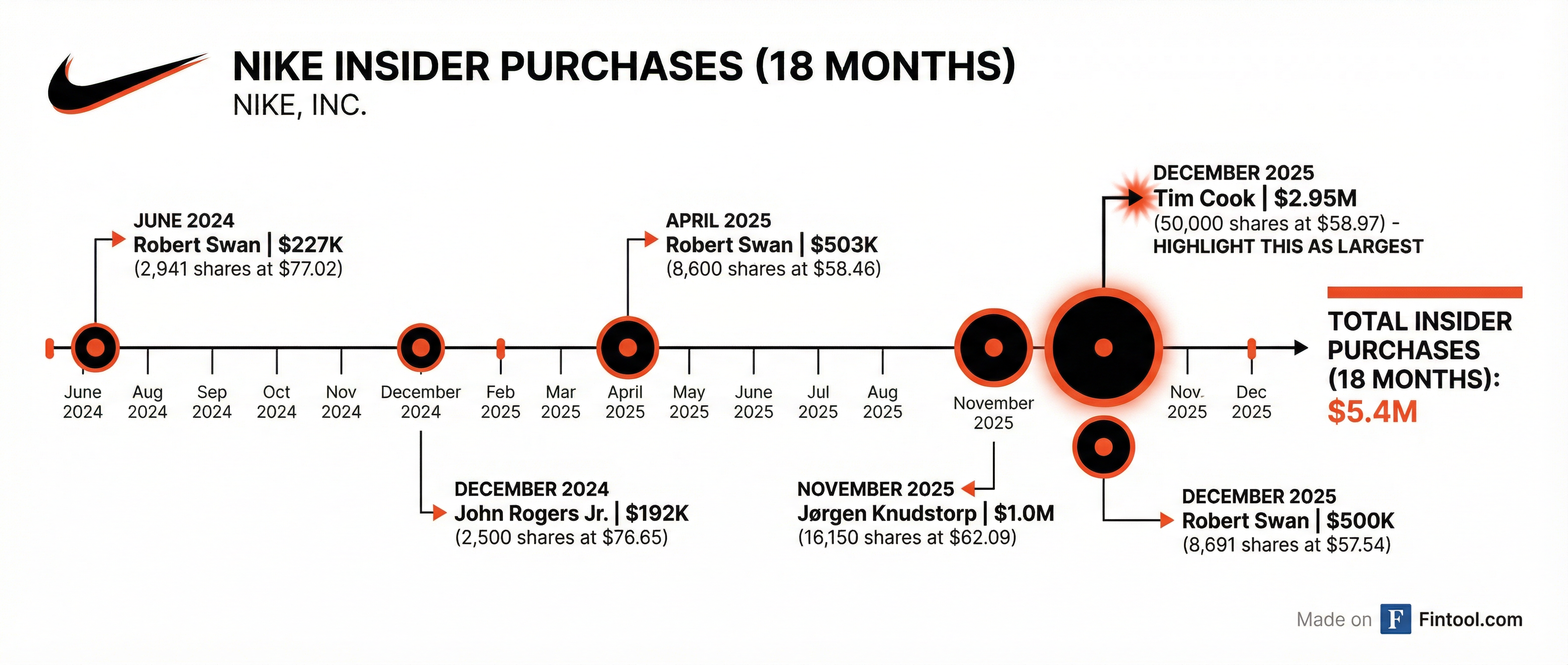
The timing is notable: Cook has been on Nike's board since 2005 and rarely makes open-market purchases. This marks his largest Nike buy in recent years—a meaningful signal from a CEO known for disciplined capital allocation.
Swan has been even more aggressive. This represents his third Nike purchase in 18 months:
| Date | Insider | Shares | Price | Value |
|---|---|---|---|---|
| Dec 22, 2025 | Tim Cook | 50,000 | $58.97 | $2.95M |
| Dec 22, 2025 | Robert Swan | 8,691 | $57.54 | $500K |
| Nov 7, 2025 | Jørgen Vig Knudstorp | 16,150 | $62.09 | $1.0M |
| Apr 4, 2025 | Robert Swan | 8,600 | $58.46 | $503K |
| Dec 27, 2024 | John W. Rogers Jr. | 2,500 | $76.65 | $192K |
| Jun 28, 2024 | Robert Swan | 2,941 | $77.02 | $227K |
Former LEGO CEO Jørgen Vig Knudstorp also bought $1 million worth in November, after the stock's initial post-earnings slide in Q1. The pattern is unmistakable: Nike's independent directors see value where the market sees risk.
Ask Fintool AI AgentThe Turnaround: "Middle Innings"
CEO Elliott Hill, who returned to lead the company a year ago, framed Q2 results as "slightly better than anticipated" while acknowledging Nike is "nowhere near our potential."
The numbers reflect a company in transition:
| Metric | Q2 2026 | Q2 2025 | Change |
|---|---|---|---|
| Revenue | $12.43B | $12.35B | +0.6% |
| Gross Margin | 40.6% | 43.6% | -300bp |
| EPS (Diluted) | $0.53 | $0.78 | -32% |
| EBIT Margin | 8.1%* | 11.2%* | -310bp |
*Values retrieved from S&P Global
The gross margin compression comes from two sources: tariff headwinds adding approximately 320 basis points of product cost pressure in FY2026, and deliberate actions to clean up inventory and reposition the marketplace.
Ask Fintool AI AgentNorth America: The Proof of Concept
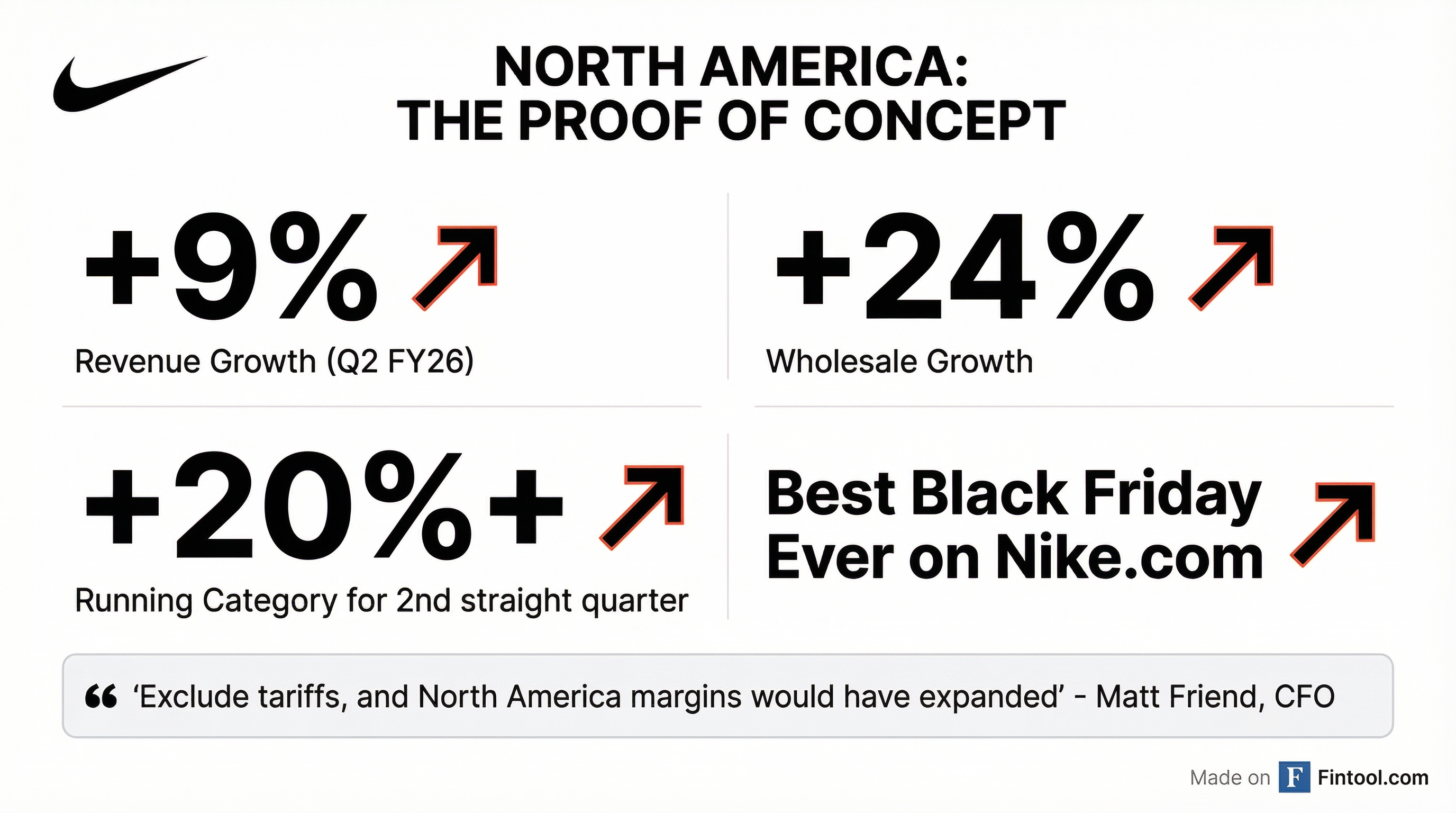
The one geography where Nike's "Win Now Actions" have reached critical mass is North America, which grew 9% in Q2 with wholesale surging 24%.
"North America is our best example of executing our Win Now Actions," CFO Matt Friend said. "North America's gross margins were down 330 basis points despite more than 500 basis points of a headwind to product costs due to the gross impact from the new tariffs."
Translation: exclude tariffs, and North America margins would have expanded. The playbook is working.
Running continues to lead the recovery, growing over 20% for the second consecutive quarter across all channels. Nike.com delivered its "best Black Friday ever," driven by strong sell-through on the Jordan Black Cat launch.
Ask Fintool AI AgentChina: The Longest Road
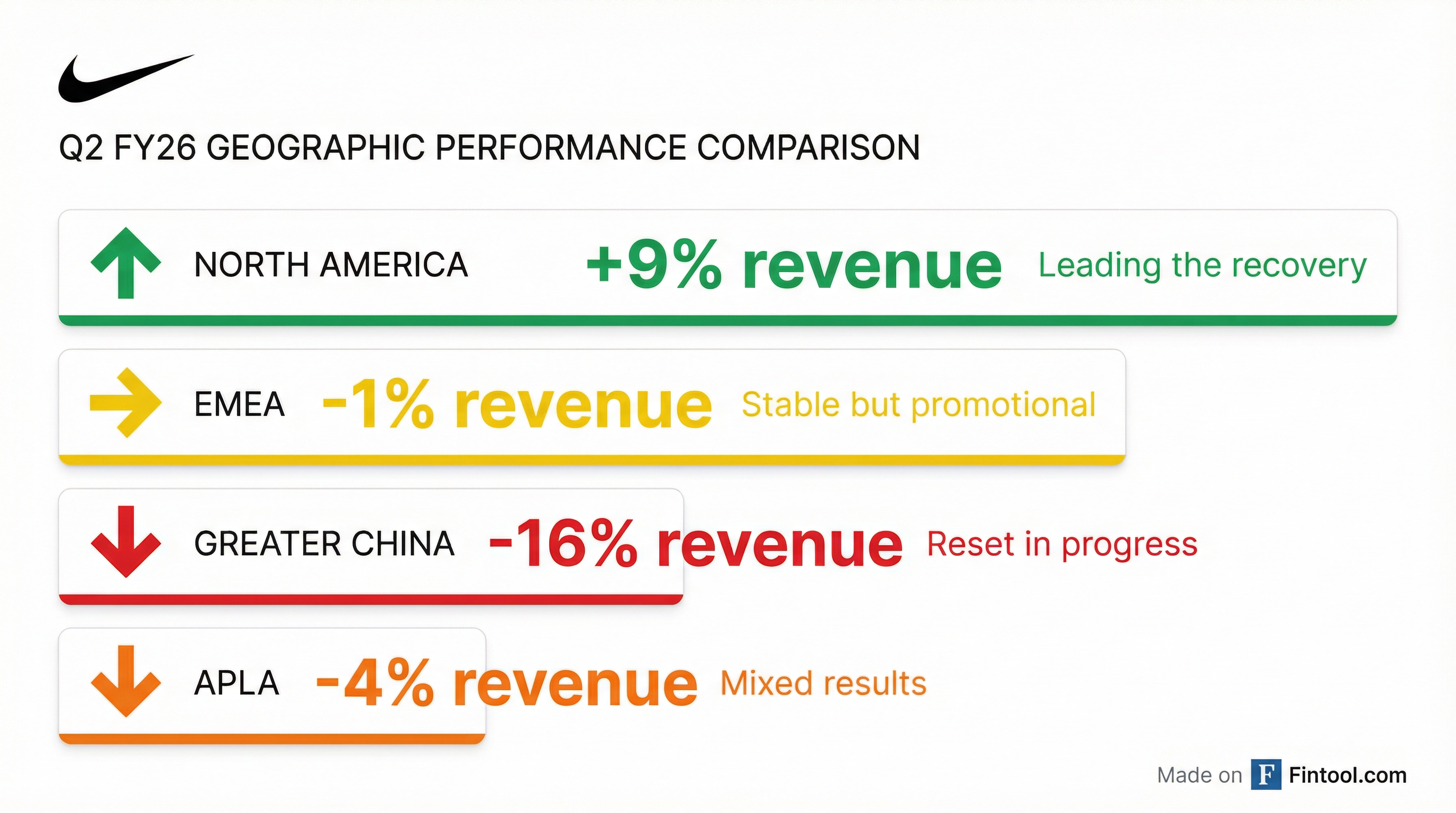
Greater China remains the problem child, with Q2 revenue down 16% and EBIT collapsing 49%.
Hill was blunt in his diagnosis: "We had become a lifestyle brand competing on price in China." The company reduced investment in ground teams and store presentation deteriorated, creating a cycle of "soft demand leading to consistent promotions and then impacting profitability."
The reset is underway but will take time. Nike cut buys for summer to improve sell-through, reduced inventory by mid-teens versus prior year, and took accelerated write-offs on aged product. Management expects China headwinds to continue for the balance of the fiscal year.
Ask Fintool AI AgentPath to Double-Digit Margins
Hill stated it "very clearly": margin expansion is his top priority, and he sees "the path back to double-digit EBIT margins for Nike Inc."
The formula includes:
- Portfolio diversification: Right-sizing classic franchises (down $4B from peak) while scaling performance categories like Running (+20%)
- Wholesale recovery: Order book growing for both spring and summer
- Operational efficiency: New COO Venkatesh Alagirisamy focused on end-to-end technology integration and cost productivity
- Geographic realignment: All four regions now report directly to Hill for faster decision-making
Q3 guidance calls for revenue down low single digits, with gross margins down 175-225 basis points. Excluding tariffs, margins would expand—a turning point.
Ask Fintool AI AgentStock in the Penalty Box
Nike shares have fallen 47% from their 2024 peak of $107.85 and are down 22% year-to-date. At Tuesday's close of $57.34, the stock trades at 27.9x trailing earnings—still premium to the S&P 500 but well below its five-year average multiple.
The aftermarket price on Christmas Eve rose to $58.61, up 2.2% from Monday's close, as markets digested the insider buying filings.
For Cook and Swan, the calculation appears straightforward: Nike's challenges are well-known, priced in, and manageable. The turnaround playbook is working in North America. Global football momentum is building ahead of the 2026 World Cup (order book up 40% vs. 2022). And management has both the strategy and the capital structure to execute.
Ask Fintool AI AgentWhat to Watch
March 2026 Q3 earnings: North America momentum sustainability and any China improvement signals
Q4 World Cup catalysts: Football kit launches, AeroFit technology debut, and marketing activation
Operating efficiency updates: Management promised more detail on cost productivity and margin recovery in "coming quarters"
When two of Silicon Valley's most successful operators put meaningful personal capital to work on the same day, at the same price, after a punishing earnings reaction—it's worth paying attention.
Related