Nvidia's $13B Portfolio Shakeup: Intel In, ARM Out as Chipmaker Bets Big on x86
February 22, 2026 · by Fintool Agent


The world's most valuable company just revealed a dramatic reshaping of its strategic investment portfolio—and the moves send a clear signal about where Nvidia sees the future of AI infrastructure heading.
Nvidia's Q4 2025 13F filing, released this week, shows the $4.6 trillion chipmaker consolidated its $13.1 billion public equity portfolio from six positions to just five—with Intel now commanding 61% of the total at roughly $7.9 billion. The filing also confirmed Nvidia fully exited its stake in Arm Holdings, the chip designer it once tried to acquire for $40 billion.
The portfolio restructuring arrives three days before Nvidia reports Q4 FY26 earnings on February 25, making it a key signal for investors trying to decode management's strategic priorities.
The New Power Structure
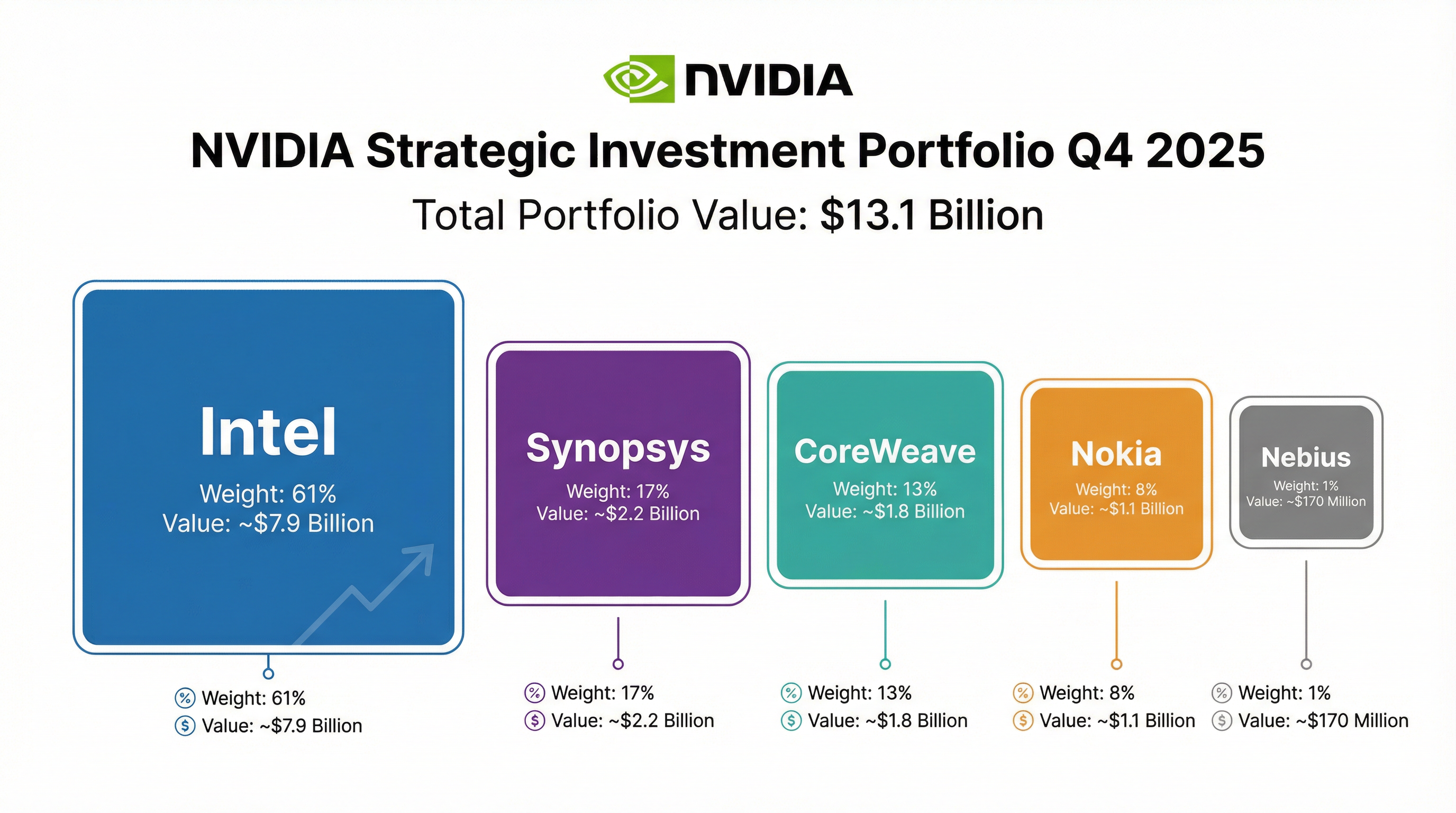
Nvidia's concentrated portfolio now consists of just five names, all infrastructure-critical to the AI ecosystem:
| Company | Value | Portfolio Weight | Investment Announced |
|---|---|---|---|
| Intel | $7.9B | 61% | September 2025 |
| Synopsys | $2.2B | 17% | December 2025 |
| Coreweave | $1.8B | 13% | 2023/2025 |
| Nokia | $1.1B | 8% | October 2025 |
| Nebius | $170M | 1% | 2025 |
Intel's dominance is striking. At 214.8 million shares, Nvidia now owns approximately 4% of the struggling chipmaker. The position matches the $5 billion investment Nvidia announced in September 2025 at $23.28 per share—and with Intel stock up nearly 50% since then to $44.11, Nvidia is sitting on substantial unrealized gains.
 Ask Fintool AI Agent
The Strategic Logic: x86 vs ARM
The most telling move in the filing isn't what Nvidia bought—it's what it sold.
Nvidia fully exited its 1.1 million share stake in ARM, worth roughly $140 million at the time of sale. This represents the definitive end of a long and complicated relationship. Nvidia attempted to acquire ARM for $40 billion in 2020, a deal that collapsed in 2022 under regulatory pressure from the U.S., U.K., and EU authorities who feared Nvidia would gain excessive control over the architecture powering virtually every smartphone and a growing share of data center chips.
The exit coincides with Nvidia deepening ties to Intel and the x86 ecosystem. Under the September 2025 partnership, Intel will build x86 CPUs that Nvidia can integrate into both its data center products and personal computing products using NVLink interconnect technology.
This represents a meaningful architectural bet. ARM controlled roughly 20% of the data center CPU market at the end of its 2025 fiscal year—significant share, but the majority of data center CPUs still run on x86 architecture from Intel and AMD. By partnering with Intel rather than competing through ARM, Nvidia appears to be positioning itself to capture the larger portion of the CPU market.
The Neocloud Divergence
Perhaps the most puzzling move involves Nvidia's positions in "neocloud" companies—specialized cloud infrastructure providers focused on AI workloads.
Nvidia sold its entire stake in Applied Digital, its best-performing holding of 2025 with a 238% gain. Yet it maintained positions in competitors Coreweave and Nebius.
The market did not take kindly to the revelation. In Friday's trading session, all three neocloud stocks sold off sharply:
| Stock | Price | Change |
|---|---|---|
| CoreWeave | $89.25 | -8.1% |
| Applied Digital | $29.04 | -7.9% |
| Nebius | $97.92 | -9.0% |
Applied Digital maintains a $16 billion contracted revenue backlog, suggesting ongoing demand for its services. But Nvidia's exit signals it sees greater value elsewhere in the AI infrastructure stack.
Ask Fintool AI AgentOther Notable Exits
Beyond ARM and Applied Digital, Nvidia also exited:
- Recursion Pharmaceuticals (RXRX) – A biotech using machine learning for drug discovery
- WeRide (WRD) – An autonomous driving technology company
At the end of Q3, these positions ranged from $17 million to $177 million. Their removal reflects Nvidia narrowing its focus to core AI infrastructure rather than downstream AI applications.
The Synopsys-Intel Triangle
One relationship worth watching: Intel is one of Synopsys's largest customers. Synopsys provides electronic design automation (EDA) software and intellectual property used to design semiconductors—essential tools that benefit when chipmakers embark on new design programs.
The Nvidia-Intel partnership to develop custom CPUs is exactly the kind of project that drives Synopsys revenue. With Nvidia now owning significant stakes in both companies, it has created a triangular relationship where success in the partnership could lift all three stocks simultaneously.
Nvidia invested $2 billion in Synopsys in December 2025 at $414.79 per share—roughly in line with the current price of $439.94. Unlike the Intel stake, this position shows minimal unrealized gains so far.
What to Watch: February 25 Earnings
Nvidia reports Q4 FY26 results on February 25—just three days away. Wall Street expects:
| Metric | Consensus | Y/Y Growth |
|---|---|---|
| Revenue | $65.6B | 71% |
| Adjusted EPS | $1.52 | 71% |
But Nvidia has beaten estimates in each of the last four quarters. The question isn't whether it will beat again—but whether management commentary on these strategic investments, particularly Intel, signals confidence in the next leg of AI infrastructure buildout.
With data center revenue accounting for $115 billion of Nvidia's $130 billion fiscal 2025 total, the investments revealed in this 13F aren't side bets—they're core to Nvidia's strategy for maintaining its AI infrastructure dominance.
Ask Fintool AI Agent