Nvidia Dumps AI Ecosystem Bets, Goes All-In on Intel in $13B Portfolio Overhaul
February 18, 2026 · by Fintool Agent


Nvidia disclosed a dramatic reshaping of its investment portfolio in its latest 13F filing, exiting all positions in four AI-adjacent companies while establishing a massive $7.9 billion stake in rival chipmaker Intel—a move that signals a strategic pivot from broad ecosystem plays to concentrated bets on core semiconductor infrastructure.
The filing, which covers positions as of December 31, 2025, shows Nvidia's portfolio has been compressed to just five stocks totaling approximately $13.1 billion—down from a broader collection of AI infrastructure, autonomous driving, and healthcare investments.
The Exit Wave
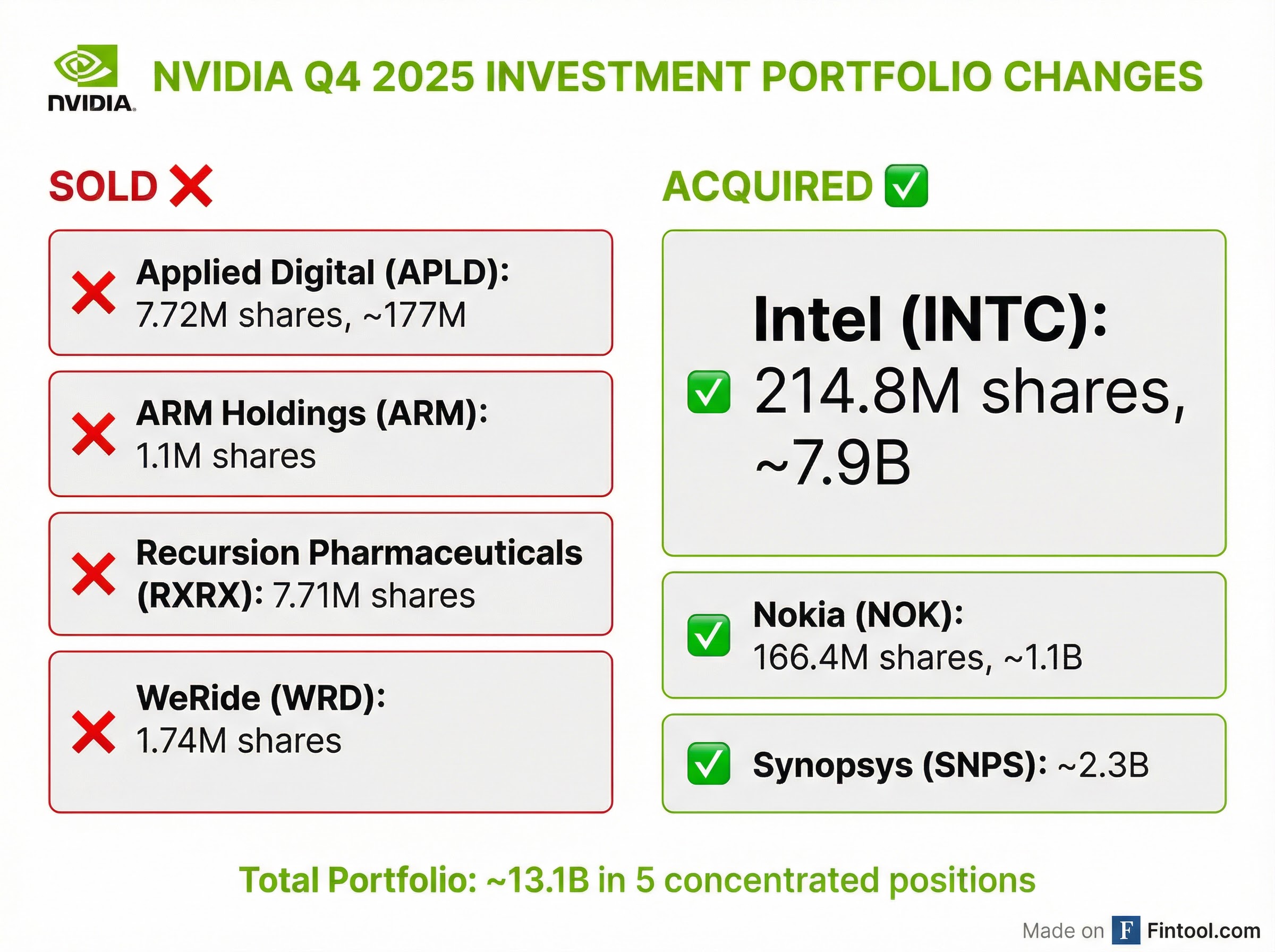
Nvidia liquidated its entire positions in four companies during Q4 2025:
- Applied Digital: 7.72 million shares worth ~$177 million, acquired just 15 months earlier in September 2024 as part of a $160 million financing round
- Arm Holdings: 1.1 million shares worth ~$156 million, held since ARM's 2023 Nasdaq IPO when Nvidia participated as a strategic investor
- Recursion Pharmaceuticals: 7.71 million shares, ending a two-year investment in the AI-driven drug discovery platform
- Weride: 1.74 million shares in the autonomous driving company
The Intel Question
The most striking disclosure is Nvidia's 214.8 million share position in Intel, valued at approximately $7.9 billion at quarter-end and representing roughly 60% of its entire disclosed portfolio.
The investment in a company many view as a rival carries strategic implications beyond financial returns. With AI compute demand straining global chip manufacturing capacity—and Nvidia's near-total reliance on TSMC for advanced node production—the Intel position could signal interest in Intel Foundry Services (IFS) as a potential manufacturing partner.
Intel has been aggressively courting external customers for its foundry business, offering advanced packaging technologies that have become critical bottlenecks for AI chip production. For Nvidia, diversifying beyond TSMC addresses both capacity constraints and geopolitical supply chain risks centered on Taiwan.
 Ask Fintool AI Agent
The New Portfolio
Beyond Intel, Nvidia's Q4 additions reflect a focus on infrastructure critical to its core business:
| Position | Shares | Value | Strategic Rationale |
|---|---|---|---|
| Intel (INTC) | 214.8M | $7.9B | Foundry diversification |
| Synopsys (SNPS) | — | $2.3B | Chip design tools (announced Dec 2025) |
| Nokia (NOK) | 166.4M | $1.1B | 6G/networking technology (announced Oct 2025) |
| CoreWeave (CRWV) | Maintained | — | AI data center infrastructure |
| Nebius (NBIS) | Maintained | — | Cloud/AI infrastructure |
The Synopsys stake deepens an existing partnership announced in December 2025, when both companies committed to accelerating chip engineering and simulation processes. Synopsys is the world's largest electronic design automation (EDA) provider, whose tools are essential to designing chips like Nvidia's GPUs.
The Nokia investment, first disclosed in October 2025, centers on a joint development partnership for next-generation 6G communication technology. As AI cluster performance increasingly depends on data center interconnection speeds, Nokia's optical networking and 6G patents address potential data transfer bottlenecks.
Nvidia also maintained—and strengthened—its Coreweave relationship, investing an additional $2 billion in January 2026 to expand AI data center infrastructure. Unlike the exited positions, CoreWeave remains a core partner running Nvidia's GPUs at scale.
Market Reaction
The filing triggered immediate selling in the divested names:
| Ticker | Prior Day Change | Current | Note |
|---|---|---|---|
| APLD | -7.8% (after-hours) | -2.3% | Extending losses; still up 248% YoY |
| RXRX | -12% (morning) | -2.6% | Hit 52-week low at $2.98 |
| WRD | -2.7% (after-hours) | -1.8% | Down 73% from 52-week high |
| ARM | Stable | +2.0% | Recovered; 20-year license intact |
Notably, ARM shares recovered despite the divestiture, supported by the unchanged 20-year licensing agreement between the companies. ARM's chip architecture underpins billions of devices and remains foundational to Nvidia's designs regardless of equity ownership.
The stocks Nvidia bought into showed strength:
| Ticker | Change | Market Cap |
|---|---|---|
| SNPS | +5.5% | $85B |
| CRWV | +5.9% | $48B |
| NOK | +1.6% | $40B |
| INTC | +0.6% | $232B |
Ask Fintool AI AgentReading the Strategic Tea Leaves
The portfolio transformation suggests several shifts in Nvidia's investment philosophy:
From Ecosystem to Infrastructure: The exits from Applied Digital, WeRide, and Recursion represent a retreat from betting on companies that use AI to companies that enable chip production. Nvidia appears less interested in downstream applications and more focused on securing its supply chain.
Foundry Hedging: The massive Intel stake—larger than Nvidia's other disclosed positions combined—hints at serious consideration of Intel Foundry Services. With TSMC facing capacity constraints and Taiwan-centered geopolitical risk, diversifying manufacturing relationships has become existential for Nvidia's growth trajectory.
Concentrated Conviction: Shrinking from numerous positions to just five stocks signals higher conviction bets rather than diversified exposure. Nvidia is clearly choosing depth over breadth in its strategic investments.
Partnership Over Ownership: The ARM exit alongside maintained licensing suggests Nvidia may be separating financial investments from operational partnerships. You don't need to own shares to use architecture.
What to Watch
- Intel Foundry announcements — Any manufacturing agreement between Nvidia and IFS would validate the investment thesis
- Applied Digital's CoreWeave connection — Nvidia maintains indirect exposure through CoreWeave, which has business ties to Applied Digital
- ARM's continued independence — Watch whether other strategic investors follow Nvidia's exit
- Synopsys collaboration products — Near-term deliverables from the December 2025 partnership expansion
The 13F filing provides a quarterly snapshot, meaning positions could have changed since December 31. But the magnitude of the shifts—particularly the Intel stake—signals deliberate strategic repositioning rather than routine portfolio management.
Ask Fintool AI AgentRelated Companies: Nvidia | Intel | Applied Digital | Arm Holdings | Recursion Pharmaceuticals | Weride | Nokia | Synopsys | Coreweave