Nvidia Completes $5 Billion Intel Stake in Historic Semiconductor Alliance
December 29, 2025 · by Fintool Agent


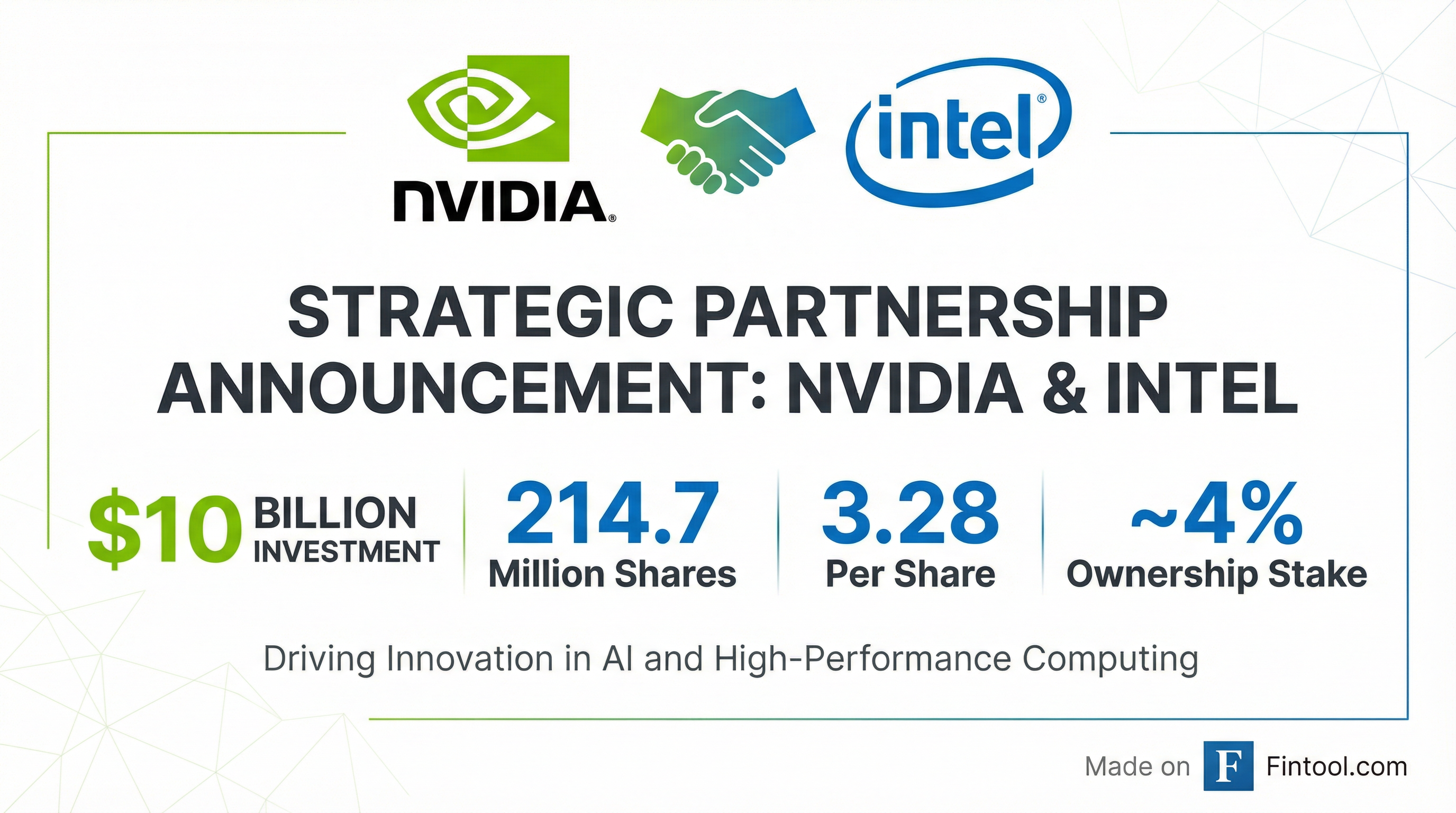
The world's most valuable company just became one of the largest shareholders of its former rival. Nvidia+7.87% completed its $5 billion purchase of Intel+4.87% shares on December 26, acquiring 214.8 million shares at $23.28 apiece and cementing a partnership that could reshape the global semiconductor industry.
The deal, first announced in September and cleared by the Federal Trade Commission on December 18, gives Nvidia an approximately 4% stake in Intel—and something far more valuable: a strategic alliance that integrates Nvidia's AI dominance with Intel's x86 ecosystem and manufacturing prowess.
Intel shares were flat in premarket trading Monday at $36.20, while Nvidia slipped 1.3% to around $188. But the stock market's muted reaction belies the magnitude of what these companies are attempting: nothing less than a fusion of the two most important computing architectures of the AI era.
The Deal Terms
| Metric | Value |
|---|---|
| Total Investment | $5.0 billion |
| Shares Acquired | 214,776,632 |
| Price Per Share | $23.28 |
| Nvidia's Stake | 4% of Intel |
| Deal Announced | September 18, 2025 |
| FTC Approval | December 18, 2025 |
| Deal Closed | December 26, 2025 |
Source: Intel 8-K filing
 Ask Fintool AI Agent
What They're Building Together
This isn't a passive investment. Nvidia and Intel are co-developing a new class of chips that could break the PCIe bottleneck that has constrained AI computing.
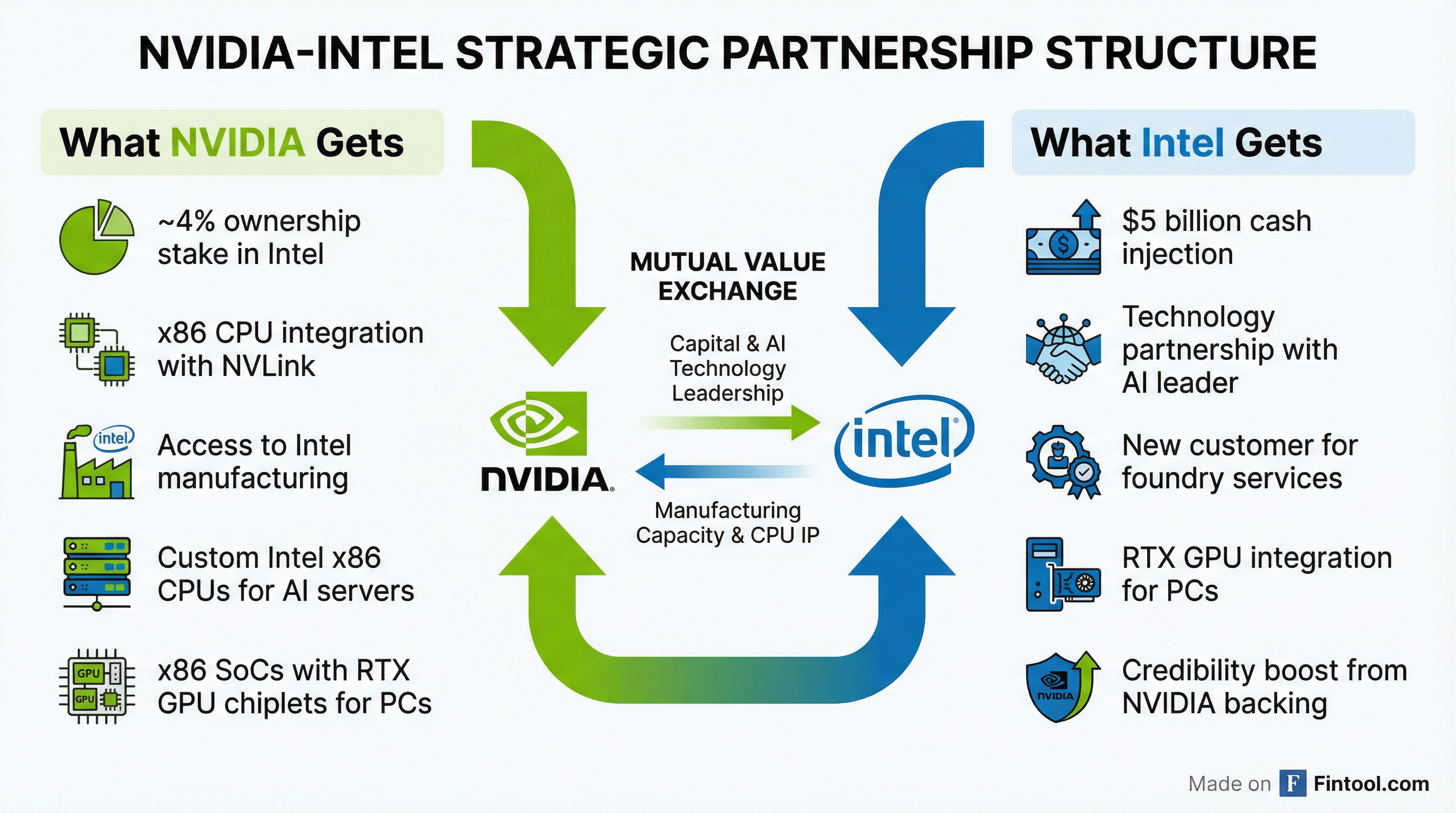
For Data Centers: Intel will design custom x86 CPUs that Nvidia will integrate into its AI infrastructure platforms using NVLink—the high-bandwidth interconnect that currently connects Nvidia's GPUs. These chips will be marketed under Nvidia's brand to hyperscalers and enterprise customers.
For Personal Computers: Intel will manufacture x86 system-on-chips (SoCs) that integrate Nvidia RTX GPU chiplets. Early leaks suggest a product codenamed "Serpent Lake" could combine Intel's next-generation CPUs with Nvidia's Rubin-generation graphics—a direct competitor to AMD's Strix Halo.
Jensen Huang, Nvidia's CEO, framed the deal in historic terms: "This historic collaboration tightly couples Nvidia's AI and accelerated computing stack with Intel's CPUs and the vast x86 ecosystem—a fusion of two world-class platforms. Together, we will expand our ecosystems and lay the foundation for the next era of computing."
A Lifeline for Intel
For Intel, the timing couldn't be more critical. The chipmaker has spent the past two years in turnaround mode, hemorrhaging cash on ambitious manufacturing expansion while its core business lost ground to Nvidia in AI and Amd+8.28% in CPUs.
The numbers tell the story of a company in transition:
| Metric | Q3 2024 | Q3 2025 | Change |
|---|---|---|---|
| Revenue | $13.3B | $13.7B | +3% |
| Net Income (Loss) | $(16.6B) | $4.1B | +$20.7B |
| Gross Margin | 15.0% | 38.2% | +23.2 ppts |
| Employees | 124,100 | 88,400 | -29% |
The $16.6 billion loss in Q3 2024 was driven by massive restructuring charges as Intel cut over 35,000 jobs. By Q3 2025, the turnaround was showing signs of life—revenue grew 3% year-over-year and the company posted positive net income for the first time in a year.
But Intel's real challenge is capital. The company has committed over $100 billion to building out domestic manufacturing capacity, including its Intel 18A process technology—the most advanced logic fabrication in the United States. That requires cash the company doesn't have.
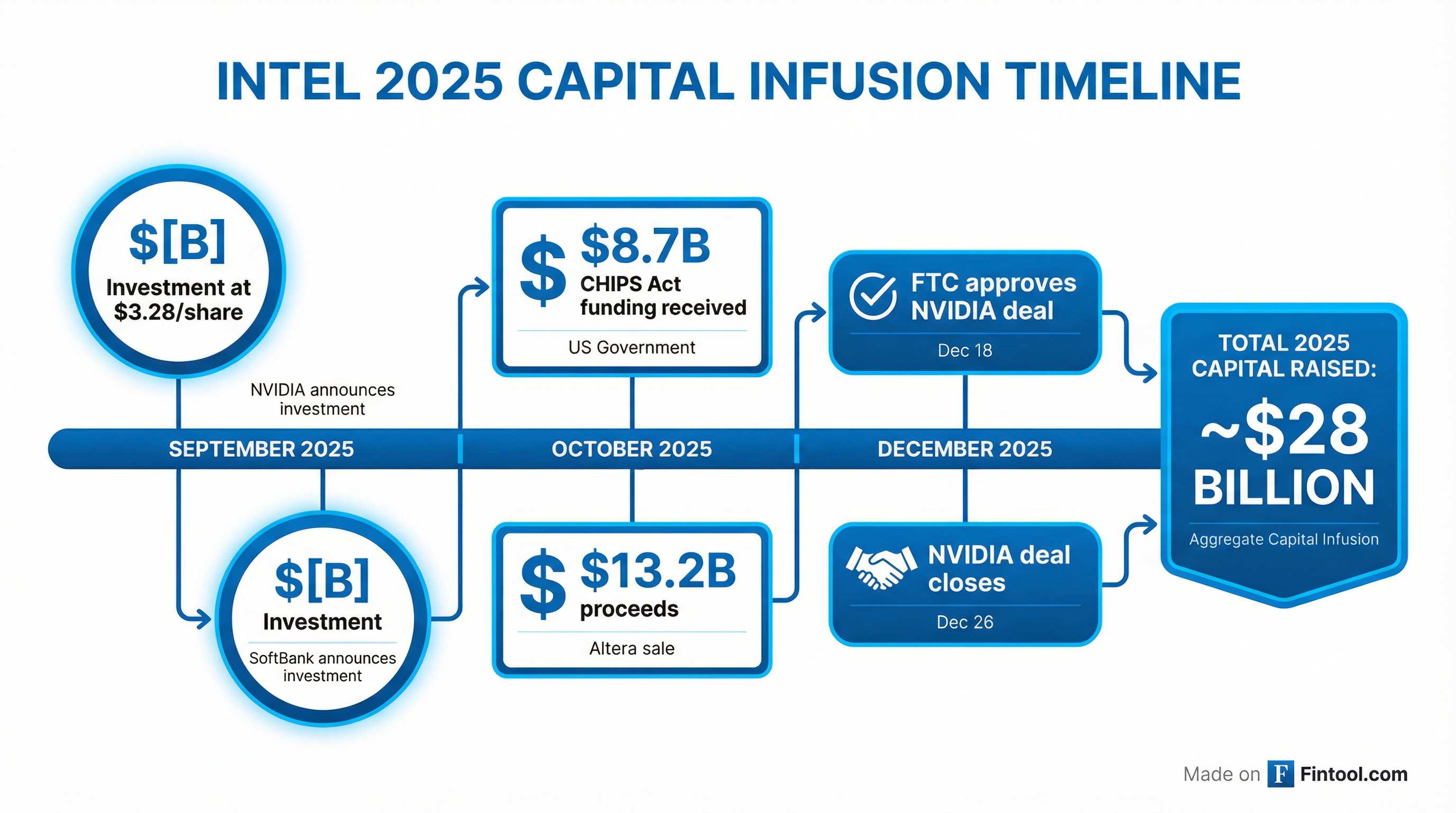
The Nvidia investment is part of a capital infusion blitz in 2025:
| Source | Amount | Status |
|---|---|---|
| Nvidia Investment | $5.0B | Closed Dec 26 |
| SoftBank Investment | $2.0B | Closed Q3 2025 |
| U.S. Government (CHIPS Act) | $5.7B | Received Q3 2025 |
| Altera Sale Proceeds | $5.2B | Received Q3 2025 |
| Total 2025 Capital Raised | ~$18B |
Intel CEO Lip-Bu Tan acknowledged the strategic importance: "We appreciate the confidence Jensen and the Nvidia team have placed in us with their investment and look forward to the work ahead as we innovate for customers and grow our business."
Ask Fintool AI AgentIntel's Financial Position
Intel's balance sheet reflects both its challenges and its cash-raising success:
| Metric | Q4 2023 | Q4 2024 | Q3 2025 |
|---|---|---|---|
| Cash & Equivalents | $7.1B | $8.2B | $11.1B |
| Total Debt | $49.7B* | $50.7B* | $46.6B |
| Capital Expenditure (Quarterly) | $(6.7B)* | $(5.8B)* | $(2.4B)* |
*Values retrieved from S&P Global
The company has managed to reduce its quarterly capex burn from nearly $7 billion to under $3 billion, while simultaneously raising its cash position by 57% from the end of 2023. The Nvidia cash injection adds another $5 billion to the war chest.
What This Means for the Industry
The Nvidia-Intel partnership has implications that extend far beyond two companies:
For AMD: The deal is a direct competitive strike. AMD has positioned itself as the only company offering both competitive CPUs and GPUs on a single platform. Now Nvidia can offer the same—with Intel's superior x86 manufacturing. AMD shares are down 22% from their 2025 highs.
For Arm: Nvidia's decision to partner with Intel on x86 suggests the company sees limits to its Arm-based Grace CPUs for data center applications. The vast majority of enterprise software still runs on x86.
For TSMC: Taiwan Semiconductor+5.48% remains the world's leading-edge foundry, but Nvidia's willingness to co-develop with Intel signals an openness to supply chain diversification—particularly as geopolitical tensions around Taiwan intensify.
For PC Buyers: The "Serpent Lake" chips combining Intel CPUs with Nvidia RTX graphics could deliver unprecedented performance-per-watt in laptops, potentially leapfrogging AMD's integrated offerings.
The Paper Gain
Nvidia's investment has already generated substantial returns on paper. At the $23.28 purchase price from September, Nvidia bought shares that now trade around $36.20—a 56% gain worth approximately $2.8 billion in just three months.
Intel stock is up nearly 80% year-to-date, though it remains far below its 2020-2021 highs above $65. Nvidia, for its part, has returned 35% in 2025—solid but far below the triple-digit gains of prior years as AI infrastructure spending has matured.
| Company | Current Price | YTD Return | Market Cap |
|---|---|---|---|
| Nvidia+7.87% | $186.54 | +35% | $4.6T* |
| Intel+4.87% | $36.20 | +80% | $173B* |
| Amd+8.28% | $212.16 | +178% | $344B* |
| Taiwan Semiconductor+5.48% | $301.44 | +124% | $1.6T* |
*Values retrieved from S&P Global
Ask Fintool AI AgentWhat To Watch
Product Timeline: The companies have not disclosed when the first jointly-developed products will reach market. Analysts expect initial offerings in late 2026 or early 2027.
Foundry Questions: Intel CEO Lip-Bu Tan has been cagey about whether Nvidia will use Intel's fabs to manufacture GPUs. When pressed, he gave a "diplomatic non-answer" about "perfecting the process" first.
Antitrust Scrutiny: While the FTC approved the investment, regulators may require NVLink interface standards to remain open. Nvidia already controls 85-95% of the data center GPU market—deeper integration with Intel's x86 could trigger additional oversight.
Intel's Turnaround: The partnership's success depends on Intel's ability to execute on its manufacturing roadmap. The Intel 18A process is the most advanced logic in the U.S., but Intel has a history of missing production deadlines.
The Bottom Line
This deal isn't about one company saving another. It's about two technology giants recognizing that the AI era requires capabilities neither possesses alone. Nvidia has the GPUs and the software stack that dominates AI training and inference. Intel has the x86 architecture that runs most of the world's enterprise software, plus manufacturing capacity that can be leveraged for geopolitical advantage.
For investors, the near-term stock moves may be modest. The real payoff comes in 2027 and beyond, when the first jointly-developed products hit the market—and when we'll know whether this "fusion of two world-class platforms" was a strategic masterstroke or an expensive exercise in corporate cooperation.
For now, the message is clear: in the race to build the AI future, even the fiercest competitors recognize that going it alone may no longer be an option.
Ask Fintool AI AgentRelated Companies