OpenAI Embraces Advertising in ChatGPT as $1.4 Trillion Infrastructure Bill Comes Due
January 16, 2026 · by Fintool Agent


OpenAI announced Friday it will begin testing advertisements in ChatGPT for users on its free and low-cost tiers, marking a fundamental shift in strategy as the AI pioneer grapples with over $1.4 trillion in infrastructure commitments and positions itself for a potential trillion-dollar IPO.
The move arrives as ChatGPT's user growth shows signs of deceleration and competition from Google's Gemini intensifies—putting pressure on Openai to diversify revenue beyond its subscription-dependent model.
The Details
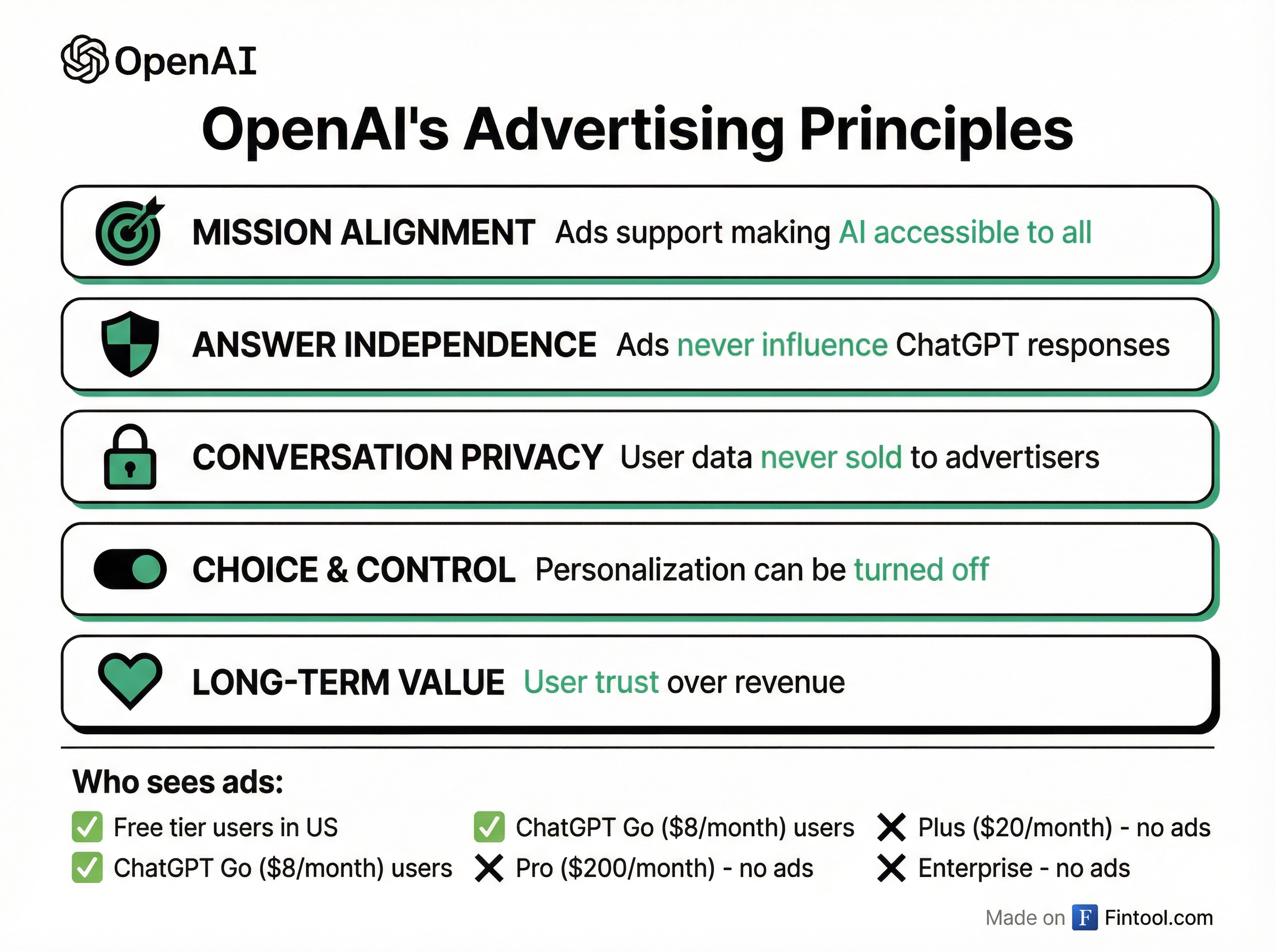
Ads will start appearing "in the coming weeks" for logged-in U.S. users on ChatGPT's free tier and the new $8/month ChatGPT Go subscription, which launches nationwide today.
How it works:
- Ads appear at the bottom of ChatGPT answers when relevant to the conversation
- Sponsored content will be "clearly labeled and separated from the organic answer"
- Users under 18 won't see ads; sensitive topics (health, politics, mental health) are excluded
- Personalization is on by default, but users can opt out and clear ad-related data
Premium tiers—ChatGPT Plus ($20/month), Pro ($200/month), and Enterprise—will remain ad-free.
Why Now: The Financial Imperative
The advertising pivot reflects mounting financial pressures that make OpenAI's subscription-only model increasingly untenable.
OpenAI has committed to $1.4 trillion in infrastructure spending through 2033, including:
- $300 billion to Oracle for data centers
- $250 billion to Microsoft+1.90% for cloud infrastructure
- $38 billion to Amazon AWS
- $22.4 billion to CoreWeave
Despite projecting $20 billion in annualized revenue by year-end 2025, HSBC estimates OpenAI faces a $207 billion funding gap by 2030—even with aggressive revenue growth assumptions.
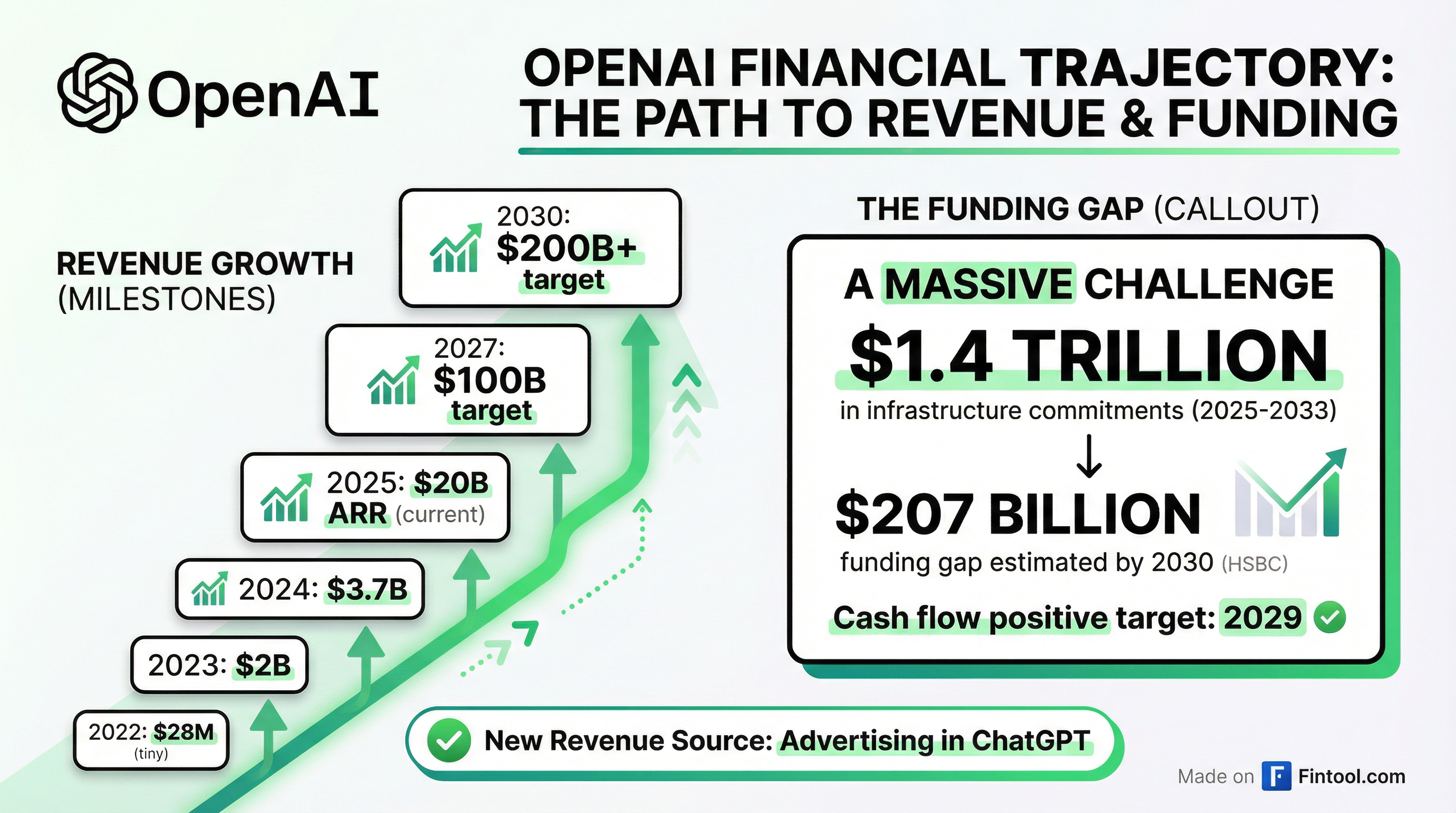
The company burned roughly $8 billion in cash in 2025 and doesn't expect positive cash flow until 2029. CEO Sam Altman has suggested revenue could reach $100 billion by 2027 and "hundreds of billions" by 2030—but those projections require revenue streams beyond subscriptions.
 Ask Fintool AI Agent
Entering a Trillion-Dollar Market
Digital advertising represents one of the largest revenue pools in technology—and one OpenAI has conspicuously avoided until now.
| Company | 2024 Revenue | % From Advertising | Users |
|---|---|---|---|
| Alphabet-2.53% | $350B | 80% | 5B monthly |
| Meta-1.31% | $164.5B | 98% | 3.3B monthly |
| OpenAI | $20B (2025 ARR) | 0% → Testing | 800M weekly |
*Values retrieved from S&P Global
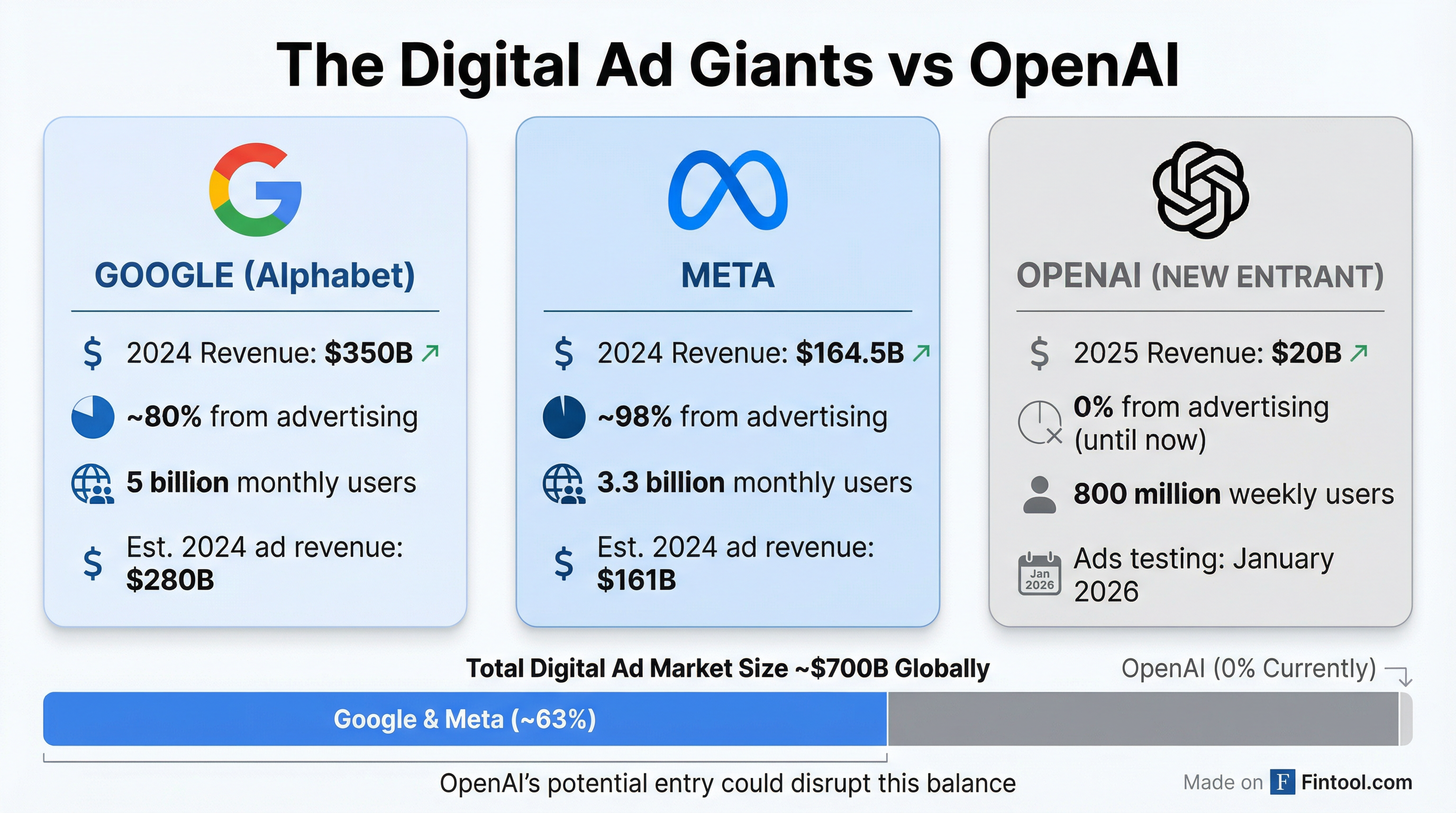
With 800 million weekly active users and approximately 2.5 billion daily prompts, ChatGPT commands substantial attention that advertisers covet. The platform ranks as the 4th most-visited website globally with over 5.8 billion monthly visits.
"The best ads are useful, entertaining, and help people discover new products and services," OpenAI wrote in its announcement. "Given what AI can do, we're excited to develop new experiences over time that people find more helpful and relevant than any other ads."
The company hinted at future ad formats that leverage conversational AI: "Soon you might see an ad and be able to directly ask the questions you need to make a purchase decision."
Altman's Reversal
The move represents a notable reversal for CEO Sam Altman, who has publicly expressed reservations about advertising in AI products.
In interviews, Altman has warned that ads could erode user trust—the foundation of ChatGPT's appeal. In a November 2025 podcast, he said OpenAI would "try ads at some point" but that he didn't believe advertising would be the company's biggest revenue opportunity.
Now, facing the reality of trillion-dollar infrastructure commitments and a potential IPO at valuations up to $1 trillion, that skepticism has given way to pragmatism.
Ask Fintool AI AgentCompetitive Context
The timing is notable given ChatGPT's growth has begun to plateau while rivals gain ground.
Sensor Tower data shows ChatGPT's global monthly active users grew just 6% from August to November 2025, reaching approximately 810 million—suggesting the platform may be approaching market saturation.
Meanwhile, Google's Gemini grew monthly active users by 30% over the same period, fueled by new features like the Nano Banana image generation model. Gemini has gained three percentage points of AI chatbot market share in the past seven months, while ChatGPT lost three points.
OpenAI responded to the competitive threat in late 2025 with a "code red" memo from Altman instructing staff to focus on improving personalization, reliability, and image generation.
What to Watch
Near-term catalysts:
- Ad testing rollout (coming weeks) and initial user/advertiser feedback
- Q1 2026 revenue trajectory as ads begin contributing
- ChatGPT Go adoption rates in the U.S.
Longer-term questions:
- Can OpenAI maintain user trust while monetizing through ads?
- Will premium subscribers churn to free tier once ads are normalized?
- How quickly can OpenAI scale ad infrastructure to compete with Google and Meta's sophisticated targeting?
- Does advertising meaningfully close the $207B funding gap, or is it a bridge to IPO proceeds?
OpenAI is betting it can have it both ways—maintaining the trust that made ChatGPT a cultural phenomenon while extracting advertising value from its massive user base. In the coming months, the market will render its verdict on whether that balance is achievable.
Ask Fintool AI AgentRelated
- Microsoft+1.90% — OpenAI's largest investor and infrastructure partner
- Alphabet-2.53% — Google Gemini competitor; dominant digital advertiser
- Meta-1.31% — Digital advertising leader; AI competitor via Llama