Pending Home Sales Crash 9.3% in December, Biggest Monthly Drop Since 2020
January 21, 2026 · by Fintool Agent


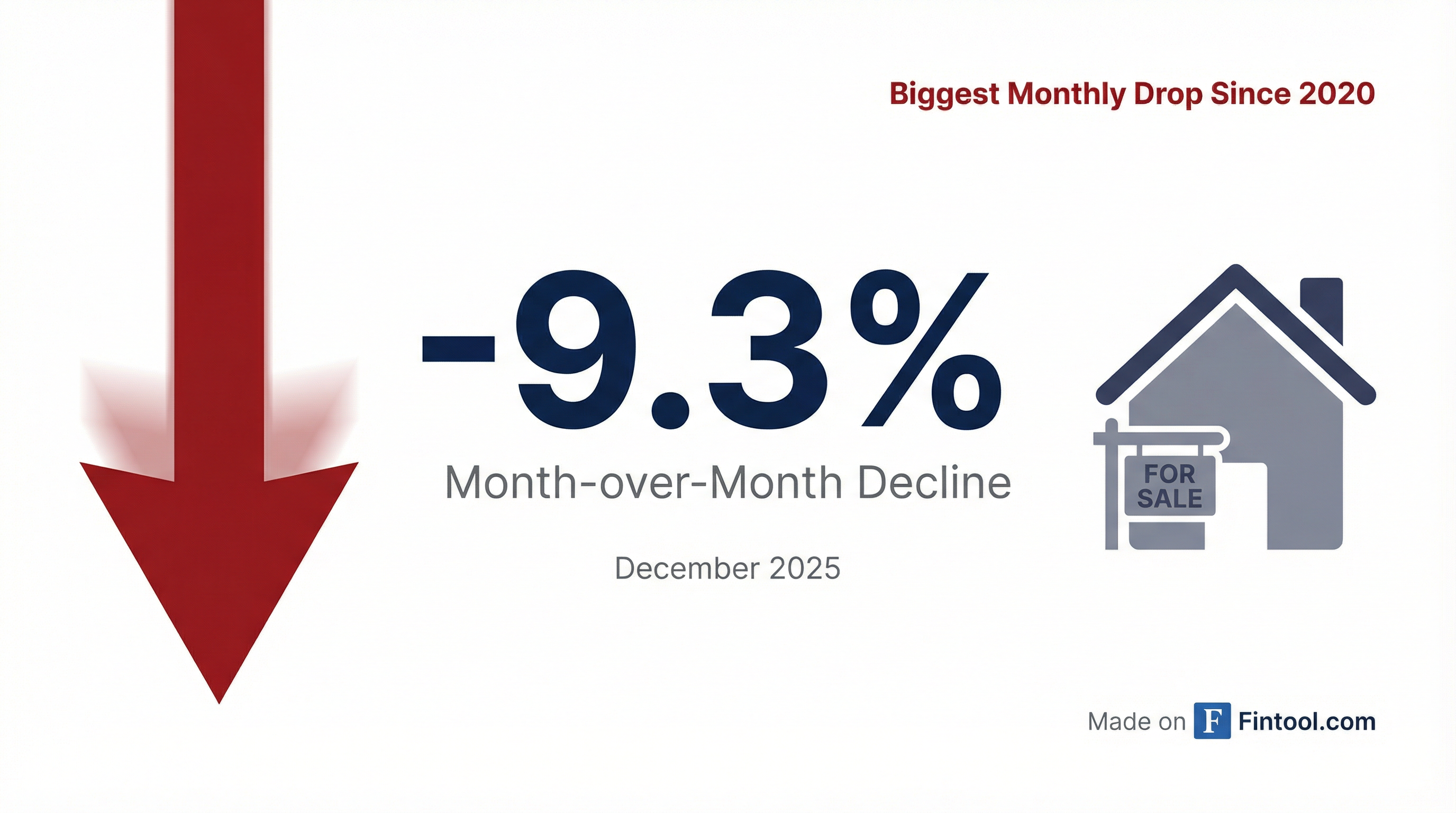
Pending home sales suffered their worst monthly decline since the pandemic, plunging 9.3% in December to hit a five-month low—a staggering miss versus the 0.4% gain economists had projected. The National Association of Realtors reported the pending home sales index fell to 71.8, down 3.0% from a year ago, as historically low inventory froze buyer activity heading into 2026.
The data throws cold water on hopes for a housing market recovery, arriving just as homebuilders gear up for the crucial spring selling season that typically accounts for two-thirds of annual new-member activity.
The Numbers: A Gut Punch for Housing Bulls
The December pending home sales report landed far outside expectations:
| Metric | December 2025 | Expectation | Prior Month |
|---|---|---|---|
| Month-over-Month Change | -9.3% | +0.4% | +3.3% |
| Year-over-Year Change | -3.0% | - | -0.3% |
| Index Level | 71.8 | - | 79.2 |
The index of 71.8 marks the lowest reading since July 2025 and represents the largest single-month decline since the early pandemic disruptions in 2020.
"After several months of encouraging signs in pending contracts and closed sales, the December new contract figures have dampened the short-term outlook," said Lawrence Yun, NAR's chief economist.
 Ask Fintool AI Agent
Regional Breakdown: Midwest Hit Hardest
All four U.S. regions posted declines, but the damage was far from uniform:
| Region | Month-over-Month | Year-over-Year |
|---|---|---|
| Midwest | -14.9% | -9.8% |
| West | -13.3% | -5.1% |
| Northeast | -11.0% | -3.6% |
| South | -4.0% | +2.0% |
The South was the only region to show any resilience, posting a modest 2.0% year-over-year gain even as monthly activity contracted. The Midwest's 14.9% monthly plunge and 9.8% annual decline represent the weakest regional performance.
The Culprit: Record-Low Inventory
Yun pointed directly at the supply side as the primary explanation for the December collapse:
"Data shows closing activity increased in December. However, new listings did not keep pace so inventory decreased. Consumers prefer seeing abundant inventory before making the major decision of purchasing a home. So, the decline in pending home sales could be a result of dampened consumer enthusiasm about buying a home when there are so few options listed for sale. In December there were only 1.18 million homes on the market—matching the lowest inventory level of 2025."
The inventory crunch is structural: existing homeowners locked into sub-4% mortgages have little incentive to sell and take on today's 6%+ rates, creating a "golden handcuffs" effect that keeps supply depressed even as demand fundamentals—demographics, household formation—remain supportive.
Mortgage Rates: Lower, but Not Enough
The 30-year fixed mortgage rate has declined to 6.06% as of January 15, 2026—down from 6.16% the prior week and well below the 2024 highs near 7%.
But the rate relief hasn't been sufficient to unlock meaningful demand. As Lennar Executive Chairman Stuart Miller noted in the company's most recent earnings call:
"We are optimistic that if mortgage rates approach the 6% level or even lower, we will soon see some firming in the market, and we will benefit from stronger affordability and therefore demand."
Rates have now touched that 6% threshold, yet the December data suggests the demand response remains muted—likely because prices haven't adjusted enough to restore affordability for first-time buyers.
Ask Fintool AI AgentHomebuilders: Prepared but Cautious
Despite the weak data, major homebuilder stocks rallied on Wednesday as part of a broader market recovery following President Trump's Davos remarks:
| Company | Ticker | Price | Change |
|---|---|---|---|
| D.R. Horton | DHI | $158.17 | +3.25% |
| Lennar | LEN | $133.42 | +2.87% |
| Pultegroup | PHM | $116.89 | +2.91% |
| Toll Brothers | TOL | $146.52 | +2.68% |
| KB Home | KBH | $61.25 | +1.81% |
The sector's resilience reflects several factors. Builders have spent the past year reducing cost structures, shortening cycle times, and managing speculative inventory more carefully.
KB Home CEO Jeff Mezger outlined the strategic pivot on the company's latest earnings call:
"Our expectation is that as we look ahead to next year, affordability improves, community count is up, we'll be setting up a solid year again. As we shift to more built-to-order and work through the last of the inventory, we expect that our margins will improve over time."
Meanwhile, Lennar's Miller emphasized the longer-term supply dynamics:
"The current environment is all about recognizing that short supply is keeping prices higher and that only lower prices enabled by lower cost structures will achieve affordability."
What to Watch: Spring or Bust
For housing bulls, the calculus is simple: the spring selling season will make or break 2026. As KB Home's Mezger put it:
"Every year as we go into the year, the spring selling season dictates how good or how poor your results may be for the year."
Key catalysts to monitor:
-
Mortgage rates: A sustained move below 6% could finally unlock meaningful demand, but rates would likely need to approach 5.5% to drive a true inflection given elevated home prices.
-
Inventory levels: Any pickup in existing-home listings would help restore buyer confidence. The spring typically brings more sellers to market, though the lock-in effect may continue to dampen supply.
-
Builder incentives: Watch for changes in rate buydown programs, closing cost assistance, and pricing strategies. Aggressive incentives typically signal weakening demand.
-
New home starts: Housing starts data for January (released in February) will show whether builders are pulling back production in response to weak contract activity.
Ask Fintool AI AgentThe Bottom Line
December's pending home sales crash is a warning shot for 2026—but not necessarily a death knell. The underlying demand for housing remains supported by demographics and chronic undersupply. What's missing is the catalyst to unlock that demand: some combination of lower rates, more inventory, or meaningful price adjustment.
For investors, the homebuilder trade hinges on whether the spring brings relief or another false start. The sector has priced in considerable pessimism already, with stocks like KB Home trading near book value and the XHB ETF down from 2024 highs. A positive spring surprise could drive significant upside; another disappointing season would test the builders' ability to maintain margins in a prolonged affordability crisis.
Related Companies: