Federal Prosecutors Open Criminal Probe Into Fed Chair Powell, Threatening Central Bank Independence
January 11, 2026 · by Fintool Agent


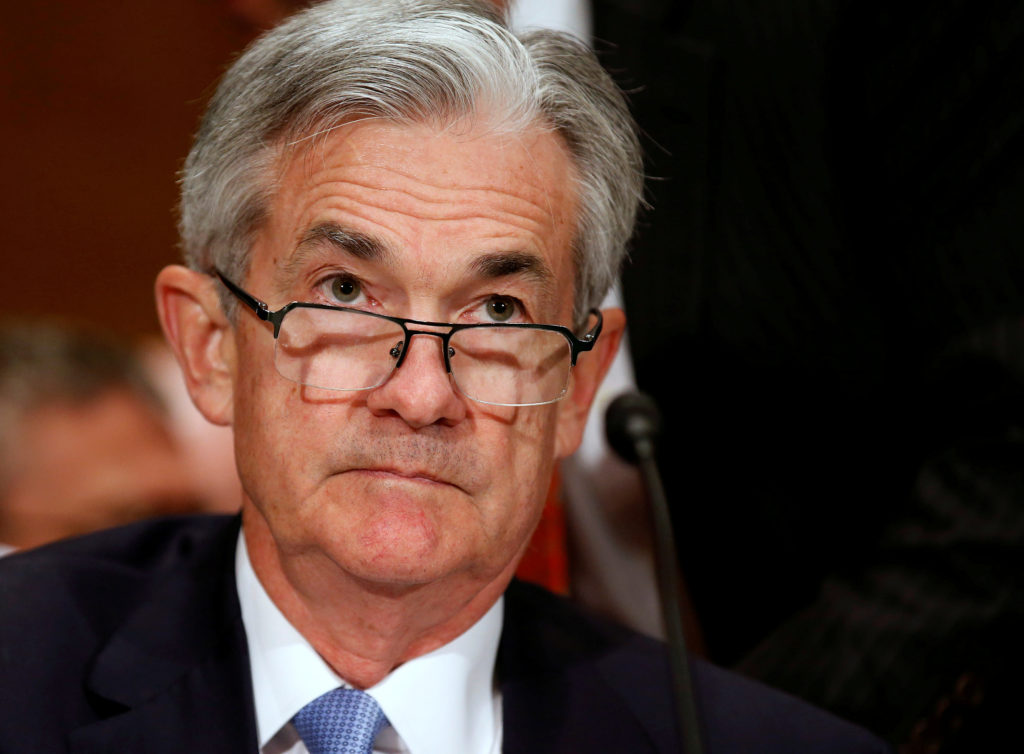
Federal prosecutors have opened a criminal investigation into Federal Reserve Chair Jerome Powell over the central bank's $2.5 billion headquarters renovation, marking an unprecedented escalation in President Trump's pressure campaign against the nation's most powerful economic institution.
The U.S. attorney's office in the District of Columbia is examining whether Powell lied to Congress about the scope of the renovation project, according to officials briefed on the matter. The inquiry, which includes analysis of Powell's public statements and examination of spending records, was approved in November by Jeanine Pirro, a longtime Trump ally appointed to run the office last year.
Powell responded with a defiant statement calling the probe political intimidation: "This new threat is not about my testimony last June or about the renovation of the Federal Reserve buildings... The threat of criminal charges is a consequence of the Federal Reserve setting interest rates based on our best assessment of what will serve the public, rather than following the preferences of the President."
The Stakes for Markets
The investigation represents a dramatic new front in the battle over Federal Reserve independence, with profound implications for monetary policy, interest rates, and financial markets. Prediction markets currently show just a 20% probability that Powell will be removed as Fed Chair this year, but the criminal probe significantly raises institutional uncertainty.
The timing is particularly consequential:
- Powell's term as Fed Chair ends in May 2026
- The Supreme Court will hear arguments on January 21 in Trump's bid to fire Fed Governor Lisa Cook
- Trump has told The New York Times he has already decided on Powell's replacement
 Ask Fintool AI Agent
Timeline: Trump's Campaign Against the Fed
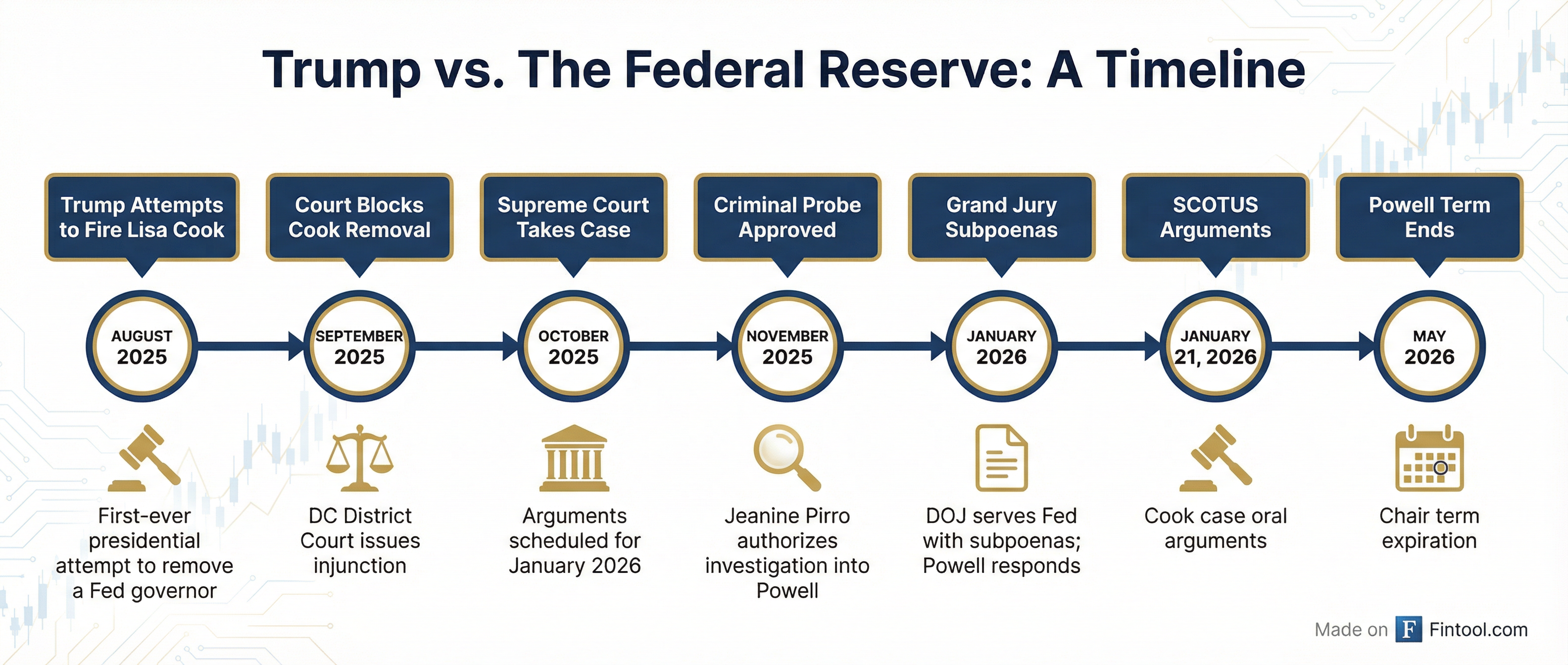
The criminal probe follows months of escalating pressure from the Trump administration on the Federal Reserve:
June 25, 2025: Powell testifies before the Senate Banking Committee, denying that the Fed renovation includes "VIP dining rooms," "new marble," "water features," "beehives," or "roof terrace gardens."
July 2025: Rep. Anna Paulina Luna (R-FL) refers Powell to the Department of Justice, alleging potential perjury and false statements to federal officials. She claims project documents submitted to the National Capital Planning Commission contradict Powell's testimony.
July 17, 2025: Powell sends a point-by-point response to OMB Director Russell Vought, defending the renovation and explaining that some features had been eliminated since initial design proposals.
July 24, 2025: Trump tours the Fed renovation site, calling it "a very luxurious situation" and suggesting the cost overruns might be "sort of" a fireable offense.
August 2025: Trump announces his intention to fire Fed Governor Lisa Cook over unproven mortgage fraud allegations—the first time in history a president has attempted to remove a Fed official.
September 2025: Federal courts issue injunctions blocking Cook's removal.
November 2025: Jeanine Pirro approves the criminal investigation into Powell.
January 10, 2026: The Department of Justice serves the Federal Reserve with grand jury subpoenas.
January 11, 2026: Powell issues his statement calling the probe political intimidation.
The Renovation Controversy
At the center of the investigation is the Fed's multi-year project to renovate the historic Marriner S. Eccles Building, the central bank's headquarters on the National Mall, and adjacent offices. The project has become a political flashpoint:
| Aspect | Details |
|---|---|
| Estimated Cost | $2.5 billion (up from initial $1.9B estimate) |
| Original Budget | $1.9 billion |
| Cost Increase | $600 million |
| Start Date | 2022 |
| Buildings | Eccles Building (1935-1937) + adjacent offices |
Fed officials have attributed cost overruns to tariffs on construction materials, higher labor costs, and supply chain disruptions. The Eccles Building required significant structural repairs including asbestos removal, lead contamination remediation, and replacement of antiquated electrical, plumbing, HVAC, and fire suppression systems.
Powell has maintained that media reports about luxury upgrades were "misleading and inaccurate in many respects," noting that the nearly 90-year-old building "was not really safe" and "was not waterproof."
Ask Fintool AI AgentKey Players
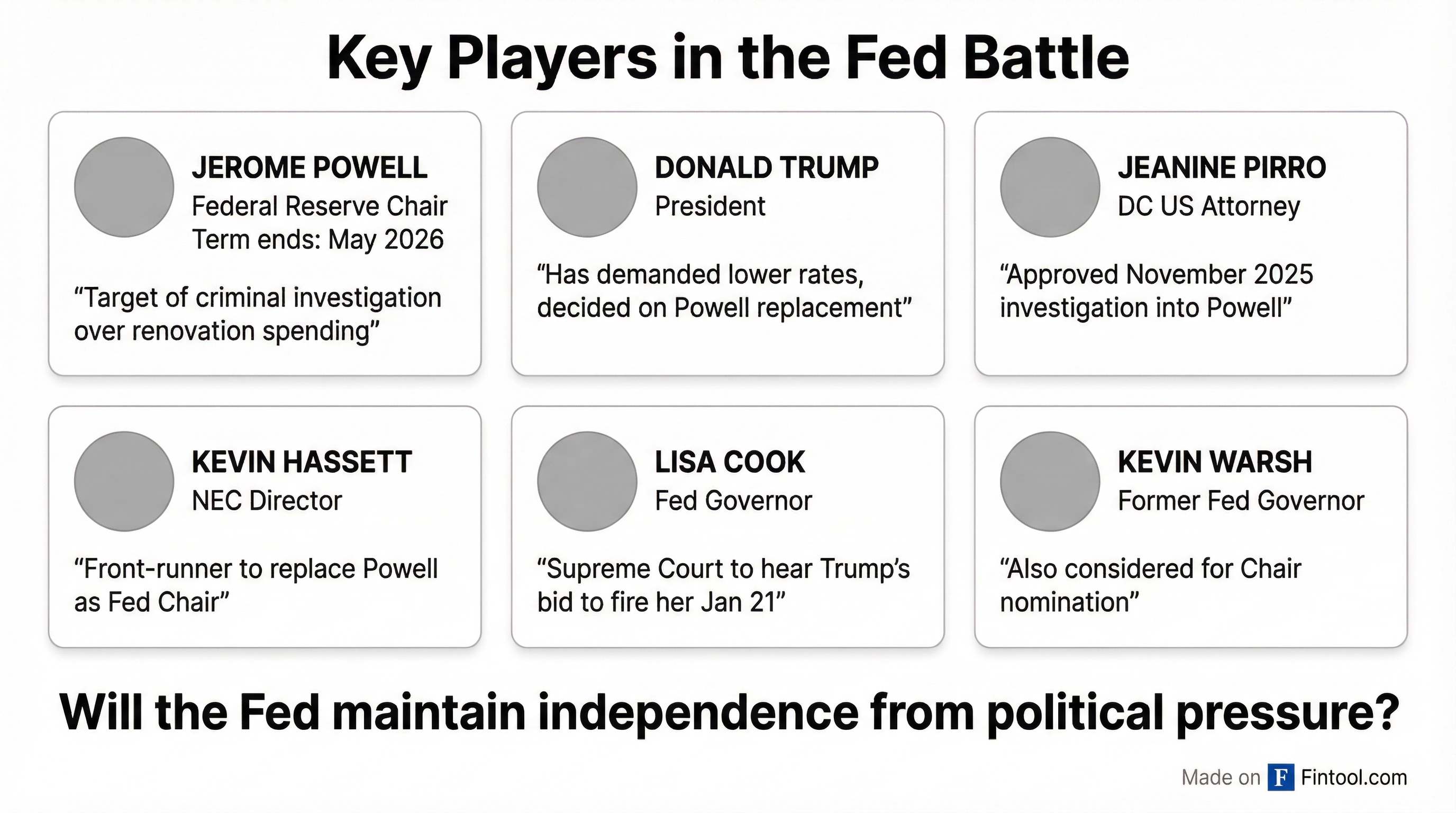
Jerome Powell - The Fed Chair, nominated by Trump in 2017, has become a frequent target of presidential criticism for resisting demands to slash interest rates significantly. His term as Chair ends in May 2026, though his term as a Governor runs through January 2028.
Kevin Hassett - Trump's National Economic Council director is the front-runner to replace Powell. Hassett speaks with Trump daily and has been a vocal advocate for lower rates on television. He served as chairman of Trump's Council of Economic Advisors from 2017-2019.
Kevin Warsh - The former Fed governor (2006-2011) is also under consideration for the Chair position. JPMorgan CEO Jamie Dimon has publicly praised Warsh as a potential "great" Chair.
Lisa Cook - The Fed Governor at the center of a parallel legal battle. The Supreme Court will hear arguments on January 21 regarding Trump's attempt to fire her over disputed mortgage fraud allegations.
Jeanine Pirro - The Trump ally who approved the criminal investigation as U.S. Attorney for the District of Columbia.
The Constitutional Battle
The investigation comes as the Supreme Court prepares to hear arguments on January 21 in Trump's bid to fire Fed Governor Lisa Cook—a case that could fundamentally reshape the Fed's independence.
The Federal Reserve Act of 1913 allows presidents to remove Fed governors only "for cause," a protection designed to insulate monetary policy from political interference. No president has ever successfully removed a Fed official, and the Supreme Court has never tested these protections.
The Cook case has drawn amicus briefs from former Fed Chairs Alan Greenspan, Ben Bernanke, and Janet Yellen, urging the Court to preserve Fed independence. The outcome could determine whether Trump—or any future president—can reshape the central bank at will.
"This is about whether the Fed will be able to continue to set interest rates based on evidence and economic conditions—or whether instead monetary policy will be directed by political pressure or intimidation," Powell said in his statement.
What's At Stake for Investors
The investigation introduces significant uncertainty into an already complex monetary policy environment:
Interest Rate Policy: Trump has repeatedly demanded rates as low as 1%, far below the current Fed target. A Trump-aligned Chair could pursue more aggressive rate cuts, potentially stoking inflation but boosting asset prices in the short term.
Market Volatility: Any perception that the Fed is losing independence could trigger bond market volatility. The 10-year Treasury yield has already risen sharply on fiscal and inflation concerns.
Bank Earnings: Major banks including JPMorgan Chase+3.95%, Goldman Sachs+4.31%, Bank of America+2.89%, Citigroup+5.98%, and Wells Fargo+2.09% are reporting earnings this week. Net interest income is highly sensitive to Fed policy.
Dollar Dynamics: Threats to Fed independence could undermine confidence in the dollar as a global reserve currency.
Bond Funds: ETFs like Ishares 20+ Year Treasury Bond Etf+0.07% (TLT) and Vanguard Total Bond Market+0.01% (BND) face heightened volatility as markets reassess Fed credibility.
Ask Fintool AI AgentWhat to Watch
January 12-17: Major bank earnings from Goldman Sachs+4.31%, JPMorgan+3.95%, Bank of America+2.89%, and Citigroup+5.98% could include commentary on Fed policy outlook and independence concerns.
January 21: Supreme Court hears oral arguments in Trump v. Cook, which could determine the scope of presidential power over the Fed.
Early 2026: Trump expected to announce his Fed Chair nominee. The Senate confirmation process will be closely watched for signals on Fed independence.
May 2026: Powell's term as Fed Chair expires. The transition period could be tumultuous if criminal proceedings are ongoing.
The criminal investigation marks uncharted territory for the Federal Reserve and U.S. economic governance. For investors, the key question is whether the institutional guardrails that have protected Fed independence for over a century will hold—or whether monetary policy will increasingly reflect political priorities rather than economic fundamentals.
Related Companies: JPMorgan Chase+3.95% | Goldman Sachs+4.31% | Bank of America+2.89% | Citigroup+5.98% | Wells Fargo+2.09%