Rockwell Automation Defends AI Moat at Citi Conference as Sentiment Improves
February 17, 2026 · by Fintool Agent



Rockwell Automation CEO Blake Moret and SVP of Software and Control Matheus Bulho took the stage at the Citi 2026 Global Industrial Tech and Mobility Conference today, delivering a robust defense of the company's competitive moat amid rising concerns about AI disruption in industrial software—while signaling that customer sentiment is "slightly better" than a quarter ago.
Shares of Rockwell rose 3.2% to $394.37 on the session, outperforming the broader industrial sector.
The AI Question That Had to Be Asked
A pointed question from the audience cut to the heart of investor concerns: Siemens took the stage at CES 2026 with Nvidia to announce what they called the "Industrial AI Operating System"—a deeper collaboration than Rockwell's own NVIDIA partnership. Does Rockwell's digital twin business face disruption?
Bulho offered a layered defense, arguing Rockwell's software is fundamentally different from the applications vulnerable to AI substitution:
"A lot of our software is actually running production. It's mission-critical software, deterministic transactions, where you're looking for consistency. You're not looking for probabilistic outcomes... software that's used in life sciences, software that's used in food and beverage, in regulated industries where compliance matters."
He added that major AI players—Anthropic on coding, OpenAI on creativity, Google on multimodal—are unlikely to prioritize industrial automation given the market's complexity and relatively smaller size.
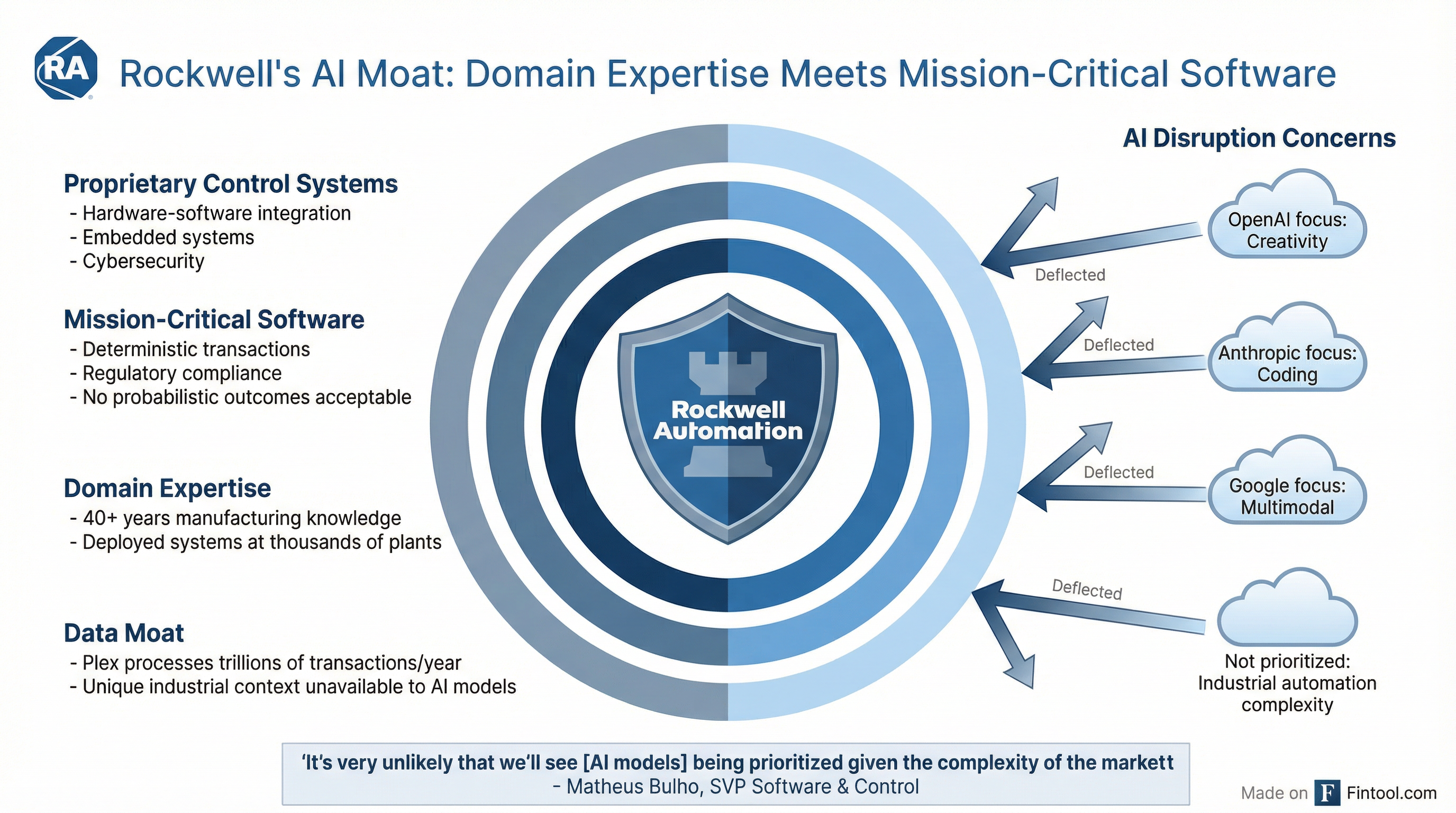
Moret reinforced the domain expertise angle, noting Rockwell's Chief Information Officer "deployed dozens of MES systems at large customers around the world" before taking charge of the company's internal AI productivity efforts—the kind of manufacturing knowledge that's difficult to replicate.
 Ask Fintool AI Agent
Q1 FY26: A Strong Start to the Year
The conference comes just 12 days after Rockwell reported Q1 FY26 results that beat on all key metrics:
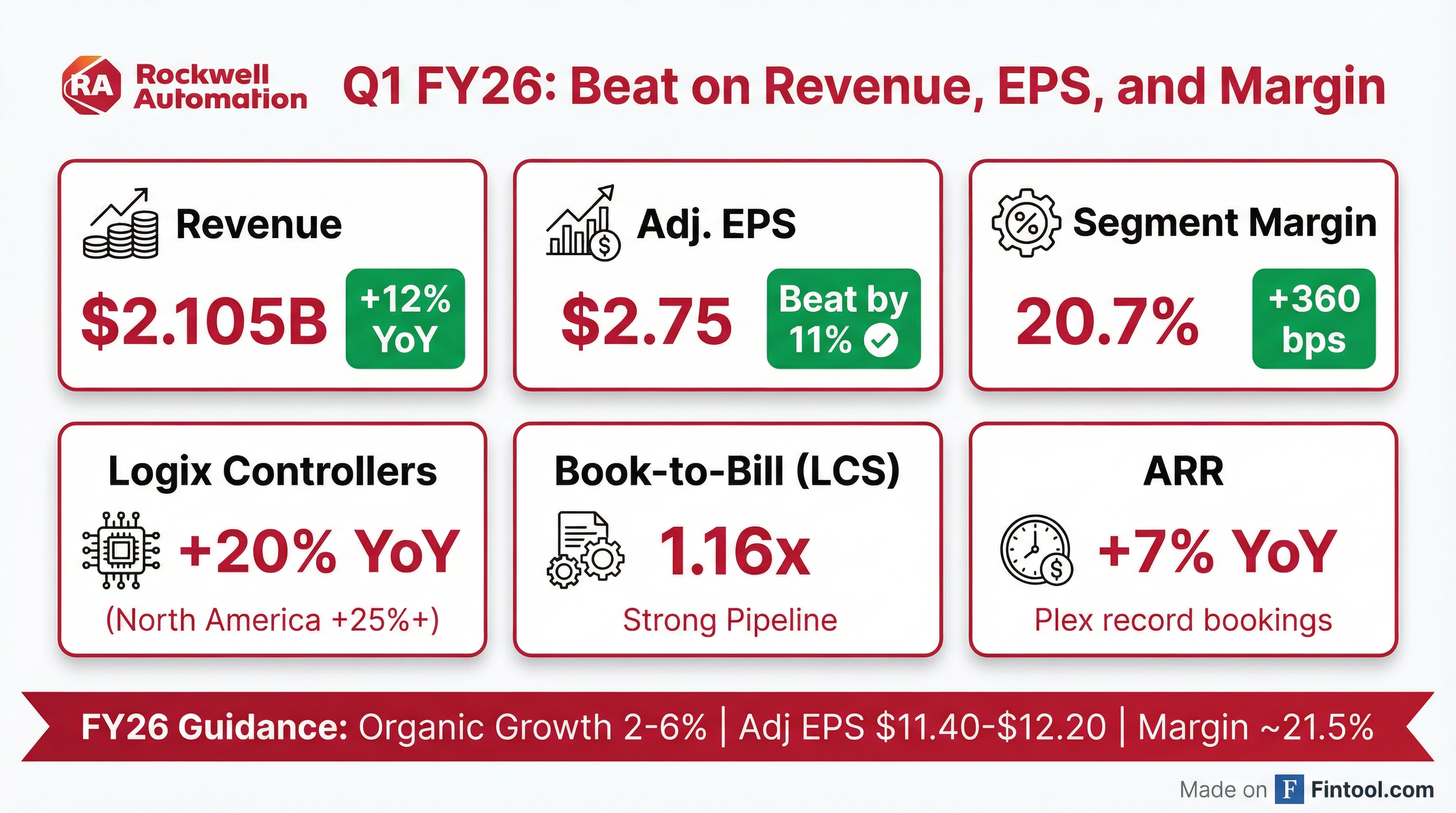
| Metric | Q1 FY26 | Q1 FY25 | YoY Change |
|---|---|---|---|
| Revenue | $2.105B | $1.881B | +12% |
| Adjusted EPS | $2.75 | $1.85 | +49% |
| Segment Operating Margin | 20.7% | 17.1% | +360 bps |
| Diluted EPS | $2.69 | $1.61 | +67% |
The adjusted EPS of $2.75 beat consensus of $2.48 by 11%, while revenue topped expectations by roughly 1%.
Critically, Bulho highlighted that Logix—Rockwell's flagship controller platform—grew over 20% year-over-year globally and over 25% in North America. This strength in the core product business, combined with margin expansion, suggests operational leverage is working.
Sentiment Is Improving—But Caution Remains
Moret acknowledged that while sentiment is "slightly better" than a quarter ago, customers are still waiting for clarity before committing to major capital projects:
"Where we're seeing customers still waiting for a little more certainty is in the major CapEx across a broad swath of the verticals. Of course, enormous amounts of capital being deployed in areas like data center. Pharmaceutical continues to deploy capital with new capacity for GLP-1... But across other verticals, a lot of the activity today is focused on products, modernizations, additional efficiency projects in existing plant, versus building new."
The one quantitative signal investors can track: Lifecycle Services book-to-bill hit 1.16x in Q1—a healthy reading that suggests the pipeline of larger projects is building. Moret expects to book "more new capacity business this year than last year by a fair bit."
The Growth Algorithm: 5-8% Long Term
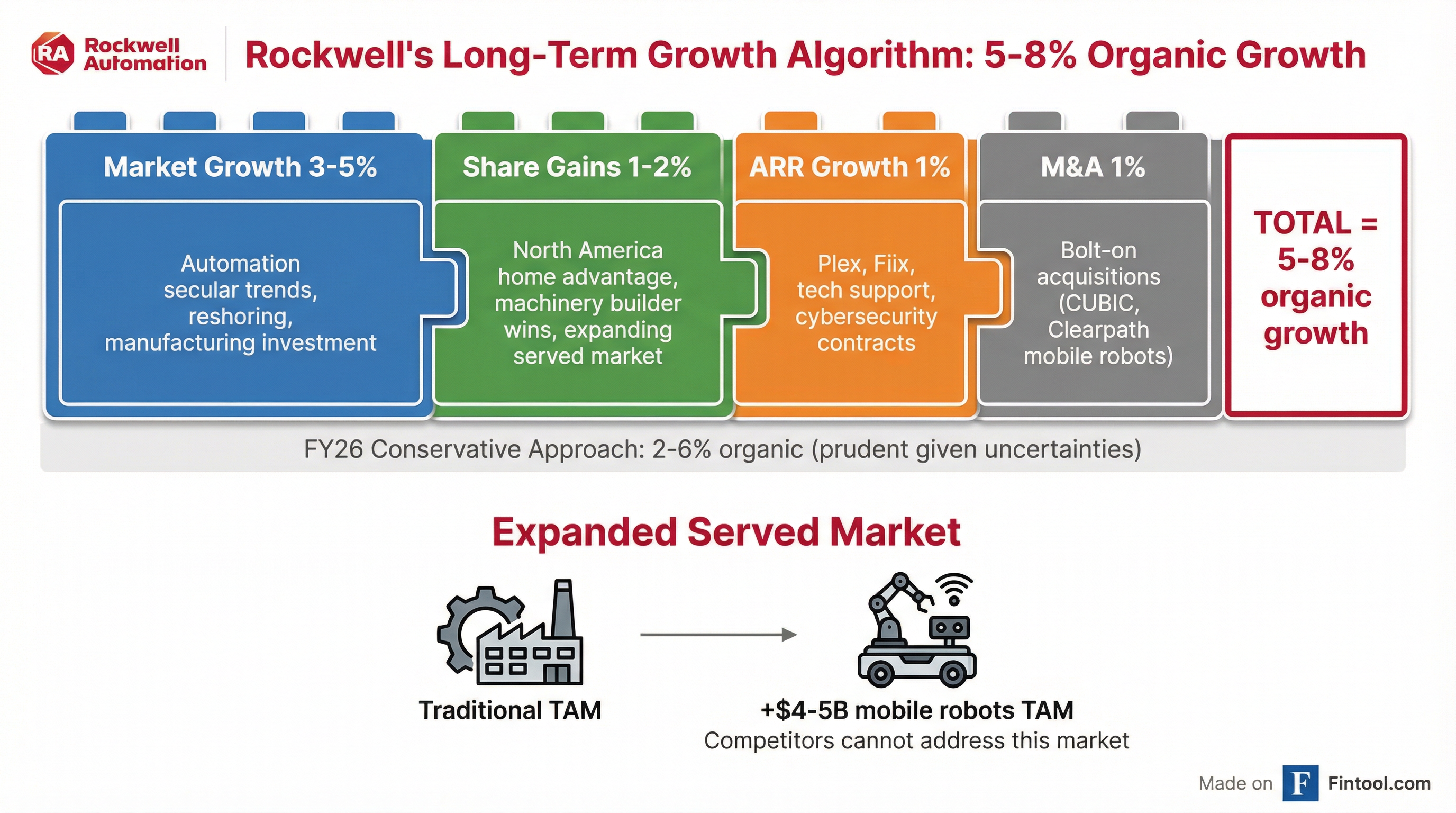
Rockwell outlined its long-term growth framework, though is taking a "prudent approach" for FY26 with guidance of 2-6% organic growth:
| Component | Target | Driver |
|---|---|---|
| Market Growth | 3-5% | Automation secular trends, reshoring |
| Share Gains | 1-2% | North America home advantage, machinery builder wins |
| ARR Growth | 1% | Plex, Fiix, tech support, cybersecurity contracts |
| M&A | 1% | Bolt-on acquisitions |
| Total | 5-8% |
A key point: Rockwell is actively expanding its served market through mobile robots (via the Clearpath acquisition). Moret estimated this adds $4-5 billion in TAM that "none of our traditional competitors have."
Ask Fintool AI AgentPlex Had Record Bookings—And Management Is Bullish
One underappreciated bright spot: Plex, Rockwell's cloud-based MES platform acquired in 2021 for $2.2 billion, had its highest quarter in terms of new bookings on record.
Bulho emphasized the data moat:
"Plex is a platform that is exposed to an amount of data that no other company has the benefit of extracting from. There are literally billions of transactions that flow through Plex every day, trillions across the spectrum of a year, across thousands of plants, and that creates a moat that is very difficult to replicate."
The go-to-market strategy is evolving, with Rockwell developing partners to not only deploy Plex but also help sell it—both domestically and internationally.
Margin Expansion: Still "Early Innings"
When asked where Rockwell stands on its productivity journey, Moret was characteristically understated: "We're still early innings."
The company has delivered hundreds of millions of dollars in productivity savings over the past two years, with initiatives spanning:
- 30% improvement in labor efficiency at the Singapore plant (primarily Software and Control)
- Insourcing, logistics, and direct material optimization
- "Rock on Rock" deployments using Rockwell's own automation technology in its facilities
Software and Control—the highest-margin segment—is targeting 34% segment margins long-term, versus 20.7% for the total company in Q1.
FY26 Guidance: Reaffirmed With Modest EPS Lift
Rockwell reiterated its full-year framework while nudging EPS guidance higher on tax benefits:
| Metric | Updated Guidance | Prior Guidance |
|---|---|---|
| Reported Sales Growth | 3-7% | 3-7% |
| Organic Sales Growth | 2-6% | 2-6% |
| Segment Margin | 21.5% | 21.5% |
| Adjusted EPS | $11.40-$12.20 | $11.20-$12.20 |
| Free Cash Flow Conversion | 100% | 100% |
For Q2, management expects sales "slightly up sequentially" with mid-single-digit year-over-year growth and margin expansion of less than 100 basis points.
Ask Fintool AI AgentThe Siemens-NVIDIA Partnership: Context Matters
The audience question about Siemens deserves context. At CES 2026, Siemens and NVIDIA announced plans to build the "Industrial AI Operating System"—with Siemens committing "hundreds of industrial AI experts" and NVIDIA providing infrastructure, simulation libraries, and AI models.
Siemens' focus, however, skews toward product design (PLM, EDA applications) rather than factory floor automation where Rockwell dominates. Moret noted: "Siemens' focus is a little bit more on the product design... compute-intensive. That's why NVIDIA is particularly interested there."
Rockwell emphasized its own NVIDIA partnership remains strong:
- Emulate3D digital twin product uses NVIDIA Omniverse APIs for photorealistic rendering
- Collaborating on small language model deployments in runtime systems for production optimization
- Partnerships extend beyond NVIDIA to Microsoft and "hundreds of other technology partners"
What to Watch
Near-term catalysts:
- Q2 earnings (early May) for continued order momentum and margin progress
- Sensia JV dissolution expected H1 FY26—guidance excludes this impact
- Continued data center and e-commerce/warehouse automation strength (60-70% growth in Q1)
Risks:
- Broader CapEx deferrals if macro uncertainty persists
- Pricing power erosion if competitors deploy AI to reduce software development costs
- Customer "vibe coding" of digital twins, as one investor colorfully suggested a European customer attempted
Moret's closing thought on the next decade: "Simplification is gonna sort out the winners and the losers over the next 10 years. I talked about that over 9 years ago, and I think it's still as relevant today as it was then."
Related: