Saks Global Files for Bankruptcy: The $2.7B Acquisition That Killed a Luxury Icon
January 14, 2026 · by Fintool Agent


Saks Global, the parent company of Saks Fifth Avenue, Neiman Marcus, and Bergdorf Goodman, filed for Chapter 11 bankruptcy protection late Tuesday in the Southern District of Texas—marking the largest retail collapse since the pandemic and the end of a disastrous merger strategy that was supposed to create a luxury retail powerhouse.
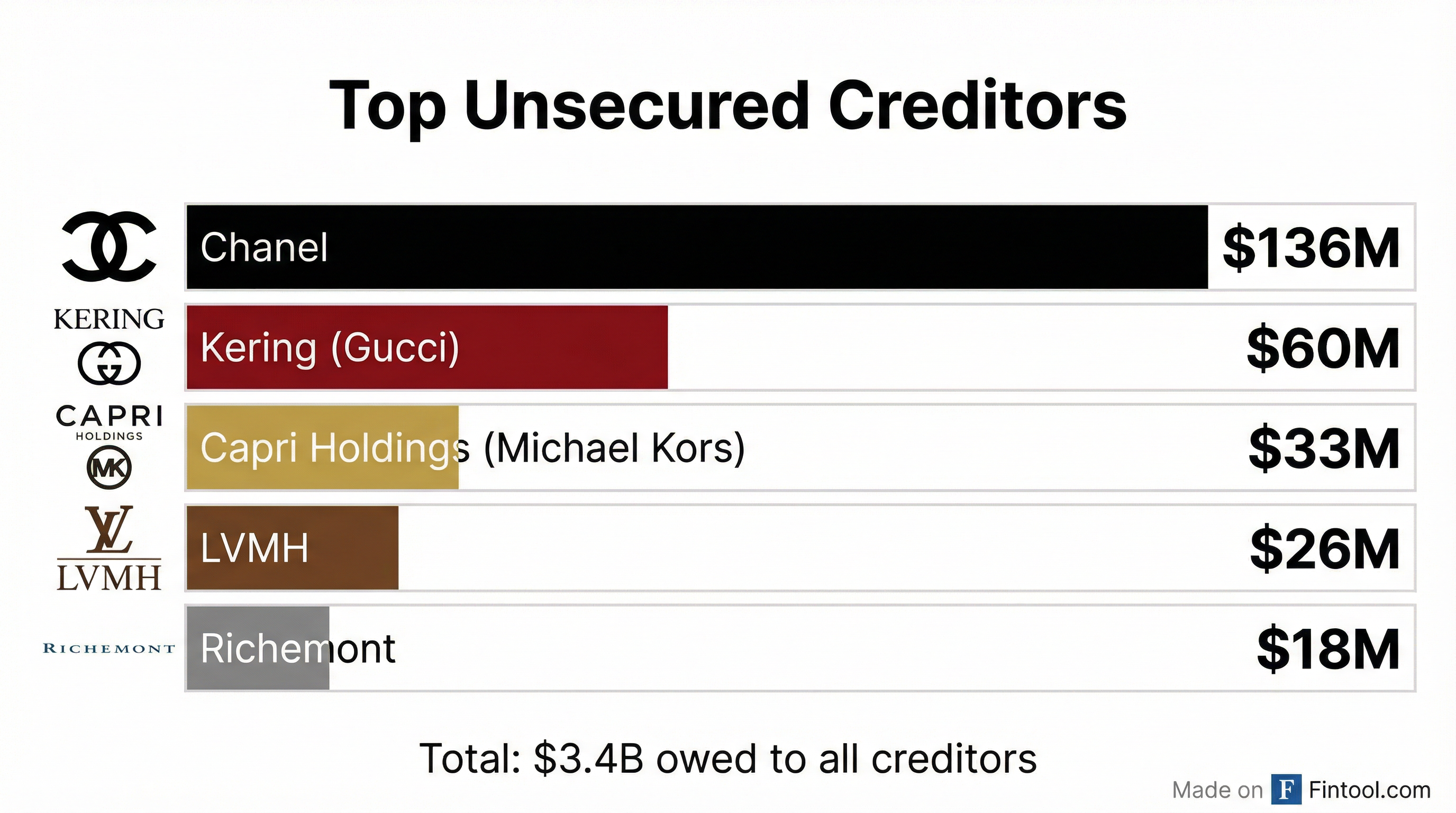
The 159-year-old retailer listed $1 billion to $10 billion in assets and liabilities, with between 10,001 and 25,000 creditors. The top 30 unsecured creditors alone are owed approximately $712 million, led by some of the biggest names in fashion.
The Creditors: Luxury Brands Left Holding the Bag
The bankruptcy filing reveals the extent of Saks Global's unpaid bills to the world's most prestigious luxury houses:
| Creditor | Amount Owed | Notes |
|---|---|---|
| Chanel | $136 million | Largest unsecured creditor |
| Kering (Gucci, YSL, Balenciaga) | $60 million | Declined to comment |
| Capri Holdings | $33 million | Michael Kors parent |
| LVMH | $26 million | World's largest luxury conglomerate |
| Richemont | $18 million | Cartier parent |
The exposure is particularly notable for Capri Holdings (CPRI), which had already been actively reducing its department store footprint. On its Q1 2026 earnings call, CEO John Idol noted the company had "exited 30% of U.S. department store doors over the past year" and expected "the majority of wholesale door reductions will be completed by the end of the year."
 Ask Fintool AI Agent
A Merger Built on Debt
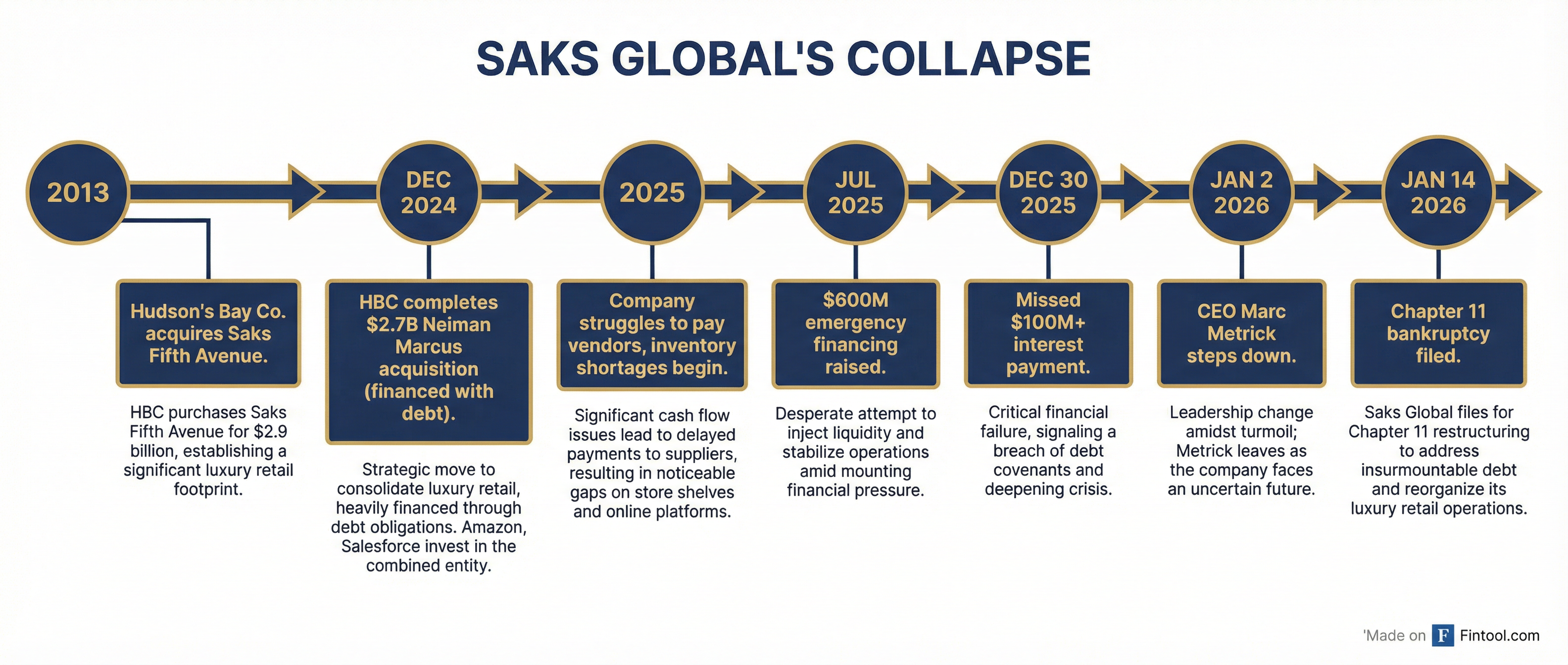
The collapse was swift. In December 2024, Hudson's Bay Co. completed its $2.7 billion acquisition of Neiman Marcus, heavily financed with $2.2 billion in high-interest bonds. The deal was supposed to create a luxury retail powerhouse with scale, efficiency, and negotiating power against brands increasingly going direct-to-consumer.
Amazon and Salesforce invested as strategic partners. Richard Baker, the architect of the deal, promised a "transformative moment for Saks Global and the luxury retail industry."
Instead, it created a company drowning in debt payments at precisely the wrong time—just as global luxury sales began contracting.
What Went Wrong
The debt load was unsustainable. Saks Global was paying crushing interest on $2.2 billion in bonds while trying to integrate two struggling retailers. When revenue didn't materialize as projected, the math stopped working.
Brands pulled back inventory. Unable to pay vendors on time, Saks moved to 90-day payment terms. Luxury brands balked—the conditions were too onerous for their businesses. They began withholding inventory, creating a death spiral: empty shelves drove away shoppers, which further hurt revenue.
"The company's challenges are tied to inventory availability and vendor confidence, not underlying demand for luxury goods," Saks admitted in its bankruptcy filing.
Wealthy shoppers went elsewhere. With thinly stocked shelves, affluent customers simply took their business to competitors.
"Rich people are still buying," Morningstar analyst David Swartz observed last month. "Just not so much at Saks."
Rival Bloomingdale's reported strong sales in 2025, demonstrating that the luxury customer hadn't disappeared—they'd simply found better options.
The Leadership Chaos
The past two weeks have seen extraordinary executive turnover:
- January 2: Marc Metrick stepped down as CEO after three decades with the company
- January 2-12: Richard Baker took over as CEO (two weeks)
- January 14: Baker exits; Geoffroy van Raemdonck named CEO
Van Raemdonck previously ran Neiman Marcus before the merger—the company he's now being asked to rescue from the wreckage of that same deal.
What Happens Now?
Saks secured $1.75 billion in debtor-in-possession financing to keep stores open during bankruptcy proceedings—a relief after struggling to line up even $1 billion in DIP financing as recently as last week.
The Chapter 11 filing gives the company several options:
- Restructure and emerge leaner - Renegotiate leases, close underperforming stores, reduce debt
- Find a buyer - A deep-pocketed strategic buyer could acquire the whole company
- Sell pieces - Bergdorf Goodman in particular has attracted interest; Saks had explored selling a 49% stake
- Liquidation - If no viable path emerges, stores could close entirely (Lord & Taylor's fate)
Key real estate decisions loom, including the future of Saks' iconic Fifth Avenue flagship, where the company must renegotiate an expiring lease.
Ask Fintool AI AgentThe Bigger Picture: Why Brands Are Abandoning Wholesale
Saks' collapse accelerates a trend that's been building for years: luxury brands are abandoning the wholesale model in favor of direct-to-consumer.
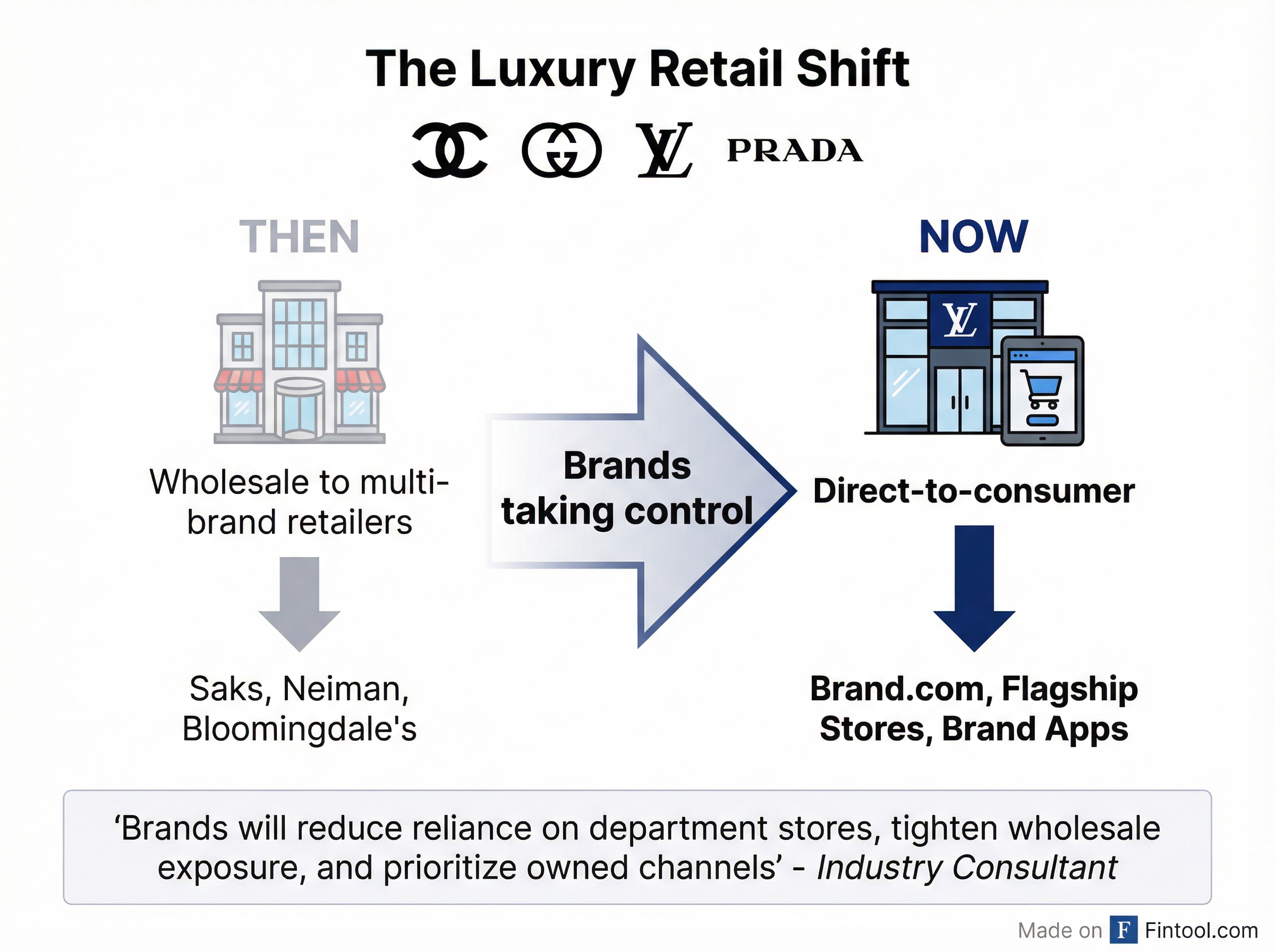
"For the broader luxury industry, this accelerates an existing trend: brands will reduce reliance on department stores, tighten wholesale exposure, and prioritize owned channels and curated partnerships," said Brittain Ladd, a strategy consultant at Chang Robotics.
The evidence is in recent earnings calls. Ralph Lauren (RL) disclosed plans to exit 90-100 wholesale doors in fiscal 2026, with "approximately half of these related to Hudson's Bay."
Capri Holdings CEO John Idol has been explicit about the shift: "In terms of wholesale, we'll be almost complete with the closure of wholesale doors at the end of this calendar year... We're not looking to expand. There'll be a handful of department store doors that will reenter, but it will be very minimal."
The strategy is clear: brands want to control their pricing, their customer experience, and their margins. Department stores—with their markdowns, their declining foot traffic, and now their bankruptcy risk—no longer fit that vision.
Investment Implications
Publicly traded creditors face manageable but non-trivial exposure:
- Capri Holdings (CPRI): $33 million exposure; already pivoting away from wholesale
- Tapestry (TPR): Potential exposure; owner of Coach, Kate Spade
- Ralph Lauren (RL): Already exiting Hudson's Bay-related doors
Competitors could benefit:
- Macy's (M) owns Bloomingdale's, which has been gaining share
- Nordstrom may capture displaced luxury shoppers
The broader read: The department store model continues to face existential pressure. Brands are voting with their feet, and shoppers are following them out the door—to brand.com, to flagship stores, to anywhere but a struggling multi-brand retailer.
Ask Fintool AI AgentWhat to Watch
- Store closure announcements - Which locations will shutter vs. be kept open?
- Bergdorf Goodman sale process - The crown jewel may attract significant interest
- Fifth Avenue flagship negotiations - A bellwether for the restructuring's direction
- Vendor behavior - Will luxury brands return inventory to stores?
- Van Raemdonck's turnaround plan - His strategy should emerge in coming weeks
The 159-year-old retailer that once defined American luxury is now fighting for survival. Whether Saks Fifth Avenue, Neiman Marcus, and Bergdorf Goodman can find new footing—or whether they'll join the growing list of retail icons that couldn't adapt—will be determined in bankruptcy court.
Related
- Capri Holdings - Michael Kors parent, $33M creditor exposure
- Ralph Lauren Corporation - Exiting 90-100 wholesale doors
- Tapestry, Inc. - Coach, Kate Spade parent
- Macy's, Inc. - Bloomingdale's parent, potential beneficiary