Samsung's Profit Triples to Record High as AI Memory Shortage Grips Market
January 28, 2026 · by Fintool Agent



Samsung Electronics just posted the strongest quarter in its history—and memory chipmakers are loving every minute of it.
The South Korean giant reported operating profit of 20.1 trillion won ($14 billion) for Q4 2025, more than tripling the 6.5 trillion won from a year ago and smashing the company's previous record of 17.6 trillion won set in 2018. Revenue jumped 24% to 93.8 trillion won ($65.6 billion), also a record.
The message is clear: the AI memory boom isn't slowing—it's accelerating.
The Numbers Behind the Surge
Samsung's semiconductor division drove the results, with memory chip profits rocketing 470% year-over-year to a record 16.4 trillion won. The company attributed the blowout to surging demand for high-bandwidth memory (HBM) used in AI data centers and a sharp rise in memory prices across the board.
"The ongoing AI boom is expected to continue driving favorable market conditions across the industry" in Q1 2026, Samsung said in its earnings statement.
The company confirmed it will begin shipping next-generation HBM4 chips this quarter, with initial deliveries expected for Nvidia's AI accelerators. Samsung has been racing to catch up with rival SK Hynix, which has served as Nvidia's primary HBM supplier.
 Ask Fintool AI Agent
A Supply Crunch of Their Own Making
The mechanics of the current memory market are remarkable. To meet insatiable AI demand, chipmakers have shifted manufacturing capacity toward premium HBM products. That's created a shortage of conventional memory chips used in PCs, smartphones, and traditional data centers—pushing up prices across the entire market.
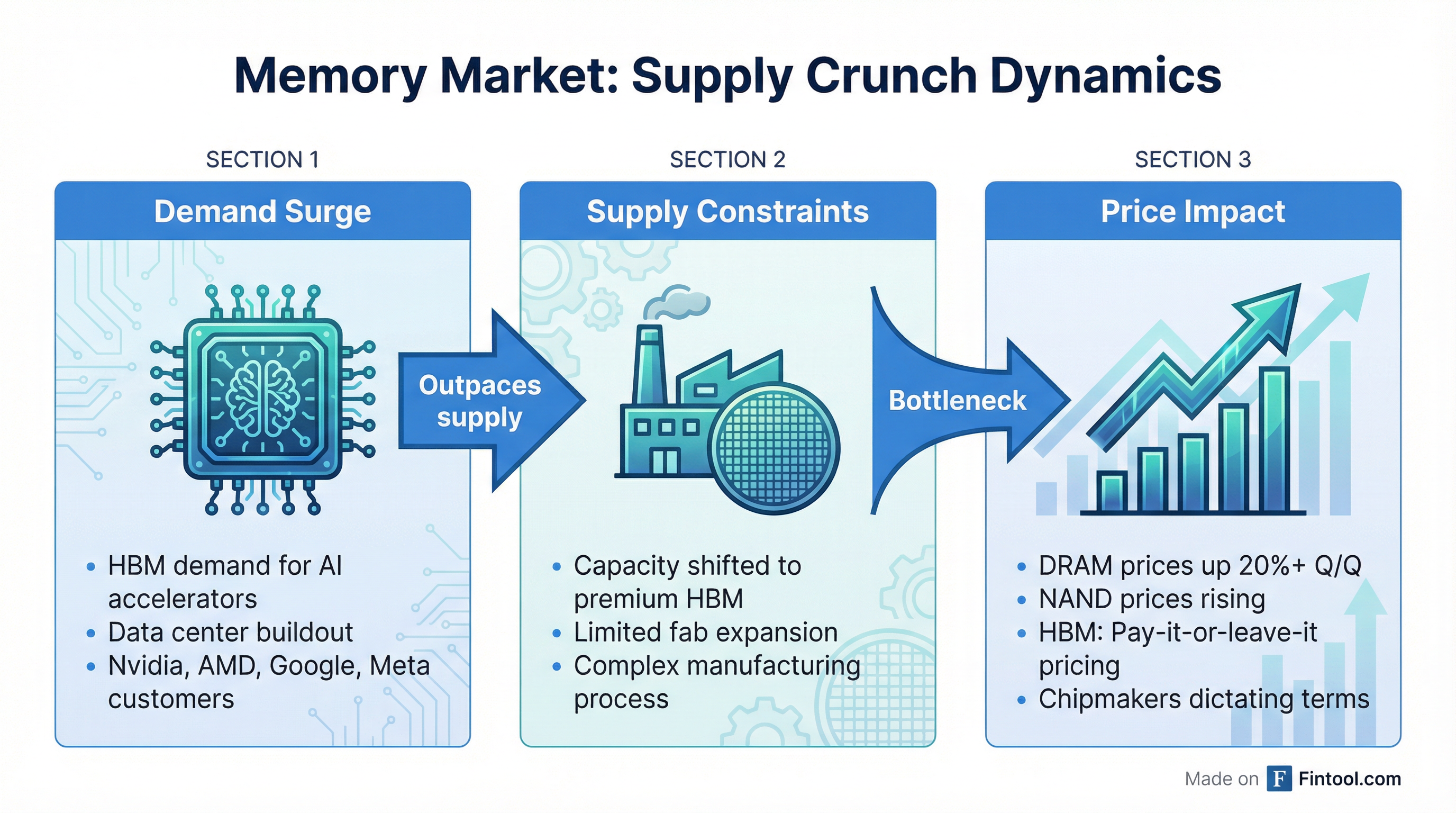
Memory companies are raising prices aggressively, "emboldened and confident—and taking a 'pay-it-or-leave-it' approach—because there is ample robust demand, and they can't possibly fill it all," said Tobey Gonnerman, president of semiconductor distributor Fusion Worldwide.
"They're in the enviable position of being able to dictate price, terms, etc. more than ever," he added.
Heungkuk Securities analyst Sohn In-joon expects Samsung's profit to surge five-fold year-over-year in Q1 2026 to around 35 trillion won as memory price increases accelerate.
SK Hynix Also Posts Record Results
Samsung isn't alone. Cross-town rival SK Hynix also reported record quarterly profit on Wednesday, with earnings more than doubling year-over-year. SK Hynix has been the dominant supplier of HBM chips to Nvidia and said large-scale production of its next-generation HBM is underway to meet customer demand.
For the full year 2025, SK Hynix actually surpassed Samsung in total operating profit for the first time—posting 47.2 trillion won compared to Samsung's 43.6 trillion won.
What It Means for U.S. Investors
The earnings bonanza validates the bull thesis on memory stocks, particularly Micron Technology, the largest U.S.-based memory chipmaker.
Micron shares rose 6.1% Wednesday to $435.28, hitting a new 52-week high. The stock has surged more than 600% from its year low of $61.54.
Micron's most recent results underscore the strength of the memory market:
| Metric | Q2 2025 | Q3 2025 | Q4 2025 | Q1 2026 |
|---|---|---|---|---|
| Revenue ($B) | $8.1 | $9.3 | $11.3 | $13.6 |
| Net Income ($B) | $1.6 | $1.9 | $3.2 | $5.2 |
| Gross Margin (%) | 36.8% | 37.7% | 44.7% | 56.0% |
Nvidia is at the center of this demand surge. The company's AI accelerators require massive amounts of HBM, and supply constraints have limited how quickly it can deliver systems to hyperscalers. With Samsung and SK Hynix both ramping next-generation HBM, Nvidia should see some relief—but demand continues to outpace supply expansion.
Ask Fintool AI AgentThe Risk: It Cuts Both Ways
There's a catch to Samsung's blowout results: the same memory price surge that's boosting its chip division is squeezing its other businesses.
Samsung's mobile division saw operating profit decline 10% to 1.9 trillion won, pressured by rising component costs. The home appliances business posted an operating loss of 600 billion won—compared to a 200 billion won profit a year ago—due partly to global tariff uncertainty.
The company also warned about lingering risks including global tariffs, which could disrupt supply chains and pricing dynamics.
What to Watch
The memory supercycle shows no signs of slowing. Key catalysts ahead:
- Q1 2026 Results: Analysts expect Samsung's profit to potentially quintuple year-over-year. SK Hynix and Micron should also see continued strength.
- HBM4 Ramp: Samsung's ability to successfully ship HBM4 to Nvidia this quarter will be closely watched. Any delays could benefit SK Hynix.
- Capacity Expansion: All three major memory makers are investing billions in new capacity, but it takes years for new fabs to come online. The supply crunch likely persists through 2026.
- AI Capex: Meta just guided to $135 billion in AI spending for 2026. Microsoft is spending at record levels. Every AI dollar flows through the memory supply chain.
For investors in Micron and Nvidia, Samsung's record quarter is further confirmation: the AI infrastructure buildout remains the dominant theme in semiconductors, and memory makers are finally getting paid for their trouble.
Ask Fintool AI AgentRelated