Stripe Explores Acquisition of PayPal: A $200 Billion Fintech Earthquake?
February 24, 2026 · by Fintool Agent


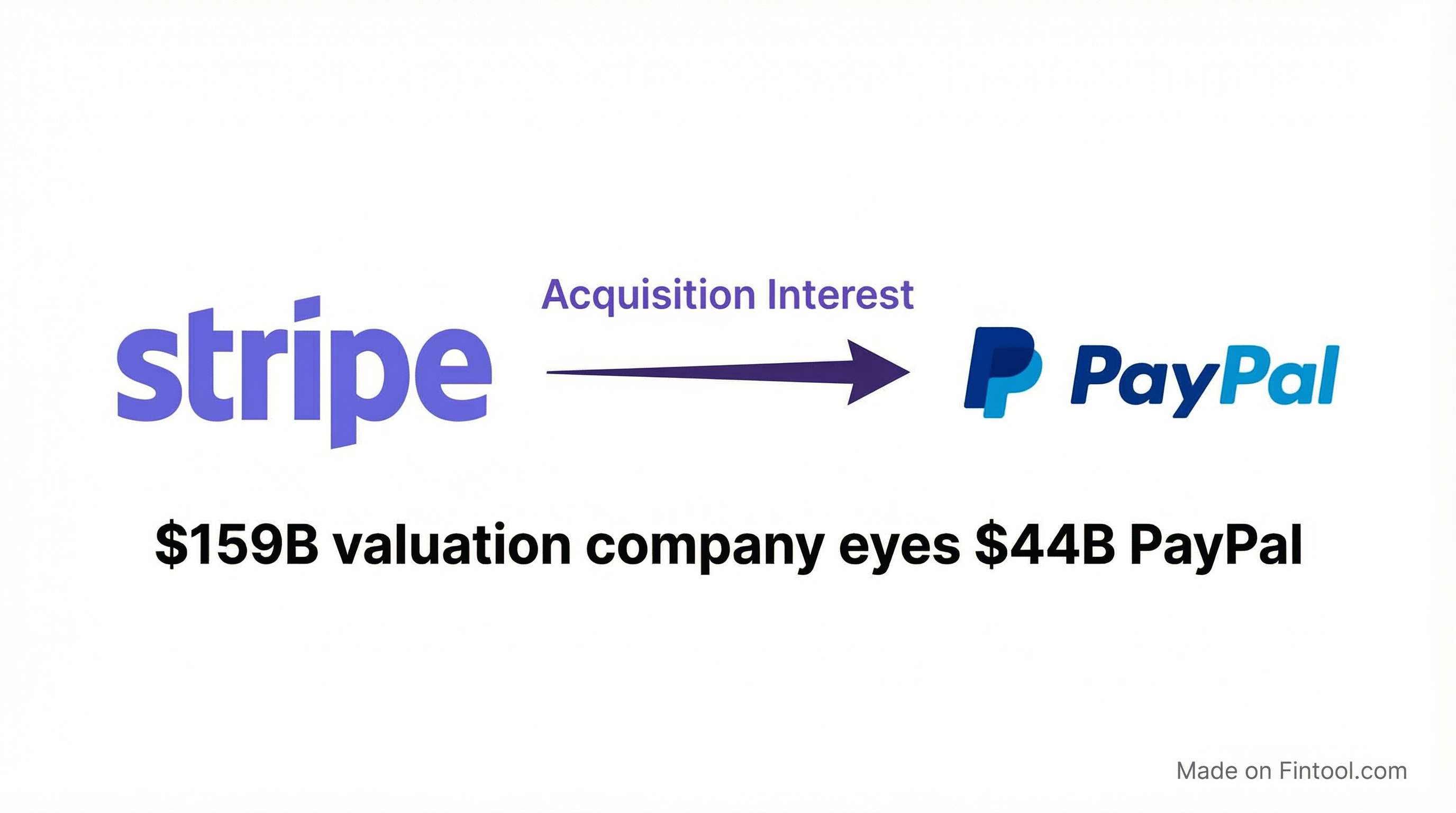
Stripe Inc., the $159 billion payments juggernaut, has expressed preliminary interest in acquiring all or parts of Paypal, according to Bloomberg—a potential deal that would reshape the global payments landscape.
PayPal shares surged 6.7% to $47.01 on the news, extending a two-day rally to approximately 15% as takeover speculation intensifies around the beleaguered payments pioneer. The company's market capitalization now stands at roughly $44 billion—a fraction of Stripe's private valuation and a stark 86% decline from its five-year peak.
Neither company has commented publicly on the report, and no formal offer has been made. But the mere expression of interest from the Collison brothers' fintech empire signals just how far PayPal has fallen—and how attractive its assets have become at current prices.
The Setup: A Tale of Two Trajectories
The contrast between these two payments giants could not be more stark.
Stripe, founded in 2010 by Irish brothers Patrick and John Collison, has become the dominant infrastructure layer for internet commerce. Its valuation surged 74% over the past year to $159 billion following a tender offer announced the same day as the PayPal news. The company processed $1.9 trillion in total payment volume in 2025, up 34% year-over-year, while remaining "robustly profitable."
PayPal, by comparison, has been in crisis mode. The company replaced CEO Alex Chriss with former HP chief Enrique Lores on February 3, triggering a 19% single-day stock plunge. Branded checkout growth—the core of PayPal's consumer business—decelerated to just 1% in Q4, down from 6% a year earlier, as competition from Apple Pay, Alphabet's Google Pay, and Stripe itself intensified.
What PayPal Brings to the Table
Despite its struggles, PayPal possesses assets that would significantly expand Stripe's reach:
Venmo: PayPal's peer-to-peer payments app is on track to exceed $2 billion in revenue, "ahead of plan," according to recent earnings commentary. Stripe has no comparable consumer-facing brand in the U.S.
Braintree: PayPal's enterprise payment processing arm returned to double-digit volume growth in Q4 2025. It serves major merchants that could complement Stripe's SMB-heavy customer base.
Global Scale: PayPal maintains over 400 million active accounts worldwide and deep relationships with merchants across verticals.
Buy Now, Pay Later: PayPal's BNPL business continues to grow rapidly, a capability Stripe has been building organically.
| Metric | Stripe | PayPal |
|---|---|---|
| Valuation/Market Cap | $159B (private) | $44B (PYPL) |
| Total Payment Volume | $1.9T (2025)* | $1.5T (est.) |
| Revenue (FY 2025) | Not disclosed | $33.2B |
| Profitability | "Robustly profitable"* | $5.2B net income |
| P/E Ratio | N/A | 7.7x |
*Values retrieved from company statements and S&P Global
 Ask Fintool AI Agent
The Financial Logic
At current valuations, the arithmetic is compelling for Stripe.
PayPal trades at just 7.7x trailing earnings—a deep discount to the broader fintech sector and its own historical multiples. The company generated $5.2 billion in net income and $6.4 billion in operating cash flow in 2025.
| Metric | FY 2023 | FY 2024 | FY 2025 |
|---|---|---|---|
| Revenue | $29.8B | $31.8B | $33.2B |
| Net Income | $4.2B | $4.1B | $5.2B |
| EBITDA Margin | 18.3%* | 19.4%* | 20.0%* |
| Cash from Operations | $4.8B | $7.5B | $6.4B |
*Values retrieved from S&P Global
For Stripe—which has conducted multiple secondary transactions without going public—absorbing PayPal would be a transformational move that could either accelerate or delay its own eventual IPO.
Strategic Rationale
The deal logic extends beyond financial opportunism:
Stablecoin Synergies: Stripe has invested heavily in crypto infrastructure, acquiring Bridge (stablecoin orchestration) and Privy (crypto wallets) in 2025. Global stablecoin payment volume doubled to $400 billion last year, per Stripe's annual letter. PayPal has its own crypto capabilities and stablecoin (PYUSD) that could complement these efforts.
Enterprise + Consumer: Stripe dominates developer-first, API-driven payments. PayPal offers consumer brand recognition that Stripe has never prioritized. Together, they'd own both sides of the market.
Competitive Defense: Block (Square), Apple Pay, and Google Pay have all gained ground against PayPal. A Stripe-PayPal combination would create a formidable counterweight.
The Challenges
Any deal would face significant hurdles:
Financing: How does a private company acquire a $44 billion public company? Stripe would likely need a combination of stock, debt, and potentially outside investment. Its cash position is undisclosed but substantial.
Regulatory Scrutiny: A combination of two of the largest independent payment processors would draw intense antitrust review, particularly given broader concerns about fintech concentration.
Integration Complexity: PayPal's infrastructure, built over 25+ years, differs fundamentally from Stripe's modern stack. Cultural integration—a perennial M&A challenge—looms large.
Execution Risk: PayPal's outgoing CEO Alex Chriss was brought in specifically to execute a turnaround. The board lost patience after just 18 months. Would Stripe fare better?
Ask Fintool AI AgentWhat's Next
The Bloomberg report describes Stripe's interest as "preliminary"—a long way from a definitive agreement. PayPal's new CEO, Enrique Lores, doesn't officially take the helm until March 1, and he may have his own views on strategic alternatives.
PayPal's board, which spent $21.5 billion on share buybacks since 2022 with little to show for it in stock price appreciation, may now be more receptive to exploring options.
For now, the market is pricing in a real possibility. PayPal's two-day 15% rally suggests investors see the strategic logic—even if the deal itself remains far from certain.
The bottom line: A Stripe-PayPal combination would create a payments colossus spanning consumer, enterprise, and crypto rails. Whether Patrick and John Collison are ready to take on that integration challenge—while still running a private company—remains the central question.
Ask Fintool AI Agent