Texas Instruments Targets $8+ Free Cash Flow Per Share in 2026 as CapEx Cycle Ends
February 24, 2026 · by Fintool Agent


Texas Instruments delivered its annual capital management update today, guiding for more than $8 per share in free cash flow for 2026—a nearly 150% increase from the $3.23 reported in 2025—as the analog semiconductor giant finally emerges from a multi-year capacity investment cycle.
Shares fell 4% to $211 during the presentation, suggesting investors may have expected a more aggressive return to the historical FCF trend line or greater clarity on the Silicon Labs acquisition timeline.
CEO Haviv Ilan and CFO Rafael Lizardi outlined how TI's 300-millimeter manufacturing strategy is entering its final "modular" phase, enabling the company to scale CapEx dynamically with demand rather than front-loading capacity investments. The pivot marks the end of a decade-long transformation that has fundamentally reshaped TI's cost structure and competitive position.
The CapEx Inflection Point
The numbers tell a stark story of capital allocation discipline paying off:
| Metric | FY 2024 | FY 2025 | FY 2026E |
|---|---|---|---|
| CapEx | $4.8B | $4.6B | $2-3B |
| Free Cash Flow/Share | $1.64 | $3.23 | $8.00+ |
| Operating Cash Flow | $6.4B | $7.2B | — |
| Revenue | $15.6B | $17.7B | $19.6B* |
*Consensus estimate
TI expects CapEx at the lower end of the $2-3 billion range if growth remains moderate (mid-to-high single digits), and at the higher end only if demand accelerates meaningfully.
"The company needs to grow, obviously, to reach $8 free cash flow per share in 2026, but it doesn't need to grow a lot," Ilan said. "Mid to single-digit growth to maybe 10%, we should be in that range."
The fall-through math is straightforward: CFO Rafael Lizardi guided to 75%-85% incremental margin on revenue growth, allowing analysts to model various scenarios. At consensus revenue of ~$19.6 billion, TI would generate roughly $8 per share. Higher growth scenarios could push FCF per share toward $11-12.
 Ask Fintool AI Agent
300mm Manufacturing: Phase 3 Begins
TI's manufacturing transformation has reached a critical milestone. The company is now in "Phase 3" across most of its facilities—the modular expansion phase where tools can be added to clean rooms without requalification delays.

Facility Status:
- RFAB2 (Richardson, TX): Transfers from legacy 150mm fabs complete. Clean room ~80-85% equipped, ramping toward full capacity
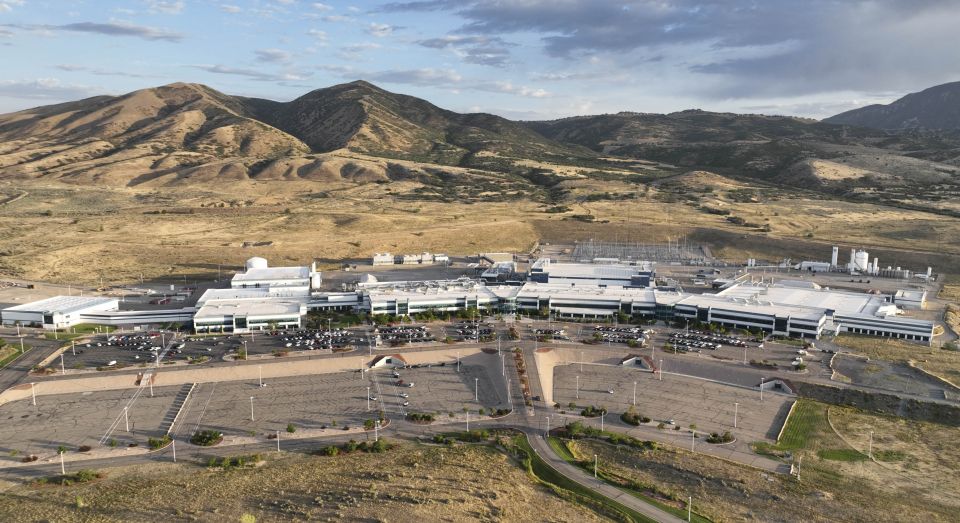
- LFAB1 (Lehi, UT): Ramping with 45-65nm production. 28nm process technology qualification underway. Will manufacture Silicon Labs products post-acquisition
- SM1 (Sherman, TX): Clean room complete, production underway, ramping according to customer demand
- SM2 (Sherman, TX): Shell complete, eliminating construction lead time for future expansion
By 2030, TI expects more than 95% of wafers sourced internally (vs. ~90% today), with more than 80% on 300mm—a dramatic increase from roughly 40% five years ago.
The cost advantage is material: internal 300mm wafer production provides both lower costs and greater supply chain control. Combined with the CHIPS Act benefits—$630 million received to date, including $555 million in Q1 2026—TI's manufacturing edge continues to widen.
Data Center: The New Growth Vector
Perhaps the most significant strategic update was TI's formal recognition of data center as a discrete end market. Previously buried within "enterprise" and "industrial," data center now stands as its own category alongside industrial, automotive, personal electronics, and communications equipment.
| End Market | FY 2025 Revenue | % of Total | YoY Growth |
|---|---|---|---|
| Industrial | $5.8B | 33% | +12% |
| Automotive | $5.8B | 33% | +6% |
| Data Center | $1.5B | 9% | +64% |
| Personal Electronics | $3.7B | 21% | +7% |
| Communications | $0.5B | 3% | +20% |
Data center grew approximately 70% year-over-year in Q4 2025 and 64% for the full year, with Q4 run-rate annualizing to roughly $1.8 billion (~10% of revenue).
TI's position in data center is concentrated in analog power management—DC-to-DC voltage regulators, multiphase controllers, power stages, hot-swap controllers, and current sensors—the components that manage power delivery from the rack level down to individual chips.
"As long as CapEx continues to be invested in data centers, we expect that growth to continue," Ilan said. "We see a lot of opportunity, a lot of diversity of parts."
The company is developing products specifically for the industry's transition to 800-volt DC architectures, where TI's GaN (gallium nitride) technology will enable higher power density per rack.
Ask Fintool AI AgentSilicon Labs: The Strategic Rationale
TI provided additional context on its $7.5 billion acquisition of Silicon Labs, announced February 4, 2026. The deal represents TI's largest since the $6.5 billion National Semiconductor acquisition in 2011.

Deal Terms:
- Price: $231 per share (69% premium to unaffected price)
- Total Value: ~$7.5 billion (enterprise value)
- Expected Close: First half of 2027
- Synergies: ~$450 million annually within 3 years post-close
- Financing: Cash on hand plus debt financing
Ilan explained why the deal makes sense now when it didn't five years ago: manufacturing economics. Silicon Labs' products can be transitioned to TI's internal 300mm facilities (particularly LFAB in Utah), capturing both OpEx efficiencies and COGS improvements that weren't available when wafers were sourced externally.
"The numbers just add up," Ilan said. "When you add OpEx efficiencies to the COGS efficiencies, it was hard to make the numbers work five years ago."
The financial hurdle rate remains unchanged: returns must exceed cost of capital (approximately 10% WACC) within 3-5 years. TI expects Silicon Labs to meet this threshold.
Silicon Labs' 85% industrial exposure and wireless connectivity focus (Bluetooth, Zigbee, Matter, Wi-Fi) complements TI's existing MCU and analog portfolio. The combination creates one of the most formidable wireless-analog portfolios in the industry.
Industrial Recovery: The Big Unknown
While data center garners attention, industrial remains TI's largest opportunity—and biggest uncertainty—for 2026. The segment grew 12% in 2025 but remains approximately 25% below its prior peak, with most sectors still 30-35% off their highs.
"Industrial is a big unknown," Ilan acknowledged. "It grew nicely in Q4, close to 20%, but I think it has a lot of room to go."
The semiconductor unit data supports optimism. According to WSTS data shared during the presentation, overall semiconductor unit shipments (excluding memory) are recovering but remain below historical trend lines. TI views this as validation that secular content growth continues across applications, even if the recovery slope is more modest than prior cycles.
Capital Returns: The Commitment Holds
TI reiterated its commitment to return 100% of free cash flow to shareholders over time through dividends and share repurchases:
- Dividend: Increased 4% in Q4 2025, marking 22 consecutive years of increases
- Yield: 2.58% as of February 20, 2026
- Buybacks: $1.5 billion repurchased in 2025, up 59% from prior year
- Authorization: ~$20 billion remaining
- Shares Outstanding: Down 47% since 2004
The company's 10-year track record shows 130% of cumulative free cash flow returned to shareholders—enabled by modest debt issuance to smooth through the CapEx cycle.
Ask Fintool AI AgentAI: The Efficiency Multiplier
When asked about artificial intelligence, Ilan outlined three major internal AI initiatives:
-
Top-Line Growth: Using AI to improve product recommendations and system selling for TI's 200,000+ customers who aren't served by direct sales. Early projects showing clear ROI.
-
CapEx Efficiency: Leveraging fab data for improved routing, start plans, and machine maintenance. "If you spend $5 billion a year on CapEx, and now you get a throughput improvement of 10%, that's $500 million a year in terms of CapEx cost reduction."
-
OpEx/R&D: Seeing productivity gains in software design and RTL (digital logic), though "not on the analog side" yet. "I don't think the AI agent replaces a design engineer in the foreseeable future."
The CapEx efficiency impact is already visible: TI previously guided to 1.5x revenue growth rate for CapEx as a percent of revenue; it now guides to 1.2x.
What to Watch
Near-term catalysts:
- Q1 2026 earnings (late April) — guidance implies ~10% year-over-year revenue growth at midpoint
- Silicon Labs regulatory approval timeline — antitrust review ongoing
- CHIPS Act milestone payments — remaining $1 billion+ in direct funding potential
Medium-term risks:
- Industrial recovery trajectory — still 25% below peak
- Data center CapEx sustainability — dependent on hyperscaler spending
- Pricing environment — TI expects low single-digit price declines (2-3%) in 2026
- Integration execution on Silicon Labs
The $8+ free cash flow per share target is achievable under consensus revenue assumptions, but the real question is whether TI can return to its historical FCF trend line by 2027-2028 as revenue growth compounds and depreciation pressure eases. At current prices around $211, shares trade at roughly 26x the 2026 FCF target—reasonable for a high-quality analog compounder, but not cheap enough to absorb significant disappointment.