TSMC Brings Cutting-Edge 3nm Chips to Japan in $17 Billion Bet on AI Demand
February 5, 2026 · by Fintool Agent


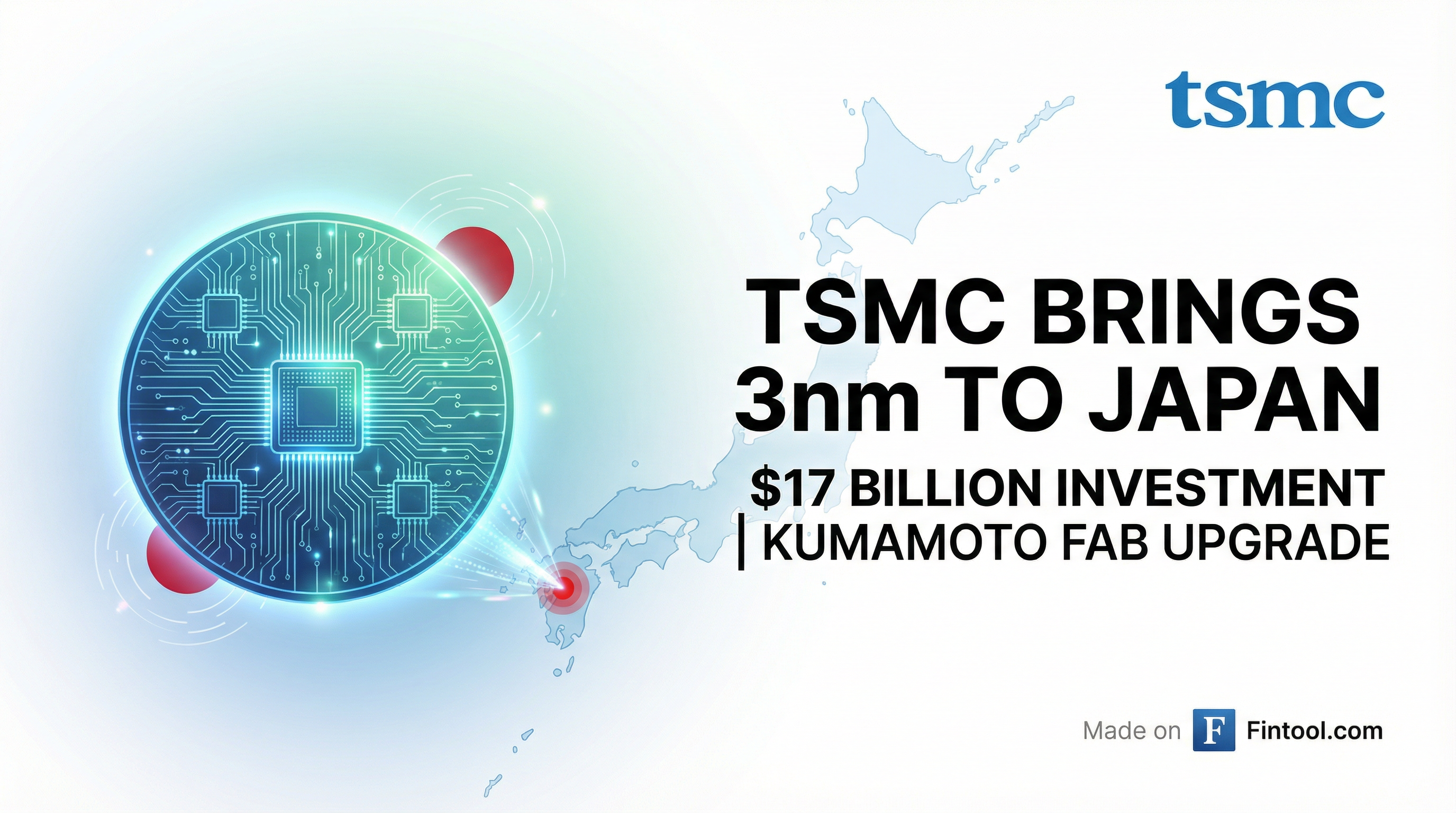
Taiwan Semiconductor Manufacturing Company is upgrading its second Japanese fab to produce cutting-edge 3-nanometer chips—the same advanced technology powering Nvidia's AI accelerators and Apple's latest devices—in a $17 billion investment that marks Japan's entry into the world's most advanced semiconductor manufacturing.
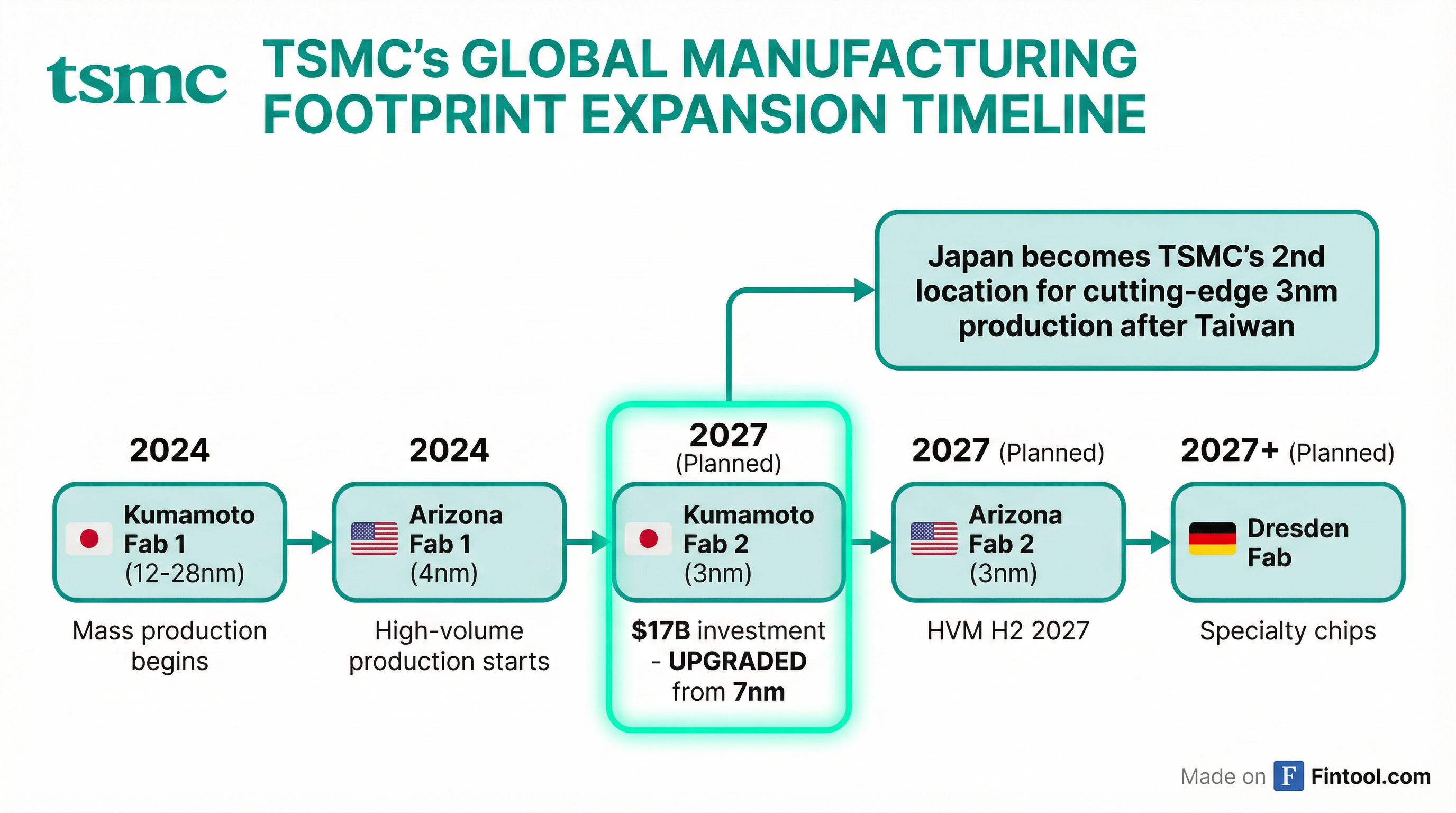
The announcement represents a significant upgrade from TSMC's original blueprint to produce 6-7nm chips at the Kumamoto facility, and positions Japan as only the second location outside Taiwan where TSMC will manufacture its most advanced semiconductors—alongside its Arizona complex.
The Announcement
TSMC Chairman and CEO C.C. Wei delivered the news directly to Japanese Prime Minister Sanae Takaichi during a high-profile meeting at the Prime Minister's Office in Tokyo on Thursday.
"The 3-nanometer technology today is the most advanced process used by AI and smartphone products," Wei told Takaichi. "We believe this fab will further contribute to local economic growth and, most importantly, form a foundation for Japan's AI business."
Takaichi responded enthusiastically, calling the project "very encouraging" from the perspective of Japanese economic security and pledging government support. "I would like you to proceed as you have proposed," she said.
The total investment in the second Kumamoto plant is reported at ¥2.6 trillion ($17 billion), according to Japan's Yomiuri newspaper—though TSMC declined to confirm the specific figure.
| Metric | Original Plan | Upgraded Plan |
|---|---|---|
| Process Node | 6-7nm | 3nm |
| Investment | $12B | $17B |
| Target Applications | Telecom equipment | AI, smartphones, autonomous vehicles |
| Timeline | Late 2027 | Late 2027 |
Why It Matters
For TSMC: Geographic Diversification at Scale
TSMC is executing an aggressive global expansion as AI demand strains its capacity. The company's 2026 capital budget of $52-56 billion represents a 27-37% increase from 2025's $40.9 billion spend, with 70-80% allocated to advanced process technologies.
| Period | Q4 2023 | Q1 2024 | Q2 2024 | Q3 2024 | Q4 2024 | Q1 2025 | Q2 2025 | Q3 2025 |
|---|---|---|---|---|---|---|---|---|
| Revenue ($B) | $20.4* | $18.5* | $20.7* | $23.9* | $26.5* | $25.2* | $31.9* | $32.5* |
| CapEx ($B) | $5.6* | $5.7* | $6.3* | $6.5* | $11.0* | $9.9* | $10.2* | $9.4* |
| Gross Margin (%) | 53.0% | 53.1% | 53.2% | 57.8% | 59.0% | 58.8% | 58.6% | 59.5% |
*Values retrieved from S&P Global
CEO Wei has projected AI accelerator revenue to grow at a mid-to-high 50% CAGR through 2029, underpinning an overall 25% revenue CAGR in dollar terms through that period.
 Ask Fintool AI Agent
For Japan: A Semiconductor Renaissance
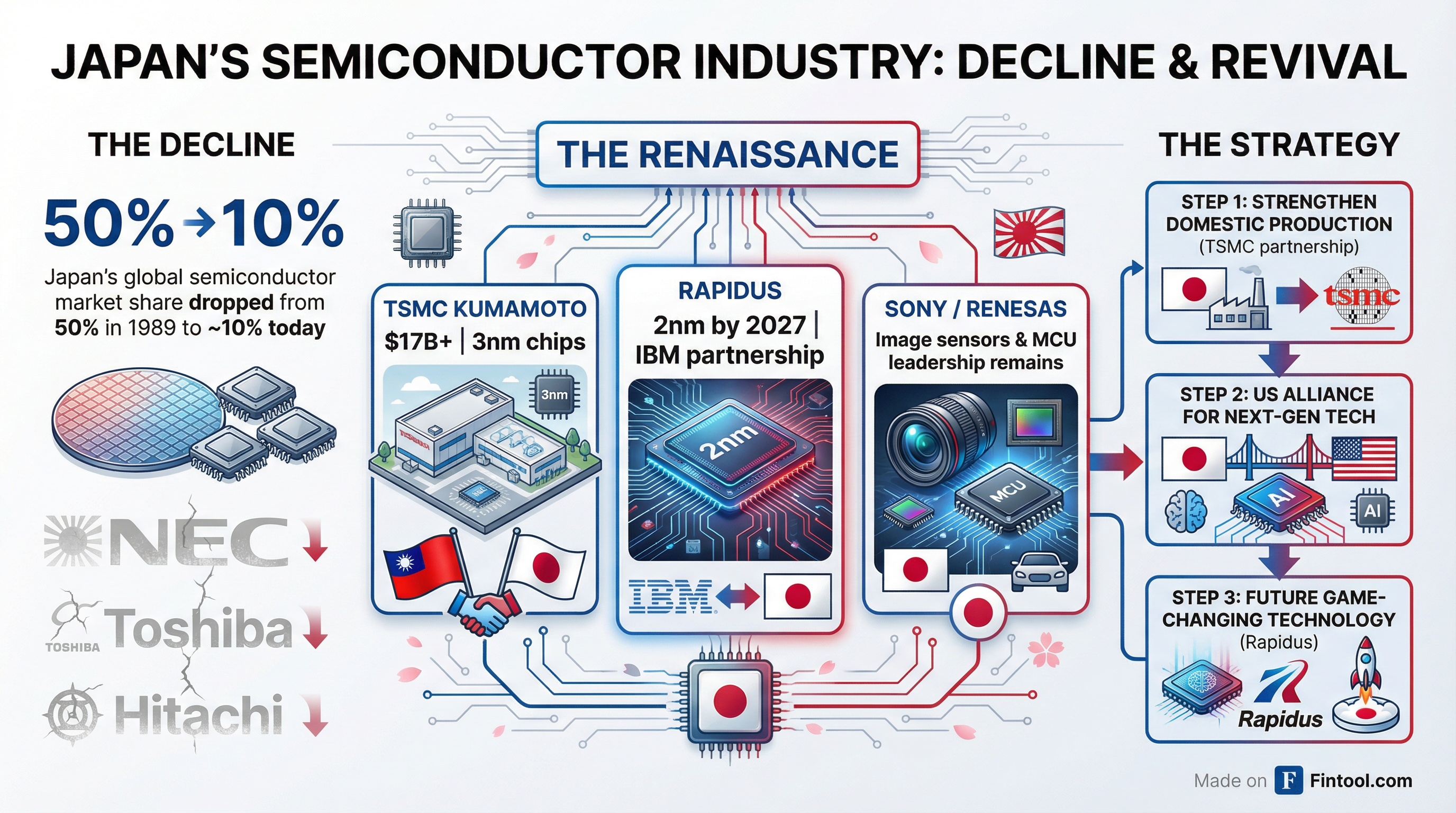
The upgrade is a triumph for Japan's efforts to revive an industry that once dominated the global market. Japanese firms held roughly 50% of global semiconductor market share in the late 1980s—six of the top ten chip companies were Japanese—before a precipitous decline to approximately 10% today.
The decline followed the 1986 US-Japan semiconductor agreement and 100% tariffs imposed by the Reagan administration, combined with the rise of fabless manufacturing and Asian foundries like TSMC.
Now, Japan is executing a three-pronged revival strategy:
- Strengthening domestic production through TSMC partnerships (Kumamoto fabs)
- US alliance for next-gen technology through the Rapidus venture with IBM
- Future game-changing technology targeting 2nm production by 2027
Japan Advanced Semiconductor Manufacturing (JASM)—a joint venture between TSMC, Sony, Denso, and Toyota—already operates the first Kumamoto fab, which began mass production of 12-28nm chips in late 2024.
For the AI Supply Chain: Reduced Geographic Risk
The Japan expansion helps diversify TSMC's concentration of advanced chip production in Taiwan amid rising US-China tensions.
Key risk mitigation benefits:
- Tariff hedge: Japan production is immune from potential US tariffs on Taiwanese imports
- Taiwan Strait contingency: Alternative production site if China-Taiwan tensions escalate
- Customer proximity: Closer to major Japanese customers including Sony (image sensors) and Toyota (automotive chips)
The announcement comes against a backdrop of strained China-Japan relations following Takaichi's November remarks that a Chinese attack on Taiwan could constitute a "survival-threatening situation" for Japan. Beijing subsequently advised Chinese citizens against traveling to Japan and reinstated bans on Japanese seafood imports.
Ask Fintool AI AgentPolitical Timing
The TSMC announcement lands just two days before Japan's general election on Sunday, where Prime Minister Takaichi is seeking to secure a public mandate for her technology and economic security policies. Her approval ratings remain high, and the TSMC commitment reinforces her administration's semiconductor-focused industrial policy.
Japanese Minister of Economy, Trade and Industry Ryosei Akazawa emphasized that TSMC's move is "fully aligned with the Takaichi administration's strategy to advance the social implementation of AI in Japan."
Market Reaction
TSM shares rose 1.5% during Thursday's session to $330.73, though they pulled back to $323.35 in after-hours trading amid the broader tech sector selloff triggered by concerns over AI infrastructure spending.*
*Market data current as of market close February 5, 2026
The company's market capitalization stands at approximately $1.7 trillion, making it Asia's most valuable listed company.*
*Values retrieved from S&P Global
What to Watch
Near-term catalysts:
- Japan election results (Sunday, February 9) and implications for government subsidies
- TSMC's Q1 2026 earnings call for updated Japan timeline details
- Progression of US-Japan semiconductor cooperation agreements
Medium-term questions:
- Will TSMC bring even more advanced nodes (2nm) to Japan?
- How will Rapidus compete for domestic Japanese chip demand?
- What role will Sony and Toyota play in the Kumamoto ecosystem?
Competitive dynamics:
- Samsung's response in Japan (currently has an R&D center in Yokohama)
- Intel's foundry strategy amid leadership transition
- China's domestic chip development under US export restrictions
Ask Fintool AI Agent