Uber Launches Autonomous Solutions: The Robotaxi Broker Bet
February 23, 2026 · by Fintool Agent


Uber is formalizing its position as the neutral platform for the autonomous vehicle era. The company today launched Uber Autonomous Solutions, a dedicated business unit packaging its digital infrastructure, user experience capabilities, and fleet operations expertise into a turnkey offering for AV partners seeking to commercialize robotaxis at scale.
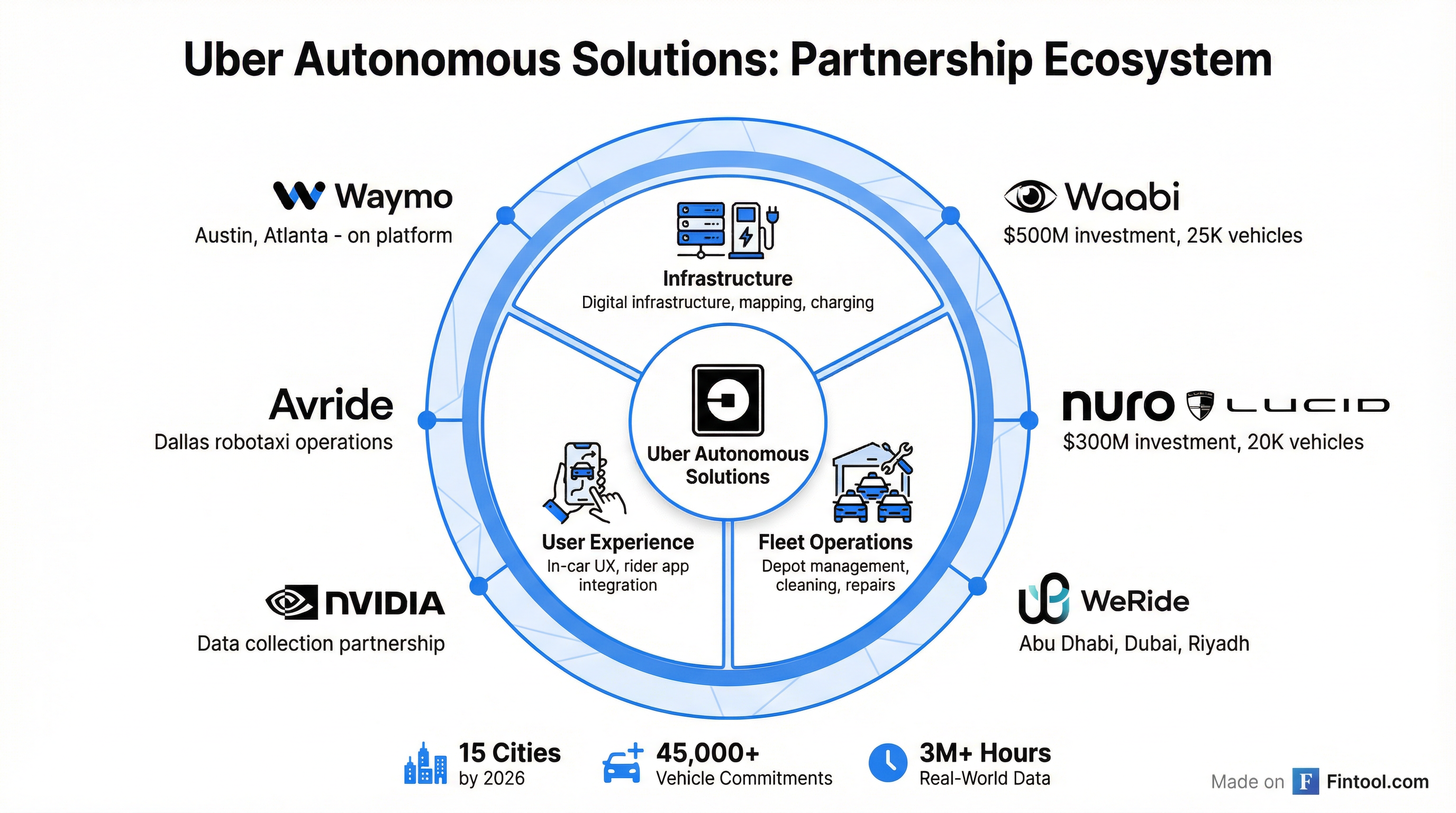
The move consolidates Uber's sprawling autonomous vehicle partnerships—spanning Waymo, Waabi, Nuro, Lucid, WeRide, Avride, and NVIDIA—under a unified commercial structure. With over $800 million committed to AV investments and agreements for 45,000+ robotaxis, Uber is betting it can become the indispensable distribution layer for self-driving regardless of who wins the technology race.
Shares fell 4.8% to $70.35 on a broad market selloff driven by tariff uncertainty, though the decline was consistent with peers.
The Three Pillars
Uber Autonomous Solutions is organized across three service categories designed to reduce friction for AV developers:
Infrastructure Solutions include multi-sensor mapping data covering millions of miles, simulation environments, and charging depot buildout. Uber announced a partnership with NVIDIA to collect over 3 million hours of real-world passenger AV data—covering pickups, drop-offs, and edge cases that robotaxis must navigate.
User Experience Solutions encompass the in-car software interface for rider control (temperature, sound, assistance), real-time driving visualization showing the vehicle's perception and planned path, and integration with complex ride products like UberX Share and Uber Reserve.
Fleet Operations Solutions leverage Uber's existing network of fleet partners for depot management, vehicle cleaning, charging, and repairs—the logistics backbone that makes 24/7 robotaxi operations viable.
The Partnership Web
Uber's AV strategy deliberately avoids building its own self-driving technology—a lesson learned after selling its ATG unit to Aurora in 2020. Instead, it's positioning as the demand aggregator and operational partner for multiple competing AV stacks:
| Partner | Investment | Vehicle Commitment | Status |
|---|---|---|---|
| Waabi | $500M (milestone-based) | 25,000+ exclusive | Deploying 2026+ |
| Nuro + Lucid | $300M | 20,000+ exclusive | SF Bay Area late 2026 |
| Waymo | Platform integration | Waymo-owned fleet | Live in Austin, Atlanta |
| WeRide | Commercial partnership | Partner-owned fleet | Abu Dhabi, Dubai, Riyadh |
| Avride | Platform integration | Partner-owned fleet | Live in Dallas |
| NVIDIA | Data partnership | N/A | 3M+ hours data collection |
The Waabi deal—announced in January as part of the Canadian startup's record $1 billion fundraise—is particularly notable. Waabi represents the "AV 2.0" wave of companies using end-to-end AI models rather than hand-coded rules, and claims its single AI "brain" can power both trucks and robotaxis.
 Ask Fintool AI Agent
The Utilization Advantage
CEO Dara Khosrowshahi's pitch to investors centers on a structural advantage: AVs on Uber's platform achieve 30% higher trips per vehicle per day than standalone robotaxi operators based on publicly available data.
The logic is straightforward. A purpose-built robotaxi fleet must handle the troughs—Monday nights, rainy Tuesday afternoons—where ride demand collapses. Uber's three-sided marketplace (rides, delivery, freight) offers continuous utilization opportunities that pure-play AV companies can't match.
"If you really think about the long, long game, one of the key elements is gonna be what companies are able to utilize these cars in the troughs," Khosrowshahi said on the Q4 earnings call. "Having delivery and freight as part of our logistics ecosystem gives us an opportunity to actually use these vehicles at a structurally higher utilization than anyone else."
This creates an interesting dynamic: the economics favor Uber even if it doesn't own the technology. The company disclosed that current AV partnerships generate positive economics at scale based on today's consumer fares—deals that Uber characterizes as "fair for our partners and fair for us."
Financial Context
Uber enters the autonomous era from a position of operational strength. Q4 2025 revenue reached $14.4 billion, up 25% year-over-year, with operating cash flow of $2.9 billion.
| Metric | Q1 2025 | Q2 2025 | Q3 2025 | Q4 2025 |
|---|---|---|---|---|
| Revenue | $11.5B | $12.7B | $13.5B | $14.4B |
| Cash from Operations | $2.3B | $2.6B | $2.3B | $2.9B |
Management emphasized that while Uber is making vehicle purchase commitments (tens of thousands announced across partnerships), the long-term vision involves financialization similar to hotel REITs or data center operators. "Just like Marriott doesn't have to own its hotels, you've got REITs that own their hotels... you will see the same thing in the future on fleets," Khosrowshahi noted.
The Competitive Calculus
Uber's announcement comes as the AV competitive landscape intensifies. Waymo's recent pre-money valuation hit $110 billion—a remarkable figure for a company that remains unprofitable and geographically limited. Tesla's robotaxi ambitions, while generating headlines, have yet to produce meaningful commercial operations.
Uber's counter-argument is that AVs have been "solved multiple times by multiple software providers"—Waymo, WeRide, Baidu, Waabi, Wayve, Nuro, and others—making winner-take-all dynamics unlikely.
"If you look at AV now, there are multiple players who are getting to the finish line," Khosrowshahi said. "With all of the players in the space, the fact that it has been solved multiple times by multiple software providers, with NVIDIA kind of setting an industry standard as well, we're very confident that AVs will be a net positive to the mobility sector."
The evidence so far supports Uber's optimism. San Francisco, Austin, and Atlanta—cities with significant AV presence—have seen Uber gross bookings accelerate, with new riders growing faster than the national average.
Ask Fintool AI AgentWhat to Watch
Near-term milestones:
- Late 2026: Nuro-Lucid-Uber robotaxi commercial launch in San Francisco Bay Area
- Year-end 2026: Target of 15 cities with AV operations globally
- Ongoing: Waabi deployment timeline (not yet disclosed)
Key questions:
- Can Uber maintain positive AV unit economics as volumes scale?
- Will OEMs ramp production fast enough to meet deployment targets?
- How will regulatory environments evolve across target markets?
- What happens to driver economics as AV mix increases?
The financialization thesis—that asset-light fleet ownership will emerge—remains the critical swing factor. If institutional capital flows into AV fleets the way it has into data centers and logistics real estate, Uber's platform model could generate substantial economics without commensurate capital intensity.
For now, Uber is building the tollbooth while others build the cars.