Uber CFO Departs After Just 27 Months as Stock Plunges 12% on Weak Guidance
February 4, 2026 · by Fintool Agent



Uber Technologies shares plunged as much as 12% Wednesday after the company announced CFO Prashanth Mahendra-Rajah would step down and issued first-quarter profit guidance that fell roughly 10% below Wall Street expectations.
The departure, disclosed alongside record Q4 results, ends a short but consequential 27-month tenure during which Uber achieved investment-grade credit status, launched its first share repurchase program, and generated nearly $10 billion in free cash flow.
Mahendra-Rajah's replacement signals the company's strategic priorities: Balaji Krishnamurthy, described by Bloomberg as an "outspoken driverless-vehicle bull," takes over February 16 after six years building institutional knowledge at Uber, including stints leading investor relations and strategic finance.
The Numbers That Moved Markets
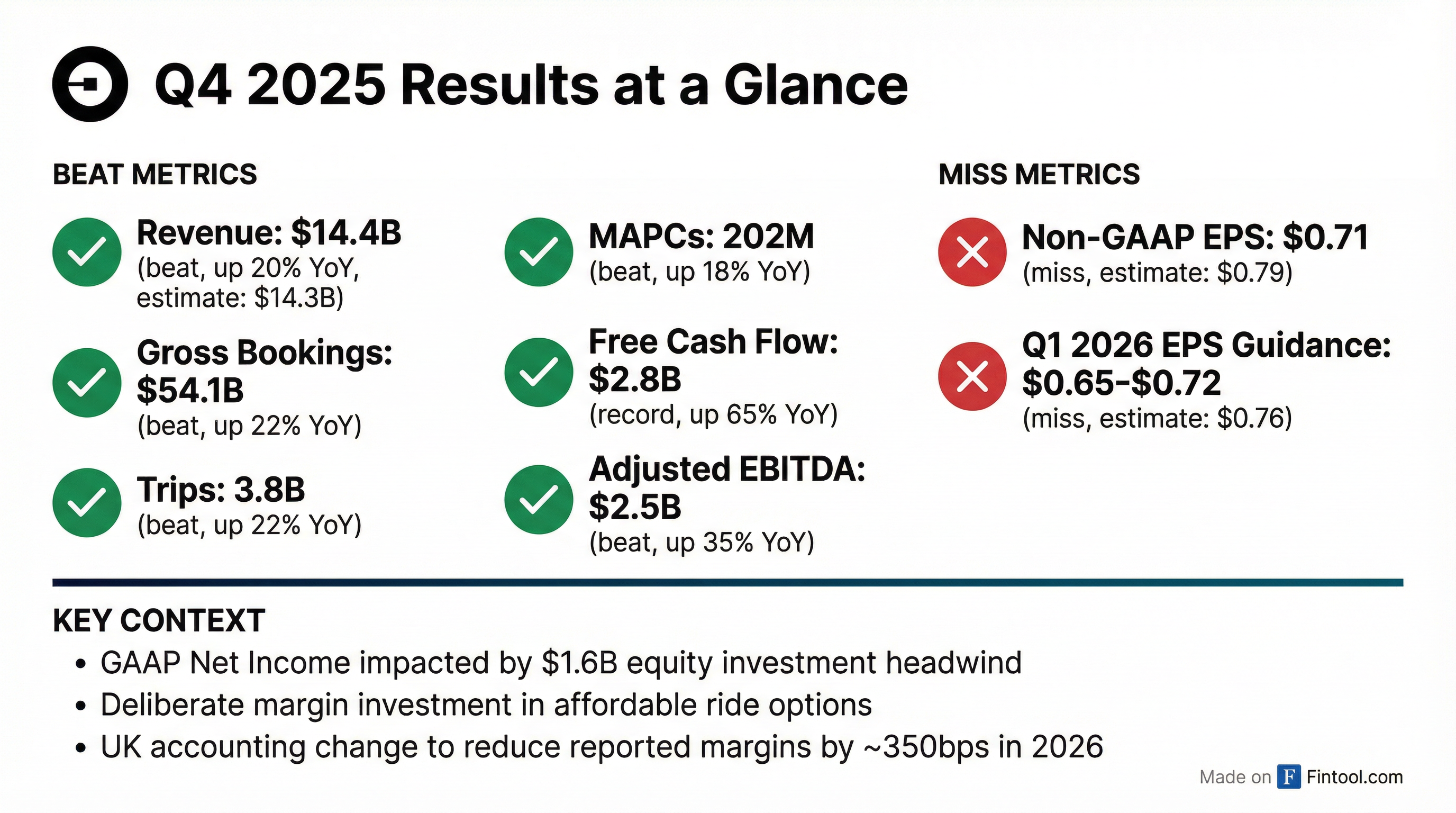
Uber's Q4 operating metrics beat across the board. Revenue rose 20% year-over-year to $14.4 billion, topping the $14.3 billion consensus. Gross bookings hit $54.1 billion (+22% YoY), trips reached 3.8 billion (+22% YoY), and monthly active platform consumers crossed 200 million for the first time.
But the profit picture told a different story. Non-GAAP EPS of $0.71 missed the $0.79 consensus, and Q1 2026 guidance of $0.65-$0.72 came in well below the $0.76 Street expectation—a midpoint miss of approximately 10%.
| Metric | Q4 2024 | Q4 2025 | YoY Change |
|---|---|---|---|
| Revenue | $11.96B | $14.37B | +20% |
| Gross Bookings | $44.2B | $54.1B | +22% |
| Trips | 3.07B | 3.75B | +22% |
| Adjusted EBITDA | $1.84B | $2.49B | +35% |
| Non-GAAP EPS | $0.56 | $0.71 | +27% |
| Free Cash Flow | $1.71B | $2.81B | +65% |
The margin pressure is intentional. Uber has been investing heavily in affordable ride options like shared rides to boost trip volumes. CEO Dara Khosrowshahi noted on the call that improving pricing conditions and lower insurance costs should support faster U.S. growth and margin expansion through 2026.
 Ask Fintool AI Agent
An Abrupt Exit—But Not a Contentious One
The 8-K filing goes out of its way to note that Mahendra-Rajah's departure "is not the result of any disagreements concerning financial disclosures or accounting matters." The departure is being treated as a "qualifying termination" under Uber's executive severance plan, meaning he'll receive standard separation benefits.
Mahendra-Rajah will remain as Senior Finance Advisor through July 1, 2026, reporting to Khosrowshahi. He said he's leaving for "an exciting new opportunity" that he will share more about soon.
His tenure, while brief, was consequential:
- Investment-grade credit rating: A major milestone for a company that was burning cash at IPO
- First share repurchase program: Uber repurchased $6.5 billion of stock in FY2025
- Major acquisitions: Steered finance through several strategic deals
- Record free cash flow: Nearly $10 billion in FY2025, up 42% year-over-year
The stock rose 56% during his watch—from $49.92 when he started in November 2023 to $77.93 at yesterday's close. But that understates the volatility: shares hit a 52-week high of $101.99 in September 2025 before retreating 30% amid broader market turbulence and autonomous vehicle competition concerns.
The New Finance Chief: An AV True Believer
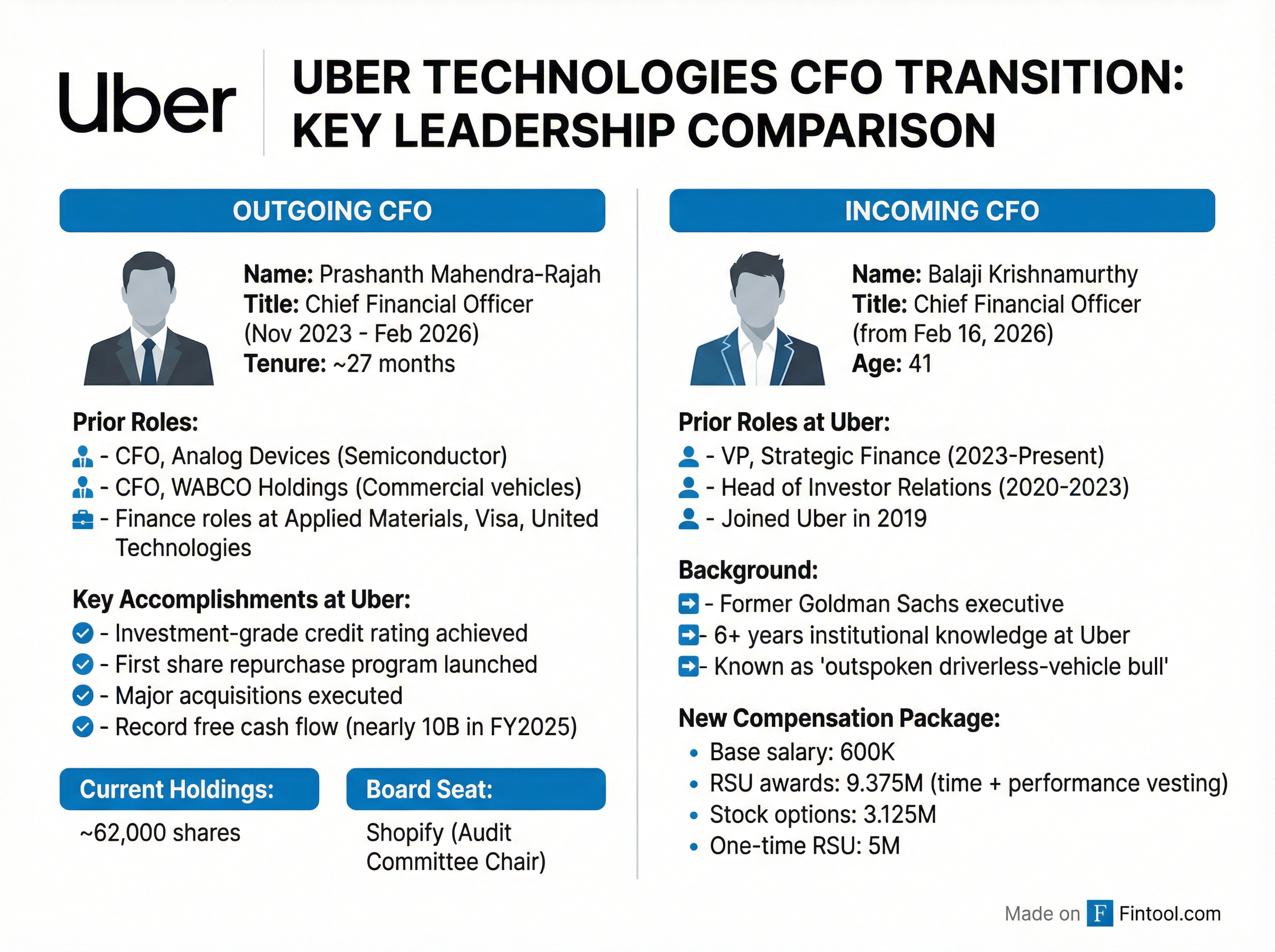
Krishnamurthy's elevation sends a clear message about Uber's strategic direction. The 41-year-old former Goldman Sachs executive has been with Uber since 2019 and has deep institutional knowledge of the business.
His compensation package reflects the stakes: a $600,000 base salary, $9.375 million in RSUs (with time and performance vesting), $3.125 million in stock options, and a one-time $5 million RSU grant.
In his statement, Krishnamurthy emphasized Uber's positioning for autonomous vehicles: "With large and growing free cash flows, over the coming years we will invest with discipline across a multitude of opportunities, including positioning Uber to win in an AV future."
Uber has been aggressively partnering with AV companies including Alphabet's Waymo and Lucid to integrate robotaxis alongside human drivers. The company recently launched "AV Labs" to aggregate robotaxi data across its platform.
Ask Fintool AI AgentWhat Investors Should Watch
Near-term margin pressure will persist. Uber's affordable pricing strategy is working—trips grew 22%—but it comes at the cost of profitability expansion. The company is also implementing an accounting change for its UK business that will reduce reported mobility revenue margin by about 350 basis points starting in Q1 2026.
The transition timing is unusual. CFO departures announced alongside earnings results often raise eyebrows, though the 8-K's explicit denial of financial disagreements and Mahendra-Rajah's stay-on as advisor suggest this is genuinely a departure for opportunity rather than conflict.
Krishnamurthy inherits a strong balance sheet. Uber ended 2025 with $7.1 billion in cash and cash equivalents, plus a long-term debt position of $10.5 billion. Free cash flow generation of nearly $10 billion annually provides substantial flexibility for AV investments, M&A, and continued buybacks.
| Forward Estimates | Q1 2026 | Q2 2026 | FY 2026 |
|---|---|---|---|
| Revenue Consensus | $13.8B* | $14.8B* | $60.3B* |
| EPS Consensus | $0.75* | $0.83* | $3.52* |
| EBITDA Consensus | $2.46B* | $2.68B* | $11.0B* |
*Values retrieved from S&P Global
Ask Fintool AI AgentThe Bottom Line
Uber's CFO transition comes at an inflection point. The company has proven it can generate massive cash flows—$10 billion in 2025—but is now deliberately trading near-term margins for growth and AV positioning. Mahendra-Rajah leaves with a strong legacy, and Krishnamurthy takes over with deep company knowledge and a clear mandate to steer Uber through its next chapter: the transition to autonomous vehicles.
The 12% stock drop may be overdone if you believe the margin pressure is transitory. But investors clearly wanted more profitability expansion, and they're not getting it yet.
Related:
- Uber Technologies Company Profile
- Shopify Company Profile (where Mahendra-Rajah serves as audit committee chair)
- Alphabet Company Profile (Waymo parent)