Ermotti Warns Swiss Capital Rules 'Not Acceptable' as UBS Hosts U.S. Banks Riding Deregulation Wave
February 9, 2026 · by Fintool Agent



UBS CEO Sergio Ermotti opened his bank's marquee investor conference in Miami with a pointed message to Swiss regulators: the proposed capital rules are "not acceptable" and "not viable."
The timing of the rebuke couldn't be more ironic. All six U.S. G-SIB banks—JPMorgan, Goldman Sachs, Morgan Stanley, Bank of America, Citigroup, and Wells Fargo—are attending the UBS Financial Services Conference this week, where the dominant conversation is about the capital markets renaissance enabled by U.S. deregulation. Meanwhile, Ermotti is fighting to prevent Switzerland from imposing what he calls rules that would make UBS "totally uncompetitive."
"Switzerland has chosen a quite emotional reaction to what happened with Credit Suisse," Ermotti told investors in his keynote fireside chat. "The current proposal as displayed are not acceptable... making our business totally uncompetitive."
The $24 Billion Question
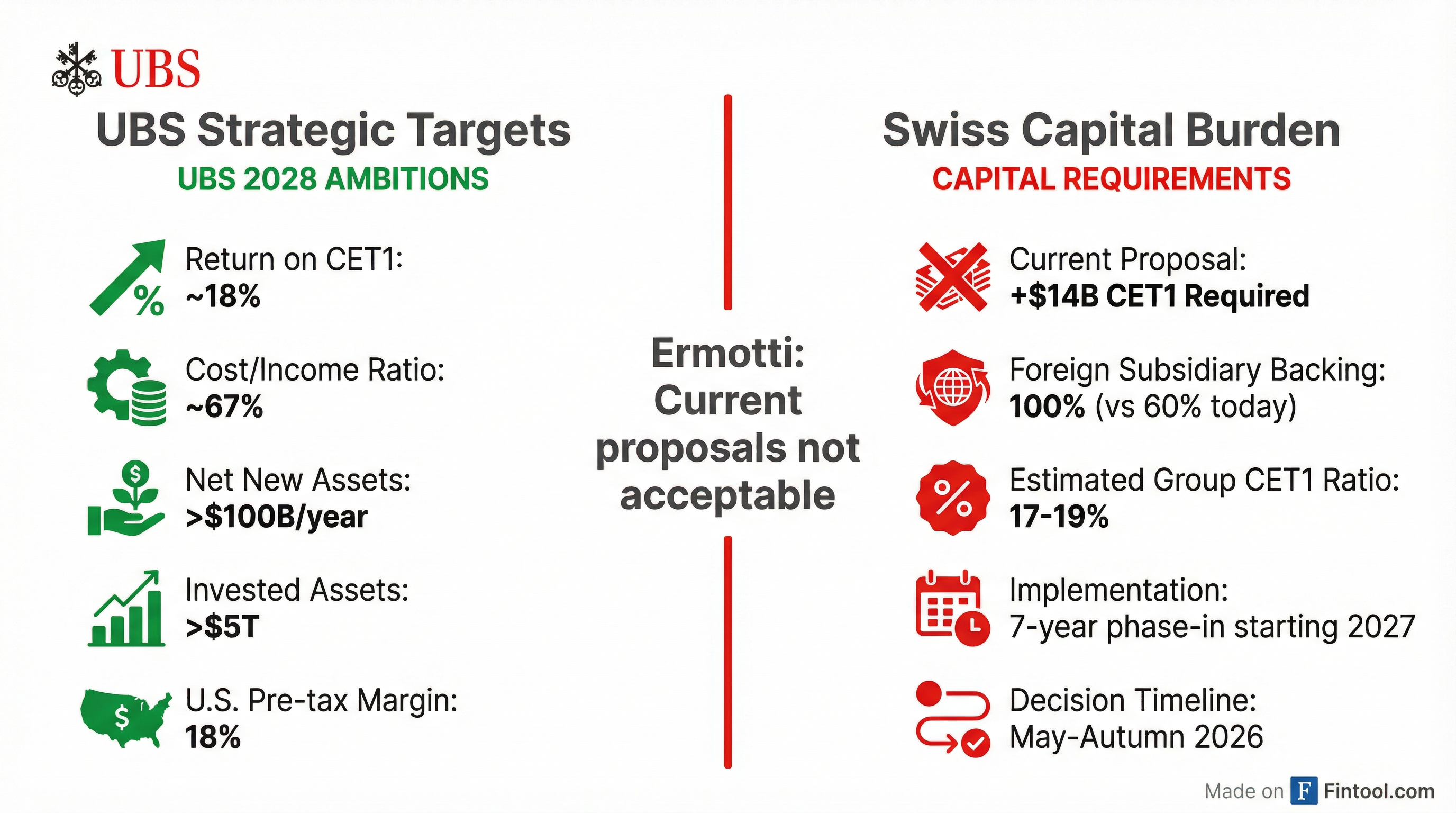
The Swiss Federal Council has proposed requiring UBS to fully back its foreign subsidiaries with capital at the parent bank—100% versus the current 60%—following the 2023 Credit Suisse collapse. The proposal would force UBS to hold approximately $24 billion in additional CET1 capital, pushing its group-level CET1 ratio to 17-19%.
"UBS today has de facto the highest minimum capital requirements of any G-SIB," Ermotti stated. "This is not an opinion, it's a fact demonstrated by experts."
The CEO expects more clarity by May when Swiss authorities are likely to launch a formal consultation, with a final outcome emerging "between the end of the summer and the start of autumn."
 Ask Fintool AI Agent
Re-Domiciliation: Not Off the Table
When asked directly whether UBS might relocate its headquarters—potentially to the U.S.—Ermotti deflected but notably did not rule it out.
"Re-domiciliation is definitely not something that we are now focusing," he said. "We are really investing a lot of energy and resources to make sure that all the decision-makers are making decisions for the future of the regulatory framework in Switzerland based on facts and not emotions."
He added: "Our preferred option is to continue to be a global bank based in Switzerland... Only then we will make a decision on what is most appropriate."
The implication was clear: if Swiss regulators ignore UBS's concerns, all options remain on the table.
Integration: The Final Mile
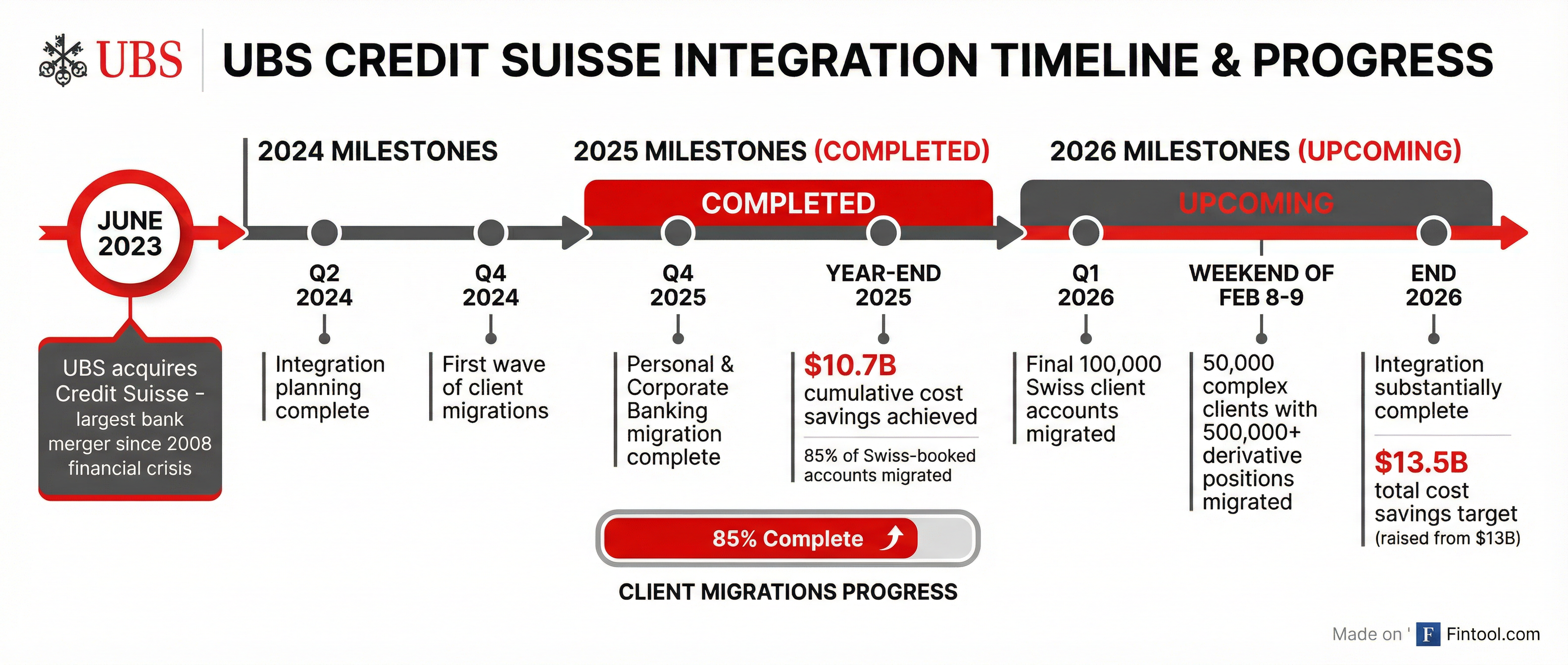
The Credit Suisse integration is now in its final stages. Ermotti revealed that over the weekend of February 8-9, UBS migrated 50,000 of its most complex clients—those with over 500,000 derivative positions—from Credit Suisse systems.
"What we did over the weekend was even more complex than what we'd done before," Ermotti said. "We had 50,000 clients with more than 500,000 different positions with derivatives."
The final 100,000 client migrations will occur in March, after which UBS can begin decommissioning the remaining Credit Suisse IT systems and data centers—unlocking what Ermotti called "something like $2 billion or more of synergies."
Key integration metrics achieved:
| Milestone | Status |
|---|---|
| Swiss client accounts migrated | 85% (950,000 clients) |
| Cumulative cost savings | $10.7B (raised target to $13.5B) |
| Non-core applications decommissioned | 73% |
| Non-core RWA reduction | 67% since Q2 2023 |
Ask Fintool AI AgentU.S. Strategy: Building Banking Capabilities
Ermotti outlined an ambitious U.S. growth strategy targeting 18% pre-tax margins by 2028, up from mid-teens currently—though he acknowledged this would still trail U.S. peers.
"It's totally unrealistic for us to think that we're gonna match the pre-tax profit margins of our U.S. peers in the U.S.," he admitted. "Like is, I would say, never say never again, but it's gonna be very challenging."
The U.S. strategy centers on:
- National bank charter: UBS received conditional approval from the OCC, which will enable it to expand deposit-gathering and NII over the next two years
- Lending penetration: Improved every quarter for seven consecutive quarters but still below potential
- High-net-worth expansion: Hiring to build out beyond the ultra-high-net-worth and global family office segments where UBS already leads
UBS manages $2.3-2.4 trillion of assets in the U.S., but Ermotti noted that "the set of banking businesses that we have on the U.S. platform is not as comprehensive as our co-peers."
Net New Assets: Sacrificing Growth for Quality
Ermotti revealed that UBS expects positive net new asset momentum in the second half of 2026, building toward $200 billion annually by 2028.
The bank had deliberately "sacrificed growth for efficiencies" over the past two years to restore profitability. This included letting go of client relationships that weren't profitable enough and adjusting compensation grids for financial advisors who weren't growing their books.
"We can't fix that issue of restoring PBT margins by being overly popular with people that are not growing their businesses," Ermotti said bluntly.
Capital Markets: Robust Pipeline, Geopolitical Headwinds
Ermotti struck a cautious tone on the "capital markets renaissance" narrative, noting that while the pipeline is "even stronger than last year," geopolitical uncertainty could derail execution.
"I don't want to spoil the party by saying that while I'm fully confident about the pipeline... we should not underestimate that geopolitical and macroeconomic developments and the current volatility will continue to lead to stop and goes."
On tariff uncertainty, he added: "The uncertainties that we see from a geopolitical standpoint around tariffs is definitely creating a little bit of uncertainties that may dent the capabilities for us, for everybody, to execute on the pipeline."
Alternatives: Fifth Largest LP in the World
A key growth driver is UBS's alternatives business, which became the fifth-largest LP globally with $330 billion in assets after merging U.S. wealth management and global asset management capabilities.
UBS's current alternatives allocation in client portfolios sits at 5%, with a target of 10% over time. However, Ermotti warned that the rapid growth of private credit carries risks that haven't been tested in a proper credit cycle.
"History tells us a very clear lesson," he said. "When people lose money, they are all pretending to be stupid and unsophisticated, no matter how good they are. So we need to pay a lot of attention because I see that this being the biggest risk by far."
Stock Performance
UBS shares are trading at $44.28, up 0.8% on the day and near their 52-week high of $49.36. The stock has nearly doubled since the Credit Suisse acquisition in March 2023, boosted by integration progress and hopes that Swiss capital rules will be watered down.*
Ask Fintool AI AgentWhat to Watch
- May 2026: Swiss authorities expected to launch formal consultation on capital requirements
- March 2026: Final 100,000 Swiss client migrations from Credit Suisse systems
- End 2026: Integration expected to be "substantially complete"; $13.5B cost savings target
- 2028: Targeting 18% RoCET1, 67% cost/income ratio, $200B+ net new assets annually
Ermotti's message to Swiss regulators was unmistakable: UBS has delivered on the Credit Suisse integration, generated record returns for shareholders, and maintained Switzerland's only global bank. Now it's time for policymakers to return the favor with proportionate, internationally competitive rules.
"Shareholders are the first line of defense," Ermotti said. "When people talk about the resilience of a banking system, they should understand that the first thing to do is have solid capital, but the second one is to have a solid sustainable business model."
Related Companies: UBS · JPMorgan · Goldman Sachs · Morgan Stanley